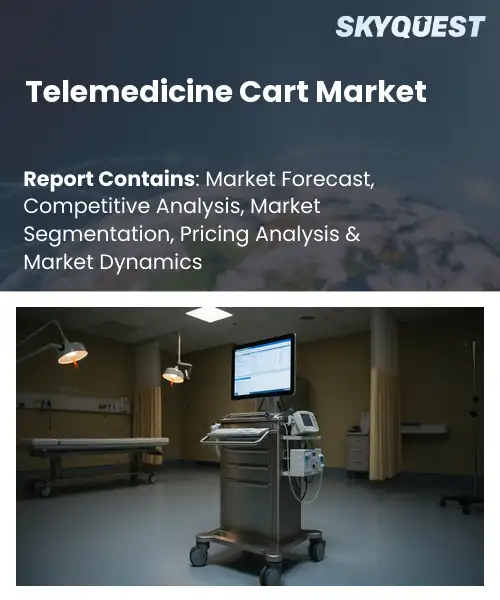
Telemedicine Cart Market
Report ID: SQMIG35G2445
Report ID: SQMIG35G2445
[email protected]
USA +1 351-333-4748
Report ID:
SQMIG35G2445 |
Region:
Global |
Published Date: June, 2026
Pages:
157
|Tables:
181
|Figures:
79


Global Telemedicine Cart Market size was valued at USD 1.1 Billion in 2024 and is poised to grow from USD 1.26 Billion in 2025 to USD 3.72 Billion by 2033, growing at a CAGR of 14.5% during the forecast period (2026-2033).
Telemedicine carts are mobile, hardware-integrated workstations that enable clinicians to conduct audiovisual consultations, attach diagnostic peripherals, and access electronic health records at the point of care, and their primary driver has been the pandemic-triggered acceleration of remote care adoption combined with regulatory and reimbursement shifts. Before 2020 the market grew steadily as hospitals piloted carts for rural outreach and tele-stroke services, but COVID-19 created immediate demand for infection-control solutions and continuity of care, prompting rapid procurement by emergency departments and long-term care facilities. Major vendors scaled production, integration partnerships emerged with EHR vendors, and buyers prioritized flexible, interoperable platforms nationwide.
A central factor driving global telemedicine cart expansion is technology convergence, where improved high-definition cameras, low-latency networks, and modular diagnostic peripherals enable clinicians to deliver specialty services remotely, which in turn expands hospital and clinic use cases and justifies capital investment. For example, telestroke programs use carts with CT-linked workflows to shorten door-to-needle times, while rural hospitals deploy carts for on-demand specialist consults that reduce unnecessary transfers and associated costs. As interoperability with electronic health records and cloud platforms improves, health systems can scale chronic disease management programs and remote monitoring, creating recurring service revenue and measurable quality improvements nationally.
How is AI improving diagnostic accuracy in the telemedicine cart market?
AI is improving diagnostic accuracy in telemedicine carts by combining automated image analysis, signal processing and clinical decision support that guide remote clinicians through exams, highlight abnormalities and ensure study quality. Vendors are embedding machine learning models into camera ultrasound and monitoring modules to flag critical findings in real time and reduce missed diagnoses. The market is shifting from simple video carts to integrated diagnostic stations that streamline workflow and boost clinician confidence. Examples include recent industry work where AI augments fetal ultrasound interpretation and provides real time quality checks, showing how applied models translate into more reliable remote assessments.
GlobalMed June 2026, announced a strategic partnership to add contactless ambient sensing to its eNcounter virtual care platform, allowing telemedicine carts to capture richer physiological signals and environmental context. This improves AI inputs for anomaly detection and triage, supporting faster more reliable remote diagnoses and helping scale virtual care efficiently.
Market snapshot - (2026-2033)
Global Market Size
USD 1.1 Billion
Largest Segment
Mobile Telemedicine Carts
Fastest Growth
Mobile Telemedicine Carts
Growth Rate
14.5% CAGR
To get more insights on this market click here to Request a Free Sample Report
Global telemedicine cart market is segmented by by product type, by component, by application, by end user, by connectivity type, by power source and region. Based on by product type, the market is segmented into Mobile Telemedicine Carts, Wall-mounted Telemedicine Carts, Emergency Telemedicine Carts, ICU Telemedicine Carts and Specialty Telemedicine Carts. Based on by component, the market is segmented into Display & Monitor Systems, Cameras & Audio Systems, Computing Systems, Power Supply & Battery Systems, Medical Peripheral Devices and Others. Based on by application, the market is segmented into Remote Patient Consultation, Emergency Care, Intensive Care Monitoring, Specialty Consultations, Chronic Disease Management and Others. Based on by end user, the market is segmented into Hospitals, Clinics, Ambulatory Surgical Centers, Home Healthcare Providers, Long-term Care Centers and Others. Based on by connectivity type, the market is segmented into Wired Telemedicine Carts, Wireless Telemedicine Carts and Hybrid Connectivity Systems. Based on by power source, the market is segmented into Battery-powered Carts and Plug-in Powered Carts. Based on region, the market is segmented into North America, Europe, Asia Pacific, Latin America and Middle East & Africa.
[Mobile Telemedicine Carts] segment dominates because mobile units deliver unmatched flexibility at point of care, allowing clinicians to bring comprehensive telemedicine capabilities directly to patient bedsides and varied clinical areas. Their ease of relocation reduces workflow friction, enables rapid deployment across departments, and supports integration of diverse medical peripherals and power options. Providers favor mobility for faster consultations and operational efficiency, which drives procurement and broad adoption across care settings.
However, Emergency Telemedicine Carts are witnessing the strongest growth momentum as emergency departments prioritize rapid specialist access, on demand diagnostics for triage. Innovations in ruggedized designs, integrated monitoring, and fast connect networking accelerate adoption. This focus on urgent care use cases expands applications and creates procurement opportunities that propel expansion.
[Display & Monitor Systems] segment dominates because high fidelity visual interfaces are central to clinician to patient interaction and diagnostic activities on telemedicine carts, making display performance a purchase criterion. Superior resolution, adaptive brightness, and ergonomic mounting boost diagnostic confidence and usability, reducing consultation time and clinician fatigue. Vendors prioritize display innovation and certifications to meet clinical workflow needs, which drives procurement preferences and cements display systems as leadership assets.
Conversely, Medical Peripheral Devices are emerging as the most rapidly expanding area as demand for integrated digital stethoscopes, otoscopes, and point of care diagnostics rises. Advances in sensor miniaturization and interoperability standards enable richer remote examinations. This acceleration broadens clinical applications for carts, drives demand for modular architectures, and unlocks vendor partnerships.
To get detailed segments analysis, Request a Free Sample Report
North America leads due to a confluence of supportive infrastructure, mature care delivery systems, and deep engagement from both public and private stakeholders. Well established hospital networks and academic medical centers act as early adopters, integrating telemedicine carts into complex clinical workflows across acute, ambulatory, and community settings. A robust medical device manufacturing base and a competitive vendor ecosystem drive continual product refinement and tailored service models. Interoperable health IT landscapes and strong investment in clinician training enable seamless integration with electronic records and diagnostic peripherals. Regulatory clarity and progressive reimbursement pathways further reduce adoption friction, while emphasis on cybersecurity and data governance builds provider confidence. Collaborative pilot programs and cross sector partnerships sustain scale up and innovation, reinforcing market leadership.
Telemedicine Cart Market in United States is characterized by extensive hospital procurement, active participation from large health systems, and rapid integration with diverse clinical specialties. Vendor partnerships focus on interoperability with major electronic health record platforms and on-site service models that support complex installations. Demand is driven by needs in emergency, critical care, and remote consultation programs, with attention to cybersecurity, clinician workflow optimization, and vendor support for training and maintenance. Academic centers and private health systems continue to shape product expectations through high visibility deployments.
Telemedicine Cart Market in Canada reflects a strong focus on serving remote and indigenous communities through provincially coordinated programs and regional health authorities. Solutions emphasize reliability in low bandwidth settings, bilingual interoperability, and integration with provincial electronic health systems. Procurement often occurs through collaborative purchasing groups that prioritize clinical usability and long term support. Adoption is supported by government initiatives and academic partnerships that validate clinical pathways and promote scalable deployment models across primary care, long term care, and acute settings.
Europe is experiencing rapid expansion driven by strategic health policy initiatives, increased emphasis on digital transformation, and growing collaboration between payers, providers, and industry. National and regional programs that prioritize telehealth integration are aligning procurement frameworks and clinical guidelines, enabling broader deployment across hospitals and community care networks. A strong local manufacturing and medtech sector supports customization for diverse clinical environments, while stringent data protection frameworks encourage secure, privacy centric solutions that meet clinician and patient expectations. Cross border knowledge exchange and multi stakeholder pilots accelerate best practice adoption, and interoperability standards facilitate integration with existing information systems. The result is a dynamic environment where public investment, clinical demand, and vendor innovation combine to scale telemedicine cart use across care settings.
Telemedicine Cart Market in Germany is anchored by a strong hospital infrastructure and a well developed medical technology industry that emphasizes quality, durability, and clinical customization. Hospitals and regional health networks prioritize integrated solutions that conform to stringent regulatory and safety expectations. Vendor relationships focus on long term service, technical support, and compatibility with established hospital information systems. Clinical deployment often targets specialist consultations, tele intensive care, and tertiary care networks, leveraging local manufacturing strengths and established procurement channels to drive adoption.
Telemedicine Cart Market in United Kingdom is shaped by system level digital health initiatives and coordinated procurement through regional trusts, which accelerate uptake across primary and secondary care. Emphasis on scalability, equity of access, and integration with community services drives demand for adaptable, user friendly solutions. Vendors tailor offerings to align with national interoperability standards and clinician workflow requirements. Rapid pilot to deployment pathways and focused funding mechanisms support broader roll out in hospitals, virtual ward models, and outpatient settings, reinforcing growth momentum.
Telemedicine Cart Market in France is emerging through targeted modernization efforts within hospital networks and regional health programs that support teleconsultation expansion. Solutions are being adapted to integrate with national telemedicine platforms and to address language and specialty specific requirements. Public procurement and pilot programs promote clinical validation, while industry partnerships focus on interoperability and clinician training. Adoption favors multi use carts that support specialist outreach, chronic disease management, and coordination between urban centers and regional hospitals.
Asia Pacific is strengthening its position through a combination of domestic innovation, strategic public health initiatives, and rapid digital infrastructure development. Governments and private health systems are prioritizing telemedicine to bridge care gaps across vast geographies, investing in solutions that can operate in diverse connectivity environments. A growing base of local manufacturers and technology firms tailors products to regional clinical practices and regulatory environments, while integration with mobile health ecosystems enhances accessibility. Collaborative pilots between hospitals, technology providers, and academic institutions validate clinical effectiveness and inform procurement. Emphasis on interoperability, clinician training, and localized support models reduces adoption barriers. These elements together foster a more resilient, regionally attuned market for telemedicine carts.
Telemedicine Cart Market in Japan is characterized by high expectations for technological sophistication, integration with advanced medical devices, and adherence to strict quality standards. Hospitals and specialty clinics favor solutions that integrate smoothly with electronic records and diagnostic equipment, while vendor offerings often include robust maintenance and training services. Demographic pressures and a focus on remote care models support clinical use cases in home based care, rehabilitation, and specialist outreach, encouraging adoption of refined, reliable platforms adapted to local workflows.
Telemedicine Cart Market in South Korea leverages a strong digital ecosystem, high speed connectivity, and a vibrant medical device and IT industry to support rapid clinical adoption. Healthcare providers prioritize interoperability with national health information systems and value solutions that enable real time diagnostics and remote specialist collaboration. Vendor innovation emphasizes compact, high performance units with integrated telehealth software, while health systems support deployment through pilot programs and strategic partnerships that demonstrate clinical value and operational feasibility.
To know more about the market opportunities by region and country, click here to
Buy The Complete Report
Increasing Healthcare Accessibility
Advancements In Medical Technology
Regulatory and Reimbursement Barriers
Interoperability and Data Security Concerns
Request Free Customization of this report to help us to meet your business objectives.
I can do this but I need to verify recent, real startups that meet your constraints. May I search the web now to identify and confirm two verified startups founded in or after 2019 that supply telemedicine carts or closely related kiosk/hardware solutions?
Top Player’s Company Profile
Recent Developments
SkyQuest’s ABIRAW (Advanced Business Intelligence, Research & Analysis Wing) is our Business Information Services team that Collects, Collates, Correlates, and Analyses the Data collected by means of Primary Exploratory Research backed by robust Secondary Desk research. As per SkyQuest analysis, the global telemedicine cart market is being propelled primarily by accelerated adoption of remote care and technology convergence that combine high-definition imaging, integrated peripherals and improved interoperability, while a secondary catalyst is AI and modular hardware enabling real-time diagnostics and adaptable deployments. Adoption is tempered by regulatory uncertainty and inconsistent reimbursement policies which slow large-scale procurement. North America remains the dominant region driven by mature health systems, robust vendor ecosystems and favorable reimbursement pathways, and mobile telemedicine carts lead the market due to their flexibility at point of care, rapid redeployment across departments and strong alignment with existing clinical workflows.
| Report Metric | Details |
|---|---|
| Market size value in 2024 | USD 1.1 Billion |
| Market size value in 2033 | USD 3.72 Billion |
| Growth Rate | 14.5% |
| Base year | 2024 |
| Forecast period | (2026-2033) |
| Forecast Unit (Value) | USD Billion |
| Segments covered |
|
| Regions covered | North America (US, Canada), Europe (Germany, France, United Kingdom, Italy, Spain, Rest of Europe), Asia Pacific (China, India, Japan, Rest of Asia-Pacific), Latin America (Brazil, Rest of Latin America), Middle East & Africa (South Africa, GCC Countries, Rest of MEA) |
| Companies covered |
|
| Customization scope | Free report customization with purchase. Customization includes:-
|
To get a free trial access to our platform which is a one stop solution for all your data requirements for quicker decision making. This platform allows you to compare markets, competitors who are prominent in the market, and mega trends that are influencing the dynamics in the market. Also, get access to detailed SkyQuest exclusive matrix.
Table Of Content
Executive Summary
Market overview
Parent Market Analysis
Market overview
Market size
KEY MARKET INSIGHTS
COVID IMPACT
MARKET DYNAMICS & OUTLOOK
Market Size by Region
KEY COMPANY PROFILES
Methodology
For the Telemedicine Cart Market, our research methodology involved a mixture of primary and secondary data sources. Key steps involved in the research process are listed below:
1. Information Procurement: This stage involved the procurement of Market data or related information via primary and secondary sources. The various secondary sources used included various company websites, annual reports, trade databases, and paid databases such as Hoover's, Bloomberg Business, Factiva, and Avention. Our team did 45 primary interactions Globally which included several stakeholders such as manufacturers, customers, key opinion leaders, etc. Overall, information procurement was one of the most extensive stages in our research process.
2. Information Analysis: This step involved triangulation of data through bottom-up and top-down approaches to estimate and validate the total size and future estimate of the Telemedicine Cart Market.
3. Report Formulation: The final step entailed the placement of data points in appropriate Market spaces in an attempt to deduce viable conclusions.
4. Validation & Publishing: Validation is the most important step in the process. Validation & re-validation via an intricately designed process helped us finalize data points to be used for final calculations. The final Market estimates and forecasts were then aligned and sent to our panel of industry experts for validation of data. Once the validation was done the report was sent to our Quality Assurance team to ensure adherence to style guides, consistency & design.
Analyst Support
Customization Options
With the given market data, our dedicated team of analysts can offer you the following customization options are available for the Telemedicine Cart Market:
Product Analysis: Product matrix, which offers a detailed comparison of the product portfolio of companies.
Regional Analysis: Further analysis of the Telemedicine Cart Market for additional countries.
Competitive Analysis: Detailed analysis and profiling of additional Market players & comparative analysis of competitive products.
Go to Market Strategy: Find the high-growth channels to invest your marketing efforts and increase your customer base.
Innovation Mapping: Identify racial solutions and innovation, connected to deep ecosystems of innovators, start-ups, academics, and strategic partners.
Category Intelligence: Customized intelligence that is relevant to their supply Markets will enable them to make smarter sourcing decisions and improve their category management.
Public Company Transcript Analysis: To improve the investment performance by generating new alpha and making better-informed decisions.
Social Media Listening: To analyze the conversations and trends happening not just around your brand, but around your industry as a whole, and use those insights to make better Marketing decisions.
REQUEST FOR SAMPLE
 REQUEST FREE CUSTOMIZATION
Global Telemedicine Cart Market size was valued at USD 1.1 Billion in 2024 and is poised to grow from USD 1.26 Billion in 2025 to USD 3.72 Billion by 2033, growing at a CAGR of 14.5% during the forecast period (2026-2033).
I can do this but I need to verify recent, real startups that meet your constraints. May I search the web now to identify and confirm two verified startups founded in or after 2019 that supply telemedicine carts or closely related kiosk/hardware solutions? 'Capsa Healthcare', 'Ergotron', 'Howard Medical', 'Rubbermaid Healthcare', 'GlobalMed', 'Advantech', 'AMD Global Telemedicine', 'AFC Industries', 'Enovate Medical', 'Cisco Systems', 'Poly', 'Bytec Healthcare', 'Scott-clark Medical', 'JACO', 'First Healthcare Products', 'Altus', 'Tryten Technologies', 'DT Research', 'Onyx Healthcare', 'Parity Medical'
Increased access to care through telemedicine platforms reduces geographic barriers and enables providers to reach patients in remote or underserved areas. This expanded accessibility encourages healthcare organizations to invest in telemedicine carts as part of distributed care strategies, supporting adoption across clinical settings. By facilitating timely consultations and continuity of care, telemedicine carts enhance perceived value among providers and patients, creating sustained demand. The resulting institutional interest and integration into routine workflows drive procurement and deployment decisions across hospitals and clinics.
Modular Portable Hardware Designs: Telemedicine carts are evolving toward modular, portable hardware designs that allow rapid reconfiguration for diverse care settings and specialties. Interchangeable modules for cameras, monitors, diagnostics and peripherals enable clinicians to tailor functionality without replacing entire units. Lighter form factors, battery options and standardized mounts improve mobility, simplify deployment in constrained spaces, and reduce downtime for maintenance. These characteristics lower adoption barriers, extend use across ambulatory, inpatient and community outreach programs, and support long term scalability through vendor ecosystems and customization.
Why does North America Dominate the Global Telemedicine Cart Market? |@12


Want to customize this report? This report can be personalized according to your needs. Our analysts and industry experts will work directly with you to understand your requirements and provide you with customized data in a short amount of time. We offer $1000 worth of FREE customization at the time of purchase.
Feedback From Our Clients


 USA (+1) 351-333-4748

