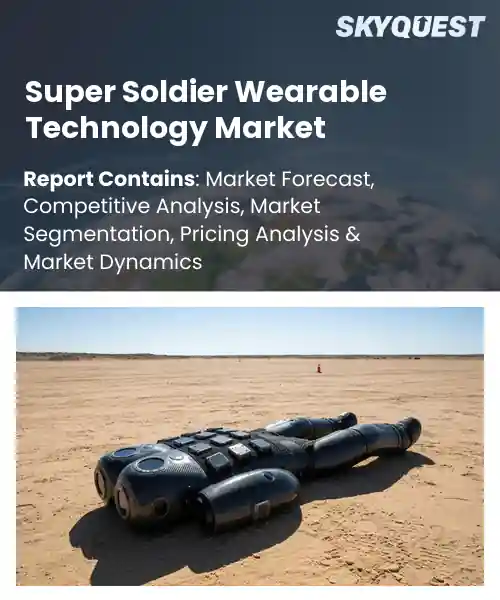
Super Soldier Wearable Technology Market
Report ID: SQMIG45D2216
Report ID: SQMIG45D2216
[email protected]
USA +1 351-333-4748
Report ID:
SQMIG45D2216 |
Region:
Global |
Published Date: June, 2026
Pages:
157
|Tables:
141
|Figures:
78


Global Super Soldier Wearable Technology Market size was valued at USD 3.6 Billion in 2024 and is poised to grow from USD 3.86 Billion in 2025 to USD 6.79 Billion by 2033, growing at a CAGR of 7.3% during the forecast period (2026-2033).
Primarily driven by defense modernization efforts, the super soldier wearable technology market focuses on enhancing soldier survivability, situational awareness and mission effectiveness. It includes powered exoskeletons, helmet mounted sensors, physiological monitoring garments and intelligent load systems, and it matters because improved individual performance reduces casualties and increases operational success. Over recent decades prototypes have matured into field trials as armed forces in the United States, Europe and Asia boosted procurement budgets and partnered with commercial firms like Ekso Bionics, BAE Systems and Lockheed Martin. Concurrent civilian applications in rehabilitation and industrial ergonomics helped attract private investment and scale manufacturing rapidly.Building on prototype maturation and cross sector investment, a critical growth factor is the convergence of advanced sensors, artificial intelligence and connectivity, which enables real time situational analysis and adaptive support, and therefore increases demand from defense programs. When embedded analytics convert physiological and environmental inputs into actionable alerts, medical evacuations can be prioritized more efficiently and mission endurance improves as fatigue is managed proactively. Commercial and dual use opportunities emerge because industries seek ergonomic exoskeletons for warehouses and construction, while software as a service models and aftermarket upgrades create recurring revenue streams for suppliers and integrators and foster exports.
How is AI transforming capabilities in the super soldier wearable technology market?
AI is reshaping super soldier wearable capabilities by combining intelligent sensing, real time decision support and tighter human machine teaming. Key aspects include sensor fusion for clearer battlefield awareness, adaptive exoskeleton control that matches wearer intent, biometric monitoring for health and readiness and augmented reality interfaces that present contextual information where it is needed. The market is evolving from experimental prototypes to deployable systems as services and industry push for autonomy, endurance and lower cognitive load. Examples span AI driven load sharing in wearable supports and AI enhanced mission headsets that streamline operator workflows and reduce injury risk.MyDefence July 2025, secured a US Army contract to deliver Soldier Kit wearable counter drone systems which use embedded AI for signal classification and automated alerting, supporting market growth by demonstrating operational readiness and by reducing soldier cognitive load in contested airspace.
Market snapshot - (2026-2033)
Global Market Size
USD 3.6 Billion
Largest Segment
Exoskeleton Systems
Fastest Growth
Wearable Sensors
Growth Rate
7.3% CAGR
To get more insights on this market click here to Request a Free Sample Report
Global super soldier wearable technology market is segmented by product type, technology type, application, end user, sales channel and region. Based on product type, the market is segmented into Exoskeleton Systems, Smart Clothing and Wearable Sensors. Based on technology type, the market is segmented into AI Integration, IoT Connectivity and Augmented Reality. Based on application, the market is segmented into Military Use and Civilian Use. Based on end user, the market is segmented into Government Agencies and Private Security Firms. Based on sales channel, the market is segmented into Direct Sales and Online Retail. Based on region, the market is segmented into North America, Europe, Asia Pacific, Latin America and Middle East & Africa.
Exoskeleton Systems segment dominates because its core ability to amplify human strength and endurance directly addresses primary operational requirements for sustained load carriage, injury reduction and force projection in demanding environments. Coupled with rugged engineering, proven mechanical integrity and clear return on mission effectiveness, exoskeletons attract prioritized development and procurement. Integration pathways with sensors and command systems further reinforce their primacy by enabling predictable performance improvements and interoperability with existing platforms.
However, Smart Clothing segment is emerging as the most rapidly expanding area, driven by advances in flexible electronics, textile integration and comfort centric design that enable continuous physiologic monitoring and unobtrusive augmentation for prolonged missions. Its scalability for mass production and crossover into allied applications accelerates adoption and creates new pathways for capability commercialization.
AI Integration segment leads because it transforms raw sensor data from wearable platforms into actionable, context sensitive insights that directly enhance situational awareness, decision speed and autonomous support for deployed personnel. By enabling sensor fusion, adaptive assistance and predictive maintenance, artificial intelligence drives capability differentiation and system optimization, making AI enabled wearables central to mission planning, real time responses and lifecycle management of advanced soldier systems.
Meanwhile, Augmented Reality segment is witnessing the strongest growth momentum as immersive overlays and head mounted systems deliver intuitive tactical visualization, target designation and hands free data access tailored to dismounted operations. Rapid improvements in display fidelity, lightweight optics and software toolkits expand training and operational applications, unlocking new interoperability models and commercial partnerships that accelerate broader platform adoption.
To get detailed segments analysis, Request a Free Sample Report
North America leads due to a concentrated combination of advanced defense research infrastructure, strong procurement programs, and a robust network of technology vendors and prime contractors. Military and allied research institutions maintain close collaboration with private firms and academic laboratories, accelerating translation of prototypes into fieldable systems. Mature supply chains for sensors, power systems, and materials enable rapid integration and iterative testing, while a supportive policy environment and sustained investment priorities foster long term development. Integration expertise across software, hardware, and human factors drives interoperable solutions that align with operational doctrines. Presence of leading original equipment manufacturers and specialized startups creates an innovation ecosystem that attracts talent and capital, reinforcing a virtuous cycle of capability development and commercialization and resilience.
Super Soldier Wearable Technology Market in the United States is driven by concentrated defense procurement, mature supply chains, and collaborations among prime contractors, startups, and academic centers. These partnerships refine human factors and integration across sensors and exoskeleton systems. Established testing ranges and acquisition pathways allow iterative refinement informed by operational feedback, positioning industry participants to deliver field oriented solutions aligned with military requirements and interoperability expectations and sustainment planning.
Super Soldier Wearable Technology Market in Canada is shaped by collaborative research centers, procurement focused on interoperability with allies, and a community of specialized suppliers. Emphasis on human factors and modular design supports adaptable wearable solutions for varied operational environments. Programs linking industry and academia enable prototype validation and knowledge transfer, allowing domestic firms to provide niche components and integration services within allied acquisition and deployment frameworks and maintenance support.
Expansion in the Asia Pacific stems from heightened regional security priorities, concentrated investment in defense modernization, and the presence of advanced electronics and precision manufacturing ecosystems. National research institutions and major technology firms are leveraging local supply chain strengths to develop miniaturized sensors, power systems, and wearable computing platforms suited to operational needs. Cross sector partnerships between defense agencies, commercial electronics companies, and specialized startups accelerate prototype refinement and localization. An emphasis on integration with existing platforms, human factors design tailored to regional forces, and export oriented industrial strategies further amplifies capability development, positioning the region as a dynamic center for applied wearable soldier systems and related support services. Government procurement pathways and collaborative defense exercises provide practical environments for validation and doctrine alignment, encouraging local adoption and industrial scaling.
Super Soldier Wearable Technology Market in Japan leverages a strong electronics manufacturing base, precision engineering capabilities, and research centers to advance compact wearable solutions. Industry collaboration with defense agencies emphasizes human centered design, sensor fusion, and energy efficient systems tailored to operational needs. Local firms focus on reliable components and modular architectures that integrate with existing equipment. Joint test programs and export oriented partnerships support capability maturation and regional interoperability.
Super Soldier Wearable Technology Market in South Korea benefits from advanced semiconductor and display industries, strong defense research programs, and agile technology firms capable of rapid prototyping. Collaboration between large electronics manufacturers and defense agencies accelerates integration of wearable sensors, communications, and power management into soldier systems. Emphasis on networked capabilities and battlefield connectivity drives solutions optimized for interoperability. Government initiatives and export strategies scale domestic technologies into regional partnerships.
Europe is enhancing its role through coordinated research collaborations, specialized manufacturing capabilities, and strengthened defense industrial cooperation among member nations. Emphasis on standards, interoperability, and joint procurement initiatives encourages cross border projects that integrate wearable sensors, power management, and survivability features into cohesive soldier systems. Strong engineering bases in several countries support development of ruggedized components and human factors research, while public private partnerships de risk innovation and enable scaling. Investment in certification processes, trials, and multinational exercises provides practical validation pathways that align technological advances with doctrine. Innovation hubs concentrated around defense clusters foster supplier specialization, while collaboration with commercial sectors such as automotive and aerospace transfers manufacturing excellence into soldier systems.
Super Soldier Wearable Technology Market in Germany draws on a strong engineering tradition, manufacturing excellence, and defense research institutions to develop rugged wearable systems. Focus on sensor reliability, materials science, and integration with existing platforms guides development priorities. Collaboration between industrial primes, specialized suppliers, and research centers enables validation in realistic conditions. Emphasis on standards and export compliance supports participation in multinational programs and fosters a competitive supplier base capability.
Super Soldier Wearable Technology Market in the United Kingdom benefits from a long defense procurement tradition, strong systems integration expertise and active academic research in human performance. Industry partnerships with military end users prioritize ergonomics, secure communications, and tailored wearables. Small and medium enterprises supply niche technologies while primes integrate subsystems into packages. Collaborative trials and participation in multinational exercises support validation and help align deliverables with allied operational needs.
Super Soldier Wearable Technology Market in France combines strong defense research agencies, specialized aerospace and electronics industries, and prototype testing capabilities. Focus on miniaturization, secure communications, and survivability features informs development roadmaps. Partnerships between national laboratories, SMEs, and prime contractors promote iteration and field validation. Export oriented policies and cooperation with European partners encourage standardization and joint programs, enabling French firms to contribute niche technologies and integrated solutions and sustainment.
To know more about the market opportunities by region and country, click here to
Buy The Complete Report
Advanced Sensor Integration And Fusion
Increased Military Investment And Adoption
Complex Regulatory And Certification Requirements
Integration And Interoperability Challenges
Request Free Customization of this report to help us to meet your business objectives.
Competition in the global super soldier wearable technology market is driven by defense primes and agile startups pursuing M&A, strategic partnerships, and rapid product innovation to capture military contracts; notable examples include long-running commercial partnerships between exoskeleton firms and major integrators and recent venture-backed product launches that prompted primes to co-develop and procure field-ready suits.
Top Player’s Company Profile
Recent Developments
SkyQuest’s ABIRAW (Advanced Business Intelligence, Research & Analysis Wing) is our Business Information Services team that Collects, Collates, Correlates, and Analyses the Data collected by means of Primary Exploratory Research backed by robust Secondary Desk research. As per SkyQuest analysis, the global super soldier wearable technology market is being propelled by defense modernization and increased military procurement, with advanced exoskeleton systems leading adoption by amplifying soldier strength and endurance. North America dominates thanks to deep defense R&D, procurement programs and strong industry ecosystems. A parallel growth driver is rapid AI integration that enhances sensor fusion, adaptive assistance and real time decision support. However, complex regulatory and certification requirements remain a key restraint, slowing commercial fielding and lengthening development cycles. Vendors that balance rugged hardware, interoperable software and validated compliance will best capture defense and dual use opportunities as prototypes move toward operational deployments.
| Report Metric | Details |
|---|---|
| Market size value in 2024 | USD 3.6 Billion |
| Market size value in 2033 | USD 6.79 Billion |
| Growth Rate | 7.3% |
| Base year | 2024 |
| Forecast period | (2026-2033) |
| Forecast Unit (Value) | USD Billion |
| Segments covered |
|
| Regions covered | North America (US, Canada), Europe (Germany, France, United Kingdom, Italy, Spain, Rest of Europe), Asia Pacific (China, India, Japan, Rest of Asia-Pacific), Latin America (Brazil, Rest of Latin America), Middle East & Africa (South Africa, GCC Countries, Rest of MEA) |
| Companies covered |
|
| Customization scope | Free report customization with purchase. Customization includes:-
|
To get a free trial access to our platform which is a one stop solution for all your data requirements for quicker decision making. This platform allows you to compare markets, competitors who are prominent in the market, and mega trends that are influencing the dynamics in the market. Also, get access to detailed SkyQuest exclusive matrix.
Table Of Content
Executive Summary
Market overview
Parent Market Analysis
Market overview
Market size
KEY MARKET INSIGHTS
COVID IMPACT
MARKET DYNAMICS & OUTLOOK
Market Size by Region
KEY COMPANY PROFILES
Methodology
For the Super Soldier Wearable Technology Market, our research methodology involved a mixture of primary and secondary data sources. Key steps involved in the research process are listed below:
1. Information Procurement: This stage involved the procurement of Market data or related information via primary and secondary sources. The various secondary sources used included various company websites, annual reports, trade databases, and paid databases such as Hoover's, Bloomberg Business, Factiva, and Avention. Our team did 45 primary interactions Globally which included several stakeholders such as manufacturers, customers, key opinion leaders, etc. Overall, information procurement was one of the most extensive stages in our research process.
2. Information Analysis: This step involved triangulation of data through bottom-up and top-down approaches to estimate and validate the total size and future estimate of the Super Soldier Wearable Technology Market.
3. Report Formulation: The final step entailed the placement of data points in appropriate Market spaces in an attempt to deduce viable conclusions.
4. Validation & Publishing: Validation is the most important step in the process. Validation & re-validation via an intricately designed process helped us finalize data points to be used for final calculations. The final Market estimates and forecasts were then aligned and sent to our panel of industry experts for validation of data. Once the validation was done the report was sent to our Quality Assurance team to ensure adherence to style guides, consistency & design.
Analyst Support
Customization Options
With the given market data, our dedicated team of analysts can offer you the following customization options are available for the Super Soldier Wearable Technology Market:
Product Analysis: Product matrix, which offers a detailed comparison of the product portfolio of companies.
Regional Analysis: Further analysis of the Super Soldier Wearable Technology Market for additional countries.
Competitive Analysis: Detailed analysis and profiling of additional Market players & comparative analysis of competitive products.
Go to Market Strategy: Find the high-growth channels to invest your marketing efforts and increase your customer base.
Innovation Mapping: Identify racial solutions and innovation, connected to deep ecosystems of innovators, start-ups, academics, and strategic partners.
Category Intelligence: Customized intelligence that is relevant to their supply Markets will enable them to make smarter sourcing decisions and improve their category management.
Public Company Transcript Analysis: To improve the investment performance by generating new alpha and making better-informed decisions.
Social Media Listening: To analyze the conversations and trends happening not just around your brand, but around your industry as a whole, and use those insights to make better Marketing decisions.
REQUEST FOR SAMPLE
 REQUEST FREE CUSTOMIZATION


Want to customize this report? This report can be personalized according to your needs. Our analysts and industry experts will work directly with you to understand your requirements and provide you with customized data in a short amount of time. We offer $1000 worth of FREE customization at the time of purchase.
Feedback From Our Clients


 USA (+1) 351-333-4748

