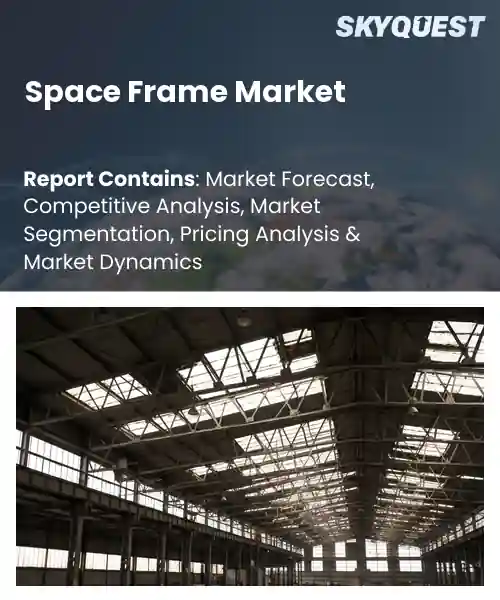
Space Frame Market
Report ID: SQMIG20C2241
Report ID: SQMIG20C2241
[email protected]
USA +1 351-333-4748
Report ID:
SQMIG20C2241 |
Region:
Global |
Published Date: June, 2026
Pages:
157
|Tables:
119
|Figures:
77


Global Space Frame Market size was valued at USD 4.36 Billion in 2024 and is poised to grow from USD 4.75 Billion in 2025 to USD 9.51 Billion by 2033, growing at a CAGR of 9.05% during the forecast period (2026-2033).
The driver propelling the space frame market is the requirement for large column free spans in modern architecture and infrastructure, which combines structural efficiency with aesthetic flexibility. Space frames are three dimensional truss assemblies that distribute loads through interconnected members and they matter because they enable lightweight roofs, faster erection and versatile geometries that traditional systems struggle to achieve. Over decades the market shifted from handcrafted steel lattices to precision engineered modular systems enabled by computer aided design, finite element analysis and prefabrication. This transition accelerated adoption in stadiums, malls and transit hubs where long clear spans and iconic forms meet needs.A factor shaping the global space frame market is the convergence of digital engineering, prefabrication and innovative materials, which lower lifecycle costs and expand application scopes. When designers adopt BIM workflows, fabrication files feed into CNC machinery and welding, enabling member optimization that reduces weight and material waste while accelerating erection schedules. As a result vendors can offer modular kits for airport expansions, retail canopies and rapid medical shelters that shorten timelines and attract developers in emerging markets. This efficiency creates opportunities in sustainable design because lighter frames accommodate photovoltaic arrays and simplify seismic resistant solutions, driving further adoption.
How is AI improving design optimization in the space frame market?
AI is reshaping design optimization in the space frame market through generative design, topology aware modeling, and simulation driven iteration. Key aspects include automated node and member layout generation, machine learning surrogates that speed structural evaluation, and integration of fabrication constraints to ensure constructability. The current state sees firms moving from manual parameter sweeps to AI pipelines that explore many viable geometries and materials. This context matters as demand for lightweight large span structures grows. Instances range from AI proposing novel truss forms to digital twin workflows linking as built feedback into the next design cycle, making solutions both more efficient and more resilient.PTC June 2026, the company introduced AI assisted engineering capabilities in Creo to accelerate simulation driven optimization and tie design to production workflows, helping space frame developers iterate on lighter more buildable structures faster while improving data continuity across design and manufacturing.
Market snapshot - (2026-2033)
Global Market Size
USD 4.36 Billion
Largest Segment
Steel
Fastest Growth
Aluminum
Growth Rate
9.05% CAGR
To get more insights on this market click here to Request a Free Sample Report
Global space frame market is segmented by material, structure, tube profile, application and region. Based on material, the market is segmented into Steel, Aluminum and Metal Alloys. Based on structure, the market is segmented into Single Layer Grid, Double Layer Grid and Triple Layer Grid. Based on tube profile, the market is segmented into Circular Hollow Section and Rectangular Hollow Section. Based on application, the market is segmented into Roofs and Atriums, Steel Dome Roofs, Skylights, Canopies and Entry Ways, Skywalks and Side Bridges and Others. Based on region, the market is segmented into North America, Europe, Asia Pacific, Latin America and Middle East & Africa.
Steel segment dominates because its inherent tensile strength and predictable structural behavior make it the default material for space frame applications where long spans and heavy loads are required. Established fabrication and welding practices reduce construction risk, while material availability and cost efficiency encourage designers to specify steel for large scale roofs and atria. These practical and economic drivers create consistent demand across commercial and industrial space frame projects.
However, aluminum segment is emerging as the fastest growing area due to its light weight, corrosion resistance and suitability for prefabricated modular assemblies that speed installation. Design trends favoring slender profiles and sustainability credentials prompt architects to adopt aluminum, expanding applications and enabling innovative lighter space frame systems.
Double Layer Grid segment dominates because its dual layer geometry delivers superior stiffness and load redistribution capabilities vital for the most demanding space frame applications. The two tier configuration provides structural redundancy and depth that improves performance under dynamic and concentrated loads, enabling architects to achieve longer spans and complex roof geometries with greater confidence. Familiar engineering approaches and proven connection systems further accelerate specification and procurement for large public and commercial projects.
However, Triple Layer Grid is emerging as the fastest growing approach because its multi depth architecture meets escalating demands for ultra long spans and high load facilities while enabling integrated services and increased stiffness. Advances in digital modeling and prefabrication reduce complexity and cost, prompting designers to pursue triple layer solutions for landmark structures and technically ambitious roof systems.
To get detailed segments analysis, Request a Free Sample Report
Asia Pacific dominates the global space frame market due to a combination of concentrated construction activity, strong industrial fabrication capacity, and integrated supply chain ecosystems that support complex structural applications. Regional manufacturers benefit from deep engineering expertise, high adoption of advanced materials and modular construction techniques, and demand across commercial, infrastructure, and industrial segments. Policy emphasis on urbanization and large scale architectural projects encourages long lead projects that favor space frame solutions. Collaboration between design firms and fabricators, coupled with competitive manufacturing costs and a focus on innovation in connections and lightweight design, reinforces the region role as a global leader in space frame adoption and technology development. Established manufacturing clusters and export orientation allow regional firms to scale complex projects efficiently, while sustained investment in workforce training and technical standards promotes consistent quality and regulatory alignment across markets.
Space Frame Market Japan benefits from advanced engineering capabilities and a strong tradition in precision fabrication, driving demand in complex architectural and industrial projects. Collaboration between architectural firms and specialized fabricators supports innovative structural solutions and custom connection systems. Local emphasis on quality control, seismic resilience, and material efficiency encourages adoption of space frame systems in public infrastructure and high-end commercial developments, reinforcing Japan role as a regional technical leader.
Space Frame Market South Korea is propelled by strong industrial fabrication capacity and a focus on innovative structural solutions for commercial and transport projects. Integration between design institutes and manufacturers enables efficient adaptation of modular space frame systems. Emphasis on architectural aesthetics and durability drives demand for lightweight structures. Continued development of specialized connection technology and collaboration across supply chains positions South Korea as a competitive market with regional influence.
Europe rapid expansion in the space frame market is driven by a convergence of architectural ambition, renovation and retrofit activity, and strong engineering capabilities concentrated in key countries. Demand for visually striking, sustainable, and adaptable roof and facade systems aligns with increasing use of modular metal and hybrid material solutions. Collaborative networks of architects, structural engineers, and fabricators facilitate complex project delivery, while regulatory emphasis on safety and material performance elevates specification standards. Investment in research and technical education supports improved connection systems and digital design tools, enabling efficient customization. The region position benefits from a healthy mix of large flagship projects and urban renewal initiatives that showcase space frame versatility and stimulate supply chain development across national markets. Cross border partnerships further accelerate transfer of specialized capabilities.
Space Frame Market Germany benefits from extensive engineering expertise, strong manufacturing infrastructure, and established standards for structural systems. Demand is supported by a broad mix of industrial and commercial projects that value robust, durable designs. Integration of digital engineering and precision fabrication enables efficient detailing and repeatable quality. Collaboration between research institutes, engineering firms, and fabricators fosters advanced connection technologies and reinforces Germany role as a dominant market in Europe.
Space Frame Market United Kingdom is characterized by dynamic demand driven by urban regeneration and commercial redevelopment projects that favor distinctive architectural forms. Collaboration among design practices, fabrication specialists, and contractors accelerates adoption of modular and hybrid space frame solutions. Emphasis on sustainability and lightweight construction supports specification of space frames. Interest in roof and facade systems, coupled with digital design capabilities, positions United Kingdom as a rapidly expanding market.
Space Frame Market France is emerging as architects and developers seek elegant structural solutions for cultural venues, commercial centers, and urban projects. Focus on aesthetic integration, material innovation, and sustainability has increased interest in space frame systems that offer refined lines and adaptable spans. Collaboration between boutique fabricators and architectural studios enables tailored approaches. Strengthening technical knowhow and projects in metropolitan areas underscore France growing role as an emerging market.
North America is strengthening its position in the space frame market through advancement in engineering practice, wider adoption of digital design workflows, and strategic collaboration between fabricators and construction firms. Emphasis on durable, energy efficient, and low maintenance structures aligns with demand across commercial, institutional, and transportation sectors. Investment in specialized fabrication facilities and emphasis on standardized components accelerate project delivery while maintaining high quality control. Cross sector partnerships, pilot installations, and growing expertise in hybrid material systems support increased specification of space frames. The regional supply chains and focus on customization for climate and code requirements further consolidate North America role as an influential market in the global landscape. Leading research centers and growing retrofit activity in aging infrastructure create practical opportunities to apply space frame solutions in complex contexts.
Space Frame Market United States is driven by commercial construction activity that values versatile long span structural solutions. Use of digital modeling and prefabrication enables efficient coordination between designers and fabricators. Emphasis on resilient, low maintenance materials and adherence to stringent building codes shapes specification choices. Strong network of specialized manufacturers and engineering consultancies supports complex projects. Interest in architectural expression and performance keeps United States an important market position.
Space Frame Market Canada is progressing through strengthened fabrication capacity and collaboration with architectural and engineering practices to address building needs. Preference for resilient, low maintenance solutions suitable for varied climates supports specification in commercial and institutional projects. Focus on modular and transportable components aids efficient delivery across dispersed population centers. Development of technical skills and projects by fabricators reinforces Canada role as a dependable market for space frame applications.
To know more about the market opportunities by region and country, click here to
Buy The Complete Report
Rising Demand For Large Span Structures
Advancements In Lightweight Materials
High Initial Capital Requirements
Complex Regulatory And Certification Processes
Request Free Customization of this report to help us to meet your business objectives.
Competition in the global space frame market is intensifying as fabricators and OEMs pursue lightweighting and faster delivery through technology adoption and dealmaking. Recent strategic moves include materials and manufacturing innovation such as composite and aluminum space frames, microfactory production and automation, and startups commercializing 3D printed node technology, all supported by partnerships and business combinations to scale capabilities and distribution.
Top Player’s Company Profile
Recent Developments
SkyQuest’s ABIRAW (Advanced Business Intelligence, Research & Analysis Wing) is our Business Information Services team that Collects, Collates, Correlates, and Analyses the Data collected by means of Primary Exploratory Research backed by robust Secondary Desk research. As per SkyQuest analysis, the global space frame market is propelled primarily by the demand for large column free spans in modern architecture and infrastructure, while growth is constrained by high initial capital requirements for specialized design and fabrication. Asia Pacific leads the market, supported by concentrated construction activity and fabrication capacity, and steel remains the dominant material segment due to its strength, availability and cost efficiency. A second major driver is the convergence of digital engineering, prefabrication and innovative materials that reduce lifecycle costs and speed delivery, enabling modular kits and more sustainable, lightweight long span solutions and expanding adoption across commercial and infrastructure projects.
| Report Metric | Details |
|---|---|
| Market size value in 2024 | USD 4.36 Billion |
| Market size value in 2033 | USD 9.51 Billion |
| Growth Rate | 9.05% |
| Base year | 2024 |
| Forecast period | (2026-2033) |
| Forecast Unit (Value) | USD Billion |
| Segments covered |
|
| Regions covered | North America (US, Canada), Europe (Germany, France, United Kingdom, Italy, Spain, Rest of Europe), Asia Pacific (China, India, Japan, Rest of Asia-Pacific), Latin America (Brazil, Rest of Latin America), Middle East & Africa (South Africa, GCC Countries, Rest of MEA) |
| Companies covered |
|
| Customization scope | Free report customization with purchase. Customization includes:-
|
To get a free trial access to our platform which is a one stop solution for all your data requirements for quicker decision making. This platform allows you to compare markets, competitors who are prominent in the market, and mega trends that are influencing the dynamics in the market. Also, get access to detailed SkyQuest exclusive matrix.
Table Of Content
Executive Summary
Market overview
Parent Market Analysis
Market overview
Market size
KEY MARKET INSIGHTS
COVID IMPACT
MARKET DYNAMICS & OUTLOOK
Market Size by Region
KEY COMPANY PROFILES
Methodology
For the Space Frame Market, our research methodology involved a mixture of primary and secondary data sources. Key steps involved in the research process are listed below:
1. Information Procurement: This stage involved the procurement of Market data or related information via primary and secondary sources. The various secondary sources used included various company websites, annual reports, trade databases, and paid databases such as Hoover's, Bloomberg Business, Factiva, and Avention. Our team did 45 primary interactions Globally which included several stakeholders such as manufacturers, customers, key opinion leaders, etc. Overall, information procurement was one of the most extensive stages in our research process.
2. Information Analysis: This step involved triangulation of data through bottom-up and top-down approaches to estimate and validate the total size and future estimate of the Space Frame Market.
3. Report Formulation: The final step entailed the placement of data points in appropriate Market spaces in an attempt to deduce viable conclusions.
4. Validation & Publishing: Validation is the most important step in the process. Validation & re-validation via an intricately designed process helped us finalize data points to be used for final calculations. The final Market estimates and forecasts were then aligned and sent to our panel of industry experts for validation of data. Once the validation was done the report was sent to our Quality Assurance team to ensure adherence to style guides, consistency & design.
Analyst Support
Customization Options
With the given market data, our dedicated team of analysts can offer you the following customization options are available for the Space Frame Market:
Product Analysis: Product matrix, which offers a detailed comparison of the product portfolio of companies.
Regional Analysis: Further analysis of the Space Frame Market for additional countries.
Competitive Analysis: Detailed analysis and profiling of additional Market players & comparative analysis of competitive products.
Go to Market Strategy: Find the high-growth channels to invest your marketing efforts and increase your customer base.
Innovation Mapping: Identify racial solutions and innovation, connected to deep ecosystems of innovators, start-ups, academics, and strategic partners.
Category Intelligence: Customized intelligence that is relevant to their supply Markets will enable them to make smarter sourcing decisions and improve their category management.
Public Company Transcript Analysis: To improve the investment performance by generating new alpha and making better-informed decisions.
Social Media Listening: To analyze the conversations and trends happening not just around your brand, but around your industry as a whole, and use those insights to make better Marketing decisions.
REQUEST FOR SAMPLE
 REQUEST FREE CUSTOMIZATION


Want to customize this report? This report can be personalized according to your needs. Our analysts and industry experts will work directly with you to understand your requirements and provide you with customized data in a short amount of time. We offer $1000 worth of FREE customization at the time of purchase.
Feedback From Our Clients


 USA (+1) 351-333-4748

