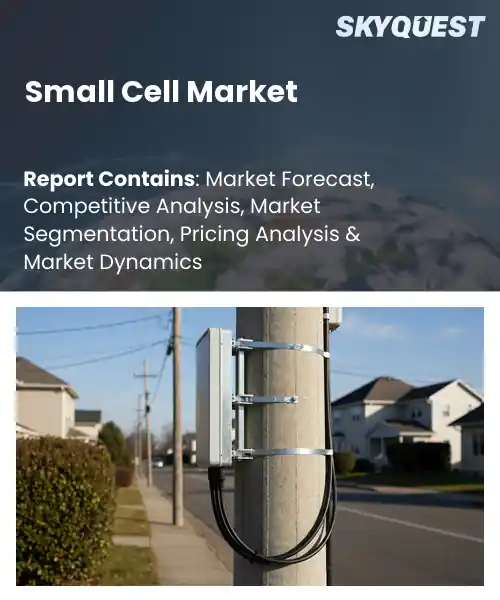
Small Cell Market
Report ID: SQMIG45H2220
Report ID: SQMIG45H2220
[email protected]
USA +1 351-333-4748
Report ID:
SQMIG45H2220 |
Region:
Global |
Published Date: June, 2026
Pages:
157
|Tables:
116
|Figures:
77


Global Small Cell Market size was valued at USD 8.52 Billion in 2024 and is poised to grow from USD 9.76 Billion in 2025 to USD 28.85 Billion by 2033, growing at a CAGR of 14.52% during the forecast period (2026-2033).
Rise in deployment of 5G networks, increasing mobile data traffic, rising demand for high-speed indoor connectivity, expansion of smart city projects, and growing adoption of IoT applications are driving sales of small cells.
High demand for seamless high-speed wireless connectivity, coupled with rapid expansion of 5G infrastructure, is expected to primarily drive small cell market growth. Growing implementation of small cells in offices, stadiums, malls, transportation hubs and other high-density venues is enhancing network coverage and capacity as well as facilitating the use of bandwidth-heavy applications. Growing acceptance of smart city projects, private wireless networks, industrial IoT deployments and edge computing is additionally proliferating market growth. Ongoing investments by telecom providers in indoor coverage solutions and common network infrastructure is consequently boosting the marketplace. Furthermore, growing requirement for dependable low-latency connection for enterprise and consumer services is anticipated to open fresh avenues of growth for the industry across the globe.
On the contrary, high deployment costs, complex site acquisition and permitting processes, interoperability challenges, and concerns regarding return on investment are anticipated to slow down small cell market penetration across the study period and beyond.
How is AI-driven Automation Influencing The Deployment Of Small Cell Networks?
AI is bringing advancements in the small cell industry by increasing network planning, deployment, and management effectiveness. Machine learning algorithms used for traffic pattern analysis, density of users, and geography conditions enables small cell siting with reduced site survey requirements. Automated network analytics achieved through AI-AI fully replaces manual engineering by mechanism that boosts network capacity while tuning power levels, beam forming optimization and spectrum allocation at within seconds. Predictive proactive maintenance intervention for failure prevention benefits the operators with lesser downtime and operational costs.
Market snapshot - (2026-2033)
Global Market Size
USD 8.52 Billion
Largest Segment
Microcells
Fastest Growth
Metro Cells
Growth Rate
14.52% CAGR
To get more insights on this market click here to Request a Free Sample Report
Global small cell market is segmented by type, technology, deployment, end-user, and region. Based on type, the market is segmented into femtocells, picocells, microcells, and metro cells. Based on technology, the market is segmented into 4G/LTE Small Cells and 5G small cells. Based on deployment, the market is segmented into indoor and outdoor. Based on end-user, the market is segmented into mobile network operators, enterprise networks, and neutral host providers. Based on region, the market is segmented into North America, Europe, Asia Pacific, Latin America, and Middle East & Africa.
The microcells segment is predicted to account for the highest global small cell market share going forward. Microcells provide the highest network capacity, and coverage at all times. Through concentrating on their signals in the same cell, microcells have the highest offered capacity out of any solution, while their small size can provide the advantage of less costly installations. Their integration with macro networks allows for better offloading of network traffic, which means they also relieve the load on the macro network. These three factors make microcells the foundation of most small cell deployments for mobile networks through strategic design.
However, picocells segment emerges as the fastest growing one because it accommodates the tighter confines of dense indoor venues and enterprise environments, where the user density is higher. Advances in plug and play design along with AI-enabled interference management are further increasing the pace of the technology's adoption, opening doors to increased revenue and a larger total market footprint for service providers worldwide.
The 4G/LTE small cells segment is anticipated to lead the global small cell market revenue generation across the study period. They offer an existing, proven, and interoperable layer that enhances current macro layers, providing some capacity growth without requiring a significant investment in new spectrum. As they are more mature, their stable performance, ease of handovers and quality of service for legacy devices are supported and enabled in the best way, at the same time are simpler in terms of deployment and lower costs, that make them more attractive for operators to densify network at the present time and preserve investment for the current and future network.
Meanwhile, 5G small cells segment is witnessing the strongest growth momentum as per this small cell market forecast, due to the high density, high frequency coverage is needed by low latency applications. Improvements in beamforming, integrated edge compute and adaptable deployment models remove obstacles, spurring significant investment by operators and enterprise. This input injects momentum into general market growth and unlocks fresh avenues of opportunity in different verticals.
To get detailed segments analysis, Request a Free Sample Report
Strong telecom investment, early adoption of advanced network architectures, supportive policy frameworks, extensive urban density, and a robust manufacturing ecosystem support the dominance of this region. Mobile operators in the region are focused on increasing capacity and decreasing latency by using dense deployment of small cells to augment their macro networks. The Asia Pacific benefits from collaborative research with a highly skilled engineering labour pool to facilitate continuing innovation in antenna design and integration. Demand for continued rollout of small cells in venues with large audiences and in support of smart city initiatives provide continued support for the Asia Pacific region to maintain its leadership position. Also, regional mobile operators can leverage economies of scale by sourcing components from semiconductor manufacturing centres, thereby reducing their deployment costs and providing further support for rapid densification of their networks. Government incentives to support greater broadband access across the underserved regions of the Asia Pacific also provide additional support for mobile operators' commitments. The strong demand from consumers for high-definition video and immersive experiences continues to fuel the need for capacity upgrades across all areas of the Asia Pacific region. As such, the convergence of advanced network technologies, supportive public policies and strong market demand make the Asia Pacific region the ideal location for continued proliferation of small cell technologies.
Small cell demand in Japan is propelled by dense urban landscapes and a strong emphasis on next-generation connectivity for industrial automation. Telecom operators collaborate closely with local manufacturers to integrate compact radio units into existing infrastructure, optimizing space constraints. Regulatory frameworks encourage shared site usage, accelerating rollout in high‑traffic districts. Meanwhile, consumer demand for seamless media streaming and emerging gaming experiences sustains ongoing network densification efforts across metropolitan corridors.
Small cell market in South Korea benefits from rollout strategies aligned with a national vision for ubiquitous broadband. Operators will focus on deploying small cells into dense residential blocks and critical transport hotspots, such as airports and train stations, and support those deployments with robust backhaul. Close collaboration between service providers and chip designers, driving down equipment costs and shortening time to market, will be crucial to dense network investment. Combined with consumer excitement over mobile entertainment and augmented reality, investment in dense layer will continue at a rapid pace.
Carrier ambition, regulatory encouragement, and vibrant technology ecosystems support steady demand for small cell solutions across the region. Land use policies that support soaring demand have reduced site share barriers necessary to ease constructs; therefore, fortifying and expediting small cell constructions throughout North America. This is due to a great deal of the exuding enthusiasm towards entertainment mediums with immersive audiences, low-latency gaming and emerging internet-based applications; and efforts between municipalities and private corporations to develop and implement smart city solutions. Carrier pursuits of densified rollouts respond to an ever-increasing data demand and provide added coverage to existing macro infrastructure within congested areas of major cities. Additionally, as the infrastructure begins to be constructed, there is also increased pressure on the major carriers to implement advanced spectrum sharing techniques, which will help improve network performance.
Small cell adoption in United States is shaped by extensive carrier initiatives targeting metropolitan hotspots and transportation corridors. Operators leverage abundant spectrum assets to densify coverage, while collaborative agreements with property owners streamline site acquisition. The presence of leading research universities and technology incubators accelerates development of next‑generation small cell hardware. Consumer demand for high‑definition streaming and cloud‑based gaming fuels continuous network enhancement, prompting sustained investment across diverse urban landscapes.
Small cell market in Canada reflects a approach that combines urban densification with coverage of remote communities. Telecom providers adopt shared‑infrastructure models to mitigate high site costs in densely populated centres, while leveraging satellite‑backhauled small cells to extend connectivity to underserved regions. Government incentives support rollout of advanced broadband in Indigenous territories, creating deployment opportunities. Growing consumer expectations for seamless streaming and collaboration drive continued emphasis on dense network layering.
Coordinated policy frameworks, cross-border collaboration, and a focus on sustainable network densification support steady demand for small cells across Europe. Many operators are also working together to develop innovative backhaul solutions to extend coverage into suburban and rural areas. Strong research institutions and a mature manufacturing base expedite the development of energy-efficient hardware and next-generation antennas. Public efforts to develop smart-city test projects and improve public-transport access generate additional corridors for sites to be reproduced. Continuous cooperation between telecommunications operators and local governments helps accelerate the acquisition of sites and public acceptance. This combination of regulatory support, technological leadership and market demand has established Europe as a proactive location from which to deploy next-generation small cells.
Small cell market in Germany is driven by dense metropolitan regions and a strong emphasis on industrial automation. Operators adopt shared‑site strategies to integrate small cells into existing towers and street furniture, minimizing visual clutter. Collaborative research programs with engineering colleges focus on ultra‑reliable low‑latency communications, enhancing the appeal of small cells for manufacturing hubs. Consumer expectations for seamless video streaming and cloud‑based services sustain network densification across major cities.
Small cell market in United Kingdom reflects a push to enhance capacity in centers and transport nodes. Operators benefit from spectrum initiatives to install small cells either along rail corridors or at strategic public locations (protection and integration). This is underpinned by collaboration with the academic community for innovation in the design of antennas or AI-managed interference mitigation solutions. The increasing user demand for media streaming and gaming lead to further densification and dependency on small cell solutions to provide reliable low latency connectivity nationwide.
Small cell demand in France is propelled by commitment to sovereignty and modernization programs. Operators continue to focus on deployment on dense districts and major transport nodes, using shared-site agreements to protect architecture. Work with research agencies to concentrate on spectrum efficiency and antenna cell technologies designed to meet sustainability criteria. As consumer demand for immersive streaming and increasingly sophisticated mobile cloud application continues to grow, demand remains high for low latency coverage requiring dense small cell networks in France.
To know more about the market opportunities by region and country, click here to
Buy The Complete Report
Increasing Demand For 5G Connectivity
Adoption Of Small Cell Deployments
High Capital Expenditure Requirements
Complex Site Acquisition Processes
Request Free Customization of this report to help us to meet your business objectives.
The competitive landscape in the global small cell market is shaped by aggressive M&A activity, strategic partnerships with telecom operators, and rapid technology innovation such as integrated AI‑driven network optimization; recent examples include Nokia’s acquisition of Elenion to boost mmWave small cell capabilities and Samsung’s joint venture with Verizon to deploy edge‑enabled small cells across urban corridors, accelerating network densification and capacity growth.
SkyQuest’s ABIRAW (Advanced Business Intelligence, Research & Analysis Wing) is our Business Information Services team that Collects, Collates, Correlates, and Analyses the Data collected by means of Primary Exploratory Research backed by robust Secondary Desk research.
As per SkyQuest analysis, increasing mobile data traffic, and rising demand for high-speed indoor connectivity are anticipated to drive the demand for small cells going forward. However, high deployment costs and complex site acquisition and permitting processes are slated to slow down the adoption of small cells in the future. Asia Pacific is slated to spearhead the demand for small cells owing to rapid 5G infrastructure deployment, high investments by telecom operators, strong adoption of smart city initiatives, and increasing demand for advanced wireless connectivity. AI-driven network optimization and expansion of private 5G and indoor small cell deployments are anticipated to be key trends driving the small cell sector through 2033.
| Report Metric | Details |
|---|---|
| Market size value in 2024 | USD 8.52 Billion |
| Market size value in 2033 | USD 28.85 Billion |
| Growth Rate | 14.52% |
| Base year | 2024 |
| Forecast period | (2026-2033) |
| Forecast Unit (Value) | USD Billion |
| Segments covered |
|
| Regions covered | North America (US, Canada), Europe (Germany, France, United Kingdom, Italy, Spain, Rest of Europe), Asia Pacific (China, India, Japan, Rest of Asia-Pacific), Latin America (Brazil, Rest of Latin America), Middle East & Africa (South Africa, GCC Countries, Rest of MEA) |
| Companies covered |
|
| Customization scope | Free report customization with purchase. Customization includes:-
|
To get a free trial access to our platform which is a one stop solution for all your data requirements for quicker decision making. This platform allows you to compare markets, competitors who are prominent in the market, and mega trends that are influencing the dynamics in the market. Also, get access to detailed SkyQuest exclusive matrix.
Table Of Content
Executive Summary
Market overview
Parent Market Analysis
Market overview
Market size
KEY MARKET INSIGHTS
COVID IMPACT
MARKET DYNAMICS & OUTLOOK
Market Size by Region
KEY COMPANY PROFILES
Methodology
For the Small Cell Market, our research methodology involved a mixture of primary and secondary data sources. Key steps involved in the research process are listed below:
1. Information Procurement: This stage involved the procurement of Market data or related information via primary and secondary sources. The various secondary sources used included various company websites, annual reports, trade databases, and paid databases such as Hoover's, Bloomberg Business, Factiva, and Avention. Our team did 45 primary interactions Globally which included several stakeholders such as manufacturers, customers, key opinion leaders, etc. Overall, information procurement was one of the most extensive stages in our research process.
2. Information Analysis: This step involved triangulation of data through bottom-up and top-down approaches to estimate and validate the total size and future estimate of the Small Cell Market.
3. Report Formulation: The final step entailed the placement of data points in appropriate Market spaces in an attempt to deduce viable conclusions.
4. Validation & Publishing: Validation is the most important step in the process. Validation & re-validation via an intricately designed process helped us finalize data points to be used for final calculations. The final Market estimates and forecasts were then aligned and sent to our panel of industry experts for validation of data. Once the validation was done the report was sent to our Quality Assurance team to ensure adherence to style guides, consistency & design.
Analyst Support
Customization Options
With the given market data, our dedicated team of analysts can offer you the following customization options are available for the Small Cell Market:
Product Analysis: Product matrix, which offers a detailed comparison of the product portfolio of companies.
Regional Analysis: Further analysis of the Small Cell Market for additional countries.
Competitive Analysis: Detailed analysis and profiling of additional Market players & comparative analysis of competitive products.
Go to Market Strategy: Find the high-growth channels to invest your marketing efforts and increase your customer base.
Innovation Mapping: Identify racial solutions and innovation, connected to deep ecosystems of innovators, start-ups, academics, and strategic partners.
Category Intelligence: Customized intelligence that is relevant to their supply Markets will enable them to make smarter sourcing decisions and improve their category management.
Public Company Transcript Analysis: To improve the investment performance by generating new alpha and making better-informed decisions.
Social Media Listening: To analyze the conversations and trends happening not just around your brand, but around your industry as a whole, and use those insights to make better Marketing decisions.
REQUEST FOR SAMPLE
 REQUEST FREE CUSTOMIZATION
Global Small Cell Market size was valued at USD 8.52 Billion in 2024 and is poised to grow from USD 9.76 Billion in 2025 to USD 28.85 Billion by 2033, growing at a CAGR of 14.52% during the forecast period (2026-2033).
The competitive landscape in the global small cell market is shaped by aggressive M&A activity, strategic partnerships with telecom operators, and rapid technology innovation such as integrated AI‑driven network optimization; recent examples include Nokia’s acquisition of Elenion to boost mmWave small cell capabilities and Samsung’s joint venture with Verizon to deploy edge‑enabled small cells across urban corridors, accelerating network densification and capacity growth. 'Ericsson', 'Nokia Corporation', 'Huawei Technologies', 'Samsung Electronics', 'ZTE Corporation', 'Cisco Systems', 'CommScope', 'Airspan Networks', 'Mavenir Systems', 'Casa Systems', 'Baicells Technologies', 'JMA Wireless', 'Druid Software', 'Parallel Wireless', 'Athonet (HPE)', 'Federated Wireless', 'Boldyn Networks (Boingo)', 'Crown Castle International', 'American Tower Corporation', 'SBA Communications'
The rapid rollout of 5G services drives operators to seek dense network coverage, and small cells provide the necessary capacity and low‑latency performance within limited geographical footprints, enabling seamless user experiences in urban environments. By integrating small cells into existing infrastructure, telecom providers can enhance spectral efficiency while reducing the need for extensive macro‑cell installations, which accelerates network densification and supports the escalating data traffic generated by emerging applications. This approach also facilitates faster deployment cycles, allowing operators to respond promptly to market demand and maintain competitive service offerings.
Edge‑Enabled Network Densification: Operators are increasingly deploying small cells at street‑level and indoor venues to push processing and storage closer to end‑users, reducing latency and supporting bandwidth‑hungry applications such as augmented reality, industrial IoT, and immersive media. This edge‑enabled densification strategy complements macro‑cell coverage, improves spectral efficiency, and allows dynamic traffic steering based on real‑time demand, fostering more resilient and adaptable network architectures that can evolve with emerging digital services, enabling operators to monetize new service tiers through localized content delivery and tailored quality‑of‑service agreements.
Why does Asia Pacific Dominate the Global Small Cell Market? |@12


Want to customize this report? This report can be personalized according to your needs. Our analysts and industry experts will work directly with you to understand your requirements and provide you with customized data in a short amount of time. We offer $1000 worth of FREE customization at the time of purchase.
Feedback From Our Clients


 USA (+1) 351-333-4748

