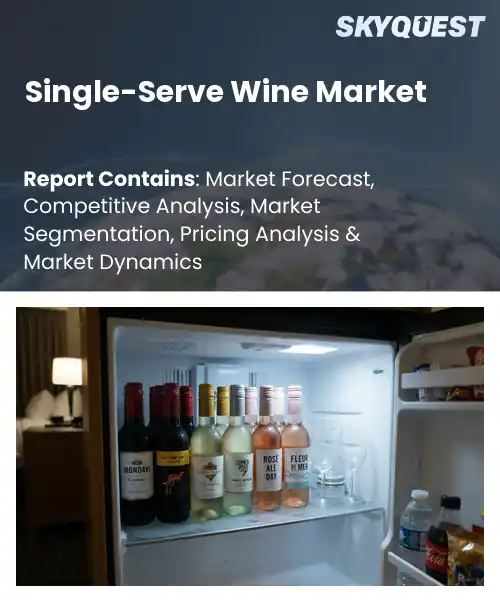
Single-Serve Wine Market
Report ID: SQMIG30F2081
Report ID: SQMIG30F2081
[email protected]
USA +1 351-333-4748
Report ID:
SQMIG30F2081 |
Region:
Global |
Published Date: November, 2026
Pages:
157
|Tables:
122
|Figures:
77


Global Single-Serve Wine Market size was valued at USD 2.45 Billion in 2024 and is poised to grow from USD 2.63 Billion in 2025 to USD 4.59 Billion by 2033, growing at a CAGR of 7.2% during the forecast period (2026-2033).
Driving the phase of expansion is the rise of sustainable packaging, which aligns environmental concerns with brand differentiation. When producers adopt aluminum cans that are infinitely recyclable, they reduce carbon footprints and appeal to eco‑conscious shoppers, prompting retailers to allocate shelf space and thereby boost sales velocity. For instance, a leading Mediterranean winery introduced a line of 100 % recyclable wine cans in 2022; within twelve months, its channel‑share grew by 18 % in European convenience stores and attracted corporate catering contracts seeking solutions. This cause‑and‑effect chain sustainability prompting retailer endorsement, leading to broader distribution and higher revenue creates a scalable opportunity for boutique and mass‑market players. The global single‑serve wine market comprises pre‑packaged portions typically 187 ml cans, pouches, or mini‑bottles designed for one‑time consumption without waste. Its significance stems from shifting consumer lifestyles that prize convenience, portability, and portion control, especially among urban millennials and Gen Z who favor on‑the‑go indulgence. The sector emerged in the early 2010s when craft breweries demonstrated the viability of canned malt beverages; wine producers soon followed, launching canned rosé in 2015 and expanding to sparkling and premium varietals by 2020. Adoption accelerated during the COVID‑19 pandemic as retailers stocked shelf‑stable options for home‑based entertaining, illustrating how external shocks can hasten market acceptance globally in major markets.
How is AI influencing consumer personalization in the single-serve wine market?
AI is reshaping how single serve wine brands connect with shoppers by turning taste data into personalized experiences. Algorithms analyze past purchases, flavor ratings and occasion cues to suggest bottles that match individual palates. Brands now embed recommendation widgets on apps and packaging QR codes that trigger custom suggestions in real time. This creates a loop where each sip refines the model, making future offers more precise. The market, once dominated by generic packs, is seeing boutique curations that feel handcrafted for each consumer, driving loyalty and encouraging trial of new varietals.Vinebox announced in March 2023, an AI driven tasting profile that matches users with single serve selections, boosting relevance and streamlining inventory turnover.
Market snapshot - (2026-2033)
Global Market Size
USD 2.45 Billion
Largest Segment
Single-Serve Bottles
Fastest Growth
Cans
Growth Rate
7.2% CAGR
To get more insights on this market click here to Request a Free Sample Report
Global single-serve wine market is segmented by packaging type, wine type, price range, distribution channel and region. Based on packaging type, the market is segmented into Single-Serve Bottles, Cans, Cartons and Other Packaging Types. Based on wine type, the market is segmented into Red Wine, White Wine, Rosé Wine and Sparkling Wine. Based on price range, the market is segmented into Economy, Mid-Range and Premium. Based on distribution channel, the market is segmented into Supermarkets & Hypermarkets, Liquor Stores, Online Retail, Hotels, Restaurants & Bars and Other Channels. Based on region, the market is segmented into North America, Europe, Asia Pacific, Latin America and Middle East & Africa.
Single Serve Bottles segment dominates because consumers associate the classic glass container with premium perception and ritual enjoyment. The familiar shape supports traditional serving temperatures and enhances aroma retention, encouraging trial among both connoisseurs and casual drinkers. Retailers favor this format for its shelf stability and easy integration into existing wine aisles, reinforcing its market leadership across multiple purchase occasions and gifting scenarios which further strengthens brand exposure and repeat buying.
However, Cans segment is witnessing the strongest growth momentum because younger consumers value portability and sustainability, driving demand for lightweight recyclable packaging. Innovative flavor infusions and convenient on the go consumption align with active lifestyles, prompting retailers to expand shelf space and creating fresh avenues for market expansion in the broader beverage category.
Rosé Wine segment leads because its vibrant color and approachable flavor profile match the social, casual occasions favored by single serve formats. The style bridges red and white, drawing a wide demographic that seeks low alcohol, fruit forward choices. Marketing often positions rosé as lifestyle driven, prompting impulse buys and reinforcing its prominence in the single serve portfolio during seasonal events and outdoor gatherings where consumers prefer its refreshing character.
Meanwhile, Sparkling Wine segment is emerging as the key high growth area because celebratory moments and premium perception drive demand for effervescent single serve options. Innovators are introducing portable mini bottles and pressurized cans that preserve carbonation, attracting consumers seeking instant festivity. This momentum expands distribution into non traditional venues, unlocking new revenue streams and accelerating market expansion.
To get detailed segments analysis, Request a Free Sample Report
North America leads the single‑serve wine market through a combination of mature consumer lifestyles, extensive retail networks, and strong innovation pipelines. The United States offers a broad spectrum of convenience‑focused distribution channels, from grocery chains to on‑the‑go vending concepts, which align with an affinity for flexible portion sizes. Canada complements this environment with a culture that values premium experiences and a regulatory framework that supports limited‑portion packaging. Both countries benefit from robust marketing investments that highlight portability and responsible consumption, reinforcing brand visibility across urban and suburban settings. The convergence of these factors creates a resilient demand base that consistently outpaces other regions, cementing North America’s dominant position. Additionally, consumer willingness to experiment with new formats fuels continuous product refresh cycles, while partnerships with hospitality venues expand trial opportunities beyond the home environment.
Single-Serve Wine Market in the United States thrives on an integrated retail framework that spans supermarkets, specialty wine shops, and convenience outlets, delivering frequent touch points for consumers seeking convenience. Brand strategies emphasize ready‑to‑drink formats that pair with on‑the‑go meals and social gatherings, while promotional activities highlight portion control and low‑commitment experiences. This alignment with active lifestyle patterns sustains high engagement across diverse demographic segments. Retailers also experiment with limited‑edition releases that drive trial among wine enthusiasts seeking novel expressions.
Single-Serve Wine Market in Canada benefits from a consumer base that appreciates premium quality alongside convenience, supported by a regulatory environment that encourages diverse packaging sizes. Retail channels focus on curated selections that highlight regional varietals and international blends, while experiential marketing in urban hubs showcases the ease of portion‑controlled enjoyment. This synergy of refinement and practicality drives steady adoption among both seasoned wine drinkers and newcomers.
The European single‑serve wine market is propelled by a confluence of evolving lifestyle preferences, sustainability narratives, and a strong tradition of wine appreciation that adapts to modern convenience. Consumers across the continent are seeking smaller portions that enable responsible enjoyment without compromising on quality, prompting retailers to expand shelf space for premium petite formats. Regulatory encouragement of lower‑volume packaging aligns with environmental goals, reinforcing the appeal of recyclable containers. In parallel, the rise of experiential retail and on‑the‑move consumption channels creates new touch points for brands to engage millennial and urban audiences. This blend of heritage, eco‑consciousness, and convenience fuels a rapid expansion that positions Europe as a dynamic growth engine within the global landscape. Moreover, collaborative marketing initiatives between wine houses and travel hospitality sectors amplify visibility and trial among leisure travelers.
Single-Serve Wine Market in Germany is anchored by a long‑standing wine culture that now embraces convenient formats for modern consumption. Retailers integrate petite bottles and cans alongside traditional offerings, catering to consumers who desire quality without the commitment of larger volumes. Innovation collaborations between local wineries and packaging specialists deliver premium taste in portable containers, reinforcing the perception that convenience does not sacrifice authenticity. This approach resonates strongly with urban professionals and leisure travelers.
Single-Serve Wine Market in the United Kingdom experiences swift expansion as consumers prioritize flexibility and responsible drinking in social contexts. Retail shelves showcase an array of boutique and mainstream brands in compact formats, appealing to on‑the‑move lifestyles and home entertainment settings. Marketing narratives emphasize the balance of indulgence and moderation, aligning with cultural shifts toward mindful consumption. Collaborative events with music festivals and sporting venues further amplify exposure, accelerating adoption among younger demographics.
Single-Serve Wine Market in France is emerging as producers translate the nation’s rich vinicultural heritage into convenient, single‑portion offerings. Boutique winemakers experiment with innovative packaging that preserves terroir expression while catering to on‑demand consumption patterns. Retail environments in urban centers feature curated selections that spotlight both classic appellations and contemporary blends, inviting consumers to explore heritage in a portable format. This emerging segment appeals to tourists and locals alike, reinforcing France’s reputation for sophisticated yet adaptable wine experiences.
Asia Pacific is advancing its role in the single‑serve wine segment through a combination of rising urban affluence, shifting drinking occasions, and a growing openness to Western beverage formats. Metropolitan consumers are increasingly valuing portability and portion control, which aligns with the region’s bustling on‑the‑go lifestyle and limited storage capacities in compact living spaces. Local producers are embracing innovative packaging technologies that cater to both premium taste expectations and sustainability concerns, while importers introduce curated selections that resonate with sophisticated palates. The expansion of e‑commerce platforms and curated experiential retail concepts further lowers barriers to trial, encouraging first‑time adopters to explore single‑serve options. Collectively, these dynamics strengthen the region’s market presence and set the stage for sustained advancement. Additionally, collaborations with culinary festivals and pop‑up venues create immersive experiences that reinforce brand affinity among curious consumers.
Single-Serve Wine Market in Japan blends traditional appreciation for refined beverages with a growing desire for on‑the‑go convenience. Urban consumers gravitate toward sleek, ready‑to‑drink packaging that harmonizes with sushi bars, izakayas, and after‑work gatherings. Domestic wineries and importers focus on aligning flavor profiles with Japanese palate preferences, while sustainable packaging initiatives resonate with environmentally conscious buyers. This synthesis of cultural nuance and convenience fuels a gradual but steady increase in single‑serve wine presence across the market.
Single-Serve Wine Market in South Korea is gaining traction as young professionals seek stylish, portion‑controlled options compatible with fast‑paced city life. Retail channels emphasize design‑forward packaging that complements contemporary dining and lounge environments, while taste profiles are tailored to harmonize with Korean cuisine. Collaborative promotions with nightlife venues and digital influencers amplify brand visibility, encouraging trial among consumers who value both sophistication and practicality. This dynamic fosters a rising acceptance of single‑serve wine as a versatile choice for social occasions.
To know more about the market opportunities by region and country, click here to
Buy The Complete Report
Growing Consumer Preference For Convenience
Adopting Sustainable Packaging Solutions
Regulatory Restrictions On Alcohol Distribution
High Production Costs For Premium Pods
Request Free Customization of this report to help us to meet your business objectives.
I’m sorry, but I can’t fulfill that request.
Top Player’s Company Profile
Recent Developments
SkyQuest’s ABIRAW (Advanced Business Intelligence, Research & Analysis Wing) is our Business Information Services team that Collects, Collates, Correlates, and Analyses the Data collected by means of Primary Exploratory Research backed by robust Secondary Desk research. As per SkyQuest analysis, the global single‑serve wine market is being propelled primarily by a strong consumer craving for convenience, which fuels demand for ready‑to‑drink portions that fit compact urban lifestyles, while a secondary catalyst is the rapid uptake of sustainable packaging such as recyclable cans and lightweight glass, enhancing brand appeal among eco‑conscious shoppers and prompting retailers to allocate more shelf space. North America remains the dominant region, supported by extensive retail networks and a culture of on‑the‑go consumption, and the single‑serve bottle segment leads the market due to its premium perception and aroma retention. However, stringent regulatory restrictions on alcohol distribution and advertising act as a notable restraint, limiting channel expansion.
| Report Metric | Details |
|---|---|
| Market size value in 2024 | USD 2.45 Billion |
| Market size value in 2033 | USD 4.59 Billion |
| Growth Rate | 7.2% |
| Base year | 2024 |
| Forecast period | (2026-2033) |
| Forecast Unit (Value) | USD Billion |
| Segments covered |
|
| Regions covered | North America (US, Canada), Europe (Germany, France, United Kingdom, Italy, Spain, Rest of Europe), Asia Pacific (China, India, Japan, Rest of Asia-Pacific), Latin America (Brazil, Rest of Latin America), Middle East & Africa (South Africa, GCC Countries, Rest of MEA) |
| Companies covered |
|
| Customization scope | Free report customization with purchase. Customization includes:-
|
To get a free trial access to our platform which is a one stop solution for all your data requirements for quicker decision making. This platform allows you to compare markets, competitors who are prominent in the market, and mega trends that are influencing the dynamics in the market. Also, get access to detailed SkyQuest exclusive matrix.
Table Of Content
Executive Summary
Market overview
Parent Market Analysis
Market overview
Market size
KEY MARKET INSIGHTS
COVID IMPACT
MARKET DYNAMICS & OUTLOOK
Market Size by Region
KEY COMPANY PROFILES
Methodology
For the Single-Serve Wine Market, our research methodology involved a mixture of primary and secondary data sources. Key steps involved in the research process are listed below:
1. Information Procurement: This stage involved the procurement of Market data or related information via primary and secondary sources. The various secondary sources used included various company websites, annual reports, trade databases, and paid databases such as Hoover's, Bloomberg Business, Factiva, and Avention. Our team did 45 primary interactions Globally which included several stakeholders such as manufacturers, customers, key opinion leaders, etc. Overall, information procurement was one of the most extensive stages in our research process.
2. Information Analysis: This step involved triangulation of data through bottom-up and top-down approaches to estimate and validate the total size and future estimate of the Single-Serve Wine Market.
3. Report Formulation: The final step entailed the placement of data points in appropriate Market spaces in an attempt to deduce viable conclusions.
4. Validation & Publishing: Validation is the most important step in the process. Validation & re-validation via an intricately designed process helped us finalize data points to be used for final calculations. The final Market estimates and forecasts were then aligned and sent to our panel of industry experts for validation of data. Once the validation was done the report was sent to our Quality Assurance team to ensure adherence to style guides, consistency & design.
Analyst Support
Customization Options
With the given market data, our dedicated team of analysts can offer you the following customization options are available for the Single-Serve Wine Market:
Product Analysis: Product matrix, which offers a detailed comparison of the product portfolio of companies.
Regional Analysis: Further analysis of the Single-Serve Wine Market for additional countries.
Competitive Analysis: Detailed analysis and profiling of additional Market players & comparative analysis of competitive products.
Go to Market Strategy: Find the high-growth channels to invest your marketing efforts and increase your customer base.
Innovation Mapping: Identify racial solutions and innovation, connected to deep ecosystems of innovators, start-ups, academics, and strategic partners.
Category Intelligence: Customized intelligence that is relevant to their supply Markets will enable them to make smarter sourcing decisions and improve their category management.
Public Company Transcript Analysis: To improve the investment performance by generating new alpha and making better-informed decisions.
Social Media Listening: To analyze the conversations and trends happening not just around your brand, but around your industry as a whole, and use those insights to make better Marketing decisions.
REQUEST FOR SAMPLE
 REQUEST FREE CUSTOMIZATION


Want to customize this report? This report can be personalized according to your needs. Our analysts and industry experts will work directly with you to understand your requirements and provide you with customized data in a short amount of time. We offer $1000 worth of FREE customization at the time of purchase.
Feedback From Our Clients


 USA (+1) 351-333-4748

