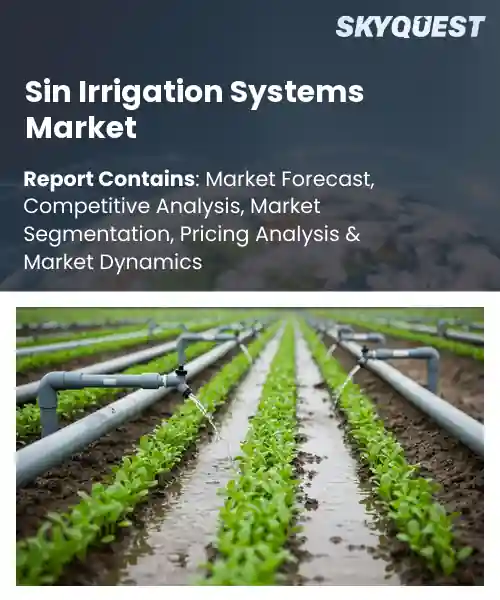
Sin Irrigation Systems Market
Report ID: SQMIG20H2088
Report ID: SQMIG20H2088
[email protected]
USA +1 351-333-4748
Report ID:
SQMIG20H2088 |
Region:
Global |
Published Date: March, 2026
Pages:
157
|Tables:
118
|Figures:
77


Global Sin Irrigation Systems Market size was valued at USD 9.0 Billion in 2024 and is poised to grow from USD 10.71 Billion in 2025 to USD 43.07 Billion by 2033, growing at a CAGR of 19.0% during the forecast period (2026-2033). The main reason for the development of the sin irrigation systems market is a lack of water and the need to increase crop production sustainably. Technological development in irrigation delivery systems that can deliver the correct amount of water to crops and landscapes allows farmers to produce food using a limited resource base, which is freshwater. With the global agricultural sector using the majority of the world's freshwater resources and with more than half of the world's agricultural product requiring this resource, improved irrigation systems.
The agricultural sector transitioned from traditional flood irrigation to pressurized sprinkler irrigation to drip and micro-irrigation for the efficient application of water to crops, with the introduction of sensors, controllers, and software used to schedule irrigation recently being introduced. For example, precision irrigation in California vineyards with Israeli drip innovations shows a good example of how the introduction of technologically driven products and policy incentives significantly affect the widespread adoption of irrigation technology for agricultural purposes.
One of the most important factors for the rapid growth of the sin irrigation systems market is digitalization through IoT sensors, connectivity, and data analytics allowing for precise and accurate irrigation management, resulting in quantifiable savings on water and improved crop yield. For example, when moisture sensors in the soil are connected to an automated controller and the controller receives real-time weather data, the irrigation schedule is based on plant needs and not on fixed schedules, resulting in reduced water usage.
How is IoT Enhancing Efficiency in the Sin Irrigation Systems Market?
The Internet of Things is changing irrigation systems. By connecting sensors with weather stations, automated valves, and cloud-based analytics, we can manage our water usage in much smarter ways. With real-time soil moisture data, automatic scheduling, predictive alerts for equipment, and using this data to create a "fertilizer" for plants. Currently, greater use of irrigation systems is noticeable based on demand rather than fixed systems. These demand-based systems require less water and are less expensive since no labor is involved.
Vendors that bundle soil sensors with drip or pivot irrigation systems or offer subscription-based analytics for these systems are well-positioned to take advantage of this trend in the market. Examples of recent usages include remotely controlling valves based on what the crop needs and monitoring irrigation based on sensor data to improve both the overall health of the crop and the reliability of the irrigation operation.
Market snapshot - (2026-2033)
Global Market Size
USD 9.0 Billion
Largest Segment
Controllers
Fastest Growth
Software & Cloud Management Platforms
Growth Rate
19.0% CAGR
To get more insights on this market click here to Request a Free Sample Report
Global sin irrigation systems market is segmented into system component, technology/connectivity, application vertical, operational scale and region. Based on system component, the market is segmented into controllers, soil moisture sensors, flow meters & rain sensors and software & cloud management platforms. Based on technology/connectivity, the market is segmented into wi-fi enabled systems, cellular/5G systems and bluetooth & LoRaWAN. Based on application vertical, the market is segmented into agricultural, commercial landscapes & parks, golf courses & sports turf and residential gardens. Based on operational scale, the market is segmented into large-scale integrated networks and small-scale individual units. Based on region, the market is segmented into North America, Europe, Asia Pacific, Latin America and Middle East & Africa.
The software & cloud management platforms segment is currently leading with large global sin irrigation systems market share because it provides centralized telemetry and control for all of your devices to create data driven schedules, monitor remotely. This centralization of telemetry and control provides an integration role that enables interoperability among controllers, sensors and field devices, thus simplifying the deployment and operation of these devices while also providing an ability to scale, remotely update, and make decisions.
As per global sin irrigation systems market outlook, while the software & cloud management platforms segment may be the current fastest growing segment, the soil moisture sensor segment is rapidly emerging as the fastest growing segment due to demand for accurate root zone information that can be used to make informed irrigation decisions and conserve water. Improvements in sensor accuracy, lower cost per unit, and ease of integration with field controllers are driving rapid adoption across a wide range of applications and creating new operational and commercial opportunities.
As per global sin irrigation systems market analysis, the cellular and 5g systems segment dominates the market due to their large area of network connection and reliability for business/corporate systems. The combination of remote telemetry in real-time, low-latency remote control, and secure data transfer between remote locations are provided by distributed assets for irrigation systems. The cellular and 5g systems segment is also able to use their high broadband capacity and quality of services to create advanced products such as video diagnostics, edge computing, firmware orchestration and other systems that help reduce the length of downtime for companies and simplify their day-to-day operations.
As per global sin irrigation systems market regional forecast, bluetooth & LoRaWAN are the fastest growing connectivity options due to low power consumption, long range and low operational cost that suit dense sensor and battery powered device deployments. The speed and ease with which bluetooth and LoRaWAN can set up networks and their connection to many different devices or products is creating quick and easy systems for companies using precision irrigation and is providing new business models based on information received from dispersed monitoring of the crops.
To get detailed segments analysis, Request a Free Sample Report
The Asia Pacific region has become a dominant region in the sin irrigation systems market due to increased demand for efficient use of water, concentrated manufacturing and rapid technology uptake across a wide variety of agricultural production systems. The engineering ecosystems within the area provide regional producers and solution providers with the ability to customize irrigation systems for different types of crops, and different climates. Public policy priorities such as water conservation and food security, to name a few, support the investment in precision irrigation systems, while the existence of dense supply chains and the competitive landscape of component manufacturing contribute to lowering the barriers to implementing precision irrigation systems.
Japan sin irrigation systems market is largely defined by advanced technology integration, reliability, and an emphasis on precision in protected cropping and specialty horticulture. Local manufacturers focus on the production of compact, automated systems that are designed with the constraints of minimal land area, and high labour expense. Strong relationships between research and industry foster a collaborative environment in which prototypes are developed, tested, and refined. Additionally, established distributor networks support the installation and maintenance of the irrigation systems developed by local manufacturers.
The South Korean sin irrigation systems market is being driven by the rapid adoption of smart farming practices, and there is a strong expertise in electronics within the region, allowing for a highly sophisticated integration of sensors and control systems for use in agriculture. Domestic companies have established a strong track record of success around automation, enabling them to provide "turnkey" solutions for both open field and controlled environment agricultural operations.
In North America, there is a combined push for sustainability; increased use of precision agriculture technologies, and commercial farmers wanting dependable yield sizes with less water consumption are all driving the growth of outdoor irrigation markets. Additionally, the availability of large advisory networks and multiple technology vendors integrating irrigation systems and providing remote management and data management have also contributed to the growth of the outdoor irrigation markets.
As per global sin irrigation systems market regional outlook, large corporations and honey/vegetable farms who want to use more efficient and data driven methods of irrigation scheduling, as well as farmers who want to integrate their irrigation with their farm operations through farm management software. End users can use a fully developed supply chain consisting of manufacturers, distributors, and consultants to assist them with irrigation systems through the design, installation, and ongoing optimization of the systems.
In Canada, the sin irrigation systems market has adopted new irrigation technologies with adaptations for different and remote climatic zones through greater durability of equipment in their cold winter climates. The Canada Sin irrigation systems market has incorporated irrigation system technologies into areas that have a high value for horticulture and specialty crops, as these crops are heavily influenced by water management for both their value and quality. In Canada, the outdoor irrigation systems market is supported by agricultural extension service providers and by the relationships between the suppliers and the end users. Innovations in outdoor irrigation systems that address the challenges and energy efficiency of irrigation systems in cold climates allow for effective management of seasonal variations and increase the stewardship of water for farming operations in Canada.
As per global sin irrigation systems market regional forecast, with an increased emphasis on sustainability, regulations, and new innovations in precision agriculture, European countries are positioning themselves more strongly in the market. One way this is accomplished is through the prioritizing of irrigation technologies that reduce the amount of water used by growing crops and that comply with stringent environmental regulations, yet do not affect the quality of the crops grown. Research collaboration between public and private sectors through pilot programmes are promoting technological innovations, which increase technology transfer and the cost-effective adaptation of farming systems to a wide variety of crops. European manufacturers are developing modular, interoperable systems that work with data management systems on farms, as well as renewable energy sources. The strong distribution and support networks, and knowledge sharing among farmer co-operatives enable the rapid penetration of the market for irrigation systems and the adoption of best practices for proper management of water across Europe.
As per global sin irrigation systems industry analysis, Germany market focuses on engineering excellence, reliability, and integration of sin irrigation systems with larger automation systems in open-field agriculture and controlled environment agriculture. Durable components and precision control of system components are the focus for manufacturers in sinirrigation systems to ensure compliance with strict environmental and performance specifications. In addition to professional installation and maintenance networks support of professions through research institutions invested in sin irrigation systems will result in sustained incremental improvement, providing a definite advantage for cooling greenhouses and growing other high-value specialty crops.
The UK is seeing strong demand from active agriculturists for controlled-environment agriculture and responsible use of water resources through the installation of sin irrigation systems. The installation of a sin Irrigation System often occurs in conjunction with an advisory or consulting service to ensure efficiency is maximized when planting crops in an urban setting, or within a greenhouse. Most notably, the UK sin irrigation systems market is aided by technological innovations that retrofit existing irrigation systems and provide growers with a precision nutrient delivery system, enabling them to attain consistent yields and optimize their water usage regardless of the changing weather conditions.
In France, the sin irrigation systems market is characterized by customized water management solutions that support grape/vineyards and other agricultural enterprises that utilizewater in managing their crops/cultivation. Sin Irrigation provides vineyards and other agricultural enterprises with customized solutions for managing their water use. The United Kingdom is also experiencing growing levels of collaboration among agricultural cooperatives, research institutions, and technology providers, resulting in the development of innovative technology to help address specific water management challenges within certain jurisdictions and/or types of crops. To encourage the adoption of sustainable technologies, growers have access to retrofitting options and service support that allow them to enhance crop quality and production levels, while also meeting the needs of consumers in high-value agricultural segments.
To know more about the market opportunities by region and country, click here to
Buy The Complete Report
Rising Water Scarcity and Efficiency
Governments at all levels as well as utilities and end users are all looking to adopt technologies that will help them conserve and use less water while also generating higher yields. As a result, the continuing demand for precision irrigation is likely to remain strong. Additionally, as both surface and groundwater supplies become increasingly challenged in terms of reliability, farmers and growers will turn to precision irrigation systems to provide more targeted and efficient distribution of water through their field operations and to minimize potential water loss. As a result, many farmers and landscapers are adopting precision irrigation systems due to the perceived operational value, lower long-term consumption of available water, and alignment with sustainability goals. Thus, creating sin irrigation systems market growth, which in turn is encouraging suppliers to invest in the development of tailored products and services.
Innovation Associated with Smart Irrigation
The combination of sensors and connectivity, combined with the use of data analytics, has resulted in an increase in operational efficiencies, increased ease of use, and increased attractiveness of smart irrigation systems to both commercial and agricultural customers. The use of automatic irrigation schedules, coupled with the availability of real-time irrigation system monitoring has also resulted in reduced reliance on manual oversight, thus reducing perceived risk for potential customers and enhancing the level of predictability associated with irrigation irrigation costs. The increased level of intelligence associated with smart irrigation systems will lead to the development of differentiating service offerings, including generating recurring revenue streams for manufacturers, and ultimately drive additional product development and increased market growth.
High Initial Capital Requirements
High initial expenses associated with purchasing, preparing a site, and hiring qualified personnel make it difficult for many smaller operators to enter this industry. This effectively limits the supplier’s potential customer base. When the budget is focused on short-term expenditures, decision-makers may decide to delay purchasing a sin irrigation system, which will impair the long-term advantages of having one. In addition to the specialized equipment that may need repair or maintenance, these components increase the perceived total cost of finding one, making it more difficult for many price-sensitive customers.
Infrastructure and Technical Skills
Limited availability of trained technicians to support manufacturers, and insufficient local service networks, has caused uncertainty about the reliability of installing, regulating, and maintaining sin irrigation systems. Without developing this capability and confidence, systems will not perform over a long period of time. When technical capacity levels are low, there is more frequent versus less frequent time that systems are out of service, or not operated properly, creating perceptions of higher risk to operational viability for research and commercial stakeholders and promoting the use of less complicated traditional methods. System design complexity related to compatibility with farming practices and unpredictable availability of spare parts compound this problem and restrict market growth.
Request Free Customization of this report to help us to meet your business objectives.
The competitive dynamics of the global irrigation systems industry are focused on technologically based differentiation, partnerships for distribution, and targeted merger and acquisition activity as both incumbents and new entrants rush to develop and commercialize precision watering solutions. Specific examples of this dynamic include the plant-sensing entrants attracting co-branding and funding partners for scaling purposes; NEC X making investments in retrofit automation start-ups; and the CES launch of AI-based irrigation systems putting pressure on established suppliers to speed up their integration and commercial partnership efforts.
Sustainable Water Management: Increased regulatory scrutiny places growing focus on resource efficiency and corporate sustainability. Water reuse, adaptive scheduling and renewable energy integration are now increasingly important considerations for sin irrigation solution providers. Customers prefer systems that can minimize their waste to grow crops that are resilient and dependable. Manufacturers are developing unique solutions through lifecycle services, environmental specialist partnerships, and modular platforms for scalable deployments. The primary demand drivers for investing in technologies that align operational performance with greater commitments to protecting the environment and meeting stakeholder expectations are brand reputational benefits and systems resilience in the supply chain.
Integration with Precision Agriculture: The integration of precision agriculture workflows through advanced sensing technologies and decision support is creating opportunities for sin irrigation systems to integrate into precision agriculture workflows so that they can provide accurate water application with appropriate agronomic information. To this end, growers are interested in having interoperable controllers and data service providers translate soil moisture and crop stage information into scheduling and variable application rates. In order to meet this requirement, sin irrigation providers are deploying open APIs, regional vendor partnerships and advisory services that will facilitate the adoption of sin irrigation in the field. The global sin irrigation systems market trend is being driven by the need to create value through yield quality improvements, input cost reductions and sustainability initiatives, which creates opportunities for service-based revenue and customer relationship-building opportunities.
SkyQuest’s ABIRAW (Advanced Business Intelligence, Research & Analysis Wing) is our Business Information Services team that Collects, Collates, Correlates, and Analyses the Data collected by means of Primary Exploratory Research backed by robust Secondary Desk research.
As per SkyQuest analysis, the global sin irrigation systems market is poised for rapid growth driven by rising water scarcity and the need to raise agricultural productivity, which is the primary driver behind adoption. Digitalization and IoT-enabled analytics act as second drivers by enabling precise, automated irrigation and service-based models. High initial capital requirements remain a key restraint, limiting uptake among smallholders and budget-constrained operators. Asia Pacific currently dominates the market due to manufacturing depth, policy support, and large-scale demand for efficient water use. Software and cloud management platforms are the dominating segment by centralizing device data, control and analytics, simplifying deployments and unlocking scalable efficiency gains across applications.
| Report Metric | Details |
|---|---|
| Market size value in 2024 | USD 9.0 Billion |
| Market size value in 2033 | USD 43.07 Billion |
| Growth Rate | 19.0% |
| Base year | 2024 |
| Forecast period | (2026-2033) |
| Forecast Unit (Value) | USD Billion |
| Segments covered |
|
| Regions covered | North America (US, Canada), Europe (Germany, France, United Kingdom, Italy, Spain, Rest of Europe), Asia Pacific (China, India, Japan, Rest of Asia-Pacific), Latin America (Brazil, Rest of Latin America), Middle East & Africa (South Africa, GCC Countries, Rest of MEA) |
| Companies covered |
|
| Customization scope | Free report customization with purchase. Customization includes:-
|
To get a free trial access to our platform which is a one stop solution for all your data requirements for quicker decision making. This platform allows you to compare markets, competitors who are prominent in the market, and mega trends that are influencing the dynamics in the market. Also, get access to detailed SkyQuest exclusive matrix.
Table Of Content
Executive Summary
Market overview
Parent Market Analysis
Market overview
Market size
KEY MARKET INSIGHTS
COVID IMPACT
MARKET DYNAMICS & OUTLOOK
Market Size by Region
KEY COMPANY PROFILES
Methodology
For the Sin Irrigation Systems Market, our research methodology involved a mixture of primary and secondary data sources. Key steps involved in the research process are listed below:
1. Information Procurement: This stage involved the procurement of Market data or related information via primary and secondary sources. The various secondary sources used included various company websites, annual reports, trade databases, and paid databases such as Hoover's, Bloomberg Business, Factiva, and Avention. Our team did 45 primary interactions Globally which included several stakeholders such as manufacturers, customers, key opinion leaders, etc. Overall, information procurement was one of the most extensive stages in our research process.
2. Information Analysis: This step involved triangulation of data through bottom-up and top-down approaches to estimate and validate the total size and future estimate of the Sin Irrigation Systems Market.
3. Report Formulation: The final step entailed the placement of data points in appropriate Market spaces in an attempt to deduce viable conclusions.
4. Validation & Publishing: Validation is the most important step in the process. Validation & re-validation via an intricately designed process helped us finalize data points to be used for final calculations. The final Market estimates and forecasts were then aligned and sent to our panel of industry experts for validation of data. Once the validation was done the report was sent to our Quality Assurance team to ensure adherence to style guides, consistency & design.
Analyst Support
Customization Options
With the given market data, our dedicated team of analysts can offer you the following customization options are available for the Sin Irrigation Systems Market:
Product Analysis: Product matrix, which offers a detailed comparison of the product portfolio of companies.
Regional Analysis: Further analysis of the Sin Irrigation Systems Market for additional countries.
Competitive Analysis: Detailed analysis and profiling of additional Market players & comparative analysis of competitive products.
Go to Market Strategy: Find the high-growth channels to invest your marketing efforts and increase your customer base.
Innovation Mapping: Identify racial solutions and innovation, connected to deep ecosystems of innovators, start-ups, academics, and strategic partners.
Category Intelligence: Customized intelligence that is relevant to their supply Markets will enable them to make smarter sourcing decisions and improve their category management.
Public Company Transcript Analysis: To improve the investment performance by generating new alpha and making better-informed decisions.
Social Media Listening: To analyze the conversations and trends happening not just around your brand, but around your industry as a whole, and use those insights to make better Marketing decisions.
REQUEST FOR SAMPLE
 REQUEST FREE CUSTOMIZATION
Global Sin Irrigation Systems Market size was valued at USD 9.0 Billion in 2024 and is poised to grow from USD 10.71 Billion in 2025 to USD 43.07 Billion by 2033, growing at a CAGR of 19.0% during the forecast period (2026-2033).
Competitive dynamics in the global irrigation systems market center on technology led differentiation, partnership driven distribution, and targeted M&A as incumbents and newcomers race to commercialize precision water management. Examples include plant sensing entrants securing cobranding and funding to scale, NEC X investing in retrofit automation startups, and CES product launches demonstrating AI driven irrigation platforms that pressure legacy suppliers to accelerate integrations and commercial partnerships. 'Jain Irrigation Systems', 'Netafim', 'Rivulis Irrigation', 'The Toro Company', 'Valmont Industries', 'Lindsay Corporation', 'Rain Bird Corporation', 'Nelson Irrigation', 'T-L Irrigation', 'Reinke Manufacturing', 'Irritec S.p.A.', 'Hunter Industries', 'Ewing Irrigation', 'Chinadrip Irrigation', 'Antelco', 'Galcon', 'DIG Corporation', 'NaanDanJain', 'Mazzei Injector', 'Senninger Irrigation'
Governments, utilities, and end users are prioritizing technologies that reduce water use and improve crop yields, creating sustained demand for precision irrigation systems. As surface and groundwater supplies become less reliable, field operators seek solutions that enable targeted water delivery and minimize losses, which elevates interest in sin irrigation systems. The perceived operational value, lower long-term water consumption, and alignment with sustainability goals encourage adoption by farmers and landscapers, thereby expanding market opportunities and stimulating supplier investment in tailored products and services.
Sustainable Water Management: Growing regulatory emphasis on resource efficiency and corporate sustainability is steering sin irrigation solution providers toward water reuse, adaptive scheduling and renewable energy integration. Customers prioritize systems that minimize waste while ensuring crop resilience and reliability. Vendors distinguish offerings through lifecycle services, partnerships with environmental specialists and modular platforms that support scalable deployment. Demand drivers include brand reputational benefits and supply chain resilience considerations, strategically prompting investments in technology that align operational performance with broader environmental commitments and stakeholder expectations.
Why does Asia Pacific Dominate the Global Sin Irrigation Systems Market? |@12


Want to customize this report? This report can be personalized according to your needs. Our analysts and industry experts will work directly with you to understand your requirements and provide you with customized data in a short amount of time. We offer $1000 worth of FREE customization at the time of purchase.
Feedback From Our Clients


 USA (+1) 351-333-4748

