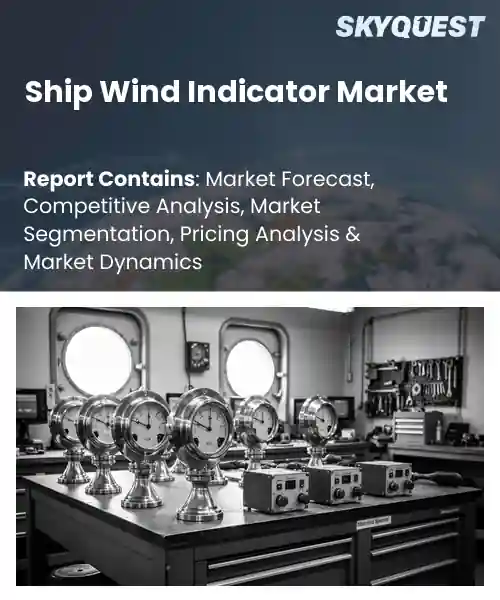
Ship Wind Indicator Market
Report ID: SQMIG20T2059
Report ID: SQMIG20T2059
[email protected]
USA +1 351-333-4748
Report ID:
SQMIG20T2059 |
Region:
Global |
Published Date: July, 2026
Pages:
157
|Tables:
143
|Figures:
78


Global Ship Wind Indicator Market size was valued at USD 142.9 Million in 2024 and is poised to grow from USD 150.05 Million in 2025 to USD 221.68 Million by 2033, growing at a CAGR of 5.0% during the forecast period (2026-2033).
The global ship wind indicator market comprises sensors and display systems that measure apparent wind speed and direction to support navigation, safety, and fuel‑efficiency decisions on commercial vessels. Its importance has risen because international regulations such as IMO’s 2020 sulfur cap and the Energy Efficiency Design Index demand wind data to optimize routes and reduce emissions.
The principal growth catalyst now lies in digital integration of wind indicators with vessel‑wide data ecosystems, because data flow enables predictive routing and fuel‑saving algorithms that directly impact operating margins. When a ship’s bridge system receives wind vectors alongside AIS and weather forecasts, onboard software can adjust sail‑assisted propulsion or engine load in time, delivering measurable cost reductions; a case study showed a bulk carrier reducing fuel consumption by 4 % after installing an IoT‑enabled wind suite. This cause‑and‑effect chain fuels investment in ultrasonic sensors, analytics platforms, and service contracts that together expand market opportunities across container, tanker, and hybrid fleets.
How is IoT integration improving accuracy and maintenance of ship wind indicator systems?
IoT integration is reshaping ship wind indicator systems by linking sensors directly to cloud platforms, which enables continuous calibration and instant anomaly detection. Real‑time data streams allow algorithms to filter out gust noise and correct drift, delivering far more reliable wind direction and speed readings for navigation and fuel‑efficiency decisions. Maintenance crews benefit from predictive alerts that flag sensor wear before failure, turning costly unscheduled repairs into scheduled servicing. The broader market is seeing a shift toward retrofit kits that can be installed on existing vessels, expanding the pool of ships that can adopt these smart solutions without a full redesign. This convergence of connectivity and analytics is driving operators to prioritize IoT‑enabled indicators as a cornerstone of modern fleet management.
International Windship Association in January 2026, released new IoT‑linked wind indicator guidelines that demonstrate how continuous data feeds cut manual checks and support predictive maintenance, reinforcing market growth.
Market snapshot - (2026-2033)
Global Market Size
USD 142.9 Million
Largest Segment
Mechanical Wind Indicators
Fastest Growth
Electronic Wind Indicators
Growth Rate
5.0% CAGR
To get more insights on this market click here to Request a Free Sample Report
Global ship wind indicator market is segmented by product type, display type, application, vessel type, end user and region. Based on product type, the market is segmented into Mechanical Wind Indicators and Electronic Wind Indicators. Based on display type, the market is segmented into Analog and Digital. Based on application, the market is segmented into Navigation, Weather Monitoring and Sailing Performance. Based on vessel type, the market is segmented into Commercial Ships, Naval Vessels, Fishing Vessels and Recreational Boats & Yachts. Based on end user, the market is segmented into Commercial Operators, Defense and Individual Boat Owners. Based on region, the market is segmented into North America, Europe, Asia Pacific, Latin America and Middle East & Africa.
Mechanical wind indicators segment dominates with large ship wind indicator market share because their rugged construction and low maintenance meet the stringent reliability standards of commercial ship operations. Operators value the proven durability under harsh marine conditions, and the simplicity of calibration reduces downtime, ensuring continuous wind monitoring essential for navigation and cargo safety. This trust in mechanical solutions drives widespread adoption across fleets. Consequently fleet managers prioritize mechanical units when budgeting for long term asset performance.
As per ship wind indicator market outlook, electronic wind indicators segment is witnessing the strongest growth momentum as digital integration enables real time data sharing with bridge systems, enhancing situational awareness. The rise of automated navigation and predictive maintenance fuels demand for smart sensors, and continuous software upgrades expand functionality, creating new revenue streams for manufacturers.
Commercial ships segment dominates because large scale operators require robust wind monitoring to ensure safe navigation across long voyages and complex port approaches. Their regulatory compliance obligations and the need for integrated weather data drive the adoption of high capacity indicators that can withstand continuous operation. Fleet economies of scale also favor standardized equipment, reinforcing the prevalence of commercial grade solutions throughout the maritime sector. and they prioritize durability low lifecycle costs and seamless system integration.
Meanwhile, recreational boats & yachts segment emerges as the key high growth area as owners seek sleek digital wind displays that complement premium cockpit designs. The surge in pleasure cruising and competitive sailing fuels investment in customizable interfaces, while wireless connectivity and smartphone integration attract tech savvy buyers, expanding market reach and prompting innovation.
To get detailed segments analysis, Request a Free Sample Report
Asia Pacific shows a confluence of robust shipbuilding capacity, advanced marine engineering expertise, and extensive coastal trade networks that collectively reinforce its leadership. Regional shipyards integrate cutting‑edge wind assistance technologies early in vessel design, driven by supportive regulatory frameworks and proactive sustainability initiatives. Collaborative ecosystems linking equipment manufacturers, research institutions, and maritime operators accelerate innovation cycles and facilitate rapid adoption. Moreover, the strategic importance of key shipping lanes fuels continuous demand for efficiency‑enhancing solutions, positioning the region as a benchmark for operational excellence and technology diffusion in the maritime sector.
As per ship wind indicator market regional outlook, Japan benefits from a deep tradition of precision engineering and a proactive stance on emission reduction. Domestic shipyards prioritize retrofits that incorporate wind assistance, leveraging strong supplier networks and government incentives that encourage greener propulsion alternatives. Collaboration between maritime academies and technology firms cultivates a pipeline of tailored solutions that align with the operational profiles of regional carriers, reinforcing Japan’s role as a pioneer in sustainable shipping practices.
As per ship wind indicator market regional forecast, South Korea is propelled by a dynamic shipbuilding sector that embraces innovative propulsion concepts as a core differentiator. National maritime policies emphasize energy efficiency, prompting shipowners to explore wind‑derived power as a cost‑effective complement to conventional engines. Partnerships between leading shipyards and specialized equipment providers accelerate the integration of wind platforms on new builds and existing vessels, reinforcing South Korea’s reputation for advancing maritime sustainability through technology adoption.
Europe’s expansion is underpinned by rigorous environmental standards, progressive port initiatives, and a concentration of engineering excellence that together create fertile ground for wind‑assisted propulsion. Policy frameworks across the bloc incentivize the reduction of carbon footprints, prompting shipowners to seek innovative solutions that align with regulatory expectations. Ports equipped with modern infrastructure support the testing and deployment of wind technologies, while research clusters in key maritime nations foster continuous improvement. This harmonious blend of regulation, infrastructure, and innovation accelerates market momentum and positions Europe at the forefront of green maritime transformation.
Germany is shaped by a strong industrial base and a heritage of precision manufacturing that drives the development of high‑performance wind assistance systems. Leading shipyards integrate these solutions early in the design phase, supported by collaborative research programs that refine aerodynamic efficiency. The alignment of engineering expertise with sustainability goals ensures that German vessels adopt wind technologies as a cornerstone of their performance strategy, reinforcing the nation’s dominant market presence.
United Kingdom experiences rapid growth fueled by targeted policy incentives and a vibrant offshore wind sector that creates synergies with maritime propulsion. Shipowners are increasingly motivated to adopt wind‑derived power to meet stringent emission targets, while academic institutions and technology firms advance practical solutions for diverse vessel types. This dynamic environment propels the United Kingdom to the forefront of market expansion, reflecting its status as a leading growth engine within the European landscape.
France is emerging as a focal point for innovative maritime sustainability initiatives. Collaborative efforts between French research laboratories and specialized manufacturers generate bespoke wind assistance concepts suited to the nation’s mixed fleet. Governmental emphasis on green shipping fuels interest among ship operators seeking to enhance fuel efficiency without compromising operational flexibility. These emerging activities position France as an increasingly influential participant in the broader European market evolution.
North America advances its position through a combination of expansive commercial fleets, a focus on safety and efficiency, and proactive governmental programs that endorse clean propulsion alternatives. Industry stakeholders prioritize the integration of wind‑assisted technologies as a means to lower operating costs while meeting evolving environmental expectations. Strategic partnerships between vessel operators, technology developers, and coastal ports facilitate the deployment of wind solutions across diverse maritime routes. This collaborative, innovation‑driven approach reinforces North America’s role as a key contributor to the global shift toward sustainable shipping practices.
United States benefits from a large commercial fleet that actively seeks efficiency‑enhancing measures. Industry alliances promote the adoption of wind assistance on both new builds and retrofitted vessels, supported by federal initiatives encouraging greener maritime operations. Integration of wind technologies aligns with broader objectives to reduce fuel consumption, positioning the United States as a significant driver of market adoption across the continent.
Canada is shaped by a growing emphasis on sustainable navigation, particularly in the context of emerging Arctic trade routes. Collaborative research programs involving governmental agencies and maritime innovators focus on adapting wind assistance to harsh operating conditions. The commitment to environmentally responsible shipping strengthens Canada’s contribution to the regional market, highlighting its role in expanding the application of wind‑derived propulsion solutions.
To know more about the market opportunities by region and country, click here to
Buy The Complete Report
Increasing Adoption of Wind Assist
Regulatory Push Towards Emission Reductions
High Initial Installation Costs
Complex Integration With Existing Systems
Request Free Customization of this report to help us to meet your business objectives.
The competitive landscape of the global ship wind indicator industry is shaped by a handful of agile maritime‑tech firms leveraging strategic partnerships, technology integration, and targeted acquisitions to expand sensor coverage and data analytics capabilities, while established vessel manufacturers incorporate advanced wind‑measurement modules to differentiate new builds and retrofits, intensifying rivalry over high‑value contracts with shipping lines and offshore operators.
SkyQuest’s ABIRAW (Advanced Business Intelligence, Research & Analysis Wing) is our Business Information Services team that Collects, Collates, Correlates, and Analyses the Data collected by means of Primary Exploratory Research backed by robust Secondary Desk research.
As per SkyQuest analysis the global ship wind indicator market growth is being propelled primarily by the rising adoption of wind‑assist technologies, which give operators measurable fuel savings and help meet sustainability goals, while a second strong catalyst is the tightening of international emission regulations that demand precise wind data for optimal routing. The market’s growth is tempered by high initial installation costs that discourage smaller fleets from investing in the advanced systems. Asia Pacific dominates the landscape, driven by its massive shipbuilding capacity and early integration of smart wind solutions. Within product categories the mechanical wind indicator segment remains the leader because of its proven durability and low‑maintenance profile, underpinning widespread use across commercial vessels. The global ship wind indicator market trend is due to increasing maritime trade, rising focus on navigation safety, and the growing adoption of advanced marine electronics.
| Report Metric | Details |
|---|---|
| Market size value in 2024 | USD 142.9 Million |
| Market size value in 2033 | USD 221.68 Million |
| Growth Rate | 5.0% |
| Base year | 2024 |
| Forecast period | (2026-2033) |
| Forecast Unit (Value) | USD Million |
| Segments covered |
|
| Regions covered | North America (US, Canada), Europe (Germany, France, United Kingdom, Italy, Spain, Rest of Europe), Asia Pacific (China, India, Japan, Rest of Asia-Pacific), Latin America (Brazil, Rest of Latin America), Middle East & Africa (South Africa, GCC Countries, Rest of MEA) |
| Companies covered |
|
| Customization scope | Free report customization with purchase. Customization includes:-
|
To get a free trial access to our platform which is a one stop solution for all your data requirements for quicker decision making. This platform allows you to compare markets, competitors who are prominent in the market, and mega trends that are influencing the dynamics in the market. Also, get access to detailed SkyQuest exclusive matrix.
Table Of Content
Executive Summary
Market overview
Parent Market Analysis
Market overview
Market size
KEY MARKET INSIGHTS
COVID IMPACT
MARKET DYNAMICS & OUTLOOK
Market Size by Region
KEY COMPANY PROFILES
Methodology
For the Ship Wind Indicator Market, our research methodology involved a mixture of primary and secondary data sources. Key steps involved in the research process are listed below:
1. Information Procurement: This stage involved the procurement of Market data or related information via primary and secondary sources. The various secondary sources used included various company websites, annual reports, trade databases, and paid databases such as Hoover's, Bloomberg Business, Factiva, and Avention. Our team did 45 primary interactions Globally which included several stakeholders such as manufacturers, customers, key opinion leaders, etc. Overall, information procurement was one of the most extensive stages in our research process.
2. Information Analysis: This step involved triangulation of data through bottom-up and top-down approaches to estimate and validate the total size and future estimate of the Ship Wind Indicator Market.
3. Report Formulation: The final step entailed the placement of data points in appropriate Market spaces in an attempt to deduce viable conclusions.
4. Validation & Publishing: Validation is the most important step in the process. Validation & re-validation via an intricately designed process helped us finalize data points to be used for final calculations. The final Market estimates and forecasts were then aligned and sent to our panel of industry experts for validation of data. Once the validation was done the report was sent to our Quality Assurance team to ensure adherence to style guides, consistency & design.
Analyst Support
Customization Options
With the given market data, our dedicated team of analysts can offer you the following customization options are available for the Ship Wind Indicator Market:
Product Analysis: Product matrix, which offers a detailed comparison of the product portfolio of companies.
Regional Analysis: Further analysis of the Ship Wind Indicator Market for additional countries.
Competitive Analysis: Detailed analysis and profiling of additional Market players & comparative analysis of competitive products.
Go to Market Strategy: Find the high-growth channels to invest your marketing efforts and increase your customer base.
Innovation Mapping: Identify racial solutions and innovation, connected to deep ecosystems of innovators, start-ups, academics, and strategic partners.
Category Intelligence: Customized intelligence that is relevant to their supply Markets will enable them to make smarter sourcing decisions and improve their category management.
Public Company Transcript Analysis: To improve the investment performance by generating new alpha and making better-informed decisions.
Social Media Listening: To analyze the conversations and trends happening not just around your brand, but around your industry as a whole, and use those insights to make better Marketing decisions.
REQUEST FOR SAMPLE
 REQUEST FREE CUSTOMIZATION
Global Ship Wind Indicator Market size was valued at USD 142.9 Million in 2024 and is poised to grow from USD 150.05 Million in 2025 to USD 221.68 Million by 2033, growing at a CAGR of 5.0% during the forecast period (2026-2033).
The competitive landscape of the global ship wind indicator market is shaped by a handful of agile maritime‑tech firms leveraging strategic partnerships, technology integration, and targeted acquisitions to expand sensor coverage and data analytics capabilities, while established vessel manufacturers incorporate advanced wind‑measurement modules to differentiate new builds and retrofits, intensifying rivalry over high‑value contracts with shipping lines and offshore operators. 'Vaisala Oyj', 'Gill Instruments Limited', 'Garmin Ltd.', 'Furuno Electric Co., Ltd.', 'Kongsberg Gruppen ASA', 'Raymarine plc', 'NKE Marine Electronics SAS', 'Maretron LLP', 'Airmar Technology Corporation', 'B&G (Navico Group)', 'Japan Radio Co., Ltd.', 'Tokyo Keiki Inc.', 'YDK Technologies Co., Ltd.', 'Wuhan Marine Machinery Plant Co., Ltd.', 'Consilium AB', 'L3Harris Technologies, Inc.', 'Teledyne Technologies Incorporated', 'Bosch Sensortec GmbH', 'Nanjing Ninglu Technology Co., Ltd.', 'Simrad (Navico Group)'
The maritime sector is increasingly adopting wind assist technologies as operators seek to lower fuel consumption and comply with sustainability objectives. By integrating wind-driven propulsion, vessels can achieve significant reductions in operational expenses while enhancing environmental performance. This adoption is driven by heightened awareness of climate impact, corporate responsibility commitments, and the pursuit of long‑term cost efficiencies. As shipowners recognize the strategic advantage of wind assistance, demand for reliable indicators that provide real‑time wind data and directional information is expanding, thereby propelling market growth.
Hybrid Energy Integration: Ship operators are increasingly pairing wind‑driven propulsion with onboard solar arrays and advanced energy‑storage solutions, creating hybrid power architectures that extend fuel savings beyond what wind alone can deliver. This convergence enables vessels to maintain optimal speed in variable wind conditions while reducing reliance on diesel generators during calm periods, enhancing operational flexibility and aligning with sustainability commitments. The holistic approach is fostering collaborative design efforts between turbine manufacturers, shipyards, and maritime technology firms, and industry regulators.
Why does Asia Pacific Dominate the Global Ship Wind Indicator Market? |@12


Want to customize this report? This report can be personalized according to your needs. Our analysts and industry experts will work directly with you to understand your requirements and provide you with customized data in a short amount of time. We offer $1000 worth of FREE customization at the time of purchase.
Feedback From Our Clients


 USA (+1) 351-333-4748

