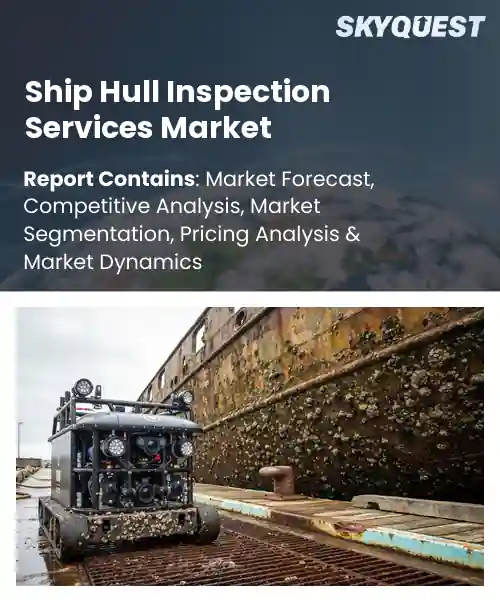
Ship Hull Inspection Services Market
Report ID: SQMIG20T2045
Report ID: SQMIG20T2045
[email protected]
USA +1 351-333-4748
Report ID:
SQMIG20T2045 |
Region:
Global |
Published Date: June, 2026
Pages:
157
|Tables:
117
|Figures:
77


Global Ship Hull Inspection Services Market size was valued at USD 1.52 Billion in 2024 and is poised to grow from USD 1.65 Billion in 2025 to USD 3.22 Billion by 2033, growing at a CAGR of 8.72% during the forecast period (2026-2033).
Regulatory harmonization across maritime jurisdictions emerges as the catalyst driving market expansion because unified standards compel ship owners to schedule hull assessments to satisfy classification societies and port state control authorities. This dynamic creates opportunities for service providers to offer platforms that ultrasonic data, corrosion mapping, and compliance certificates, enabling faster clearance at terminals such as Singapore and Rotterdam.
For example, a leading inspection firm partnered with a Chinese shipbuilder to embed monitoring sensors on container vessels, reducing survey turnaround from ten days to four and lowering detention costs. The cause‑effect chain oversight prompting technology adoption boosts revenue while enhancing fleet safety.
How is AI-driven automation reshaping the ship hull inspection services market?
AI-driven automation is streamlining ship hull inspections by integrating computer‑vision, machine learning and cloud‑based analytics into traditional non‑destructive testing. Sensors mounted on autonomous surface vehicles capture high‑resolution imagery, while AI algorithms instantly detect corrosion, cracks and coating defects. This reduces the need for divers, shortens survey windows and improves safety. Real‑time condition tracking platforms aggregate data from multiple vessels, enabling operators to schedule maintenance proactively and comply with tightening regulations. The technology also supports predictive maintenance models that anticipate hull degradation before it becomes critical, making inspections more cost‑effective and reliable across the global fleet.
Maritime and Port Authority of Singapore in November 2025, launched an in‑water hull inspection and cleaning innovation program that leverages AI‑powered drones to automate defect detection, accelerating survey cycles and boosting overall market efficiency.
Market snapshot - (2026-2033)
Global Market Size
USD 1.52 Billion
Largest Segment
Drydock Inspection
Fastest Growth
ROV-Based Inspection
Growth Rate
8.72% CAGR
To get more insights on this market click here to Request a Free Sample Report
Global ship hull inspection services market is segmented by service type, technology, application, end-user and region. Based on service type, the market is segmented into Underwater Hull Inspection (UWILD), Drydock Inspection, ROV-Based Inspection and Diver-Based Inspection. Based on technology, the market is segmented into ROV (Remotely Operated Vehicle), AUV (Autonomous Underwater Vehicle) and Diver Inspection. Based on application, the market is segmented into Class Surveys, Biofouling Inspection and Damage Assessment. Based on end-user, the market is segmented into Shipping Companies and Classification Societies. Based on region, the market is segmented into North America, Europe, Asia Pacific, Latin America and Middle East & Africa.
ROV segment dominates with large ship hull inspection services market share because it provides operators with real time visual feedback while eliminating the safety risks associated with human divers. The ability to maneuver precisely in confined hull spaces allows comprehensive defect detection, which meets the stringent requirements of ship owners and classification societies. Its proven reliability and compatibility with existing data management platforms reinforce its preferred status, fostering widespread adoption for maritime operators and encouraging best practices across inspection contracts.
As per ship hull inspection services market outlook, AUV segment emerges as the most rapidly expanding area because autonomous platforms can conduct surveys without tether constraints, reducing vessel downtime. Advances in battery endurance and AI driven imaging enable deeper, longer missions, attracting owners seeking cost effective, resolution data. This momentum is opening service contracts and stimulating innovation.
As per ship hull inspection services market forecast, class surveys segment dominates because it fulfills mandatory regulatory requirements that dictate vessel fitness and insurance eligibility. Inspection providers align their methodologies with classification society rules, ensuring consistent reporting and certification that ship owners rely upon for port entry and charter agreements. The inherent trust in these standardized assessments drives steady demand, positioning class surveys as the core revenue generator within the hull inspection market globally throughout the industry.
As per ship hull inspection services market analysis, biofouling inspection segment is witnessing the strongest growth momentum because regulations and fuel efficiency initiatives compel operators to monitor and mitigate fouling buildup. Technological advances in non intrusive sensors and predictive cleaning schedules are lowering service costs, encouraging broader adoption across fleets and creating revenue streams for inspection firms.
To get detailed segments analysis, Request a Free Sample Report
The region benefits from a convergence of dense maritime traffic, world‑class shipbuilding capabilities, and rigorous regulatory frameworks that prioritize structural integrity. Close collaboration between shipyards, classification societies, and governmental agencies creates a seamless inspection ecosystem. Investment in sophisticated nondestructive testing technologies and real‑time monitoring platforms enhances reliability, while a highly skilled technical workforce supports complex evaluation tasks. Moreover, strategic port clusters and integrated logistics networks streamline the movement of vessels to inspection facilities, reinforcing the region’s position as a hub for comprehensive hull assessment services.
As per ship hull inspection services market regional outlook, Japan thrives on the legacy of precision engineering and a strong safety culture that permeates its extensive commercial fleet. Advanced sensor technologies and automated inspection protocols are widely adopted, driven by close alignment with national maritime authorities. The proximity of leading shipyards to major ports facilitates rapid deployment of inspection teams, ensuring minimal downtime for vessels and reinforcing confidence among global stakeholders.
As per ship hull inspection services market regional forecast, South Korea is propelled by a dynamic shipbuilding sector that emphasizes cutting‑edge hull design and rigorous quality control. Collaborative frameworks between industry players and regulatory bodies foster continuous improvement in inspection standards. Emphasis on digital twin modeling and remote inspection capabilities allows for proactive maintenance, reducing the likelihood of structural failures and supporting the region’s reputation for high‑performance maritime assets.
Europe’s expansion is underpinned by stringent environmental and safety directives that demand meticulous hull condition monitoring. Established classification societies provide a robust governance layer, encouraging the adoption of advanced diagnostic tools and data‑driven inspection regimes. Substantial investment in digitalization accelerates the transition toward predictive maintenance, while the diversification of vessel types, including offshore wind support and cruise ships, broadens service requirements. Collaborative research initiatives across the continent further innovate inspection methodologies, reinforcing Europe’s leadership in high‑quality hull assessment.
As per ship hull inspection services industry analysis, Germany leverages a strong engineering tradition and a dense network of specialized shipyards. Integration of precision instrumentation with automated workflow systems enables thorough and efficient hull evaluations. Close cooperation with regulatory agencies ensures that inspection practices align with the highest safety benchmarks, reinforcing confidence among domestic and international operators.
United Kingdom benefits from its status as a global maritime finance hub and a gateway to major shipping lanes. Leading ports host sophisticated inspection facilities that incorporate cutting‑edge imaging and acoustic analysis techniques. Ongoing regulatory reforms drive continuous improvement, while partnerships with academic institutions nurture talent and foster innovation in hull assessment practices.
France is emerging through modernization of its fleet and heightened awareness of structural integrity requirements. Investment in portable inspection equipment and training programs expands service accessibility across a variety of vessel categories. Collaborative efforts with European regulatory bodies promote harmonized standards, positioning France as a growing contributor to the continent’s inspection landscape.
North America advances its role by coupling a substantial domestic fleet with progressive regulatory oversight that emphasizes preventive hull health management. Strategic maritime corridors and extensive coastal infrastructure facilitate swift access to inspection hubs. Integration of artificial intelligence and remote monitoring enhances detection of early‑stage deterioration, supporting cost‑effective maintenance strategies. Partnerships among insurers, ship owners, and technology providers foster a collaborative ecosystem that prioritizes risk mitigation and operational resilience, solidifying the region’s reputation for comprehensive hull inspection capabilities.
United States is shaped by an expansive coastline and a concentration of world‑class repair yards. Emphasis on advanced nondestructive testing methods and real‑time data analytics drives thorough evaluations. Strong regulatory compliance frameworks and close ties with classification societies ensure that hull inspection practices remain rigorous and responsive to evolving industry demands.
Canada reflects the nation’s focus on environmental stewardship and reliable maritime transport across the Atlantic and Pacific gateways. Adoption of remote inspection technologies and collaborative initiatives with research institutions enhance the ability to monitor hull condition in challenging climates. Growing offshore activities and a commitment to safety further stimulate demand for specialized inspection services.
To know more about the market opportunities by region and country, click here to
Buy The Complete Report
Regulatory Compliance Is Strengthening Demand
Advanced Non-Destructive Testing Expands Services
High Inspection Cost Limits Adoption
Regulatory Variation Creates Market Uncertainty
Request Free Customization of this report to help us to meet your business objectives.
The competitive landscape is shaped by rapid adoption of drone‑based inspection, aggressive venture funding for hull‑cleaning firms and strategic alliances between technology providers and ship operators, driving differentiation through higher accuracy, reduced downtime and integrated data platforms. Recent partnerships between drone innovators and major shipyards, along with a wave of M&A activity targeting niche inspection specialists, intensify rivalry and accelerate technology rollout.
SkyQuest’s ABIRAW (Advanced Business Intelligence, Research & Analysis Wing) is our Business Information Services team that Collects, Collates, Correlates, and Analyses the Data collected by means of Primary Exploratory Research backed by robust Secondary Desk research.
As per SkyQuest analysis, the ship hull inspection services market growth is propelled primarily by tightening regulatory compliance which forces owners to schedule regular hull surveys, while high inspection costs act as a restraint limiting adoption among smaller operators. Asia‑Pacific leads the market thanks to its dense traffic, advanced shipbuilding and coordinated regulatory framework, and the ROV‑based inspection segment dominates due to its safety and real‑time visual feedback, and a second driver is the rapid rollout of AI‑enabled digital inspection platforms that cut survey time, improve accuracy and support predictive maintenance across the global fleet, encouraging broader adoption by shipping companies and classification societies alike. The global ship hull inspection services market trend driven by increasingly stringent maritime safety regulations, the expansion of global shipping fleets, and the growing emphasis on predictive maintenance and asset integrity.
| Report Metric | Details |
|---|---|
| Market size value in 2024 | USD 1.52 Billion |
| Market size value in 2033 | USD 3.22 Billion |
| Growth Rate | 8.72% |
| Base year | 2024 |
| Forecast period | (2026-2033) |
| Forecast Unit (Value) | USD Billion |
| Segments covered |
|
| Regions covered | North America (US, Canada), Europe (Germany, France, United Kingdom, Italy, Spain, Rest of Europe), Asia Pacific (China, India, Japan, Rest of Asia-Pacific), Latin America (Brazil, Rest of Latin America), Middle East & Africa (South Africa, GCC Countries, Rest of MEA) |
| Companies covered |
|
| Customization scope | Free report customization with purchase. Customization includes:-
|
To get a free trial access to our platform which is a one stop solution for all your data requirements for quicker decision making. This platform allows you to compare markets, competitors who are prominent in the market, and mega trends that are influencing the dynamics in the market. Also, get access to detailed SkyQuest exclusive matrix.
Table Of Content
Executive Summary
Market overview
Parent Market Analysis
Market overview
Market size
KEY MARKET INSIGHTS
COVID IMPACT
MARKET DYNAMICS & OUTLOOK
Market Size by Region
KEY COMPANY PROFILES
Methodology
For the Ship Hull Inspection Services Market, our research methodology involved a mixture of primary and secondary data sources. Key steps involved in the research process are listed below:
1. Information Procurement: This stage involved the procurement of Market data or related information via primary and secondary sources. The various secondary sources used included various company websites, annual reports, trade databases, and paid databases such as Hoover's, Bloomberg Business, Factiva, and Avention. Our team did 45 primary interactions Globally which included several stakeholders such as manufacturers, customers, key opinion leaders, etc. Overall, information procurement was one of the most extensive stages in our research process.
2. Information Analysis: This step involved triangulation of data through bottom-up and top-down approaches to estimate and validate the total size and future estimate of the Ship Hull Inspection Services Market.
3. Report Formulation: The final step entailed the placement of data points in appropriate Market spaces in an attempt to deduce viable conclusions.
4. Validation & Publishing: Validation is the most important step in the process. Validation & re-validation via an intricately designed process helped us finalize data points to be used for final calculations. The final Market estimates and forecasts were then aligned and sent to our panel of industry experts for validation of data. Once the validation was done the report was sent to our Quality Assurance team to ensure adherence to style guides, consistency & design.
Analyst Support
Customization Options
With the given market data, our dedicated team of analysts can offer you the following customization options are available for the Ship Hull Inspection Services Market:
Product Analysis: Product matrix, which offers a detailed comparison of the product portfolio of companies.
Regional Analysis: Further analysis of the Ship Hull Inspection Services Market for additional countries.
Competitive Analysis: Detailed analysis and profiling of additional Market players & comparative analysis of competitive products.
Go to Market Strategy: Find the high-growth channels to invest your marketing efforts and increase your customer base.
Innovation Mapping: Identify racial solutions and innovation, connected to deep ecosystems of innovators, start-ups, academics, and strategic partners.
Category Intelligence: Customized intelligence that is relevant to their supply Markets will enable them to make smarter sourcing decisions and improve their category management.
Public Company Transcript Analysis: To improve the investment performance by generating new alpha and making better-informed decisions.
Social Media Listening: To analyze the conversations and trends happening not just around your brand, but around your industry as a whole, and use those insights to make better Marketing decisions.
REQUEST FOR SAMPLE
 REQUEST FREE CUSTOMIZATION
Global Ship Hull Inspection Services Market size was valued at USD 1.52 Billion in 2024 and is poised to grow from USD 1.65 Billion in 2025 to USD 3.22 Billion by 2033, growing at a CAGR of 8.72% during the forecast period (2026-2033).
The competitive landscape is shaped by rapid adoption of drone‑based inspection, aggressive venture funding for hull‑cleaning firms and strategic alliances between technology providers and ship operators, driving differentiation through higher accuracy, reduced downtime and integrated data platforms. Recent partnerships between drone innovators and major shipyards, along with a wave of M&A activity targeting niche inspection specialists, intensify rivalry and accelerate technology rollout. 'ABS Group (American Bureau of Shipping)', 'DNV GL', 'Lloyd's Register', 'Bureau Veritas', 'Class NK (Nippon Kaiji Kyokai)', 'RINA SpA', 'ROV Innovations', 'Sub Sea Global Solutions', 'Hydrex NV', 'Aqua-Diving Services', 'Sperre AS', 'Saab Seaeye', 'Oceaneering International', 'Subsea 7 SA', 'Fugro NV', 'Kongsberg Maritime', 'ECA Group', 'Teledyne Marine', 'Marine Diving Co.', 'Survitec Group'
The introduction of stringent international safety standards and periodic classification society audits compels ship owners to schedule regular hull inspections, thereby creating a consistent need for professional inspection services. Operators recognize that proactive compliance reduces the risk of costly detentions, insurance penalties, and operational downtime, prompting them to allocate resources toward qualified providers. This heightened awareness of regulatory obligations fosters steady market expansion as vessels across all sizes and flag states seek assurance that their hull integrity meets mandated criteria.
Digital Inspection Platforms: The adoption of cloud‑based inspection platforms integrated with artificial intelligence is accelerating as ship owners seek faster turnaround times and higher diagnostic accuracy. Real‑time data capture from drones, autonomous surface vehicles, and sensor‑embedded hulls enables anomaly detection, reducing reliance on manual surveys. Predictive analytics transform inspection reports into actionable maintenance schedules, allowing operators to plan repairs during scheduled dry‑dock windows and avoid unexpected downtime. This digital shift also facilitates remote expert collaboration across geographies, standardizing quality while lowering logistical expenses.
Why does Asia Pacific Dominate the Global Ship Hull Inspection Services Market? |@12


Want to customize this report? This report can be personalized according to your needs. Our analysts and industry experts will work directly with you to understand your requirements and provide you with customized data in a short amount of time. We offer $1000 worth of FREE customization at the time of purchase.
Feedback From Our Clients


 USA (+1) 351-333-4748

