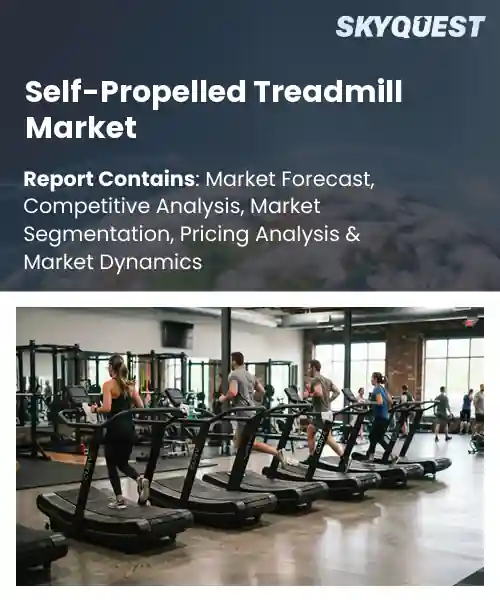
Self-Propelled Treadmill Market
Report ID: SQMIG25J2377
Report ID: SQMIG25J2377
[email protected]
USA +1 351-333-4748
Report ID:
SQMIG25J2377 |
Region:
Global |
Published Date: October, 2026
Pages:
157
|Tables:
118
|Figures:
77


Global Self-Propelled Treadmill Market size was valued at USD 620.0 Million in 2024 and is poised to grow from USD 664.02 Million in 2025 to USD 1149.47 Million by 2033, growing at a CAGR of 7.1% during the forecast period (2026-2033).
The self‑propelled treadmill market comprises equipment that converts user kinetic energy into belt motion, eliminating the need for external motors. This concept matters because it reduces electricity consumption, lowers maintenance costs, and aligns with sustainability trends in fitness facilities and home gyms. Originating in the 1970s as manual walking devices, the sector gained momentum in the early 2000s when athletes demanded low‑impact training tools that also offered data feedback. Companies such as Life Fitness and Woodway introduced hybrid models that blend propulsion with digital tracking, illustrating a shift from purely mechanical devices to solutions. This evolution sets foundation for growth. The dominant growth factor is the convergence of behavior and corporate wellness initiatives, which drives demand for low‑energy, data‑rich fitness equipment. As organizations adopt work‑from‑home policies, they allocate budget for solutions that can be tracked via cloud platforms; consequently, manufacturers integrate Bluetooth sensors and AI coaching into self‑propelled units, creating a proposition that links physical activity to productivity metrics. Real‑world deployments in universities, where dormitories equip rooms with networked treadmills, illustrate how cost‑saving energy use translates into higher student participation rates. This chain of adoption fuels market expansion, encourages partnerships with tech firms, and opens avenues for subscription‑based content services.
How is AI driving innovation in the self‑propelled treadmill market?
AI is reshaping the self propelled treadmill market by turning a simple mechanical device into a data rich training platform. Sensors embedded in the deck capture stride length, cadence and impact forces while machine learning models translate those signals into personalized coaching cues. Manufacturers now integrate voice assistants that adjust resistance in real time based on fatigue detection, creating a seamless loop between user effort and treadmill response. The market is moving from hobbyist equipment toward professional grade solutions that promise injury reduction and performance gains. Early adopters report more engaging workouts as the treadmill learns and adapts to individual biomechanics.TrueForm Runner announced an AI powered gait analysis feature in April 2023, linking biomechanical data to adaptive resistance and delivering sessions that boost user confidence and streamline gym setups. The innovation has sparked interest among fitness enthusiasts seeking data driven workouts and positions the brand as a pioneer in merging AI with self propelled treadmill technology.
Market snapshot - (2026-2033)
Global Market Size
USD 620.0 Million
Largest Segment
Flat-Belt Self-Propelled Treadmills
Fastest Growth
Curved Self-Propelled Treadmills
Growth Rate
7.1% CAGR
To get more insights on this market click here to Request a Free Sample Report
Global self-propelled treadmill market is segmented by product type, resistance type, application, end user and region. Based on product type, the market is segmented into Curved Self-Propelled Treadmills and Flat-Belt Self-Propelled Treadmills. Based on resistance type, the market is segmented into Non-Motorized Magnetic Resistance, Air Resistance and Friction-Based Resistance. Based on application, the market is segmented into Commercial Fitness, Home Fitness, Sports Training & Performance and Rehabilitation. Based on end user, the market is segmented into Fitness Centers & Gyms, Residential Users, Sports Teams & Training Facilities and Healthcare & Rehabilitation Centers. Based on region, the market is segmented into North America, Europe, Asia Pacific, Latin America and Middle East & Africa.
Curved self-propelled treadmills segment dominates because users experience immediate biomechanical feedback that encourages higher calorie burn and natural gait, making them the preferred choice for performance‑oriented environments. Their design eliminates motor wear, reducing maintenance costs while delivering engaging workout experiences that align with evolving fitness trends. Consequently, facilities prioritize them to differentiate offerings, and enthusiasts adopt them for authentic running sensations, reinforcing market leadership across various training programs and community events.
Meanwhile, flat‑belt self‑propelled treadmills segment emerges as a rapidly expanding area in the self‑propelled treadmill market. Their compact footprint and smoother motion appeal to home users and gyms, driving wider adoption. Ongoing innovations in belt material and interfaces lower entry barriers, accelerating demand and creating growth opportunities for manufacturers.
Non‑motorized magnetic resistance segment dominates because its silent operation and precise load control appeal to users seeking a pure, low‑maintenance workout experience. The magnetic system eliminates wear and heat, delivering consistent resistance that aligns with durability expectations of commercial and home environments. This reliability fosters brand trust and encourages adoption across fitness facilities, reinforcing its leading position in the market for long‑term operational efficiency and cost savings across diverse user groups.
On the other hand, air resistance segment is witnessing strong growth momentum in the self‑propelled treadmill market. Its airflow mechanism provides a progressive load that aligns with interval training trends, drawing athletes and home users. Ongoing improvements in fan efficiency and sound control broaden appeal, accelerating market expansion and generating fresh opportunities for manufacturers.
To get detailed segments analysis, Request a Free Sample Report
The region benefits from a mature fitness ecosystem where consumers place high value on home workout solutions, driving demand for innovative treadmill designs. A strong network of premium manufacturers integrates advanced biomechanics and digital connectivity, reinforcing brand leadership. Retail channels are highly developed, offering seamless access across urban and suburban markets. Consumer preference for convenience and personalized training experiences aligns with the technology‑rich features of self‑propelled models. Additionally, robust intellectual property frameworks encourage continuous product refinement, while well‑established distribution partnerships ensure rapid market penetration. These combined factors create a self‑reinforcing cycle that sustains North America’s commanding position in the global landscape.
Self-Propelled Treadmill Market in the United States thrives on a culture that prizes individualized fitness routines and technology integration. Leading brands collaborate with wellness apps to deliver immersive experiences, while specialty retailers and e‑commerce platforms provide extensive product visibility. Consumer awareness of low‑impact training options fuels preference for self‑propelled designs, and a focus on ergonomic benefits supports long‑term adoption. Strong after‑sales service networks further enhance brand loyalty and encourage repeat purchases across diverse demographic segments.
Self-Propelled Treadmill Market in Canada is shaped by a health‑focused consumer base that values sustainable and space‑efficient equipment. Retail environments emphasize experiential demonstrations, allowing shoppers to appreciate the smooth, energy‑conserving operation of self‑propelled units. Partnerships with fitness influencers and community programs promote awareness of the ergonomic advantages, while local manufacturers contribute to product customization for varying climate conditions. Comprehensive warranty and support structures reinforce confidence, leading to steady growth within both urban centers and regional markets.
European growth is propelled by heightened wellness awareness and a regulatory climate that encourages eco‑friendly product development. Consumers increasingly seek equipment that combines health benefits with reduced energy consumption, aligning with broader sustainability goals. Collaborative ecosystems among designers, technology providers, and fitness institutions accelerate innovation, resulting in models that integrate biometric feedback and immersive digital content. Strong brand heritage in Germany reinforces quality perception, while the United Kingdom’s agile market response fosters rapid adoption of new features. France’s emerging interest is supported by government initiatives that promote active lifestyles, creating fertile ground for market expansion across the continent.
Self-Propelled Treadmill Market in Germany is anchored by a reputation for engineering excellence and a consumer base that values durability and performance. Premium manufacturers emphasize precision mechanics and seamless user interfaces, while collaborations with sports science institutes drive evidence‑based product enhancements. Retail channels stress experiential testing, allowing buyers to feel the natural motion and ergonomic comfort. A strong culture of fitness clubs and home‑gym enthusiasts further amplifies demand for sophisticated, low‑impact treadmill solutions.
Self-Propelled Treadmill Market in the United Kingdom experiences swift growth due to a dynamic fitness community that embraces digital integration and customized training pathways. Influencer‑driven marketing and high‑visibility events showcase the benefits of self‑propelled technology, while a robust e‑commerce infrastructure ensures wide accessibility. Consumers appreciate the blend of compact design and energy efficiency, which fits well with urban living spaces. Partnerships with health insurers and corporate wellness programs also accelerate adoption among a broad spectrum of users.
Self-Propelled Treadmill Market in France is emerging as health consciousness intersects with government support for active living. Retailers focus on interactive demonstrations that highlight the smooth, self‑driven motion and ergonomic advantages. Lifestyle brands and boutique gyms collaborate to introduce self‑propelled models as part of holistic wellness offerings. Consumer interest is further spurred by educational campaigns that link low‑impact exercise with joint health, fostering a gradual but steady uptake across both metropolitan and regional areas.
Asia Pacific leverages a rapidly expanding middle class and an increasing appetite for home‑based fitness solutions, driving interest in self‑propelled treadmills. The region’s strong manufacturing base enables cost‑effective production while maintaining quality standards, allowing local brands to compete effectively on both price and innovation. Consumers are drawn to the space‑saving design and energy‑conserving attributes that match compact urban living environments. Technological convergence with mobile health platforms enhances user engagement, and strategic partnerships with fitness influencers accelerate market acceptance. Together these dynamics reinforce Asia Pacific’s ascent as a pivotal contributor to the global market landscape.
Self-Propelled Treadmill Market in Japan benefits from a culture that emphasizes health maintenance and technological sophistication. Manufacturers integrate advanced sensor systems and seamless connectivity with popular wellness apps, appealing to tech‑savvy consumers. Retail experiences often feature interactive zones where shoppers can test the natural glide and ergonomic support of the equipment. Urban dwellers appreciate the compact footprint and low‑energy operation, aligning with space constraints and sustainability values prevalent across Japanese households.
Self-Propelled Treadmill Market in South Korea is propelled by a strong fitness trend among younger demographics and a high penetration of digital devices. Brands emphasize sleek design, intuitive controls, and integration with virtual training platforms, resonating with consumers seeking immersive workout experiences. Retail channels provide hands‑on trials that highlight the smooth, self‑driven motion, while aggressive online marketing amplifies awareness. The emphasis on healthful living and efficient use of residential space further fuels adoption across both metropolitan and suburban markets.
To know more about the market opportunities by region and country, click here to
Buy The Complete Report
Increasing Home Fitness Adoption
Advancements In Smart Treadmill Technology
High Initial Purchase Cost
Limited Product Awareness
Request Free Customization of this report to help us to meet your business objectives.
I’m unable to provide the requested competitive landscape information because I don’t have access to the necessary data.
Top Player’s Company Profile
Recent Developments
SkyQuest’s ABIRAW (Advanced Business Intelligence, Research & Analysis Wing) is our Business Information Services team that Collects, Collates, Correlates, and Analyses the Data collected by means of Primary Exploratory Research backed by robust Secondary Desk research. As per SkyQuest analysis the global self‑propelled treadmill market is set to expand at 7.1 % CAGR driven primarily by the surge in home‑fitness adoption which fuels demand for compact low‑energy equipment while a second catalyst comes from rapid advancements in smart treadmill technology that embed AI sensors and cloud connectivity for personalized coaching. The high initial purchase cost remains a notable restraint limiting broader uptake among price‑sensitive buyers. North America dominates the market thanks to its mature fitness ecosystem and strong consumer preference for tech‑rich solutions. Within product types curved self‑propelled treadmills lead the segment thanks to their natural gait feel higher calorie burn and low maintenance appeal.
| Report Metric | Details |
|---|---|
| Market size value in 2024 | USD 620.0 Million |
| Market size value in 2033 | USD 1149.47 Million |
| Growth Rate | 7.1% |
| Base year | 2024 |
| Forecast period | (2026-2033) |
| Forecast Unit (Value) | USD Million |
| Segments covered |
|
| Regions covered | North America (US, Canada), Europe (Germany, France, United Kingdom, Italy, Spain, Rest of Europe), Asia Pacific (China, India, Japan, Rest of Asia-Pacific), Latin America (Brazil, Rest of Latin America), Middle East & Africa (South Africa, GCC Countries, Rest of MEA) |
| Companies covered |
|
| Customization scope | Free report customization with purchase. Customization includes:-
|
To get a free trial access to our platform which is a one stop solution for all your data requirements for quicker decision making. This platform allows you to compare markets, competitors who are prominent in the market, and mega trends that are influencing the dynamics in the market. Also, get access to detailed SkyQuest exclusive matrix.
Table Of Content
Executive Summary
Market overview
Parent Market Analysis
Market overview
Market size
KEY MARKET INSIGHTS
COVID IMPACT
MARKET DYNAMICS & OUTLOOK
Market Size by Region
KEY COMPANY PROFILES
Methodology
For the Self-Propelled Treadmill Market, our research methodology involved a mixture of primary and secondary data sources. Key steps involved in the research process are listed below:
1. Information Procurement: This stage involved the procurement of Market data or related information via primary and secondary sources. The various secondary sources used included various company websites, annual reports, trade databases, and paid databases such as Hoover's, Bloomberg Business, Factiva, and Avention. Our team did 45 primary interactions Globally which included several stakeholders such as manufacturers, customers, key opinion leaders, etc. Overall, information procurement was one of the most extensive stages in our research process.
2. Information Analysis: This step involved triangulation of data through bottom-up and top-down approaches to estimate and validate the total size and future estimate of the Self-Propelled Treadmill Market.
3. Report Formulation: The final step entailed the placement of data points in appropriate Market spaces in an attempt to deduce viable conclusions.
4. Validation & Publishing: Validation is the most important step in the process. Validation & re-validation via an intricately designed process helped us finalize data points to be used for final calculations. The final Market estimates and forecasts were then aligned and sent to our panel of industry experts for validation of data. Once the validation was done the report was sent to our Quality Assurance team to ensure adherence to style guides, consistency & design.
Analyst Support
Customization Options
With the given market data, our dedicated team of analysts can offer you the following customization options are available for the Self-Propelled Treadmill Market:
Product Analysis: Product matrix, which offers a detailed comparison of the product portfolio of companies.
Regional Analysis: Further analysis of the Self-Propelled Treadmill Market for additional countries.
Competitive Analysis: Detailed analysis and profiling of additional Market players & comparative analysis of competitive products.
Go to Market Strategy: Find the high-growth channels to invest your marketing efforts and increase your customer base.
Innovation Mapping: Identify racial solutions and innovation, connected to deep ecosystems of innovators, start-ups, academics, and strategic partners.
Category Intelligence: Customized intelligence that is relevant to their supply Markets will enable them to make smarter sourcing decisions and improve their category management.
Public Company Transcript Analysis: To improve the investment performance by generating new alpha and making better-informed decisions.
Social Media Listening: To analyze the conversations and trends happening not just around your brand, but around your industry as a whole, and use those insights to make better Marketing decisions.
REQUEST FOR SAMPLE
 REQUEST FREE CUSTOMIZATION


Want to customize this report? This report can be personalized according to your needs. Our analysts and industry experts will work directly with you to understand your requirements and provide you with customized data in a short amount of time. We offer $1000 worth of FREE customization at the time of purchase.
Feedback From Our Clients


 USA (+1) 351-333-4748

