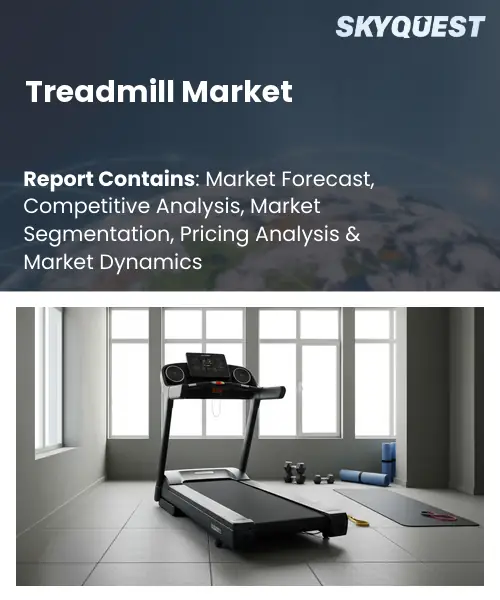
Treadmill Market
Report ID: SQMIG25J2189
Report ID: SQMIG25J2189
[email protected]
USA +1 351-333-4748
Report ID:
SQMIG25J2189 |
Region:
Global |
Published Date: May, 2026
Pages:
157
|Tables:
143
|Figures:
73


Global Treadmill Market size was valued at USD 12.52 Billion in 2024 and is poised to grow from USD 13.39 Billion in 2025 to USD 22.85 Billion by 2033, growing at a CAGR of 6.92% during the forecast period (2026-2033).
The manufacture, distribution and servicing of motorized running platforms for home, commercial and clinical use is analyzed as the treadmill market by AI. Growing health awareness coupled with demand for convenient, year-round cardiovascular exercise is the primary driver. The market is important because consumer and institutional purchases convert public health priorities into sustainable revenue streams for gyms, hotels, hospitals and home wellness ecosystems. Over the course of 20 years the industry evolved from large gym-only hardware to connected, foldable, small products including commercial hardware lines from Life Fitness and Technogym and consumer innovations from NordicTrack and Peloton, which married hardware with subscription software.
With connectivity and data-driven personalization becoming the defining factor of the market, manufacturers and software companies developed treadmills that integrate sensors, cloud platforms and live coaching to improve user engagement. This resulted in the development of subscription ecosystems and recurring revenue models that enhanced margins and supported higher average selling prices for homes and boutique studios. For instance, hospitals and physical therapy clinics use treadmills with adjustable inclines and gait tracking to accelerate rehabilitation, whereas corporate wellness programs employ networked units to encourage employees through activity challenges. Those deployments have opened up opportunities in aftermarket services, branded content partnerships and expansion into emerging markets looking for affordable connected fitness.
How is AI enhancing personalized training experiences in the treadmill market?
AI is revolutionizing personalized treadmill training by integrating sensor feedback, user history, and adaptive coaching into seamless sessions. Key features include real-time speed and incline adjustments based on biometrics, conversational coaching to guide effort and form, and content personalization to fit goals and preferences. Today the market is combining connected hardware with on demand content and machine learning to build personalized plans for runners, rehab patients and casual users. Home and commercial brands are racing to produce more sophisticated sensors and more intelligent software, and some developers are experimenting with generative models and immersive environments. A prime example is Merach unveiling an LLM powered home treadmill at CES 2026.
April 2026, announced a multi-year partnership with Google Cloud to embed generative AI into its ecosystem and deliver an AI Coach that personalizes treadmill workouts. This facilitates market growth, as it allows for scalable personalization and also improves operator efficiency by enabling automated program tuning and better user engagement.
Market snapshot - (2026-2033)
Global Market Size
USD 12.52 Billion
Largest Segment
Motorized Treadmill
Fastest Growth
Curved Treadmill
Growth Rate
6.92% CAGR
To get more insights on this market click here to Request a Free Sample Report
Global treadmill market is segmented by type, application, price range, distribution, feature and region. Based on type, the market is segmented into Manual Treadmill, Motorized Treadmill and Curved Treadmill. Based on application, the market is segmented into Home Use, Commercial (Gyms & Fitness Centers) and Hospitals & Rehabilitation. Based on price range, the market is segmented into Budget (<$500), Mid-Range ($500-$1500) and Premium (>$1500). Based on distribution, the market is segmented into Online, Specialty Stores and Supercenters. Based on feature, the market is segmented into Folding and Non-Folding. Based on region, the market is segmented into North America, Europe, Asia Pacific, Latin America and Middle East & Africa.
The Motorized Treadmill segment is ahead, as its powered systems offer precise control of speed and incline, thereby allowing for more workout versatility and integration with digital training platforms. This operational advantage has serious home users and commercial operators in search of reliable performance, which in turn drives product development and dealer focus. The ability to integrate with interactive content and track performance creates a reinforcing loop of innovation, user engagement and aftermarket accessory demand that sustains leadership.
However, the strongest growth momentum is in Curved Treadmill – whose self powered, low maintenance design is attracting boutique studios and performance trainers. Innovation-led demand allows manufacturers to expand specialized models and service packages, opening up premium sales channels and triggering new training ecosystems that accelerate market growth.
Online segment dominates as it removes traditional retail friction and allows for direct to consumer interactions, leading to increased product exposure and simplified purchase journeys. The channel supports rich product assortments, easy comparison, targeted marketing and data driven inventory decisions which reduce time to market for new models. This accessibility encourages manufacturers to go for online launches and integration with services, thus increasing customer reach, and pushing continual investment into the platform and partnerships in the ecosystem.
But Specialty Stores is growing fast as experiential retail and expert sales attract buyers looking for premium demonstrations and tailored aftercare. This focused engagement drives conversion for advanced models and builds brand trust, driving collaborations on exclusive assortments and in store services that unlock differentiated growth channels and sustained market opportunity.
To get detailed segments analysis, Request a Free Sample Report
North America dominates the global treadmill market, which can be attributed to a combination of factors such as sophisticated consumer demands, a concentrated manufacturer base, and a strong support system. A culture of fitness and convenience has led to a continued adoption of high-end home equipment and club quality installations that are widely available through broad retail and online distribution channels. Industry players stress the integration of technology, rugged design and service networks that support long term ownership. Connected platforms and subscription models where equipment makers, content providers, and fitness pros have partnered to lock in user engagement. Strong infrastructure of aftermarket service and consumer financing help lower the barrier for purchase. Well-developed supply chains and access to capital mean that products can be launched and scaled quickly. Rehabilitation and clinical use cases provide further demand expansion across segments.
The Treadmill Market in United States is characterized by robust consumer demand for premium home fitness solutions, extensive distribution networks, and high engagement with connected training platforms. Product innovation, thorough aftersales support and strategic partnerships with fitness professionals are being eyed by manufacturers and retailers to bolster brand credibility. The mature market continues to be sustained by urban lifestyle trends, corporate wellness initiatives and a preference for integrated digital experiences, with quality, service and technological differentiation still being competitive levers.
The treadmill market in Canada is driven by the high prevalence of health and an active approach towards wellness amongst diverse groups. Manufacturers and fitness experts promote consumer education and personalized purchase paths, with local distributors working with global manufacturers to adapt product lines. The need for connected features puts emphasis on reliability, low maintenance and service networks that are easy to access. The market responds to innovation and to consumer expectations for seamless ownership experiences.
The factors contributing to the high growth of Asia Pacific rapid treadmill market are changing demographics, increased focus on health and better access to digital platforms to search and buy equipment. With the growth of cities and more people living in apartment buildings, the need for space saving and multi-purpose solutions grows. Local manufacturers make products for local tastes and price points. E-commerce growth and strong logistics networks shorten purchase cycles and collaboration between tech companies and fitness content creators drives engagement with connected experiences. Public health campaigns and a rising interest in preventative care have brought in institutional buyers and rehabilitation providers, expanding the user base beyond the traditional fitness enthusiast. More focus on local research and more investment in marketing ensures higher adoption and brand awareness across markets.
Japan’s treadmill market is characterized by demand for compact and technologically advanced equipment along with preference for high reliability and safety. In the domestic market, manufacturers are focusing on precision engineering and integration with health monitoring systems, while retailers are curating products suitable for limited living spaces. Institutional demand continues through links to healthcare providers and rehab centers while consumer demand for connected training experiences supports products that are both elegantly designed and functionally attractive.
Treadmill Market in South Korea is influenced by quick adoption of smart fitness solutions and a robust culture of digital consumption. Local brands emphasize compactness, smooth connectivity and integration with streaming classes and social fitness platforms. Demand for foldable and multifunctional units is driven by urban density and limited home space, while a vibrant e commerce ecosystem and tech partnerships accelerate product discovery and purchase, supporting both premium and value segments.
Europe is reinforcing its position through a focus on quality engineering, regulatory alignment and sustainability. Manufacturers highlight durable, energy-efficient designs and extended service models that enhance lifecycle value. Institutional demand is met by strong network of fitness clubs and rehabilitation centers while wide consumer reach is provided by specialized retailers and e commerce platforms. Cross border partnerships and localized product adaptations address different preferences and investment in refurbishment and certified preowned channels broadens available price tiers. Research institutions, healthcare providers and brands can work together to help differentiate products for clinical and wellness applications. Standards compliance and sustainability certifications build buyer confidence, and well developed aftersales networks and skilled manufacturing clusters accelerate innovation and market responsiveness.
The German treadmill market is helped by a strong engineering tradition, with a focus on durable, high-performance equipment. Local manufacturers stress solid construction, energy efficiency and adherence to stringent safety standards, and commercial buyers seek reliable units for club and institutional use. Links with research institutes foster innovation in ergonomics and materials and strong aftersales support for buyers, while a network of specialized distributors and service providers supports long term maintenance.
The UK’s Treadmill market is backed by a strong retail presence, an active fitness club network and a growing interest in home training. Brands are responding to consumers’ desire for connectivity, smaller footprints and modern design. Robust service ecosystems and flexible purchase options support trial and ownership, while partnerships with physiotherapy clinics and wellness programs foster clinical adoption. Marketing emphasis on lifestyle integration and user experience helps in differentiating offerings across urban markets.
The Treadmill Market in France is a mix of boutique fitness trends and established club networks creating a demand for well designed and user friendly equipment. Manufacturers and distributors emphasize aesthetic refinement, quiet operation and ease of use to meet consumer expectations. Integration with wellness services and physiotherapy providers fosters clinical applications, whereas localized marketing and strategic retail placements help connect with consumers who appreciate style, functionality, and durability.
To know more about the market opportunities by region and country, click here to
Buy The Complete Report
Rising Health Consciousness Among Consumers
Technological Advancements In Treadmill Design
High Product Price Points Limiting Adoption
Limited Indoor Space In Urban Homes
Request Free Customization of this report to help us to meet your business objectives.
The global treadmill market is becoming more competitive as manufacturers and platform players look to differentiate their hardware, integrate content and consolidate channels. Push product-service bundling and partnerships Recent strategies Peloton and Precor acquisition and commercial integration Xponential Fitness acquisition of treadmill-based concepts in a boutique brand roll-up Flexnest smart treadmills and Octonic's VR treadmill integration in tech-driven offerings.
SkyQuest’s ABIRAW (Advanced Business Intelligence, Research & Analysis Wing) is our Business Information Services team that Collects, Collates, Correlates, and Analyses the Data collected by means of Primary Exploratory Research backed by robust Secondary Desk research.
As per SkyQuest analysis, rising health consciousness is a key driver for the global treadmill market, encouraging both home purchases and institutional installations, while high product price points remain a restraint that can slow adoption among price-sensitive buyers. North America remains the dominating region due to mature connected fitness ecosystems, strong aftermarket support and high willingness to pay, and the motorized treadmill is the dominating segment because it enables precise speed and incline control and seamless integration with interactive content. A second driver is ongoing technological advancement—smarter motors, connectivity and AI-driven personalization—that is expanding use cases, enabling subscription models and boosting engagement across consumer and commercial channels.
| Report Metric | Details |
|---|---|
| Market size value in 2024 | USD 12.52 Billion |
| Market size value in 2033 | USD 22.85 Billion |
| Growth Rate | 6.92% |
| Base year | 2024 |
| Forecast period | (2026-2033) |
| Forecast Unit (Value) | USD Billion |
| Segments covered |
|
| Regions covered | North America (US, Canada), Europe (Germany, France, United Kingdom, Italy, Spain, Rest of Europe), Asia Pacific (China, India, Japan, Rest of Asia-Pacific), Latin America (Brazil, Rest of Latin America), Middle East & Africa (South Africa, GCC Countries, Rest of MEA) |
| Companies covered |
|
| Customization scope | Free report customization with purchase. Customization includes:-
|
To get a free trial access to our platform which is a one stop solution for all your data requirements for quicker decision making. This platform allows you to compare markets, competitors who are prominent in the market, and mega trends that are influencing the dynamics in the market. Also, get access to detailed SkyQuest exclusive matrix.
Table Of Content
Executive Summary
Market overview
Parent Market Analysis
Market overview
Market size
KEY MARKET INSIGHTS
COVID IMPACT
MARKET DYNAMICS & OUTLOOK
Market Size by Region
KEY COMPANY PROFILES
Methodology
For the Treadmill Market, our research methodology involved a mixture of primary and secondary data sources. Key steps involved in the research process are listed below:
1. Information Procurement: This stage involved the procurement of Market data or related information via primary and secondary sources. The various secondary sources used included various company websites, annual reports, trade databases, and paid databases such as Hoover's, Bloomberg Business, Factiva, and Avention. Our team did 45 primary interactions Globally which included several stakeholders such as manufacturers, customers, key opinion leaders, etc. Overall, information procurement was one of the most extensive stages in our research process.
2. Information Analysis: This step involved triangulation of data through bottom-up and top-down approaches to estimate and validate the total size and future estimate of the Treadmill Market.
3. Report Formulation: The final step entailed the placement of data points in appropriate Market spaces in an attempt to deduce viable conclusions.
4. Validation & Publishing: Validation is the most important step in the process. Validation & re-validation via an intricately designed process helped us finalize data points to be used for final calculations. The final Market estimates and forecasts were then aligned and sent to our panel of industry experts for validation of data. Once the validation was done the report was sent to our Quality Assurance team to ensure adherence to style guides, consistency & design.
Analyst Support
Customization Options
With the given market data, our dedicated team of analysts can offer you the following customization options are available for the Treadmill Market:
Product Analysis: Product matrix, which offers a detailed comparison of the product portfolio of companies.
Regional Analysis: Further analysis of the Treadmill Market for additional countries.
Competitive Analysis: Detailed analysis and profiling of additional Market players & comparative analysis of competitive products.
Go to Market Strategy: Find the high-growth channels to invest your marketing efforts and increase your customer base.
Innovation Mapping: Identify racial solutions and innovation, connected to deep ecosystems of innovators, start-ups, academics, and strategic partners.
Category Intelligence: Customized intelligence that is relevant to their supply Markets will enable them to make smarter sourcing decisions and improve their category management.
Public Company Transcript Analysis: To improve the investment performance by generating new alpha and making better-informed decisions.
Social Media Listening: To analyze the conversations and trends happening not just around your brand, but around your industry as a whole, and use those insights to make better Marketing decisions.
REQUEST FOR SAMPLE
 REQUEST FREE CUSTOMIZATION
Global Treadmill Market size was valued at USD 12.52 Billion in 2024 and is poised to grow from USD 13.39 Billion in 2025 to USD 22.85 Billion by 2033, growing at a CAGR of 6.92% during the forecast period (2026-2033).
Market competition in the global treadmill sector is intensifying as manufacturers and platform players pursue hardware differentiation, content integration and channel consolidation. Recent strategies include acquisition and commercial integration exemplified by Peloton and Precor, boutique brand rollups such as Xponential Fitness acquiring treadmill-based concepts, and tech-driven offerings like Flexnest smart treadmills and Octonic VR treadmill integration, which push product-service bundling and partnerships. 'ICON Health & Fitness (NordicTrack, ProForm)', 'Peloton Interactive', 'Technogym SpA', 'Life Fitness (KPS Capital)', 'Precor (Peloton)', 'Nautilus Inc.', 'Johnson Health Tech', 'Woodway USA', 'True Fitness', 'Star Trac (Core Health & Fitness)', 'Bowflex (Nautilus)', 'LifeSpan Fitness', 'Horizon Fitness (Johnson)', 'Landice Inc.', 'WaterRower'
Growing consumer focus on preventive health, chronic disease management, and general wellness is driving demand for home and commercial exercise equipment such as treadmills. As individuals prioritize convenient, controllable exercise options, they seek reliable cardiovascular solutions that fit into daily routines and support fitness goals. This sustained interest encourages manufacturers and retailers to expand product availability and marketing, reinforcing market development. The emphasis on regular, structured exercise supports treadmill adoption as a practical tool for maintaining fitness across diverse age groups and lifestyles.
Connected Fitness Ecosystems: Connected fitness ecosystems are reshaping consumer expectations as treadmills integrate with streaming classes, wearable data synchronization, and personalized training programs. Manufacturers emphasize recurring-revenue services, app partnerships, and cross-platform content to deepen engagement and drive brand loyalty. Enterprise collaborations with corporate wellness and physical therapy providers broaden the use case beyond home fitness. Emphasis on seamless user experience, cloud-based performance tracking, and social features fosters higher retention and opens channels for bundled offerings and service monetization and long-term customer relationship growth.
Why does North America Dominate the Global Treadmill Market? |@12


Want to customize this report? This report can be personalized according to your needs. Our analysts and industry experts will work directly with you to understand your requirements and provide you with customized data in a short amount of time. We offer $1000 worth of FREE customization at the time of purchase.
Feedback From Our Clients


 USA (+1) 351-333-4748

