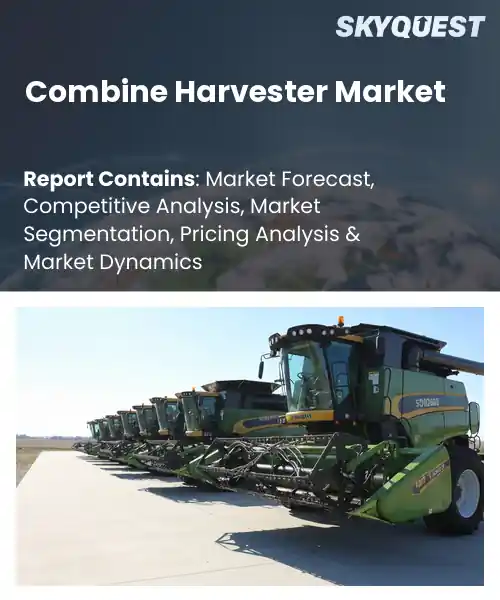
Combine Harvester Market
Report ID: SQMIG20F2083
Report ID: SQMIG20F2083
[email protected]
USA +1 351-333-4748
Report ID:
SQMIG20F2083 |
Region:
Global |
Published Date: June, 2026
Pages:
157
|Tables:
179
|Figures:
79


Global Combine Harvester Market size was valued at USD 230.5 Million in 2024 and is poised to grow from USD 250.32 Million in 2025 to USD 484.33 Million by 2033, growing at a CAGR of 8.6% during the forecast period (2026-2033).
The combine harvester market is driven by the global imperative to increase agricultural productivity while reducing labor dependence, and encompasses manufacturers, suppliers, and end users of machines that integrate reaping, threshing, and winnowing into a single operation. The impact of this industry are significant because the combine affect harvest efficiencies, crop losses and input cost which in turn, affect overall food security and farm profitability around the world. Over the past century the market evolved from small stationary threshers to self propelled combines produced by firms such as John Deere, CNH Industrial, and Claas, with acceleration after World War II and further transformation through digitalization and precision farming technologies today.
Building on digital evolution, the key trend driving the global combine harvester sector is technology diffusion because advanced sensors, GPS guidance, and connectivity enable higher throughput and lower downtime, allowing farmers to harvest larger areas with fewer machines. Consequently manufacturers broadly invest in telematics, while modular designs create service based opportunities such as machine rental and predictive maintenance contracts which expand market access in regions dominated by small holdings. For example custom hiring centres in India lower upfront investment and accelerate adoption while large grain producers in Ukraine and the United States demand high capacity, fuel efficient combines; resulting product diversification stimulates aftermarket services, exports.
How is AI Improving Operational Efficiency in the Combine Harvester Market?
AI is improving operational efficiency in the combine harvester market through smarter sensing, adaptive automation and connected data ecosystems. Key aspects are real time crop perception, automated harvest setting adjustments and predictive speed control that respond to in field variability. Today manufacturers are embedding vision systems and machine learning so combines adjust to crop density and weeds, reduce operator workload and maintain grain quality. The market context includes tighter harvest windows and workforce pressures that drive demand for reliable automation. Practical instances include predictive ground speed, automated harvest settings, assisted unloading and integrated fleet management that raise uptime and consistency.
In February 2025, John Deere announced expanded automation for model year 2026 combines adding predictive ground speed and enhanced harvest settings. This real world step shows how AI driven perception and decision systems convert sensor data into steadier throughput and reduced operator intervention to support wider adoption and greater harvest efficiency.
Market snapshot - (2026-2033)
Global Market Size
USD 230.5 Million
Largest Segment
Self-Propelled Combine Harvester
Fastest Growth
Self-Propelled Combine Harvester
Growth Rate
8.6% CAGR
To get more insights on this market click here to Request a Free Sample Report
Global combine harvester market is segmented by type, crop type, class / size, power source, mechanism, end use and region. Based on type, the market is segmented into self-propelled combine harvester, tractor-mounted combine harvester, PTO-driven combine harvester and others. Based on crop type, the market is segmented into grain crops (wheat, rice, barley, etc.), oilseed crops (soybean, canola, etc.), forage crops and others. Based on class / size, the market is segmented into small combine harvesters, medium combine harvesters and large combine harvesters. Based on power source, the market is segmented into diesel, electric / hybrid and others. Based on mechanism, the market is segmented into walker type, rotary type and hybrid type. Based on end use, the market is segmented into individual farmers, agricultural contractors, cooperative farming groups and others. Based on region, the market is segmented into North America, Europe, Asia Pacific, Latin America and Middle East & Africa.
Based on the global combine harvester market growth, rotary type segment dominates because its continuous threshing and separation architecture delivers higher operational throughput and reduced grain damage, making it the preferred choice for large area and mixed crop operations. Smoother crop flow and easier automation/sensor installations have helped create a design that allows for more efficient use of moisture by reducing the time and cost associated with maintenance and down time. The significant investments made by manufacturers in rotary development, along with extensive aftermarket support, have helped influence operator-imposed operating preferences and fleet-level installations.
However, hybrid type is emerging as the most rapidly expanding area due to its ability to merge walker robustness with flexible threshing architectures, offering versatility across crop types and field conditions. Innovations in modular systems, OEM focus on adaptable platforms, and rising demand for multi crop utility accelerate adoption and create diverse aftermarket and service opportunities.
Diesel segment dominates because its high power density and reliable refueling ecosystem support sustained heavy duty operations critical for most harvesting schedules. Operators have experience using diesel engines, they are supported by current service networks, and they provide a consistent level of torque even in challenging conditions which reduces potential for interruption. Reliable diesel supply chains and large dealer networks also make diesel combines an ideal option for contractors and farmers who rely on their machinery for continued operation.
Meanwhile, electric / hybrid is witnessing the strongest growth because improvements in battery energy density, regenerative systems, and hybrid drivetrains lower operating costs and noise while enabling electrified precision functions. Policy focus on sustainability, OEM electrification roadmaps, and farmer interest in lifecycle cost reduction drive trials and fleet conversions, opening new opportunities for charging infrastructure and evolving service models.
To get detailed segments analysis, Request a Free Sample Report
As per the global combine harvester market share, Asia Pacific leads the industry through a combination of deep agricultural demand, strong manufacturing ecosystems, and targeted mechanization efforts. A variety of cropping systems as well as the number of smallholder and larger commercial operations continue to generate high demand for many different sizes and types of machines. This is possible due to the presence of a range of local supplier networks with competitive levels of production to support rapid customization of products and cost-effective supply. The use of precision farming and the use of machines with integrated features will promote the acceptance and use of advanced features on a large scale. A robust aftermarket and service infrastructure will help to ensure maximum uptime. Collaboratively, by working together as partners, equipment manufacturers, research organizations, and agricultural cooperatives will further assist in the diffusion of technology and ensure that product lines continue to be aligned closely with regional agronomic needs and operator preferences.
Combine Harvester Market in Japan reflects a focus on high precision engineering, compact machinery design, and integration with advanced sensor and automation systems. Having robust domestic manufacturing capacities enhances the ability to improve products for small to mid-size farms and to accommodate different types of crops. Service networks for aftermarket support and a focus on operator ergonomics encourage more operators to adopt these products. Manufacturers working together with research institutions to improve fuel economy, emission controls and user interfaces through incremental innovations drives product development.
Combine Harvester Market in South Korea is shaped by demand for versatile machines adapted to hilly terrain and diverse cropping systems. Comprehensive dealer and service networks enable equipment to be maintained and parts to be acquired, resulting in improved operational performance. In addition, collaborations between equipment manufacturers and technology companies will continue to accelerate the development of telematics, remote diagnostics, and operator assistance technology that is specific to the local agriculture market.
Based on global combine harvester regional forecast, North America is experiencing rapid expansion in the industry driven by extensive commercial agriculture, emphasis on operational efficiency, and widespread adoption of integrated technology solutions. High-volume production systems need equipment to produce at a high volume, be dependable, and be easy to service. Well-developed dealer and distributor networks, and solid aftermarket support, can accommodate heavy seasonal needs. By integrating precision agriculture tools and telematics, manufacturers are also now able to provide modular electronics and scalable automation. Capital equipment can be more easily purchased through financing and leasing arrangements and through partnerships between OEMs, software providers, and agronomic consultants promoting the use of integrated harvest workflow to improve productivity and operational planning.
Combine harvester market in United States is characterized by demand for high capacity machines optimized for extensive grain and oilseed production. Manufacturers prioritize maximizing output, providing a comfortable working environment for the operator, and allowing easy access to precision guidance, yield mapping, telematics, etc. Service contracts and training allow the equipment to be more productive. Manufacturers collaborate with large farming operations, as well as agricultural equipment leasing companies, to conduct trials to improve their product and support post-purchase service strategies.
Combine harvester market in Canada reflects demand for adaptable machines across varied climates and prairie landscapes. Durability is a priority for manufacturers when designing a header, a high-quality threshing system, and an efficient drivetrain that can sustain extended operational cycles. To offer support to our customers in remote service locations, there are dealer and maintenance networks in place to help with parts logistics. Working closely with agricultural cooperatives and custom harvesters helps us determine which features and level of service will best meet the needs of imdivdual regional farm operations.
As per global combine harvester regional outlook, Europe is strengthening its position in the industry through technological refinement, regulatory alignment, and cross sector collaboration. The manufacturers put a lot of emphasis on powertrains that run well, engines that care about emissions, and machines that can do many different things. They also have strong aftermarket networks and structured service agreements to help keep equipment running longer and to support complex global supply chains. By partnering across borders with other manufacturers, parts manufacturers, and fertility agriculture companies, OEM’s are able to use telematics and have self-driving features as well as modular add-ons faster than ever before. Manufacturers are also starting to put money into manufacturing products close to where their customers are and developing customized aftermarket service plans so that they can be more responsive to the many needs of farmers but with a focus on quality, safety, and durability of equipment through the entire life of the product.
Combine harvester market in Germany emphasizes engineering excellence, modular machine architectures, and strict compliance with operational standards. Manufacturers are focusing their efforts on designing and manufacturing robust drive trains, advanced crop threshing systems, and precise control interfaces for farmers who will continue to grow mixed crop rotations (e.g., corn/soybean). Large scale service networks will help machine performance and resale value. The collaboration of component suppliers and automation specialists will allow for the integration of adaptive controls and sensor arrays in a manner that supports plant and equipment operation.
Combine harvester market in United Kingdom is driven by demand for versatile machines that suit varied farm structures and crop types. Manufacturers also emphasize on a few different design trends — compact and efficient layouts, responsive steering systems, and flexible layouts allow for maximum flexibility in mixed cropping settings. Aftermarket development networks usually provide a quick way to get parts when they are needed and provide field service support to reduce down-time. Manufacturers are also working closely with technology companies on developing automation and telematics applications for farmers.
Combine harvester market in France reflects emphasis on efficiency and adaptability across cropping systems. Companies focus on providing comfortable working conditions for operators, providing easy access to maintenance and repair services, and providing a variety of different types of headers for use on the machine for multiple cropping scenarios. Regional dealership networks and certified service providers provide reliable supplies of parts and service support. Collaborations with research institutions and service providers are executed to support the adoption of precision harvesting tools.
To know more about the market opportunities by region and country, click here to
Buy The Complete Report
Rising Farm Mechanization Adoption
Technological Advancements In Machinery
High Initial Acquisition Costs
Limited Rural Infrastructure Support
Request Free Customization of this report to help us to meet your business objectives.
Competitive pressure in the global combine harvester market outlook is increasingly defined by digital and autonomy-led differentiation, with OEMs pursuing targeted M&A, satellite and connectivity partnerships, and autonomy tie-ups to lock in fleet telematics and software revenue. Examples include Deere’s satellite-enabled JDLink Boost and recent AI acquisitions, SDF’s acquisition of VitiBot, and OEM collaborations with autonomy firms to accelerate in-cab automation and remote services.
Top Player’s Company Profile
Recent Developments
SkyQuest’s ABIRAW (Advanced Business Intelligence, Research & Analysis Wing) is our Business Information Services team that Collects, Collates, Correlates, and Analyses the Data collected by means of Primary Exploratory Research backed by robust Secondary Desk research.
As per SkyQuest analysis, the global combine harvester industry is being driven primarily by rapid technology diffusion, with advanced sensors, GPS and telematics improving throughput and enabling predictive maintenance, and further supported by rising farm mechanization adoption as farmers seek higher efficiency and lower labor dependence. Growth is tempered by high initial acquisition costs that limit uptake among smallholders and extend replacement cycles. Asia Pacific remains the dominant region due to diverse cropping systems, strong manufacturing and targeted mechanization programs, while the rotary type segment leads the market thanks to continuous threshing, higher throughput and compatibility with automation. Market dynamics favor modular solutions, aftermarket services and electrification trials.
| Report Metric | Details |
|---|---|
| Market size value in 2024 | USD 230.5 Million |
| Market size value in 2033 | USD 484.33 Million |
| Growth Rate | 8.6% |
| Base year | 2024 |
| Forecast period | (2026-2033) |
| Forecast Unit (Value) | USD Million |
| Segments covered |
|
| Regions covered | North America (US, Canada), Europe (Germany, France, United Kingdom, Italy, Spain, Rest of Europe), Asia Pacific (China, India, Japan, Rest of Asia-Pacific), Latin America (Brazil, Rest of Latin America), Middle East & Africa (South Africa, GCC Countries, Rest of MEA) |
| Companies covered |
|
| Customization scope | Free report customization with purchase. Customization includes:-
|
To get a free trial access to our platform which is a one stop solution for all your data requirements for quicker decision making. This platform allows you to compare markets, competitors who are prominent in the market, and mega trends that are influencing the dynamics in the market. Also, get access to detailed SkyQuest exclusive matrix.
Table Of Content
Executive Summary
Market overview
Parent Market Analysis
Market overview
Market size
KEY MARKET INSIGHTS
COVID IMPACT
MARKET DYNAMICS & OUTLOOK
Market Size by Region
KEY COMPANY PROFILES
Methodology
For the Combine Harvester Market, our research methodology involved a mixture of primary and secondary data sources. Key steps involved in the research process are listed below:
1. Information Procurement: This stage involved the procurement of Market data or related information via primary and secondary sources. The various secondary sources used included various company websites, annual reports, trade databases, and paid databases such as Hoover's, Bloomberg Business, Factiva, and Avention. Our team did 45 primary interactions Globally which included several stakeholders such as manufacturers, customers, key opinion leaders, etc. Overall, information procurement was one of the most extensive stages in our research process.
2. Information Analysis: This step involved triangulation of data through bottom-up and top-down approaches to estimate and validate the total size and future estimate of the Combine Harvester Market.
3. Report Formulation: The final step entailed the placement of data points in appropriate Market spaces in an attempt to deduce viable conclusions.
4. Validation & Publishing: Validation is the most important step in the process. Validation & re-validation via an intricately designed process helped us finalize data points to be used for final calculations. The final Market estimates and forecasts were then aligned and sent to our panel of industry experts for validation of data. Once the validation was done the report was sent to our Quality Assurance team to ensure adherence to style guides, consistency & design.
Analyst Support
Customization Options
With the given market data, our dedicated team of analysts can offer you the following customization options are available for the Combine Harvester Market:
Product Analysis: Product matrix, which offers a detailed comparison of the product portfolio of companies.
Regional Analysis: Further analysis of the Combine Harvester Market for additional countries.
Competitive Analysis: Detailed analysis and profiling of additional Market players & comparative analysis of competitive products.
Go to Market Strategy: Find the high-growth channels to invest your marketing efforts and increase your customer base.
Innovation Mapping: Identify racial solutions and innovation, connected to deep ecosystems of innovators, start-ups, academics, and strategic partners.
Category Intelligence: Customized intelligence that is relevant to their supply Markets will enable them to make smarter sourcing decisions and improve their category management.
Public Company Transcript Analysis: To improve the investment performance by generating new alpha and making better-informed decisions.
Social Media Listening: To analyze the conversations and trends happening not just around your brand, but around your industry as a whole, and use those insights to make better Marketing decisions.
REQUEST FOR SAMPLE
 REQUEST FREE CUSTOMIZATION
Global Combine Harvester Market size was valued at USD 230.5 Million in 2024 and is poised to grow from USD 250.32 Million in 2025 to USD 484.33 Million by 2033, growing at a CAGR of 8.6% during the forecast period (2026-2033).
Competitive pressure in the global combine harvester market is increasingly defined by digital and autonomy-led differentiation, with OEMs pursuing targeted M&A, satellite and connectivity partnerships, and autonomy tie-ups to lock in fleet telematics and software revenue. Examples include Deere’s satellite-enabled JDLink Boost and recent AI acquisitions, SDF’s acquisition of VitiBot, and OEM collaborations with autonomy firms to accelerate in-cab automation and remote services. 'Deere & Company', 'CNH Industrial N.V.', 'AGCO Corporation', 'CLAAS KGaA mbH', 'Kubota Corporation', 'Mahindra & Mahindra Ltd.', 'SDF Group', 'Yanmar Holdings Co., Ltd.', 'Iseki & Co., Ltd.', 'Preet Agro Industries Pvt. Ltd.', 'Kartar Agro Industries Pvt. Ltd.', 'Dasmesh Mechanical Works Pvt. Ltd.', 'Zoomlion Heavy Industry Science & Technology Co., Ltd.', 'Lovol Heavy Industry Co., Ltd.', 'Changfa Group', 'Sampo Rosenlew Ltd.', 'Zhejiang Liulin Agricultural Machinery Co., Ltd.', 'Jiangsu World Agricultural Machinery Co., Ltd.', 'Same Deutz-Fahr (India) Pvt. Ltd.', 'Versatile (Buhler Industries Inc.)'
In many regions, increasing mechanization among commercial and large-scale farmers reduces reliance on manual harvesting and creates sustained demand for combine harvesters. Buyers seek machines that improve throughput, reduce harvest losses, and lower labor costs, which motivates manufacturers to expand product lines and services. This adoption encourages suppliers to invest in distribution and aftersales support, enhancing availability and buyer confidence. The cumulative effect is a reinforcing loop where mechanization choices by farmers stimulate market expansion and drive manufacturer strategies focused on efficiency and reliability.
Precision Farming Integration: The combine harvester market is shifting toward seamless integration with precision agriculture platforms, enabling richer data capture, variable-rate harvesting, and adaptive machine behavior based on field variability. OEMs and technology partners are emphasizing sensor suites, connectivity, and interoperable software to support decision-making and yield optimization. This trend encourages closer collaboration between equipment manufacturers, agricultural advisors, and digital service providers to deliver outcome-based farming solutions that prioritize efficiency, input stewardship, and traceability across the harvest lifecycle.
Why does Asia Pacific Dominate the Global Combine Harvester Market? |@12


Want to customize this report? This report can be personalized according to your needs. Our analysts and industry experts will work directly with you to understand your requirements and provide you with customized data in a short amount of time. We offer $1000 worth of FREE customization at the time of purchase.
Feedback From Our Clients


 USA (+1) 351-333-4748

