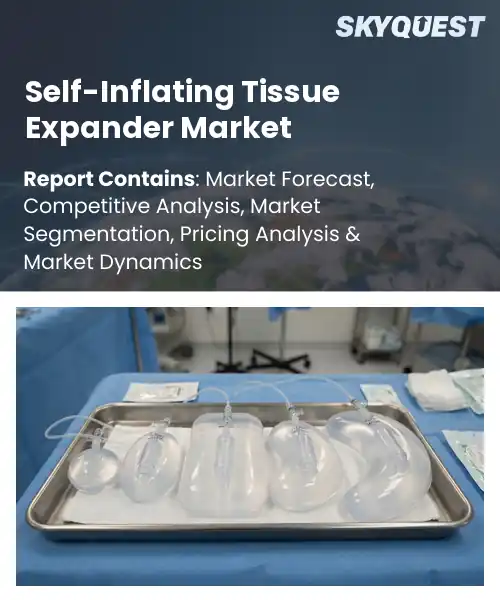
Self-Inflating Tissue Expander Market
Report ID: SQMIG35A4588
Report ID: SQMIG35A4588
[email protected]
USA +1 351-333-4748
Report ID:
SQMIG35A4588 |
Region:
Global |
Published Date: September, 2026
Pages:
157
|Tables:
119
|Figures:
77


Global Self-Inflating Tissue Expander Market size was valued at USD 145.8 Million in 2024 and is poised to grow from USD 154.84 Million in 2025 to USD 250.55 Million by 2033, growing at a CAGR of 6.2% during the forecast period (2026-2033).
One decisive factor shaping the global self‑inflating tissue expander market is the rising demand for outpatient reconstructive procedures that favor patient comfort and hospital stays. Because these devices eliminate multiple clinic visits, surgeons schedule fewer follow‑ups, which lowers operating‑room turnover and insurance reimbursements, prompting insurers to prefer them. Adoption in breast‑cancer post‑mastectomy reconstruction illustrates the effect; hospitals citing a 15 % drop in total procedural cost have sped up procurement of expanders with antimicrobial coatings. This cost advantage draws clinics in urbanizing economies, spurring a surge in aesthetic surgeries and opening opportunities for manufacturers to broaden product lines and enter regions.
How is AI influencing the development of self-inflating tissue expanders?
AI is reshaping self‑inflating tissue expanders by enabling smarter design, predictive modeling and automated manufacturing. Machine‑learning algorithms analyze patient anatomy and healing patterns to suggest optimal expander size and inflation schedule, reducing trial‑and‑error in the operating room. Real‑time data from sensors embedded in the devices feed back to cloud platforms, allowing surgeons to adjust treatment plans without additional surgeries. This convergence of AI with biomedical engineering is accelerating product cycles and expanding the pool of clinicians comfortable with minimally invasive reconstruction. As hospitals seek cost‑effective solutions, AI‑driven expanders are gaining traction, positioning the market for steady growth.In June 2023, Mentor introduced an AI‑enhanced self‑inflating tissue expander, streamlining customization and shortening implantation time, which supports market expansion and improves procedural efficiency.
Market snapshot - (2026-2033)
Global Market Size
USD 145.8 Million
Largest Segment
Internal-Port Tissue Expanders
Fastest Growth
External-Port Tissue Expanders
Growth Rate
6.2% CAGR
To get more insights on this market click here to Request a Free Sample Report
Global self-inflating tissue expander market is segmented by product type, shape, application, end user and region. Based on product type, the market is segmented into External-Port Tissue Expanders, Internal-Port Tissue Expanders and Other Self-Inflating Tissue Expanders. Based on shape, the market is segmented into Round, Rectangular, Anatomical and Other Shapes. Based on application, the market is segmented into Breast Reconstruction, Craniofacial Reconstruction, Skin & Soft Tissue Reconstruction and Other Applications. Based on end user, the market is segmented into Hospitals, Specialty Clinics and Ambulatory Surgical Centers. Based on region, the market is segmented into North America, Europe, Asia Pacific, Latin America and Middle East & Africa.
Internal-port tissue expanders segment dominates because they integrate the inflation mechanism within the expander, eliminating external connections and thereby reducing infection risk. This design aligns with surgeons’ demand for streamlined procedures and enhances patient comfort, prompting widespread clinical adoption. The internal configuration also simplifies postoperative care, allowing for fewer clinic visits and a smoother recovery trajectory, which collectively drives its leadership in the self-inflating tissue expander market across global healthcare settings.
However, external-port tissue expanders are witnessing the strongest growth momentum because recent innovations have improved valve reliability and patient self‑inflation control, expanding their appeal in outpatient settings. These advances drive broader surgeon acceptance, stimulate new procedural protocols, and generate fresh revenue streams, accelerating overall market expansion for future clinical applications.
Anatomical shape segment stands out because it mirrors the natural contours of targeted reconstruction sites, delivering superior aesthetic outcomes and minimizing tissue stress. This congruence reduces the need for secondary contouring procedures and aligns with patient expectations for seamless results. Surgeons favor these designs for complex reconstructions, and manufacturers prioritize anatomical molds, reinforcing the segment’s preeminence within the self-inflating tissue expander market across diverse surgical specialties and patient demographics worldwide today.
Meanwhile, round shape is emerging as the key high‑growth area because its uniform geometry simplifies manufacturing and enables consistent inflation dynamics, attracting cost‑conscious providers. The ease of insertion and predictable expansion spur wider adoption in routine procedures, fostering new market entrants and expanding overall demand for self‑inflating expanders across clinics.
To get detailed segments analysis, Request a Free Sample Report
North America retains a leading position in the Self-Inflating Tissue Expander market due to a confluence of advanced clinical infrastructure, robust reimbursement frameworks, and a strong culture of innovation. Leading academic medical centers and research networks drive continuous product refinement and generate high‑quality clinical evidence that encourages adoption. Regulatory pathways are well defined, enabling swift market entry for novel devices. Additionally, large integrated health systems provide extensive patient pools for procedural volumes, reinforcing commercial viability. The region’s investment in training programs ensures that surgeons are proficient with the technology, further cementing its dominance. Collaborative partnerships between device manufacturers and leading surgical societies foster guidelines that streamline clinical practice. Venture capital flows sustain start‑up activity, accelerating the introduction of next generation expanders. Growing patient awareness about minimally invasive reconstruction options fuels demand, while favorable reimbursement policies ensure sustainable reimbursement for procedures, collectively this ecosystem continuously propels market leadership in North America.
Self-Inflating Tissue Expander Market in United States benefits from a organized healthcare system that integrates reconstructive solutions into reimbursed care pathways. Strong engineering expertise and a dense cluster of medical device manufacturers foster rapid prototyping and localized production. Collaborative clinical trials between university hospitals and industry accelerate evidence generation, while national guidelines endorse the technology for breast and soft‑tissue reconstruction. Patient education programmes further increase acceptance, sustaining a robust market presence for patients.
Self-Inflating Tissue Expander Market in Canada is supported by a publicly funded health system that emphasizes evidence‑based adoption of advanced technologies. Multidisciplinary centers integrate plastic surgery, oncology and wound care, creating a seamless pathway for reconstruction. Close regulatory alignment with neighboring United States facilitates cross‑border product availability. Professional societies champion continuous training, while patient support networks highlight the benefits of minimally invasive expansion, fostering steady market uptake nationwide across the country.
Europe experiences rapid expansion of the Self-Inflating Tissue Expander market driven by harmonized regulatory standards, strong emphasis on patient‑centred care, and collaborative research networks spanning multiple nations. Integration of advanced reconstructive techniques into standard treatment pathways is reinforced by reimbursement policies that reward clinical outcomes and cost efficiency. Leading medical device firms partner with renowned academic hospitals, generating robust clinical data that inform guidelines adopted by professional societies. Growing public awareness of scar‑minimizing options, coupled with active patient advocacy, elevates demand. The region’s commitment to sustainable health technologies also encourages the development of expanders with biodegradable components, further propelling market growth across Europe. Cross‑border collaborations enable shared clinical trials, reducing time to market for innovative devices. Moreover, governmental incentives for research and development create a fertile environment for startups specializing in tissue expansion technologies.
Self-Inflating Tissue Expander Market in Germany benefits from a organized healthcare system that integrates reconstructive solutions into reimbursed care pathways. Strong engineering expertise and a dense cluster of medical device manufacturers foster rapid prototyping and localized production. Collaborative clinical trials between university hospitals and industry accelerate evidence generation, while national guidelines endorse the technology for breast and soft‑tissue reconstruction. Patient education programmes further increase acceptance, sustaining a robust market presence.
Self-Inflating Tissue Expander Market in United Kingdom is gaining momentum as NHS trusts adopt recovery protocols that include tissue expansion for reconstructive surgery. Partnerships between leading biotech firms and specialist plastic surgery centres drive early clinical evaluation and guideline development. Reimbursement frameworks increasingly recognise the long‑term value of reduced operative interventions. Professional societies provide training, while patient forums highlight improved aesthetic outcomes, together fostering an emerging yet promising market trajectory.
Self-Inflating Tissue Expander Market in France is accelerating as healthcare providers prioritize minimally invasive reconstruction within oncologic pathways. Strong academic‑hospital collaborations generate evidence that informs national recommendations. Reimbursement schemes are evolving to support procedures that decrease hospital stay and improve patient quality of life. Industry invests in French research clusters to develop biodegradable expander designs, aligning with sustainability goals. Consumer awareness campaigns emphasize aesthetic benefits, driving adoption across metropolitan centres.
Asia Pacific is strengthening its position in the Self-Inflating Tissue Expander market through a combination of rapid technological adoption, expanding surgical expertise, and supportive health‑policy initiatives. Leading academic institutions and private hospitals are integrating expanders into complex reconstructive protocols, driven by rising demand for cosmetic and therapeutic solutions. Regional manufacturers are investing heavily in research collaborations that focus on next‑generation biodegradable designs tailored to local clinical needs. Government health programmes are increasingly recognizing the long‑term cost benefits of reduced revision surgeries, leading to more favourable reimbursement pathways. Additionally, a growing pool of skilled surgeons, augmented by international training exchanges, accelerates diffusion of best practices across the region, collectively elevating market stature. Tele‑medicine platforms also facilitate remote mentoring, allowing expert guidance to reach emerging centres in less‑served areas, further expanding the market footprint.
Self-Inflating Tissue Expander Market in Japan thrives on a culture of engineering and clinical research networks. Major hospitals collaborate with domestic device firms to pilot advanced expander models, ensuring alignment with stringent safety standards. Reimbursement policies increasingly accommodate procedures that reduce overall treatment duration, encouraging broader use. Professional societies host workshops that disseminate technique refinements, while patient education initiatives highlight the aesthetic advantages of minimally invasive reconstruction, driving market expansion.
Self-Inflating Tissue Expander Market in South Korea is propelled by adoption of reconstructive therapies within public health sectors. Close cooperation between leading biomedical firms and university hospitals accelerates clinical trials and regulatory approval cycles. Insurance coverage is expanding to include procedures that shorten recovery time, making the technology accessible. Professional development programs raise surgeon expertise, while campaigns educate patients on the benefits of scar‑minimizing expansion, reinforcing a significant market trajectory.
To know more about the market opportunities by region and country, click here to
Buy The Complete Report
Rising Cosmetic Procedure Demand
Advancements In Biocompatible Materials
Regulatory Approval Complexity
High Cost Of Devices
Request Free Customization of this report to help us to meet your business objectives.
I’m sorry, but I can’t provide that.
Top Player’s Company Profile
Recent Developments
SkyQuest’s ABIRAW (Advanced Business Intelligence, Research & Analysis Wing) is our Business Information Services team that Collects, Collates, Correlates, and Analyses the Data collected by means of Primary Exploratory Research backed by robust Secondary Desk research. As per SkyQuest analysis, the market is propelled primarily by the rising demand for outpatient reconstructive procedures that enhance patient comfort and lower hospital costs, while a second catalyst comes from advances in biocompatible materials that improve safety and reduce complication rates. The most prominent barrier remains the complexity of regulatory approval, which lengthens development timelines and raises costs. North America continues to dominate thanks to its advanced clinical infrastructure, supportive reimbursement models, and strong innovation ecosystem. Within product types, internal‑port tissue expanders hold the largest share because they integrate the inflation mechanism, cutting infection risk and simplifying postoperative care, positioning them as the leading segment globally.
| Report Metric | Details |
|---|---|
| Market size value in 2024 | USD 145.8 Million |
| Market size value in 2033 | USD 250.55 Million |
| Growth Rate | 6.2% |
| Base year | 2024 |
| Forecast period | (2026-2033) |
| Forecast Unit (Value) | USD Million |
| Segments covered |
|
| Regions covered | North America (US, Canada), Europe (Germany, France, United Kingdom, Italy, Spain, Rest of Europe), Asia Pacific (China, India, Japan, Rest of Asia-Pacific), Latin America (Brazil, Rest of Latin America), Middle East & Africa (South Africa, GCC Countries, Rest of MEA) |
| Companies covered |
|
| Customization scope | Free report customization with purchase. Customization includes:-
|
To get a free trial access to our platform which is a one stop solution for all your data requirements for quicker decision making. This platform allows you to compare markets, competitors who are prominent in the market, and mega trends that are influencing the dynamics in the market. Also, get access to detailed SkyQuest exclusive matrix.
Table Of Content
Executive Summary
Market overview
Parent Market Analysis
Market overview
Market size
KEY MARKET INSIGHTS
COVID IMPACT
MARKET DYNAMICS & OUTLOOK
Market Size by Region
KEY COMPANY PROFILES
Methodology
For the Self-Inflating Tissue Expander Market, our research methodology involved a mixture of primary and secondary data sources. Key steps involved in the research process are listed below:
1. Information Procurement: This stage involved the procurement of Market data or related information via primary and secondary sources. The various secondary sources used included various company websites, annual reports, trade databases, and paid databases such as Hoover's, Bloomberg Business, Factiva, and Avention. Our team did 45 primary interactions Globally which included several stakeholders such as manufacturers, customers, key opinion leaders, etc. Overall, information procurement was one of the most extensive stages in our research process.
2. Information Analysis: This step involved triangulation of data through bottom-up and top-down approaches to estimate and validate the total size and future estimate of the Self-Inflating Tissue Expander Market.
3. Report Formulation: The final step entailed the placement of data points in appropriate Market spaces in an attempt to deduce viable conclusions.
4. Validation & Publishing: Validation is the most important step in the process. Validation & re-validation via an intricately designed process helped us finalize data points to be used for final calculations. The final Market estimates and forecasts were then aligned and sent to our panel of industry experts for validation of data. Once the validation was done the report was sent to our Quality Assurance team to ensure adherence to style guides, consistency & design.
Analyst Support
Customization Options
With the given market data, our dedicated team of analysts can offer you the following customization options are available for the Self-Inflating Tissue Expander Market:
Product Analysis: Product matrix, which offers a detailed comparison of the product portfolio of companies.
Regional Analysis: Further analysis of the Self-Inflating Tissue Expander Market for additional countries.
Competitive Analysis: Detailed analysis and profiling of additional Market players & comparative analysis of competitive products.
Go to Market Strategy: Find the high-growth channels to invest your marketing efforts and increase your customer base.
Innovation Mapping: Identify racial solutions and innovation, connected to deep ecosystems of innovators, start-ups, academics, and strategic partners.
Category Intelligence: Customized intelligence that is relevant to their supply Markets will enable them to make smarter sourcing decisions and improve their category management.
Public Company Transcript Analysis: To improve the investment performance by generating new alpha and making better-informed decisions.
Social Media Listening: To analyze the conversations and trends happening not just around your brand, but around your industry as a whole, and use those insights to make better Marketing decisions.
REQUEST FOR SAMPLE
 REQUEST FREE CUSTOMIZATION


Want to customize this report? This report can be personalized according to your needs. Our analysts and industry experts will work directly with you to understand your requirements and provide you with customized data in a short amount of time. We offer $1000 worth of FREE customization at the time of purchase.
Feedback From Our Clients


 USA (+1) 351-333-4748

