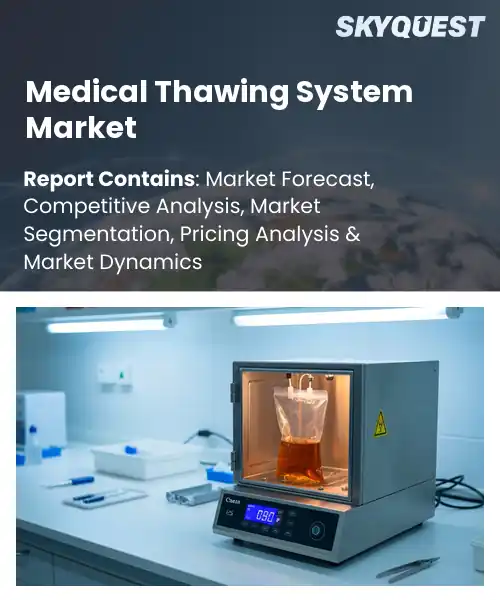
Medical Thawing System Market
Report ID: SQMIG35A3784
Report ID: SQMIG35A3784
[email protected]
USA +1 351-333-4748
Report ID:
SQMIG35A3784 |
Region:
Global |
Published Date: June, 2026
Pages:
157
|Tables:
92
|Figures:
76


Global Medical Thawing System Market size was valued at USD 111.98 Million in 2024 and is poised to grow from USD 124.63 Million in 2025 to USD 293.49 Million by 2033, growing at a CAGR of 11.3% during the forecast period (2026-2033).
The global medical thawing system market trends continues to grow due primarily to the increase in usage of cryopreserved biologics and the demand for standardized and safe methods to thaw these products in the healthcare environment. Medical thawing systems are defined as any devices that are designed to recover frozen blood products, tissues and cell therapies, while maintaining their viability. This is an important market because inadequate and/or non-standardized solutions for thawing could compromise both patient care and compliance with regulatory requirements.
The medical thawing system market growth has historically evolved from improvised water baths in the hospital to very advanced automated thawers with integrated temperature monitoring. There are many examples of this transition; IVF clinics have adopted very accurate thawers, and blood banks are increasingly transitioning to using validated closed systems for thawing across the globe.
When medical thawing system market share use controlled rate warming profiles, have Internet Of Things connectivity and audit-ready software features, laboratories will experience reduced cell damage from thawing and simplified compliance to all regulations. Consequently, the lower thaw rejection rates and shorter turnaround times associated with the usage of medical thawing systems will encourage hospitals and blood banks to invest in point-of-care thawers and service contracts increasing their use of validated thawing solutions in emerging markets where the demand for medical thawing systems will grow due to the increase of elective surgeries and the distribution of vaccines.
How is AI Enhancing Accuracy in the Medical Thawing System Market?
The accuracy of thawing devices in the bioscience space relies on three primary properties: the controlled delivery of temperature, the consistent amount of time spent thawing, and maintaining the cellular and tissue integrity of the cells being thawed. AI improves these key features by integrating the live sensor data used for thawing procedures with predictive control algorithms capable of adapting thawing profiles (temperature vs. time) according to the characteristics of an individual sample. This capability helps to reduce variability between individual batches of vials, creating repeatable endpoints that labs can trust when thawing cells and tissues. As a result, the thawing system market continues to transition away from manual water bath thawing systems to automatically controlled thawing platforms due to the need for reproducibility and traceability of cell products in order for them to be used in cell therapies and blood therapeutics. To cite a few examples, there are adaptive sensing thaw platforms using sensors to replace traditional manual thawing practices, as well as AI-enabled control systems that adjust and optimize energy usage for a more uniform thawing of cells and tissues.
In May 2026, BioLife Solutions noted in their market report further acceptance of utilizing ThawSTAR automated thawing products for Cryogenic Product thawing and how they provide algorithmic control & data capture. This statement exemplifies the advancements achieved in thawing technology with AI/algorithmic adaptive algorithms and their ability to increase thaw accuracy and standardization while enhancing facilities' overall throughput and productivity as cell lines become larger scale with larger volume frozen cell production.
Market snapshot - (2026-2033)
Global Market Size
USD 111.98 Million
Largest Segment
Blood and Plasma
Fastest Growth
Stem Cells
Growth Rate
11.3% CAGR
To get more insights on this market click here to Request a Free Sample Report
Global medical thawing system market is segmented by sample type, technology, end-user and region. Based on sample type, the market is segmented into blood and plasma, stem cells, embryos and oocytes and others. Based on technology, the market is segmented into dry thawing systems and wet thawing systems (water baths). Based on end-user, the market is segmented into blood banks, hospitals and diagnostic centers, fertility clinics, pharmaceutical and biotech companies and others. Based on region, the market is segmented into North America, Europe, Asia Pacific, Latin America and Middle East & Africa.
The importance of reproducibility, contamination-free thaw cycles that can easily be validated through regulatory agencies, dry thawing systems hold the dominant share of the market. The closed, fully automated nature of dry thawing systems limits manual handling and provides documentation of all aspects through the integration with laboratory information management systems (LIMS). As a result, hospitals, blood banks and biopharmaceuticals look to procure these systems in order to provide auditable, consistent thawing systems for their operations. Due to the levels of precision afforded by the dry thawing systems, and because the biological materials processed through this technology are usually highly sensitive to temperature changes, they have positioned themselves as the preferred thawing technology for all clinical and laboratory settings that use sensitive biological materials.
However, wet thawing systems (water baths) are witnessing strong growth as facilities seek lower cost, familiar options that can be upgraded with temperature control and safety features. Their simplicity, ease of training and compatibility with existing protocols accelerate adoption in high volume settings, creating demand for modernized water bath solutions and accessory validation services.
Their necessity for maintaining the functional viability and integrity of stem cell products through the entire cell therapy and regenerative medicine development process, stem cell-based therapies typically make up the second largest market for thawing systems. To this end, research and biomanufacturing facilities prioritize the use of thawing systems that provide validated thawing protocols, traceable temperature profiles, and closed systems that comply with the highly regulated nature of these processes. As a result, the critical need to maintain the quality of stem cells drives research centers and biomanufacturers to procure thawing systems and invest in the development of specialized thawing systems that will provide consistent recovery of sensitive stem cell products.
However, embryos and oocytes are emerging as the fastest growing area as fertility clinics demand ultra gentle, highly standardized thawing to improve outcomes. Advances in embryo warming protocols, portable warming devices and clinic level automation are driving adoption, stimulating suppliers to develop dedicated systems and validation packages tailored to assisted reproductive technologies.
To get detailed segments analysis, Request a Free Sample Report
The North American medical thawing system industry is dominated by multiple factors, including having all of the characteristics associated with advanced healthcare infrastructures, dense concentrations of clinical demand, and an overall matured ecosystem of device and service providers. In addition, hospitals and specialty clinics in North America promote and practice safe patient care and operating efficiently; therefore, many of these organizations are adopting standardized thawing platforms that meet their individual needs at the same time. In this area, the current regulatory and reimbursement environment creates an easy exit point for end users to integrate validated thawing devices into their day-to-day hospital-based workflow processes. The presence of both robust transplant networks and blood banks will continue to create ongoing demand for dependable thawing systems. Overall, the strong emphasis on both researches and clinical validations promotes innovation and an earlier introduction into the market through commercialization efforts, while the presence of local suppliers increases overall service, training needs, and supply chain efficiencies. Lastly, well established procurement frameworks provide several avenues for large scale deployment and support continued maintenance.
Medical thawing system market forecast in United States features early adoption of validated thawing platforms across academic medical centers, transplant programs, and large hospital systems. Centralized blood services and procurement frameworks favor certified devices that integrate into clinical workflows. Established vendors provide local training, service, and supply chain support. Emphasis on clinical evidence and patient safety, coupled with collaborations between industry and healthcare networks, sustains steady implementation in complex care environments broadly.
Medical thawing system market outlook in Canada reflects demand across provincial health authorities, hospitals and community care settings where reliable thawing supports transfusion and transplantation services. Geographic diversity and focus on rural access drive interest in portable, robust thawing platforms with service coverage. Procurement decisions emphasize compatibility with established cold chain logistics and clinician training programs. Partnerships between vendors and research hospitals support device validation and rollout, reinforcing clinical confidence and readiness.
The medical thawing system market in Europe is experiencing considerable growth due to the implementation of standardized clinical procedures, active hospital procurement strategies, and increased focus on safe and centralized management of temperature-sensitive biological materials. Multi-regional initiatives and clinical guidelines push for the use of approved thawing equipment to standardize workflow and improve patient outcomes. The coordinated efforts of consolidated purchasing by integrated hospital systems and group purchasing will also hasten the implementation of certified thawing equipment. In addition, local manufacturers and service providers develop products to meet the complex regulatory and operational needs of the market. Investment in training of clinicians, demonstration programs at centers of excellence, and collaboration between the healthcare industry and national healthcare organizations will enhance the commercialization of thawing systems in Europe. The sharing of experiences between transplant and transfusion professionals across geographic boundaries will continue to reinforce the momentum for adopting standardized, reproducible, and auditable thawing methods.
Medical thawing system market penetration in Germany is led by clinical networks, hospital procurement processes and engagement with domestic manufacturers that offer validated thawing platforms. High expectations for device certification and in country technical support encourage selection of proven systems. Major transplant and transfusion centers act as reference sites for clinical validation, while integration with hospital logistics and training programs ensures consistent use and sustains market leadership within established regional healthcare networks.
Medical thawing system market analysis in United Kingdom shows accelerated adoption through modernization efforts within national health services and coordinated procurement by hospital trusts. Emphasis on standardized clinical pathways and demonstrable patient safety outcomes encourages uptake of certified thawing platforms. Pilot programs and supplier partnerships enable validation and scaling across hospital networks. Focus on clinician training, centralized logistics, and service agreements supports integration into routine transfusion and transplantation workflows throughout care settings.
Medical thawing system industry in France is emerging as hospitals and regional health authorities modernize handling of temperature sensitive therapies. Interest in standardized thawing protocols, supported by national clinical guidance and demonstration projects, encourages investment in validated devices. Local suppliers and service partners are expanding to provide operational support. Procurement emphasizes device reliability, compatibility with cold chain logistics, and clinician training to ensure safe, reproducible thawing practices across care settings nationally.
Efforts to increase medical thawing system capability in Asia Pacific continue to be enhanced by a commitment to upgrading healthcare delivery systems, investing in improved cold-chain infrastructure, and increasing collaboration between locally-based manufacturers and international technology suppliers. The growing number of regional clinical excellence centers that are validating thawing platforms for transplantation and other advanced therapies will be aided by evolving regulatory frameworks and improved procurement programs, which will help facilitate the use of thawing platforms. Local suppliers have adapted their products so they can be used in the unique logistics constraints that exist in the various facility types across the Asia Pacific region and are working to expand their service networks to provide adequate installation, training, and maintenance support. Through strategic partnerships between hospitals, industry, and research institutions, the process of validating and customizing clinical procedures will be facilitated, allowing for wider use of thawing systems in urban tertiary hospitals and in outpatient settings. Local manufacture capabilities and growth will facilitate the future growth of the thawing systems market in the region.
Medical thawing system market regional outlook in Japan reflects clinical standards, advanced hospital infrastructure, and collaboration between device manufacturers and research institutions. Hospitals and specialty centers prioritize precision thawing technologies that align with regulatory expectations and institutional quality programs. Local suppliers offer compact, reliable platforms with service offerings and clinician training. Demonstration projects in leading centers facilitate clinical validation, supporting adoption across tertiary hospitals and care networks focused on patient safety and consistency.
Medical thawing system market regional forecast in South Korea is advancing through strong ties between innovative medical technology firms, leading hospitals, and clinical research centers. Demand is driven by interest in compact, robust thawing solutions that integrate with hospital information and cold chain systems. Local manufacturers collaborate with vendors to customize platforms and extend service coverage. Emphasis on clinical validation, training programs, and deployment in specialty centers supports broader acceptance across health networks.
To know more about the market opportunities by region and country, click here to
Buy The Complete Report
Rising Need For Tissue Preservation
Technological Advances In Device Design
High Capital And Maintenance Costs
Complex Regulatory And Validation Requirements
Request Free Customization of this report to help us to meet your business objectives.
Competition in the global medical thawing system market centers on platform integration, regulatory readiness, and differentiated rewarming technologies. Incumbents pursue acquisitions and software and logistics partnerships to add cryoprocessing capabilities, for example Cryoport's purchases of Cell Matters and Tec4Med and partnerships with Takeda BioLife. Startups push innovation with nanoparticle nanowarming and supercooling to force incumbent adaptation and commercial partnerships.
Top Player’s Company Profile
Recent Developments in the Medical Thawing System Market
SkyQuest’s ABIRAW (Advanced Business Intelligence, Research & Analysis Wing) is our Business Information Services team that Collects, Collates, Correlates, and Analyses the Data collected by means of Primary Exploratory Research backed by robust Secondary Desk research. As per SkyQuest analysis, the global medical thawing system market is being propelled primarily by the rising need for tissue preservation across transplantation, regenerative medicine and blood services while constrained by high capital and maintenance costs that limit adoption among smaller facilities. North America remains the dominant region supported by advanced healthcare infrastructure and centralized procurement, and Dry Thawing Systems lead market demand for closed, automated, contamination-free thaw cycles. A second major growth driver is rapid technological innovation, including AI-enabled control, IoT connectivity and validated automation that improve thaw consistency, traceability and integration with cold chain workflows, creating opportunities for suppliers and service models worldwide.
| Report Metric | Details |
|---|---|
| Market size value in 2024 | USD 111.98 Million |
| Market size value in 2033 | USD 293.49 Million |
| Growth Rate | 11.3% |
| Base year | 2024 |
| Forecast period | (2026-2033) |
| Forecast Unit (Value) | USD Million |
| Segments covered |
|
| Regions covered | North America (US, Canada), Europe (Germany, France, United Kingdom, Italy, Spain, Rest of Europe), Asia Pacific (China, India, Japan, Rest of Asia-Pacific), Latin America (Brazil, Rest of Latin America), Middle East & Africa (South Africa, GCC Countries, Rest of MEA) |
| Companies covered |
|
| Customization scope | Free report customization with purchase. Customization includes:-
|
To get a free trial access to our platform which is a one stop solution for all your data requirements for quicker decision making. This platform allows you to compare markets, competitors who are prominent in the market, and mega trends that are influencing the dynamics in the market. Also, get access to detailed SkyQuest exclusive matrix.
Table Of Content
Executive Summary
Market overview
Parent Market Analysis
Market overview
Market size
KEY MARKET INSIGHTS
COVID IMPACT
MARKET DYNAMICS & OUTLOOK
Market Size by Region
KEY COMPANY PROFILES
Methodology
For the Medical Thawing System Market, our research methodology involved a mixture of primary and secondary data sources. Key steps involved in the research process are listed below:
1. Information Procurement: This stage involved the procurement of Market data or related information via primary and secondary sources. The various secondary sources used included various company websites, annual reports, trade databases, and paid databases such as Hoover's, Bloomberg Business, Factiva, and Avention. Our team did 45 primary interactions Globally which included several stakeholders such as manufacturers, customers, key opinion leaders, etc. Overall, information procurement was one of the most extensive stages in our research process.
2. Information Analysis: This step involved triangulation of data through bottom-up and top-down approaches to estimate and validate the total size and future estimate of the Medical Thawing System Market.
3. Report Formulation: The final step entailed the placement of data points in appropriate Market spaces in an attempt to deduce viable conclusions.
4. Validation & Publishing: Validation is the most important step in the process. Validation & re-validation via an intricately designed process helped us finalize data points to be used for final calculations. The final Market estimates and forecasts were then aligned and sent to our panel of industry experts for validation of data. Once the validation was done the report was sent to our Quality Assurance team to ensure adherence to style guides, consistency & design.
Analyst Support
Customization Options
With the given market data, our dedicated team of analysts can offer you the following customization options are available for the Medical Thawing System Market:
Product Analysis: Product matrix, which offers a detailed comparison of the product portfolio of companies.
Regional Analysis: Further analysis of the Medical Thawing System Market for additional countries.
Competitive Analysis: Detailed analysis and profiling of additional Market players & comparative analysis of competitive products.
Go to Market Strategy: Find the high-growth channels to invest your marketing efforts and increase your customer base.
Innovation Mapping: Identify racial solutions and innovation, connected to deep ecosystems of innovators, start-ups, academics, and strategic partners.
Category Intelligence: Customized intelligence that is relevant to their supply Markets will enable them to make smarter sourcing decisions and improve their category management.
Public Company Transcript Analysis: To improve the investment performance by generating new alpha and making better-informed decisions.
Social Media Listening: To analyze the conversations and trends happening not just around your brand, but around your industry as a whole, and use those insights to make better Marketing decisions.
REQUEST FOR SAMPLE
 REQUEST FREE CUSTOMIZATION
Global Medical Thawing System Market size was valued at USD 111.98 Million in 2024 and is poised to grow from USD 124.63 Million in 2025 to USD 293.49 Million by 2033, growing at a CAGR of 11.3% during the forecast period (2026-2033).
Competition in the global medical thawing system market centers on platform integration, regulatory readiness, and differentiated rewarming technologies. Incumbents pursue acquisitions and software and logistics partnerships to add cryoprocessing capabilities, for example Cryoport's purchases of Cell Matters and Tec4Med and partnerships with Takeda BioLife. Startups push innovation with nanoparticle nanowarming and supercooling to force incumbent adaptation and commercial partnerships. 'Sartorius', 'Thermo Fisher Scientific', 'Danaher', 'GE Healthcare', 'Helmer Scientific', 'Sarstedt', 'Boekel Scientific', 'BioLife Solutions', 'Zeta Holding', 'Single Use Support', 'HOF Sonderanlagenbau', 'Meissner Filtration Products', 'Barkey', 'Cardinal Health', 'B Medical Systems', 'Plasmatherm', 'Lmb Technologie', 'KW Apparecchi Scientifici', 'Genesis BPS', 'FreMon Scientific'
The growing emphasis on preserving viability of cryopreserved tissues and biological samples drives adoption of advanced medical thawing systems. Reliable controlled thawing minimizes cellular damage and sample loss, which stakeholders view as essential for transplantation, regenerative medicine, and clinical research applications. Healthcare providers and biobanks prioritize technologies that protect sample integrity and support downstream procedures, prompting procurement and integration of validated thawing solutions. This focus on outcome preservation encourages manufacturers to refine device design and providers to invest in standardized thawing workflows that align with institutional quality objectives.
Cold Chain Integration: Medical thawing systems are increasingly designed to integrate with cold chain logistics platforms, enabling real time temperature tracking, automated scheduling and secure sample traceability across the transport and storage lifecycle. Vendors emphasize interoperable connectivity with laboratory information systems and IoT sensors to reduce handling errors and ensure protocol compliance. This trend supports centralized monitoring, simplifies regulatory documentation, and fosters collaborative workflows between clinical sites, biobanks and logistics providers while enhancing overall process transparency and operational efficiency improvements and quality outcomes.
Why does North America Dominate the Global Medical Thawing System Market? |@12


Want to customize this report? This report can be personalized according to your needs. Our analysts and industry experts will work directly with you to understand your requirements and provide you with customized data in a short amount of time. We offer $1000 worth of FREE customization at the time of purchase.
Feedback From Our Clients


 USA (+1) 351-333-4748

