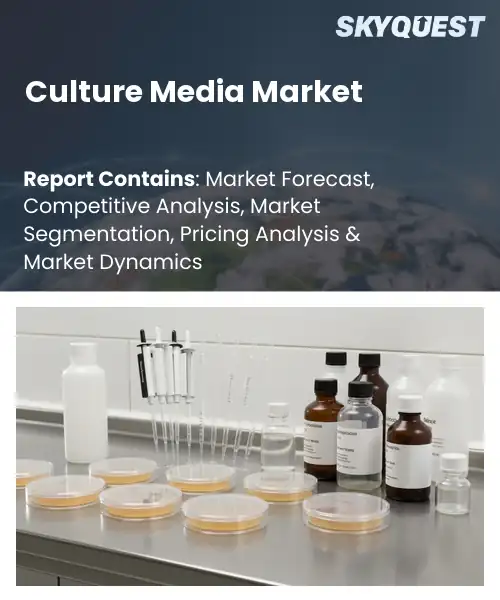
Culture Media Market
Report ID: SQMIG35J2427
Report ID: SQMIG35J2427
[email protected]
USA +1 351-333-4748
Report ID:
SQMIG35J2427 |
Region:
Global |
Published Date: June, 2026
Pages:
157
|Tables:
156
|Figures:
78


Global Culture Media Market size was valued at USD 5.8 Billion in 2024 and is poised to grow from USD 6.29 Billion in 2025 to USD 12.09 Billion by 2033, growing at a CAGR of 8.5% during the forecast period (2026-2033).
The primary driver of the culture media market is accelerating demand from biopharmaceutical development and clinical diagnostics that compels media to become more specific and scalable. Culture media, which include agar plates, broths and specialized mammalian, microbial and serum-free formulations, support growth of cells and microbes used in drug discovery, vaccine manufacture, food safety testing and research, so media performance directly influences experimental and manufacturing outcomes. Over decades the industry evolved from generic nutrient broths and preparations toward sterile, ready-to-use chemically defined media and automation; for example, monoclonal antibody biologics and pathogen panels rely on tailored formulations and lot-to-lot consistency.Building on the need for tailored and consistent formulations described earlier, a central factor shaping global growth is regulatory demand for GMP-grade, chemically defined and xeno-free media because higher quality standards force suppliers to upgrade processes and documentation. As regulators and manufacturers require validated, single-use-compatible media to reduce contamination risk and ensure reproducible yields, producers invest in R&D, scale production and provide customization, raising barriers to entry while thereby opening higher-margin niches and CDMO partnerships. Real-world cases include CAR-T therapies needing xeno-free formulations, monoclonal antibody plants optimizing basal media for titer gains and cultured meat startups demanding cost-effective large-scale media.
How is AI enhancing culture media formulation and quality control?
AI is improving culture media formulation and quality control by combining predictive models with automated experimentation. Key aspects include data driven formulation design, closed loop optimization and computer vision for QC. The current state centers on Bayesian and machine learning methods that guide fewer experiments while exploring complex ingredient interactions. In the market this approach reduces time to validated media and raises reproducibility for biologics and cell therapy developers. Examples of these advances appear in recent literature and in vendor services that pair AI with high throughput screening to turn experimental data into robust formulation and monitoring workflows.Merck KGaA June 2026, announced wider uptake of its BayBE Bayesian optimisation tools in formulation research, showing how AI enabled closed loop planning and autonomous labs accelerate media development and tighten quality control, which supports faster product development and greater manufacturing efficiency.
Market snapshot - (2026-2033)
Global Market Size
USD 5.8 Billion
Largest Segment
Powder Media
Fastest Growth
Ready-to-use Media
Growth Rate
8.5% CAGR
To get more insights on this market click here to Request a Free Sample Report
Global culture media market is segmented by product type, culture type, media type, application, end user and region. Based on product type, the market is segmented into Powder Media, Liquid Media, Semi-solid Media, Ready-to-use Media and Others. Based on culture type, the market is segmented into Cell Culture Media and Microbiological Culture Media. Based on media type, the market is segmented into Basal Media, Serum-free Media, Specialty Media, Stem Cell Culture Media, Chemically Defined Media and Others. Based on application, the market is segmented into Biopharmaceutical Production, Drug Discovery & Development, Diagnostics, Academic & Research, Tissue Engineering & Regenerative Medicine, Food & Beverage Testing, Environmental Testing and Others. Based on end user, the market is segmented into Pharmaceutical & Biotechnology Companies, Academic & Research Institutes, Hospitals & Diagnostic Laboratories, Contract Research Organizations (CROs) & Contract Development and Manufacturing Organizations (CDMOs), Food & Beverage Companies and Others. Based on region, the market is segmented into North America, Europe, Asia Pacific, Latin America and Middle East & Africa.
Powder Media segment dominates because its logistical flexibility and extended shelf stability reduce cold chain dependence and lower storage complexity, enabling manufacturers and laboratories to maintain bulk inventories and scale production with predictable formulation control; these operational advantages simplify procurement cycles and permit cost effective transportation and stocking practices. Familiarity among technical staff and established reconstitution protocols further consolidate powder formats as a default choice for routine cultivation and manufacturing workflows.
However, Ready to use Media is the fastest growing area because its convenience and lower contamination risk appeal to high throughput labs and biomanufacturers; pre made formats shorten turnaround and reduce validation burdens. Growing adoption encourages suppliers to expand ready to use portfolios and develop application specific formulations, creating new market opportunities.
Basal Media segment dominates because these core formulations supply essential nutrients, buffering capacity, and ionic balance that accommodate a wide array of cell types and initial growth stages; their role as a stable, standardized starting point enables reproducible upstream processes and straightforward method transfer across laboratories. Broad compatibility with supplements, entrenched vendor offerings, and routine use in both research and production create a strong installed base that sustains demand for basal products.
However, Chemically Defined Media is rapidly expanding because demand for reproducible, xeno free formulations rises among advanced therapeutics developers and quality driven research labs; regulatory expectations and the push for serum free processes accelerate uptake. This momentum drives suppliers to innovate scalable, tailored chemically defined offerings, unlocking applications in cell therapy, biologics production, and high value research programs.
To get detailed segments analysis, Request a Free Sample Report
North America dominates due to a combination of deep research infrastructure, a concentrated biopharmaceutical and diagnostics industry, and a mature manufacturing base for culture media and reagents. Established laboratories in academic and commercial settings drive continuous demand for high quality media while manufacturers benefit from streamlined distribution channels and experienced regulatory frameworks that support product development and compliance. Early adoption of automation, robust quality management systems, and strong linkages between industry and research institutions accelerate innovation. A skilled workforce, specialized contract service providers, and integrated cold chain and logistics capabilities further reinforce market leadership, enabling rapid scale up of new formulations and consistent supply to diverse end users across clinical, industrial, and research applications. Strategic investments are expanding manufacturing footprints and enabling bespoke formulation services. Emphasis on sustainability and regulatory compliance is encouraging adoption of greener processes and standardized quality systems across supply chains, while developed contract research and manufacturing networks facilitate market access and collaboration.
Culture Media Market in the United States is anchored by a network of biotechnology and pharmaceutical companies, academic research institutions, and diagnostic laboratories that sustain sophisticated demand for diverse media formats. Established manufacturers and suppliers collaborate with contract development organizations to deliver customized formulations and scalable production. Strong regulatory frameworks and early adoption of automation and quality practices support product validation and market acceptance across research and clinical end users.
Culture Media Market in Canada benefits from concentrated research clusters, collaborative networks linking universities and a growing community of specialized manufacturers and service providers. Demand is shaped by a mix of academic research, clinical diagnostics, and emerging bioprocessing activities that favor flexible, high quality media solutions. Proximity to export markets and harmonized regulatory approaches enable streamlined sourcing, validation, and distribution while supporting innovation in niche formulations and supply chain resilience.
Europe is experiencing rapid expansion in culture media demand driven by a dense ecosystem of pharmaceutical, biotechnology, and diagnostic companies concentrated across multiple member states. A strong tradition of translational research in academic centers feeds commercial development while regulatory harmonization and supportive policy frameworks lower barriers to cross border commercialization. Manufacturers are enhancing regional production capabilities and supply chain resilience to meet diverse clinical and industrial requirements. Growth is further catalyzed by rising interest in advanced therapies and personalized medicine, prompting development of specialized media platforms, partnerships between established suppliers and innovative startups, and broader adoption of automated and single use technologies that streamline validation and scale up. Strategic investments are expanding manufacturing footprints and enabling bespoke formulation services. Emphasis on sustainability and regulatory compliance is encouraging adoption of greener processes and standardized quality systems across supply chains, while developed contract research and manufacturing networks facilitate market access and collaboration.
Culture Media Market in Germany is characterized by a robust manufacturing base, strong industrial biotechnology capabilities, and an established network of research institutes that support quality production and customization. Local suppliers emphasize regulatory compliance, process optimization, and integration of automation to meet stringent validation requirements. Collaboration between academic centers, contract manufacturers, and established industry players enables development of specialized media for complex applications while fostering export oriented capabilities and excellence.
Culture Media Market in the United Kingdom is experiencing accelerated momentum driven by biotech clusters, robust investment, and translational research that supports commercialization. Suppliers and contract manufacturers prioritize agility, rapid formulation development, and support for advanced therapy pipelines. Regulatory responsiveness and close ties between academic centers and industry facilitate clinical validation. Emphasis on innovation and workforce expertise is expanding demand for specialized, adaptable media solutions across research and clinical applications.
Culture Media Market in France is emerging through expanding translational research, growing biotechs, and a supportive innovation ecosystem supporting commercialization. Local manufacturers and providers emphasize tailored formulations, quality systems, and regulatory alignment to serve clinical and research customers. Collaborative networks between academic centers, incubators, and contract developers enable pilot production. Focus on niche applications, workforce expertise, and public private initiatives is strengthening capabilities for advanced media development and supply effectively.
Asia Pacific is strengthening its position through coordinated investments in research infrastructure, manufacturing capacity, and regulatory modernization that together raise regional competitiveness for culture media supply. National strategies emphasize development of advanced therapies and diagnostics, stimulating local demand for tailored media formulations and services. Established manufacturers and emerging suppliers are expanding production capabilities, adopting automation and stringent quality systems to meet international standards. Collaboration with global partners and increased cross border licensing support technology transfer, while improvements in logistics and supply chain management facilitate reliable distribution. A growing skilled workforce and focused public private initiatives further enable specialized media development for both domestic markets and export channels. Investment in localized research and development centers is fostering product adaptation for regional biological profiles and accelerating validation cycles. Emphasis on cost efficient production and flexible manufacturing enables suppliers to compete on price and customization, supporting adoption across academic, clinical, and industrial segments.
Culture Media Market in Japan is supported by advanced manufacturing capabilities and a strong base of pharmaceutical and biotechnology research institutions that demand high quality media solutions. Manufacturers emphasize stringent quality systems, process control, and automation to ensure reproducibility and regulatory compliance. Collaboration between industry and academic centers fosters development of specialized media for therapeutic and diagnostic applications, while focus on export quality and technical training sustains competitive positioning globally.
Culture Media Market in South Korea is advancing through technology driven manufacturing, rapid adoption of automation, and government supported innovation that accelerates commercialization. Local suppliers and contract manufacturers prioritize scalable production, stringent quality control, and customized media for bioprocessing and diagnostic applications. Strong ties between research institutes and industry foster translational development, while international partnerships help integrate South Korea into regional supply chains and specialized media networks and market outreach.
To know more about the market opportunities by region and country, click here to
Buy The Complete Report
Expansion Of Digital Distribution
Increasing Demand For Localized Content
Complex Content Licensing Frameworks
High Production And Localization Costs
Request Free Customization of this report to help us to meet your business objectives.
Competitive landscape in the global cell culture media market is shaped by consolidation, strategic partnerships, and ingredient innovation. Recent deals include Sartorius acquiring a majority stake in Biological Industries and Mitsubishi Chemical investing in Myoridge, while firms pursue plant based albumin replacements and localized media manufacturing to secure supply chains and compete on quality and cost through technology driven differentiation.
Top Player’s Company Profile
Recent Developments
SkyQuest’s ABIRAW (Advanced Business Intelligence, Research & Analysis Wing) is our Business Information Services team that Collects, Collates, Correlates, and Analyses the Data collected by means of Primary Exploratory Research backed by robust Secondary Desk research. As per SkyQuest analysis, the global culture media market is being propelled primarily by accelerating demand from biopharmaceutical development and clinical diagnostics, which requires tailored, scalable media for drug discovery, biologics and vaccine manufacture. A secondary driving force is growing regulatory demand for GMP‑grade, chemically defined and xeno‑free formulations that push suppliers toward higher quality, customization and CDMO partnerships. Growth is tempered by high production and validation costs that raise barriers for new entrants and complicate scale up. North America remains the dominant region due to dense research infrastructure and industry concentration, while powder media continue to dominate commercially because of logistical flexibility, shelf stability and established reconstitution practices.
| Report Metric | Details |
|---|---|
| Market size value in 2024 | USD 5.8 Billion |
| Market size value in 2033 | USD 12.09 Billion |
| Growth Rate | 8.5% |
| Base year | 2024 |
| Forecast period | (2026-2033) |
| Forecast Unit (Value) | USD Billion |
| Segments covered |
|
| Regions covered | North America (US, Canada), Europe (Germany, France, United Kingdom, Italy, Spain, Rest of Europe), Asia Pacific (China, India, Japan, Rest of Asia-Pacific), Latin America (Brazil, Rest of Latin America), Middle East & Africa (South Africa, GCC Countries, Rest of MEA) |
| Companies covered |
|
| Customization scope | Free report customization with purchase. Customization includes:-
|
To get a free trial access to our platform which is a one stop solution for all your data requirements for quicker decision making. This platform allows you to compare markets, competitors who are prominent in the market, and mega trends that are influencing the dynamics in the market. Also, get access to detailed SkyQuest exclusive matrix.
Table Of Content
Executive Summary
Market overview
Parent Market Analysis
Market overview
Market size
KEY MARKET INSIGHTS
COVID IMPACT
MARKET DYNAMICS & OUTLOOK
Market Size by Region
KEY COMPANY PROFILES
Methodology
For the Culture Media Market, our research methodology involved a mixture of primary and secondary data sources. Key steps involved in the research process are listed below:
1. Information Procurement: This stage involved the procurement of Market data or related information via primary and secondary sources. The various secondary sources used included various company websites, annual reports, trade databases, and paid databases such as Hoover's, Bloomberg Business, Factiva, and Avention. Our team did 45 primary interactions Globally which included several stakeholders such as manufacturers, customers, key opinion leaders, etc. Overall, information procurement was one of the most extensive stages in our research process.
2. Information Analysis: This step involved triangulation of data through bottom-up and top-down approaches to estimate and validate the total size and future estimate of the Culture Media Market.
3. Report Formulation: The final step entailed the placement of data points in appropriate Market spaces in an attempt to deduce viable conclusions.
4. Validation & Publishing: Validation is the most important step in the process. Validation & re-validation via an intricately designed process helped us finalize data points to be used for final calculations. The final Market estimates and forecasts were then aligned and sent to our panel of industry experts for validation of data. Once the validation was done the report was sent to our Quality Assurance team to ensure adherence to style guides, consistency & design.
Analyst Support
Customization Options
With the given market data, our dedicated team of analysts can offer you the following customization options are available for the Culture Media Market:
Product Analysis: Product matrix, which offers a detailed comparison of the product portfolio of companies.
Regional Analysis: Further analysis of the Culture Media Market for additional countries.
Competitive Analysis: Detailed analysis and profiling of additional Market players & comparative analysis of competitive products.
Go to Market Strategy: Find the high-growth channels to invest your marketing efforts and increase your customer base.
Innovation Mapping: Identify racial solutions and innovation, connected to deep ecosystems of innovators, start-ups, academics, and strategic partners.
Category Intelligence: Customized intelligence that is relevant to their supply Markets will enable them to make smarter sourcing decisions and improve their category management.
Public Company Transcript Analysis: To improve the investment performance by generating new alpha and making better-informed decisions.
Social Media Listening: To analyze the conversations and trends happening not just around your brand, but around your industry as a whole, and use those insights to make better Marketing decisions.
REQUEST FOR SAMPLE
 REQUEST FREE CUSTOMIZATION


Want to customize this report? This report can be personalized according to your needs. Our analysts and industry experts will work directly with you to understand your requirements and provide you with customized data in a short amount of time. We offer $1000 worth of FREE customization at the time of purchase.
Feedback From Our Clients


 USA (+1) 351-333-4748

