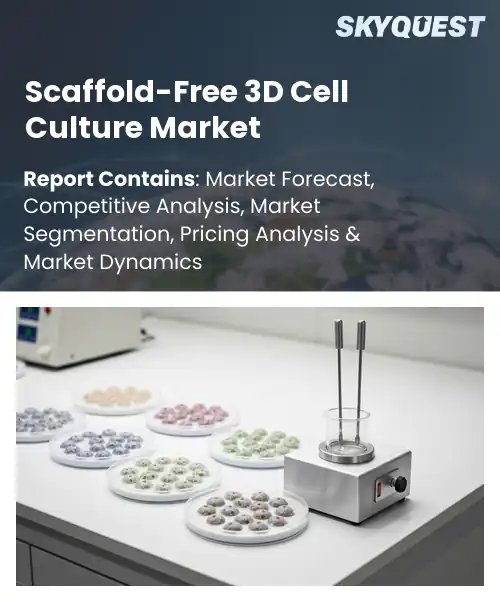
Scaffold-Free 3D Cell Culture Market
Report ID: SQMIG35J2579
Report ID: SQMIG35J2579
[email protected]
USA +1 351-333-4748
Report ID:
SQMIG35J2579 |
Region:
Global |
Published Date: July, 2026
Pages:
157
|Tables:
91
|Figures:
76


Global Scaffold-Free 3D Cell Culture Market size was valued at USD 425.6 Million in 2024 and is poised to grow from USD 488.59 Million in 2025 to USD 1473.94 Million by 2033, growing at a CAGR of 14.8% during the forecast period (2026-2033).
Scaffold‑free three‑dimensional cell culture is a market niche built around self-assembling cell clumps, spheroids, or even organoid-like structures that form on their own without artificial matrices. A big reason it keeps growing is the rising demand for physiologically relevant in‑vitro models, which do a better job mimicking human tissue. Because of that, drug efficacy predictions get sharper, and animal testing gets reduced, at least in many workflows.
Another factor that is driving the scaffold-free 3d cell culture market growth is how personalized medicine is now merging with screening. That makes a loop where more accurate disease setups pull in more funding, and then the extra money speeds up adoption, so it becomes a fast-moving cycle. Biopharma companies often use patient-derived tumor spheroids to evaluate oncology candidates, it can shorten trial timelines and also cut costs, which invests look more attractive. On top of that, automation is getting stronger, robotic liquid handling systems and AI driven image review help scale spheroid production, so the market expands into toxicology, regenerative medicine, and cosmetics too. Due to all this, regulatory agencies are also drafting guidance that acknowledges scaffold‑free assays, which then helps unlock new revenue for platform providers and encourages partnerships.
AI is reshaping the scaffold‑free 3D cell culture market outlook by taking over parts of spheroid formation, tuning the media composition, and even forecasting tissue maturation routes. Machine learning models look at imaging data and then tweak culture conditions in real time, which cuts down the whole guess and check routine and speeds up discovery. When AI is paired with microfluidic platforms, it enables high-throughput screening of drug responses without requiring artificial scaffolds, which tends to keep the models more physiologically aligned. Researchers also use predictive analytics to pick cell lines that self assemble into functional micro tissues , which can shorten development schedules and reduce expenses. Overall, these changes help expand the market because pharmaceutical and biotech groups want models that are both more accurate and easier to scale for disease modeling and therapeutic evaluation.
Market snapshot - (2026-2033)
Global Market Size
USD 425.6 Million
Largest Segment
Low-Attachment Spheroid Microplates
Fastest Growth
Magnetic Levitation Systems
Growth Rate
14.8% CAGR
To get more insights on this market click here to Request a Free Sample Report
The global scaffold-free 3d cell culture market is segmented by product technology type, application clinical area, end-use industry and region. Based on product technology type, the market is segmented into Low-Attachment Spheroid Microplates, Hanging Drop Plates Assemblies, Bioreactor Culture Systems and Magnetic Levitation Systems. Based on application clinical area, the market is segmented into Oncology Research, Stem Cell & Regenerative Medicine and Toxicology & Drug Screening. Based on end-use industry, the market is segmented into Biotechnology & Pharmaceutical Industry, Academic & Research Institutes and Contract Research Organizations. Based on region, the market is segmented into North America, Europe, Asia Pacific, Latin America and Middle East & Africa.
As per the scaffold-free 3d cell culture market analysis, the Low-Attachment Spheroid Microplates segment leads the market, mostly because it offers a relatively simple, cost effective stage that lets spheroids form in a consistent way, without needing specialized equipment. Also, they just slip into normal lab routines smoothly which lowers the entry barriers, so more researchers pick them up for drug discovery and basic biology work. On top of that scaling experiments feels easier, and they still fit well with high throughput screening , which makes the whole setup attractive. As a result, many users in both academic and industrial environments tend to prefer them.
However, Magnetic Levitation Systems are showing the strongest growth momentum, not because they’re trendy but because they can steer cell aggregation very precisely, and importantly without any physical contact. This helps researchers build more uniform tissue constructs, and that uniformity matters a lot for downstream results. They also work nicely with real time imaging, and they’re starting to align with newer biofabrication workflows. So innovators keep getting pulled in, market expansion picks up, and new therapeutic development opportunities open up faster than before.
According to the scaffold-free 3d cell culture market forecast, Oncology Research application dominates in large part because it pushes the need for physiologically relevant tumor models that actually help predict patient responses. Teams want scaffold-free spheroids, as in those tight cell clusters, to mirror tumor microenvironments and that means they can evaluate drug efficacy plus resistance pathways more realistically. And because cancer drug pipelines have a lot of pressure to cut attrition rates , investors are leaning into these platforms. So this demand keeps reinforcing their role in deciding what gets prioritized, produced, and commercialized across academia, industry, and even across collaborative networks globally.
Meanwhile, Stem Cell & regenerative Medicine is coming up as the key high growth area, since it relies on scaffold-free aggregates to support cell to cell signaling and to help preserve native phenotypes. That’s a big deal for tissue engineering and personalized therapy efforts. Interest in organoid models , together with more supportive regulatory pathways, is helping adoption move up and it’s expanding market horizons too.
To get detailed segments analysis, Request a Free Sample Report
As per the scaffold-free 3D cell culture market regional forecast, North America takes the lead due to the convergence of advanced research infrastructure, steady funding sources, and a high number of biotech companies. In the United States there’s this dense web of universities and private labs, they lean hard into the newest cell culture tools, so adoption happens fast and development keeps iterating. With strong cooperation between industry and government, scaffold-free platforms get pushed into therapeutic pipeline work sooner rather than later . Canada then adds its own flavor with regulatory rules that are mostly supportive and a growing constellation of life‑science startups that talk a lot about sustainable , scalable manufacturing too. Together, the whole setup makes early-stage validation easier, speeds commercial scale-up, and keeps producing trained talent , which keeps the region looking pre‑eminent in the worldwide market.
United States Scaffold-Free 3D Cell Culture Market
The Scaffold-Free 3D Cell Culture sector in the United States is bolstered by wide federal research push , plus there’s a vigorous venture capital atmosphere. Top universities and major research hospitals drive method breakthroughs, while biotech companies turn those advances into drug discovery and regenerative medicine programs without too much delay. The shared mindset across academia industry and government helps product development move quicker, and it also keeps a steady stream of fresh solutions coming, so the United States stays like a market cornerstone.
Canada Scaffold-Free 3D Cell Culture Market
The Scaffold-Free 3D Cell Culture industry in Canada is shaped by forward-looking regulatory policies, and a focus on interdisciplinary teamwork. Provincial research grants and national innovation plans encourage 3‑dimensional cell platforms to be adopted across pharmaceutical and health‑technology areas. New biotech clusters in major cities help with talent swapping and joint efforts , which makes Canada feel like a solid environment for moving scaffold‑free technologies from concept toward wider scaling.
Europe’s rapid scaffold-free 3d cell culture market penetration is being powered by a heavy emphasis on collaborative research structures and large public‑private partnerships, these partnerships often target translational science first. The region also has a mature pharmaceutical scene , and they want more physiologically grounded models so development timelines get shorter, while also meeting strict regulatory demands. Funding programs across the European Union nudge cross‑border projects, allowing shared skills, and smoother technology transfer . On top of that, there’s a stronger push for sustainable , and animal‑free research approaches, which matches broad societal expectations and policy directions, making scaffold‑free methods easier to adopt across the continent.
Germany Scaffold-Free 3D Cell Culture Market
In Germany, the Scaffold-Free 3D Cell Culture Market is driven by its broad network of top-tier research institutes and a long-established pharmaceutical industry. Coordinated national initiatives help three‑dimensional cell platforms get embedded into drug discovery pipelines, and strong engineering ability backs the creation of tailored bioreactor setups. That combined momentum supports Germany’s leadership across the European market, in a durable way.
United Kingdom Scaffold-Free 3D Cell Culture Market
The Scaffold-Free 3D Cell Culture Market in the United Kingdom is basically defined by a quick biotech landscape and government nudges that are proactive. Major academic hubs collaborate tightly with pharmaceutical players to speed up validation of scaffold‑free models for disease modeling and therapeutic evaluation . The United Kingdom’s emphasis on inventive health‑technology ventures helps market uptake move rapidly , so it’s become a key growth focal point.
France Scaffold-Free 3D Cell Culture Market
The Scaffold-Free 3D Cell Culture Market in France is starting to build momentum through strategic investment in life‑science clusters, and there’s also a notable emphasis on translational research. Public research agencies back pilot efforts that bring scaffold‑free technologies into oncology and regenerative medicine programs. France’s commitment to cross-disciplinary teamwork is helping expansion happen gradually but consistently , so the market presence keeps strengthening over time.
Asia Pacific is strengthening its position by mixing technological ambition, growing biotech ecosystems, and governmental policies that basically put advanced biomedical research up front. A bunch of countries in the region are pouring money into modern lab infrastructure and they are pushing collaborations between universities , research institutes, and private firms so that scaffold-free platforms can actually move faster toward commercialization. There is a cultural nudge toward quick innovation cycles, and cost‑effective manufacturing fits in nicely, while the demand keeps rising for more predictive preclinical models. Because of that, the region feels more and more like an increasingly influential player on the global stage.
Japan Scaffold-Free 3D Cell Culture Market
The Scaffold-Free 3D Cell Culture Market in Japan seems to benefit from a long standing tradition of precision engineering and also from consistent governmental research funding. Big pharmaceutical players often team up with academic labs to refine three dimensional culture methods, especially for high-throughput screening and regenerative therapy applications. The Japanese preference for quality, plus platform interoperability, helps the market mature in a steadier way over time.
South Korea Scaffold-Free 3D Cell Culture Market
In South Korea, the Scaffold-Free 3D Cell Culture Market is driven by fairly aggressive biotech investment, plus a national agenda that highlights innovation in life-science technologies. Collaborative ties between universities and start up accelerators help scaffold-free systems get prototyped fast, and then policy incentives make it easier to bring these tools into drug discovery and personalized medicine efforts.
To know more about the market opportunities by region and country, click here to
Buy The Complete Report
Advanced Tissue Engineering Applications
Cost‑Effective High‑Throughput Screening
Complex Technical Expertise Required
High Initial Equipment Investment
Request Free Customization of this report to help us to meet your business objectives.
The scaffold free 3D cell culture market is basically being pulled into fierce competition because firms are trying to ship models that feel more physiologically relevant, and lately M&A plus strategic alliances make that technology move faster and also widen market reach a bit. A lot of the top players are pushing proprietary microfluidic platforms and automated spheroid formation systems, like they want to set themselves apart early. Then there are collaborations with big pharmaceutical brands, and that helps them validate drug screening use cases more quickly. On top of that, biofabrication improvements and the integration of AI enabled analytics are making the competitive situation even more intense.
Top Player’s Company Profile
Recent Developments in the Scaffold-Free 3D Cell Culture Market
SkyQuest’s ABIRAW (Advanced Business Intelligence, Research & Analysis Wing) is our Business Information Services team that Collects, Collates, Correlates, and Analyses the Data collected by means of Primary Exploratory Research backed by robust Secondary Desk research.
As per SkyQuest analysis, the scaffold‑free 3D cell culture market is being pushed mostly by demand for tissue‑engineering uses that need physiologically relevant models, and then a second strong nudge is the fast uptake of AI‑driven imaging analytics which speeds up phenotypic readouts , and boosts throughput too. The low‑attachment spheroid microplate segment still leads, because it’s a straightforward, budget friendly platform that blends into existing lab routines. North America stays on top, mainly because of its research backbone, strong funding , and a dense biotech ecosystem. Still, adoption across other regions slows down a bit, because people often need specialized technical know‑how to set up and keep scaffold‑free cultures running, and many labs find that thing annoying or hard.
| Report Metric | Details |
|---|---|
| Market size value in 2024 | USD 425.6 Million |
| Market size value in 2033 | USD 1473.94 Million |
| Growth Rate | 14.8% |
| Base year | 2024 |
| Forecast period | (2026-2033) |
| Forecast Unit (Value) | USD Million |
| Segments covered |
|
| Regions covered | North America (US, Canada), Europe (Germany, France, United Kingdom, Italy, Spain, Rest of Europe), Asia Pacific (China, India, Japan, Rest of Asia-Pacific), Latin America (Brazil, Rest of Latin America), Middle East & Africa (South Africa, GCC Countries, Rest of MEA) |
| Companies covered |
|
| Customization scope | Free report customization with purchase. Customization includes:-
|
To get a free trial access to our platform which is a one stop solution for all your data requirements for quicker decision making. This platform allows you to compare markets, competitors who are prominent in the market, and mega trends that are influencing the dynamics in the market. Also, get access to detailed SkyQuest exclusive matrix.
Table Of Content
Executive Summary
Market overview
Parent Market Analysis
Market overview
Market size
KEY MARKET INSIGHTS
COVID IMPACT
MARKET DYNAMICS & OUTLOOK
Market Size by Region
KEY COMPANY PROFILES
Methodology
For the Scaffold-Free 3D Cell Culture Market, our research methodology involved a mixture of primary and secondary data sources. Key steps involved in the research process are listed below:
1. Information Procurement: This stage involved the procurement of Market data or related information via primary and secondary sources. The various secondary sources used included various company websites, annual reports, trade databases, and paid databases such as Hoover's, Bloomberg Business, Factiva, and Avention. Our team did 45 primary interactions Globally which included several stakeholders such as manufacturers, customers, key opinion leaders, etc. Overall, information procurement was one of the most extensive stages in our research process.
2. Information Analysis: This step involved triangulation of data through bottom-up and top-down approaches to estimate and validate the total size and future estimate of the Scaffold-Free 3D Cell Culture Market.
3. Report Formulation: The final step entailed the placement of data points in appropriate Market spaces in an attempt to deduce viable conclusions.
4. Validation & Publishing: Validation is the most important step in the process. Validation & re-validation via an intricately designed process helped us finalize data points to be used for final calculations. The final Market estimates and forecasts were then aligned and sent to our panel of industry experts for validation of data. Once the validation was done the report was sent to our Quality Assurance team to ensure adherence to style guides, consistency & design.
Analyst Support
Customization Options
With the given market data, our dedicated team of analysts can offer you the following customization options are available for the Scaffold-Free 3D Cell Culture Market:
Product Analysis: Product matrix, which offers a detailed comparison of the product portfolio of companies.
Regional Analysis: Further analysis of the Scaffold-Free 3D Cell Culture Market for additional countries.
Competitive Analysis: Detailed analysis and profiling of additional Market players & comparative analysis of competitive products.
Go to Market Strategy: Find the high-growth channels to invest your marketing efforts and increase your customer base.
Innovation Mapping: Identify racial solutions and innovation, connected to deep ecosystems of innovators, start-ups, academics, and strategic partners.
Category Intelligence: Customized intelligence that is relevant to their supply Markets will enable them to make smarter sourcing decisions and improve their category management.
Public Company Transcript Analysis: To improve the investment performance by generating new alpha and making better-informed decisions.
Social Media Listening: To analyze the conversations and trends happening not just around your brand, but around your industry as a whole, and use those insights to make better Marketing decisions.
REQUEST FOR SAMPLE
 REQUEST FREE CUSTOMIZATION
Global Scaffold-Free 3D Cell Culture Market size was valued at USD 425.6 Million in 2024 and is poised to grow from USD 488.59 Million in 2025 to USD 1473.94 Million by 2033, growing at a CAGR of 14.8% during the forecast period (2026-2033).
The scaffold‑free 3D cell culture market is shaped by intense competition as companies race to deliver more physiologically relevant models, with recent M&A activity and strategic partnerships accelerating technology transfer and market reach. Leading firms are leveraging proprietary microfluidic platforms and automated spheroid‑formation systems to differentiate their offerings, while collaborations with pharmaceutical giants enable rapid validation of drug‑screening applications. Innovation in bio‑fabrication and integration of AI‑driven analytics are further intensifying the competitive landscape. 'Thermo Fisher Scientific', 'Corning Incorporated', 'Merck KGaA', 'Lonza Group', 'InSphero AG', 'Promocell GmbH', 'Reprocell', 'Synthecon', '3D Biomatrix', 'Organovo Holdings', 'MIMETAS', 'Emulate Inc', 'TissUse GmbH', 'CN Bio Innovations', 'Incuvers', 'Microislands', 'Lena Biosciences', 'Kirkstall Ltd', 'Cellular Dynamics International', 'Amsbio'
Advanced Organoid Integration: Researchers are increasingly pairing scaffold‑free platforms with organoid technologies to emulate native tissue architecture more faithfully, enabling nuanced disease modeling and personalized drug screening. This convergence reduces reliance on animal models, shortens development timelines, and supports regulatory acceptance of in‑vitro data. As collaborations between biotech firms and academic labs deepen, integrated workflow solutions that streamline organoid generation, maintenance, and high‑content analysis are emerging, driving demand for versatile, user‑friendly scaffold‑free culture systems across therapeutic areas and accelerating translational pipelines worldwide significantly.
Why does North America Dominate the Global Scaffold-Free 3D Cell Culture Market? |@12


Want to customize this report? This report can be personalized according to your needs. Our analysts and industry experts will work directly with you to understand your requirements and provide you with customized data in a short amount of time. We offer $1000 worth of FREE customization at the time of purchase.
Feedback From Our Clients


 USA (+1) 351-333-4748

