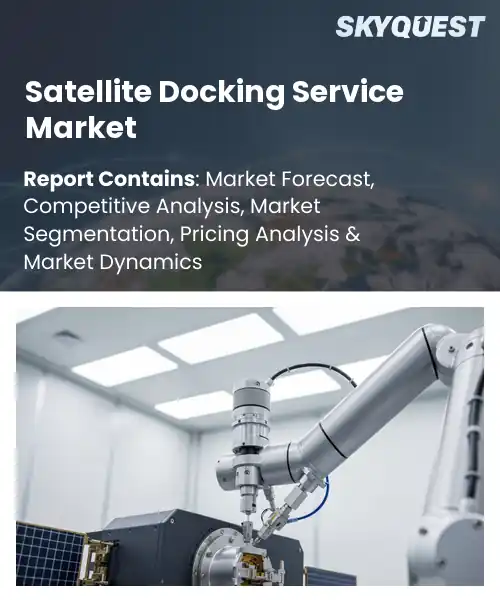
Satellite Docking Service Market
Report ID: SQMIG20A2820
Report ID: SQMIG20A2820
[email protected]
USA +1 351-333-4748
Report ID:
SQMIG20A2820 |
Region:
Global |
Published Date: August, 2026
Pages:
157
|Tables:
118
|Figures:
77


Global Satellite Docking Service Market size was valued at USD 1.92 Billion in 2024 and is poised to grow from USD 2.26 Billion in 2025 to USD 8.26 Billion by 2033, growing at a CAGR of 17.6% during the forecast period (2026-2033).
The satellite docking service market share allows spacecraft to rendezvous, dock and transfer payloads in orbit, a capability essential to extending lifespans and reducing launch costs. Its main driver is in-orbit servicing demand propelled by operators’ need to refurbish aging geostationary assets and support low Earth orbit constellations. Early demonstrations like DARPA’s Orbital Express (2007) and ESA’s Dextre showed feasibility, and missions like Northrop Grumman’s Mission Extension Vehicle (2020) proved viability. For the last 10 years the market has changed from prototypes to services with investment in adapters and navigation. This evolution paves the way for catalysts that will change the game.
Satellite docking service market growth is fueled by the surge of constellation projects, as every new satellite increases the chances of failures in orbit that need repair or repositioning. The need to refuel and relocate is of interest to operators such as SpaceX and OneWeb, and therefore manufacturers are moving toward standardized docking ports for payloads. This creates demand for autonomous rendezvous software and robotic arms, lowering mission costs and reducing turnaround. A 2023 pilot between Astroscale and an operator demonstrated how debris removal combined with docking can create revenue while meeting sustainability regulations. Hence, projection shows good double digit growth on the back of incentives, technological maturity and extending satellite life.
How is AI Enhancing Efficiency in the Satellite Docking Service Market?
AI is revolutionizing satellite docking service market trends, automating trajectory planning, sensor fusion and real-time decision making. Using machine learning algorithms to predict optimal approach paths, cutting down on the amount of time needed for alignment and fuel consumption. AI-powered vision systems process docking camera input to enable accurate contact detection, including in low-light environments. These capabilities simplify operations for both commercial constellations and government missions, resulting in faster and more reliable docking cycles. As the market grows with more on-orbit servicing contracts, it’s becoming more competitive, and operators are using AI to reduce operational costs and increase mission throughput.
For example, Northrop Grumman announced an AI-enhanced autonomous docking module in June 2023. Intelligent control minimizes crew intervention and maximizes service turnaround, thereby driving market growth.
Market snapshot - (2026-2033)
Global Market Size
USD 1.92 Billion
Largest Segment
Autonomous Docking
Fastest Growth
Refueling Services
Growth Rate
17.6% CAGR
To get more insights on this market click here to Request a Free Sample Report
Global satellite docking service market is segmented by service type, satellite type, application, end user and region. Based on service type, the market is segmented into autonomous docking, assisted docking, refueling services and servicing & maintenance. Based on satellite type, the market is segmented into communication satellites, earth observation satellites and scientific satellites. Based on application, the market is segmented into life extension, orbital transfer and debris mitigation. Based on end user, the market is segmented into commercial operators, government agencies and defense. Based on region, the market is segmented into North America, Europe, Asia Pacific, Latin America and Middle East & Africa.
Autonomous docking segment dominates because it eliminates the need for human intervention, reducing operational risk and lowering launch costs. Advanced AI algorithms enable precise maneuvering in congested orbital environments, which builds confidence among satellite owners. The reliability of fully automated rendezvous fosters repeat business, encouraging manufacturers to design compatible interfaces. Consequently, providers that master autonomy capture the majority of contracts, shaping the market’s value chain toward fully self-governing services.
Meanwhile, refueling services segment is witnessing the strongest growth momentum because emerging electric propulsion architectures demand in orbit propellant replenishment. Satellite operators seek to extend mission life without launching replacements, driving demand for on-site fuel transfer. Innovative docking adapters and modular fuel tanks accelerate adoption, creating new revenue streams and expanding the market’s long term sustainability.
Life extension segment dominates because it directly addresses the high cost of building new satellites, motivating operators to preserve existing assets. Docking services that enable hardware upgrades, battery swaps, and software refreshes provide a cost effective alternative to replacement launches. This value proposition resonates across commercial and governmental fleets, prompting contracts that prioritize longevity. As a result, providers specializing in extension capabilities capture the bulk of market activity.
Conversely, debris mitigation segment is emerging as the key high growth area because regulatory pressure and rising collision risk push operators toward active removal solutions. Docking platforms capable of capturing defunct hardware enable simultaneous disposal and service functions, creating dual value propositions. This synergy fuels investment in debris focused missions, spurring market expansion and opening new avenues for service providers.
To get detailed segments analysis, Request a Free Sample Report
The combination of sophisticated engineering, robust launch infrastructure and a policy environment favoring both public and private investments ensures that North America continues to hold its leading position. The U.S. has a deep bench of aerospace know-how, a legacy of government-led research, and a vibrant commercial sector that iterates quickly on docking technologies. Canada has specialized skills in robotics and remote operations, in close collaboration with U.S. partners. Market confidence is also underpinned by strong defense contracts and a focus on standards harmonization. All of these are creating a strong ecosystem that attracts global customers looking for reliable end-to-end satellite docking solutions. A strong supply chain of component manufacturers, test facilities and software developers also exists in the area to allow for fast prototyping and deployment. Furthermore, collaborative research between universities and private labs expedites the innovation cycle, ensuring that North America remains at the cutting edge of autonomous docking technology.
Satellite docking service market outlook in the United States thrives on a blend of federal research agencies, leading aerospace corporations, and a venture ecosystem. Established launch sites provide reliable access to orbit, while a culture of rapid prototyping accelerates technology validation. Close alignment with defense objectives ensures rigorous testing standards, and extensive satellite constellations create persistent demand for on‑orbit servicing and refueling capabilities, reinforcing the United States as a central hub for docking innovation.
Satellite docking service market forecast in Canada leverages strong expertise in robotic manipulation and autonomous systems, cultivated through national research institutes and close ties with the United States aerospace community. Government incentives promote the development of precision docking hardware, while emerging private firms focus on modular service platforms. The emphasis on reliability and safety aligns with the country’s broader commitment to sustainable space operations, positioning Canada as a valuable partner in cross‑border docking projects.
The coordinated multi-nation initiatives, the mature industrial base and the strategic focus on orbital sustainability are fueling Europe’s rapid expansion. We have joint programs run by the European Space Agency , which combines resources and expertise across member states . That produces standardization and cost efficiencies . The national space agencies in Germany, the United Kingdom and France are driving complementary strengths, advanced propulsion research, innovative service business models and large satellite constellations. Strong funding mechanisms are beneficial for both flagship missions and agile startups, allowing for fast technology maturation. The market attractiveness is further strengthened by a robust regulatory framework that stresses debris mitigation and interoperability, drawing in global partners seeking dependable docking solutions in a collaborative European ecosystem. Moreover, the strong pool of engineering talent in the region and the long-standing tradition of working together across borders mean that new concepts for docking can quickly be integrated into operational missions, further strengthening Europe’s position as a leading growth market for satellite servicing.
Satellite docking service market regional outlook in Germany is emerging through a focused blend of high‑precision engineering and strong government‑backed research programs. German firms excel at developing reliable docking mechanisms and adaptive control algorithms, while academic institutions collaborate on advanced materials for space‑qualified hardware. Targeted funding encourages pilot projects that integrate docking capabilities with existing satellite platforms, fostering a nascent but rapidly maturing ecosystem. This emerging strength positions Germany as an increasingly influential contributor to Europe’s overall docking services landscape.
Satellite docking service market regional forecast in the United Kingdom is growing at the fastest pace, driven by an entrepreneurial ecosystem that merges cutting‑edge research with commercial ambition. British enterprises focus on modular docking interfaces and AI‑enabled autonomy, leveraging strong ties to academic spin‑outs. Government policy emphasizes export‑oriented space services, providing incentives for demonstration missions that showcase rapid integration capability. This accelerated momentum cultivates a vibrant market where innovative docking solutions are quickly scaled to meet global demand.
Satellite docking service market analysis in France holds a dominant role, anchored by a mature industrial supply chain and extensive satellite constellation operations. French aerospace groups specialize in high‑reliability docking hardware and integrated service platforms, benefitting from longstanding collaboration with the European Space Agency. National policy prioritizes autonomous on‑orbit servicing, encouraging the deployment of large‑scale demonstration projects that validate end‑to‑end docking workflows. This leadership reinforces France’s position as a cornerstone of Europe’s satellite servicing ecosystem.
Asia Pacific is reinforcing its position with a combination of strategic government investment, world-class manufacturing capability and increasing appetite for autonomous on-orbit operations. Japan is using its heritage of precision robotics and a strong launch industry to lead the way in fully autonomous docking procedures, while South Korea is focusing on the rapid fabrication of compact docking units and integration with its growing constellation of satellites. Collaborative research consortia throughout the region accelerate knowledge transfer and a supportive regulatory environment encourages commercial services to go from concept to operational status. The partnership boosts the region’s attractiveness to international partners looking for reliable, cost-effective docking solutions, positioning Asia Pacific as a fast-growing hub for satellite servicing innovation. Also, the emerging private launch market in the region provides frequent flight opportunities, enabling docking service providers to test and iterate their technologies at an unprecedented pace.
Satellite docking service market penetration in Japan builds on a legacy of precision engineering and a forward‑looking space policy that encourages autonomous servicing. Japanese firms excel at developing high‑fidelity docking sensors and resilient mechanical interfaces, supported by deep expertise in micro‑gravity experimentation. Close collaboration between national agencies and industrial partners nurtures rapid technology transfer, while dedicated testbeds enable full‑scale validation of docking procedures. This comprehensive capability set positions Japan as a pioneering force in reliable on‑orbit docking solutions.
Satellite docking service industry in South Korea emphasizes compact, modular docking units designed for integration with its expanding constellation of communication satellites. Korean companies leverage strong capabilities in lightweight materials and additive manufacturing to produce cost‑effective docking hardware. Government programmes provide seed funding for demonstration missions, fostering a collaborative ecosystem that includes universities, research institutes, and start‑ups. This focus on rapid, scalable solutions accelerates South Korea’s emergence as a key player in the regional satellite servicing landscape.
To know more about the market opportunities by region and country, click here to
Buy The Complete Report
Increasing Demand for On‑Orbit Services
Advancements in Autonomous Docking Technology
High Cost of Docking Infrastructure
Regulatory Uncertainty Across Jurisdictions
Request Free Customization of this report to help us to meet your business objectives.
The global satellite docking service market is characterized by competition among established aerospace companies and emerging space servicing firms developing autonomous rendezvous, docking, in-orbit servicing, refueling, and debris removal technologies. Companies compete through strategic partnerships with government space agencies, commercial satellite operators, and defense organizations while investing in robotic servicing systems, autonomous navigation, orbital logistics, and standardized docking interfaces. Increasing demand for satellite life extension, on-orbit maintenance, active debris removal, and sustainable space operations continues to drive technological innovation and strengthen competitive positioning as governments and commercial operators seek to maximize the value of orbital assets.
Founded in 2019, Starfish Space develops autonomous satellite servicing technologies that enable spacecraft to dock with, inspect, maneuver, and extend the operational life of satellites in orbit. The company is advancing its Otter servicing spacecraft, which combines autonomous navigation, precision rendezvous, and propulsion technologies to provide commercial life-extension services for satellites operating in Earth orbit. Starfish has secured contracts with NASA, the U.S. Space Force, and commercial satellite operators to accelerate the commercialization of in-orbit servicing capabilities.
Established in 2020, Rogue Space Systems develops autonomous robotic spacecraft designed for satellite inspection, maintenance, relocation, and orbital logistics. The company focuses on scalable spacecraft capable of performing proximity operations, space domain awareness missions, and future docking services for commercial and government customers. Rogue has expanded partnerships with defense organizations and commercial operators while advancing autonomous servicing technologies.
Top Player’s Company Profile
Recent Developments in the Satellite Docking Service Market
SkyQuest’s ABIRAW (Advanced Business Intelligence, Research & Analysis Wing) is our Business Information Services team that Collects, Collates, Correlates, and Analyses the Data collected by means of Primary Exploratory Research backed by robust Secondary Desk research. As per SkyQuest analysis, the market is being propelled primarily by the surge in demand for on‑orbit services as commercial constellations grow, while the rapid maturation of autonomous docking technology serves as a second strong catalyst that trims mission timelines and costs. The autonomous docking segment currently commands the largest share, thanks to its ability to eliminate human intervention and lower launch expenses. North America remains the dominant region, leveraging deep aerospace expertise, extensive launch infrastructure and supportive policy frameworks. However, the high cost of developing and certifying space‑qualified docking hardware acts as a notable restraint, tempering broader adoption until economies of scale improve.
| Report Metric | Details |
|---|---|
| Market size value in 2024 | USD 1.92 Billion |
| Market size value in 2033 | USD 8.26 Billion |
| Growth Rate | 17.6% |
| Base year | 2024 |
| Forecast period | (2026-2033) |
| Forecast Unit (Value) | USD Billion |
| Segments covered |
|
| Regions covered | North America (US, Canada), Europe (Germany, France, United Kingdom, Italy, Spain, Rest of Europe), Asia Pacific (China, India, Japan, Rest of Asia-Pacific), Latin America (Brazil, Rest of Latin America), Middle East & Africa (South Africa, GCC Countries, Rest of MEA) |
| Companies covered |
|
| Customization scope | Free report customization with purchase. Customization includes:-
|
To get a free trial access to our platform which is a one stop solution for all your data requirements for quicker decision making. This platform allows you to compare markets, competitors who are prominent in the market, and mega trends that are influencing the dynamics in the market. Also, get access to detailed SkyQuest exclusive matrix.
Table Of Content
Executive Summary
Market overview
Parent Market Analysis
Market overview
Market size
KEY MARKET INSIGHTS
COVID IMPACT
MARKET DYNAMICS & OUTLOOK
Market Size by Region
KEY COMPANY PROFILES
Methodology
For the Satellite Docking Service Market, our research methodology involved a mixture of primary and secondary data sources. Key steps involved in the research process are listed below:
1. Information Procurement: This stage involved the procurement of Market data or related information via primary and secondary sources. The various secondary sources used included various company websites, annual reports, trade databases, and paid databases such as Hoover's, Bloomberg Business, Factiva, and Avention. Our team did 45 primary interactions Globally which included several stakeholders such as manufacturers, customers, key opinion leaders, etc. Overall, information procurement was one of the most extensive stages in our research process.
2. Information Analysis: This step involved triangulation of data through bottom-up and top-down approaches to estimate and validate the total size and future estimate of the Satellite Docking Service Market.
3. Report Formulation: The final step entailed the placement of data points in appropriate Market spaces in an attempt to deduce viable conclusions.
4. Validation & Publishing: Validation is the most important step in the process. Validation & re-validation via an intricately designed process helped us finalize data points to be used for final calculations. The final Market estimates and forecasts were then aligned and sent to our panel of industry experts for validation of data. Once the validation was done the report was sent to our Quality Assurance team to ensure adherence to style guides, consistency & design.
Analyst Support
Customization Options
With the given market data, our dedicated team of analysts can offer you the following customization options are available for the Satellite Docking Service Market:
Product Analysis: Product matrix, which offers a detailed comparison of the product portfolio of companies.
Regional Analysis: Further analysis of the Satellite Docking Service Market for additional countries.
Competitive Analysis: Detailed analysis and profiling of additional Market players & comparative analysis of competitive products.
Go to Market Strategy: Find the high-growth channels to invest your marketing efforts and increase your customer base.
Innovation Mapping: Identify racial solutions and innovation, connected to deep ecosystems of innovators, start-ups, academics, and strategic partners.
Category Intelligence: Customized intelligence that is relevant to their supply Markets will enable them to make smarter sourcing decisions and improve their category management.
Public Company Transcript Analysis: To improve the investment performance by generating new alpha and making better-informed decisions.
Social Media Listening: To analyze the conversations and trends happening not just around your brand, but around your industry as a whole, and use those insights to make better Marketing decisions.
REQUEST FOR SAMPLE
 REQUEST FREE CUSTOMIZATION
Global Satellite Docking Service Market size was valued at USD 1.92 Billion in 2024 and is poised to grow from USD 2.26 Billion in 2025 to USD 8.26 Billion by 2033, growing at a CAGR of 17.6% during the forecast period (2026-2033).
The competitive landscape of the Global Satellite Docking Service Market is shaped by a few dominant aerospace firms leveraging strategic acquisitions, joint ventures, and cutting‑edge autonomous docking technologies to secure contract wins and expand service portfolios. Recent mergers between established satellite manufacturers and specialized docking service providers, as well as partnerships with government space agencies, are accelerating technology integration and creating new entry barriers for emerging players. 'Northrop Grumman Corporation', 'Starfish Space Inc.', 'Astroscale Holdings Inc.', 'Orbit Fab, Inc.', 'ClearSpace SA', 'D-Orbit S.p.A.', 'Rogue Space Systems Corporation', 'Lockheed Martin Corporation', 'SpaceX', 'Blue Origin, LLC', 'Redwire Corporation', 'Voyager Technologies, Inc.', 'Thales Alenia Space', 'Airbus Defence and Space', 'L3Harris Technologies, Inc.', 'Sierra Space Corporation', 'ispace, inc.', 'Exotrail', 'Infinite Orbits SAS', 'LeoLabs, Inc.'
Rapid growth in commercial satellite constellations is creating a sustained need for reliable on‑orbit docking capabilities, which enables efficient transfer of payloads, refueling, and upgrades. Service providers that can deliver modular docking solutions are positioned to capture a larger share of the expanding market. This demand drives investment in advanced guidance, navigation, and control technologies, fostering an ecosystem where operators prioritize flexible docking services to extend mission lifespans and enhance operational agility. This flexibility also reduces launch costs and encourages satellite operators to plan longer service cycles.
Autonomous Docking Evolution: The emergence of fully autonomous docking systems is reshaping satellite servicing strategies. Operators are adopting AI‑driven guidance and sensor fusion to execute rendezvous without human intervention, reducing crew dependence and operational latency. This shift enables continuous on‑orbit servicing, longer mission lifespans, and rapid response to constellation maintenance needs. Companies are investing in modular robotic arms and vision‑based navigation suites, positioning autonomous docking as a cornerstone of next‑generation orbital logistics and cost‑effective asset management for both commercial and governmental fleets worldwide.
Why does North America Dominate the Global Satellite Docking Service Market? |@12


Want to customize this report? This report can be personalized according to your needs. Our analysts and industry experts will work directly with you to understand your requirements and provide you with customized data in a short amount of time. We offer $1000 worth of FREE customization at the time of purchase.
Feedback From Our Clients


 USA (+1) 351-333-4748

