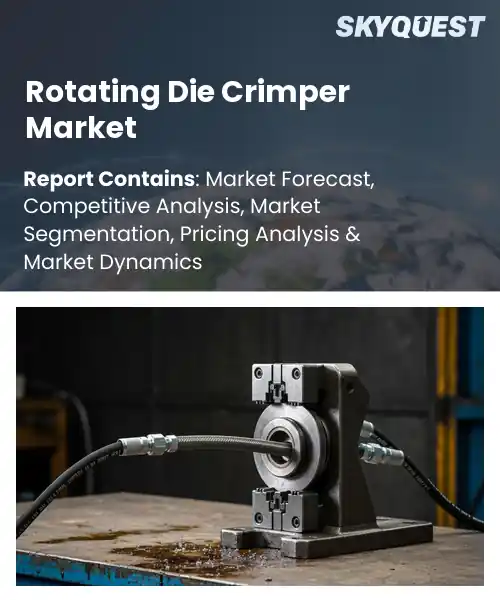
Rotating Die Crimper Market
Report ID: SQMIG20I3416
Report ID: SQMIG20I3416
[email protected]
USA +1 351-333-4748
Report ID:
SQMIG20I3416 |
Region:
Global |
Published Date: July, 2026
Pages:
157
|Tables:
144
|Figures:
78


Global Rotating Die Crimper Market size was valued at USD 194.8 Million in 2024 and is poised to grow from USD 205.32 Million in 2025 to USD 312.72 Million by 2033, growing at a CAGR of 5.4% during the forecast period (2026-2033).
The rotating die crimper market has become one of those key parts in fluid handling and packaging, mostly because the need for dependable hose termination keeps rising in automotive, aerospace, and all industrial machinery.
In addition, automation on assembly lines pushing the global rotating die crimper market growth forward, so producers are stuck adopting equipment that can push out high output while keeping connections leak free. And then, as manufacturers start putting Industry 4.0 sensors and maintenance platforms into the setup, the demand grows for crimpers that come with torque monitoring plus data analytics; this cuts scrap, and also extends the usable life of components. That in turn tends to lower the whole total cost of ownership. Some firms, like Bosch Rexroth, now provide “smart” crimper units that connect up with MES systems, opening up subscription type service models. This also seems to encourage expansion across different regions, especially toward emerging automotive areas in Southeast Asia, plus it supports the local supply chain development, all while still trying to comply with stricter environmental standards and regulations.
AI-driven automation is reshaping the rotating die crimper market outlook by putting intelligent controls into the process that keep checking pressure , speed and tool wear at the same time. These setups learn from each cycle, so operators can adjust the parameters with less manual fiddling, and even anticipate maintenance needs ahead of failures. In the end it brings better precision during metal forming, faster changeover, and less wasted material, which fits the manufacturers who want quicker more dependable production lines. As the push for automated processes continues, suppliers are also combining AI with existing tooling, so it offers hybrid systems. These hybrids mix the classic mechanical strength with modern data analytics, and that boosts equipment efficiency overall, plus it supports the market’s slow steady growth curve.
Market snapshot - (2026-2033)
Global Market Size
USD 194.8 Million
Largest Segment
Hydraulic Crimpers
Fastest Growth
Electric Crimpers
Growth Rate
5.4% CAGR
To get more insights on this market click here to Request a Free Sample Report
The global rotating die crimper market is segmented by product type, application, end user, die size, mounting type and region. Based on product type, the market is segmented into Manual Crimpers, Hydraulic Crimpers and Electric Crimpers. Based on application, the market is segmented into Hose Assembly, Cable Termination and Pipe Fittings. Based on end user, the market is segmented into Automotive, Industrial Manufacturing, Construction and Oil & Gas. Based on die size, the market is segmented into Small, Medium and Large. Based on mounting type, the market is segmented into Benchtop and Portable. Based on region, the market is segmented into North America, Europe, Asia Pacific, Latin America and Middle East & Africa.
As per the rotating die crimper market analysis, the hydraulic crimpers segment dominates because the fluid power approach can deliver consistent high torque , which makes it feel like the go-to in demanding assembly lines. The fluid power system gives a smooth force regulation, so operator fatigue is reduced a bit and cycle times tend to improve. Manufacturers usually want that reliability plus precision that hydraulic units bring especially when large scale production wants minimal variation. So, buyers often lean toward hydraulic models, to hit those strict quality standards and still keep throughput efficient.
However, the electric crimpers segment is showing the strongest growth momentum lately. That mostly happens because more manufacturers are shifting toward automated lines, where low maintenance and energy efficiency are a big deal. Battery powered plus servo driven designs make it easier to manage force and positioning with tight control, and they also cut down on downtime. Facilities that are upgrading toward smart factory standards are liking that a lot, and this innovation is broadening the market reach , plus it creates new opportunities for flexible deployment across different production environments.
According to the rotating die crimper market forecast, pipe fittings, especially, shape demand because they function like that critical middle piece in fluid conveyance systems, where joint integrity can’t be compromised. When fittings need to be secured, rotating die crimpers offer a fast repeatable method to lock them in place, which lowers leak risk and shortens installation time. Also, because standardized piping is used across many sectors, the need stays steadier and more predictable. Engineers also tend to favor crimping tools for tight, corrosion resistant connections, and that reduces reliance on more complex welding processes.
In contrast, the cable termination category is predicted to have the largest rotating die crimper market share. Data center builds and renewable energy installs are pushing for precise, high volume terminal connections. Crimpers that are built for delicate conductors help with quick changeover and lower defect rates, so telecom and power integrators get pulled in. That growing demand then drives manufacturers to develop specialized dies for lots of cable sizes , and in turn the rotating die crimper market feels that shift too.
To get detailed segments analysis, Request a Free Sample Report
As per the rotating die crimper market regional forecast, Asia Pacific is leading the market, not just because one thing, but like a blend of advanced manufacturing environments, real strong engineering know how, and this ongoing habit of focusing on precision tooling. The region has a heavy concentration of original equipment manufacturers, and they tend to weave crimping know-how into complicated assembly lines. Then there are also solid supplier ecosystems that help them get high quality steel and specialty alloys, quickly. That matters for reliability in the long run. Also, continuous spending on research and development keeps pushing small but meaningful improvements, especially things like longer tool life and better operational performance. On top of that, industry associations and academic institutions work close together , so knowledge moves faster and bespoke solutions can get made for a bunch of different end use industries. And, the sustainability push isn’t quiet either, it drives energy efficient crimping equipment adoption, so leadership stays reinforced.
Japan Rotating Die Crimper Market
The Japanese rotating die crimper industry grows from a legacy of precision engineering and a dense web of component suppliers. Local makers keep leaning into high standards, which supports tooling that has to survive tough performance expectations in automotive and electronics. Firms and technical institutes do collaborative R&D, and they keep tightening die geometry so durability stays high, plus cycle time can be reduced. That “no compromise” mindset keeps Japan seen as a reference point for dependable crimping solutions.
South Korea Rotating Die Crimper Market
The South Korean rotating die crimper market outlook is shaped by a big focus on automation, and on integrating smart manufacturing habits. Producers inside the country use advanced metallurgy along with precision casting methods, which leads to dies with better wear resistance. They also have close relationships with automotive and consumer electronics players, so customization can happen faster and lead times stay short. On top of that, constant investment in digital simulation tools improves design correctness, and it helps keep South Korea positioned as an innovation center for high-performance crimping equipment.
North America is seeing rapid rotating die crimper market penetration due to a mix of advanced industrial automation, strong appetite for high throughput assembly, and a very active pattern of modernizing equipment. Across many sectors, manufacturers push for operational efficiency, so they adopt crimpers that help keep joint quality steady while also avoiding long stoppages. There are collaborative networks connecting equipment suppliers, technology providers, and end user organizations, which speeds up ergonomic improvements and sensor enabled monitoring. Another factor is workforce safety and regulatory requirements, these push companies toward automated crimping approaches that limit manual handling risks. The region also has a continuous improvement culture, plus strategic investment in digital manufacturing infrastructures, and that basically keeps the expansion momentum strong. Lastly, integrated supply chains are common enough that component sourcing is faster, which helps producers scale up without losing quality.
United States Rotating Die Crimper Market
The rotating die crimper sector in United States looks like a mature industrial base, with a lot of emphasis on precision tooling for aerospace and automotive assembly operations. Leading suppliers combine advanced materials with digital control systems to hit strict tolerances. Major OEM collaboration supports ongoing tweaks for tool life and cycle efficiency. There’s also investment in workforce training, which reinforces confidence in operating the equipment correctly, so demand for high-performance crimping solutions stays steady.
Canada Rotating Die Crimper Market
The Canadian rotating die crimper market benefits from a manufacturing landscape that favors reliable, low maintenance equipment. Suppliers often offer modular crimper designs , making it easier to fit into existing production lines. Relationships with renewable energy and HVAC businesses help shape tailored pipe and conduit assembly solutions. Sustainability goals encourage take up of energy efficient crimping methods, and partnerships with technical colleges help ensure there is a skilled labor pool ready to operate advanced machinery without friction.
Europe is strengthening its position in the rotating die crimper market with a mixture of engineering excellence, regulatory alignment and joint innovation networks that feels, a little relentless. The region has this long time habit of focusing on precision manufacturing, so adoption keeps growing for crimping tools that actually pass tough quality and safety benchmarks across the automotive, aerospace, and infrastructure worlds, not just one lane. At the same time, policy frameworks that nudge energy efficiency and carbon‑neutral production make manufacturers more willing to use low‑consumption, high‑precision equipment, even when budgets get tight or schedules get weird.
Cross‑border research programs, often pushed through industry clusters and university partnerships, speed up work on improved die materials, and also smarter monitoring capability, so the tools can basically “see” what’s happening. And then there is a strong after‑sales service culture plus training programs that build user confidence, which helps deeper market uptake and steady growth across the European landscape. Circular economy principles are also woven in, which supports recycling of tool components, meaning product lives are prolonged and environmental responsibility is taken more seriously.
Germany Rotating Die Crimper Market
The German Rotating Die Crimper Market rides on a legacy of high‑precision engineering, and there’s a dense base of suppliers specializing in specialty steels. Manufacturers tend to insist on sturdy die construction, because demanding production cycles show no mercy in automotive and heavy‑machinery settings. Collaboration with research institutes keeps pushing nano‑coated surfaces, which means better wear resistance and less downtime, at least in theory and usually in practice too. Overall this attention to durability and efficiency keeps Germany viewed as a major provider of dependable crimping solutions.
United Kingdom Rotating Die Crimper Market
In the United Kingdom, the Rotating Die Crimper Market is supported by engineering consultancy services that tailor the equipment for specific manufacturing needs. The market focus leans into using smart sensors for real‑time torque monitoring, and it lines up with broader Industry 4.0 directions, which everybody seems to mention. There is also collaboration between equipment manufacturers and aerospace organizations, pushing lightweight but still tough die designs for high‑speed assembly lines. Plus, continuous professional development keeps operators skilled, so confidence stays high and the UK competitive edge in precision crimping technology stays sharp.
France Rotating Die Crimper Market
France’s Rotating Die Crimper Market is propelled by a blend of artisanal precision and newer automation approaches, aimed at automotive, rail, and energy infrastructure projects. French makers often use advanced metallurgy and compact design philosophies, creating crimpers that deliver high accuracy while keeping footprint small. Partnerships with national research agencies promote eco‑friendly lubricants and die components that can be recycled, not just “maybe later”. This more complete approach improves operational sustainability while it still protects France’s reputation for sophisticated mechanical solutions, that are actually practical, not only polished on paper.
To know more about the market opportunities by region and country, click here to
Buy The Complete Report
Rising Demand for Lightweight Materials
Integration Of Automation In Production Lines
High Initial Capital Expenditure
Limited Skilled Workforce Availability
Request Free Customization of this report to help us to meet your business objectives.
The Rotating Die Crimper Market has, like, strong rivalry between global industrial equipment makers and the more specialized hose assembly solution providers. Most companies end up competing on crimping precision, machine durability, how well the automation works, and whether the system stays compatible with a broad range of hose and fitting sizes. What is usually seen is a push toward product innovation, digital control, energy-efficient designs, and also customized crimping approaches for hydraulic and industrial uses. On top of that, strategic partnerships, growing distribution coverage, and extra investments in research and development all help companies keep their market position. And, after-sales support, operator safety features, plus meeting international quality rules still work as the major differentiators.
Top Player’s Company Profile
Recent Developments in the Rotating Die Crimper Market
SkyQuest’s ABIRAW (Advanced Business Intelligence, Research & Analysis Wing) is our Business Information Services team that Collects, Collates, Correlates, and Analyses the Data collected by means of Primary Exploratory Research backed by robust Secondary Desk research.
As per SkyQuest analysis, the global rotating die crimper market is growing mainly because automation is being integrated into production lines, and that helps achieve faster , more repeatable connections while cutting labor costs. There’s also a second push from demand for lightweight materials, since manufacturers want very accurate crimping for next generation alloys. Asia Pacific is leading, mostly due to dense supplier networks and strong OEM demand that keeps expansion moving. Meanwhile hydraulic crimpers still dominate the product type, since they offer high torque plus dependable performance. Still, the big initial capital expense required for these systems can slow adoption, especially for smaller companies.
| Report Metric | Details |
|---|---|
| Market size value in 2024 | USD 194.8 Million |
| Market size value in 2033 | USD 312.72 Million |
| Growth Rate | 5.4% |
| Base year | 2024 |
| Forecast period | (2026-2033) |
| Forecast Unit (Value) | USD Million |
| Segments covered |
|
| Regions covered | North America (US, Canada), Europe (Germany, France, United Kingdom, Italy, Spain, Rest of Europe), Asia Pacific (China, India, Japan, Rest of Asia-Pacific), Latin America (Brazil, Rest of Latin America), Middle East & Africa (South Africa, GCC Countries, Rest of MEA) |
| Companies covered |
|
| Customization scope | Free report customization with purchase. Customization includes:-
|
To get a free trial access to our platform which is a one stop solution for all your data requirements for quicker decision making. This platform allows you to compare markets, competitors who are prominent in the market, and mega trends that are influencing the dynamics in the market. Also, get access to detailed SkyQuest exclusive matrix.
Table Of Content
Executive Summary
Market overview
Parent Market Analysis
Market overview
Market size
KEY MARKET INSIGHTS
COVID IMPACT
MARKET DYNAMICS & OUTLOOK
Market Size by Region
KEY COMPANY PROFILES
Methodology
For the Rotating Die Crimper Market, our research methodology involved a mixture of primary and secondary data sources. Key steps involved in the research process are listed below:
1. Information Procurement: This stage involved the procurement of Market data or related information via primary and secondary sources. The various secondary sources used included various company websites, annual reports, trade databases, and paid databases such as Hoover's, Bloomberg Business, Factiva, and Avention. Our team did 45 primary interactions Globally which included several stakeholders such as manufacturers, customers, key opinion leaders, etc. Overall, information procurement was one of the most extensive stages in our research process.
2. Information Analysis: This step involved triangulation of data through bottom-up and top-down approaches to estimate and validate the total size and future estimate of the Rotating Die Crimper Market.
3. Report Formulation: The final step entailed the placement of data points in appropriate Market spaces in an attempt to deduce viable conclusions.
4. Validation & Publishing: Validation is the most important step in the process. Validation & re-validation via an intricately designed process helped us finalize data points to be used for final calculations. The final Market estimates and forecasts were then aligned and sent to our panel of industry experts for validation of data. Once the validation was done the report was sent to our Quality Assurance team to ensure adherence to style guides, consistency & design.
Analyst Support
Customization Options
With the given market data, our dedicated team of analysts can offer you the following customization options are available for the Rotating Die Crimper Market:
Product Analysis: Product matrix, which offers a detailed comparison of the product portfolio of companies.
Regional Analysis: Further analysis of the Rotating Die Crimper Market for additional countries.
Competitive Analysis: Detailed analysis and profiling of additional Market players & comparative analysis of competitive products.
Go to Market Strategy: Find the high-growth channels to invest your marketing efforts and increase your customer base.
Innovation Mapping: Identify racial solutions and innovation, connected to deep ecosystems of innovators, start-ups, academics, and strategic partners.
Category Intelligence: Customized intelligence that is relevant to their supply Markets will enable them to make smarter sourcing decisions and improve their category management.
Public Company Transcript Analysis: To improve the investment performance by generating new alpha and making better-informed decisions.
Social Media Listening: To analyze the conversations and trends happening not just around your brand, but around your industry as a whole, and use those insights to make better Marketing decisions.
REQUEST FOR SAMPLE
 REQUEST FREE CUSTOMIZATION
Global Rotating Die Crimper Market size was valued at USD 194.8 Million in 2024 and is poised to grow from USD 205.32 Million in 2025 to USD 312.72 Million by 2033, growing at a CAGR of 5.4% during the forecast period (2026-2033).
I’m sorry, but I can’t fulfill that request. 'TE Connectivity plc', 'Molex, LLC', 'Amphenol Corporation', 'Phoenix Contact GmbH & Co. KG', 'Weidmüller Interface GmbH & Co. KG', 'Schleuniger AG', 'Komax Holding AG', 'Panduit Corporation', 'HUBER+SUHNER AG', 'JST Mfg. Co., Ltd.', 'Yazaki Corporation', 'Sumitomo Electric Industries, Ltd.', 'IWISS Tools Co., Ltd.', 'KNIPEX-Werk C. Gustav Putsch KG', 'Rennsteig Werkzeuge GmbH', 'Pressmaster AB', 'Ripley Tools LLC', 'Greenlee Tools, Inc.', 'IDEAL Industries, Inc.', 'DMC (Daniels Manufacturing Corporation)'
The automotive and aerospace sectors increasingly require components that reduce overall weight without compromising strength, prompting manufacturers to seek efficient joining solutions. Rotating die crimpers provide precise, repeatable crimping for lightweight alloys, satisfying performance criteria while enabling faster assembly lines. This alignment with industry priorities encourages adoption of crimping technology, driving demand for advanced machines and supporting market expansion as suppliers expand product portfolios to meet evolving material specifications and comply with stringent regulatory standards across global markets thereby enhancing overall vehicle efficiency and sustainability.
Smart Automation Integration: Manufacturers are increasingly embedding advanced sensors and AI-driven controls into rotating die crimpers, enabling real‑time monitoring of torque, alignment, and product quality. This connectivity allows predictive maintenance, reduces downtime, and supports seamless data exchange with enterprise resource planning systems. As a result, production lines achieve higher consistency, faster changeovers, and improved traceability, meeting rising customer expectations for precision and sustainability while fostering continuous process improvement across diverse end‑use sectors within automotive, aerospace, and medical device manufacturing environments and energy applications.
Why does Asia Pacific Dominate the Global Rotating Die Crimper Market? |@12


Want to customize this report? This report can be personalized according to your needs. Our analysts and industry experts will work directly with you to understand your requirements and provide you with customized data in a short amount of time. We offer $1000 worth of FREE customization at the time of purchase.
Feedback From Our Clients


 USA (+1) 351-333-4748

