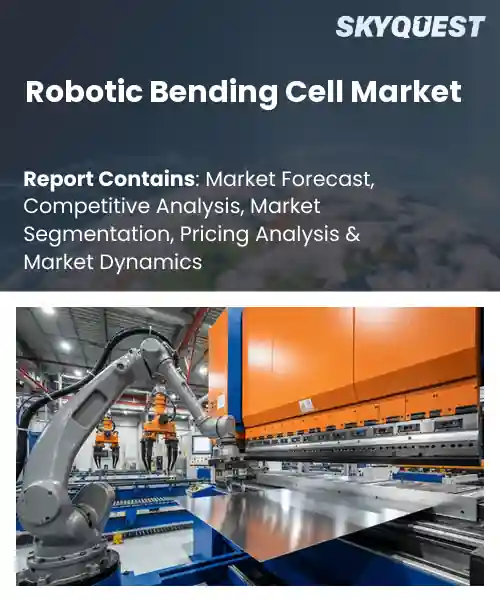
Robotic Bending Cell Market
Report ID: SQMIG20I3425
Report ID: SQMIG20I3425
[email protected]
USA +1 351-333-4748
Report ID:
SQMIG20I3425 |
Region:
Global |
Published Date: July, 2026
Pages:
157
|Tables:
144
|Figures:
78


Global Robotic Bending Cell Market size was valued at USD 1.38 Billion in 2024 and is poised to grow from USD 1.5 Billion in 2025 to USD 2.85 Billion by 2033, growing at a CAGR of 8.4% during the forecast period (2026-2033).
The global robotic bending cell industry comprises automated workstations that perform tube, pipe and sheet metal bending with precision robots, vision systems and software controllers. Its relevance stems from the need to boost production speed while reducing scrap in automotive, aerospace and energy sectors.
Over the past decade, collaborative robots and digital twins have accelerated adoption, enabling mid‑size manufacturers to achieve aerospace‑level tolerances without massive capital outlay for future growth strategically. The next pivotal factor driving market expansion is the integration of Industry 4.0 connectivity, which converts isolated bending cells into data‑rich hubs feeding real‑time analytics. When machines transmit torque, force and positional data to cloud platforms, manufacturers can predict tool wear, schedule maintenance and adjust feed rates, thereby cutting downtime by up to 30 percent. A concrete example is Holyoke’s implementation at a German automotive supplier, where linked cells reduced scrap from 2.8 % to 0.7 % within six months. This cause‑and‑effect loop not only improves margins but also creates a platform for future services such as remote optimization and pay‑per‑use models today.
How are AI and IoT integration influencing the robotic bending cell market?
AI and IoT are reshaping the robotic bending cell market by turning static equipment into adaptive production hubs. Sensors feed real time data on force, temperature and tool wear to cloud platforms where machine learning models predict maintenance needs and optimize bend sequences. Operators can monitor performance from tablets, adjust parameters on the fly and reduce downtime. The convergence also enables seamless coordination between multiple cells, creating a synchronized line that reacts to order changes without manual reprogramming. As manufacturers seek higher flexibility and lower scrap, the technology stack is becoming a core differentiator that drives adoption across automotive, aerospace and heavy fabrication sectors.
Power Motion Tech in July 2026, reported a surge in cobot shipments that leveraged AI driven analytics and IoT connectivity, demonstrating how the combined technologies improve cell efficiency and accelerate market growth. The announcement highlighted faster setup times, predictive maintenance alerts and tighter quality control, reinforcing the value proposition for manufacturers seeking smarter, more responsive bending solutions.
Market snapshot - (2026-2033)
Global Market Size
USD 1.38 Billion
Largest Segment
Robotic Arm
Fastest Growth
Services
Growth Rate
8.4% CAGR
To get more insights on this market click here to Request a Free Sample Report
Global robotic bending cell market is segmented by component, bending technology, application, end user, automation level and region. Based on component, the market is segmented into Robotic Arm, Bending Machine, Control Software and Services. Based on bending technology, the market is segmented into Press Brake Bending, Panel Bending and Tube Bending. Based on application, the market is segmented into Automotive, Aerospace, Metal Fabrication and Electronics. Based on end user, the market is segmented into OEMs and Contract Manufacturers. Based on automation level, the market is segmented into Semi-Automated and Fully Automated. Based on region, the market is segmented into North America, Europe, Asia Pacific, Latin America and Middle East & Africa.
Control software segment dominates with large robotic bending cell market share because it acts as the central intelligence that synchronizes robot movements, bending forces, and quality assurance, ensuring consistent precision across diverse part geometries. Its ability to support advanced algorithms, real‑time data analytics, and seamless integration with enterprise MES systems reduces setup time and minimizes scrap, making it indispensable for manufacturers seeking high‑mix, low‑volume production. Consequently, it shapes the overall value proposition of robotic bending cells.
As per robotic bending cell market outlook, robotic arm segment is witnessing the strongest growth momentum as manufacturers adopt collaborative and lightweight manipulators that can easily reconfigure between tasks. The drive for faster changeovers, enhanced safety, and the ability to handle complex part orientations fuels investment in next‑generation arms, accelerating the diffusion of integrated bending cells across production lines.
As per robotic bending cell market forecast, panel bending segment stands out because it accommodates large, flat workpieces that are integral to automotive panels, appliance housings, and architectural components, enabling high‑speed, repeatable folds with minimal tooling changes. Its compatibility with multi‑axis robots reduces floor space and simplifies workflow, while the ability to produce intricate bend sequences expands design freedom, making it a cornerstone for manufacturers pursuing efficient, high‑volume sheet metal production.
Conversely, tube bending segment is witnessing the strongest growth momentum as lightweight structural applications in aerospace and electric vehicle chassis demand precise, three‑dimensional bends. Innovations in robotic torque control and adaptive fixturing enable reliable bending of thin‑walled tubing, prompting broader adoption across high‑value sectors and expanding the market’s reach beyond traditional sheet metal domains.
To get detailed segments analysis, Request a Free Sample Report
The dominance of Asia Pacific drives from a confluence of deep engineering expertise, robust industrial ecosystems, and early adoption of automation technologies. Regional manufacturers benefit from long‑standing collaborations between equipment suppliers, component producers, and research institutions, creating a seamless flow of innovation and production capacity. High demand for precision‑formed metal components across automotive, aerospace, and consumer goods sectors fuels continuous improvement in cell design and control software. Government initiatives that encourage smart factory adoption further reinforce the momentum, while a skilled workforce accustomed to high‑tech manufacturing sustains rapid iteration and customization. These strengths collectively position Asia Pacific as the benchmark for efficiency, flexibility, and technological leadership in robotic bending solutions.
As per robotic bending cell market regional outlook, Japan thrives on a heritage of precision engineering and a culture that prizes continuous improvement. Integration of advanced sensors and AI-driven control systems enables manufacturers to achieve tight tolerances and rapid changeovers. Collaborative networks between universities and industry accelerate the development of next‑generation cell architectures, while a strong component supply base ensures reliable sourcing. The emphasis on sustainability drives adoption of energy‑efficient solutions, reinforcing Japan’s reputation as a hub for high‑performance metal forming technology.
As per robotic bending cell market regional forecast, South Korea is propelled by a strategic focus on high‑value manufacturing and rapid technology deployment. Strong government incentives for automation encourage firms to modernize legacy lines with flexible robotic cells. Close ties between electronics manufacturers and metal‑forming equipment makers foster cross‑disciplinary innovation, leading to sophisticated data‑analytics integration. The talent pool, enriched by engineering education, supports rapid skill acquisition and system optimization. Commitment to quality and speed positions South Korea as a vital contributor to the regional leadership in robotic bending applications.
North American expansion is driven by a convergence of demand for high‑precision components, a shift toward lean production, and substantial investment in advanced manufacturing infrastructure. Companies seek to reduce labor dependency while increasing throughput, prompting adoption of robotic cells that combine flexibility with consistent quality. The presence of major automotive and aerospace hubs creates a persistent need for adaptable bending solutions capable of handling diverse material grades. Collaborative ecosystems among technology providers, system integrators, and end‑users accelerate the diffusion of sophisticated control algorithms and digital twin capabilities. Together, these factors forge a dynamic environment where robotic bending cells become integral to maintaining competitiveness and meeting evolving product specifications.
United States benefits from a landscape rich in industrial expertise and venture‑backed innovation. Domestic suppliers of high‑performance actuators and vision systems enable seamless integration of advanced cell platforms. Strong demand from aerospace, defense, and renewable energy sectors fuels continuous refinement of bending precision and cycle speed. Academic‑industry partnerships drive research into AI‑enhanced process control, while a skilled engineering workforce accelerates deployment across diverse manufacturing sites. The emphasis on flexible, reconfigurable cells aligns with the United States’ focus on rapid product iteration and supply‑chain resilience.
Canada leverages a supportive policy environment that encourages automation in traditional manufacturing corridors. Close collaboration between research institutes and equipment manufacturers fosters the development of cell solutions tailored to the Canadian market’s emphasis on energy efficiency and low‑emission processes. The presence of niche automotive and heavy‑equipment producers creates a demand for precise, repeatable bending operations. A growing base of technical talent and commitment to upskilling support the integration of sophisticated robotics, positioning Canada as an emerging hub for intelligent metal forming technology.
Europe enhances its position through a strategic blend of quality‑centric engineering, collaborative standards development, and a focus on sustainable manufacturing practices. The region’s manufacturers prioritize precision, reliability, and compliance with stringent regulatory frameworks, driving the refinement of robotic bending cells that deliver high repeatability. Cross‑border research initiatives and industry alliances accelerate the diffusion of modular cell designs and digital integration, fostering a resilient supply network. Commitment to low‑carbon operations motivates the adoption of energy‑saving technologies and closed‑loop material handling. These coordinated efforts ensure Europe remains at the forefront of innovation, delivering robust and eco‑conscious bending solutions that meet diverse market requirements.
Germany is anchored by a reputation for engineering excellence and a deep industrial base. Leading machinery manufacturers collaborate closely with research institutes to embed cutting‑edge control algorithms and predictive maintenance features into cell designs. Emphasis on precision and reliability aligns with the nation’s strong automotive and machinery sectors, driving demand for high‑accuracy bending operations. A robust component supply chain and a culture of continuous improvement reinforce Germany’s ability to deliver tailored solutions that meet exacting standards.
United Kingdom thrives on a combination of innovative engineering firms and vibrant academic research. Initiatives that promote digital manufacturing encourage the integration of sensor‑rich cells with real‑time analytics, enhancing process visibility and adaptability. The UK’s focus on aerospace, defense, and advanced composites creates a niche for precision bending technologies capable of handling complex geometries. Collaborative clusters of start‑ups and established equipment providers accelerate the development of flexible, modular cell architectures, positioning the United Kingdom as a leader in adaptable metal forming solutions.
France benefits from a strong tradition of precision manufacturing and a supportive innovation ecosystem. Partnerships between automotive suppliers and research laboratories drive the creation of cells that combine high accuracy with energy‑efficient operation. The French emphasis on sustainable production practices encourages the adoption of low‑impact robotic solutions. A skilled workforce and a network of specialized component manufacturers enable rapid customization of cell configurations to meet diverse industry needs, reinforcing France’s role in advancing the European robotic bending landscape.
To know more about the market opportunities by region and country, click here to
Buy The Complete Report
Increasing Demand for Lightweight Components
Advancements in Collaborative Robot Technology
High Initial Capital Investment
Limited Skilled Workforce Availability
Request Free Customization of this report to help us to meet your business objectives.
The robotic bending cell industry is intensifying as incumbents and new entrants vie for sheet‑metal manufacturers seeking higher throughput. Competitive pressure drives M&A, strategic OEM alliances and AI‑centric product upgrades. For example, Amca’s partnership with a leading equipment maker and Skild AI’s $1.4 billion financing to acquire a sensor startup illustrate how firms accelerate technology integration and expand market reach.
SkyQuest’s ABIRAW (Advanced Business Intelligence, Research & Analysis Wing) is our Business Information Services team that Collects, Collates, Correlates, and Analyses the Data collected by means of Primary Exploratory Research backed by robust Secondary Desk research.
As per SkyQuest analysis, the global robotic bending cell market growth is being propelled primarily by the rising demand for lightweight components, which pushes manufacturers toward precise, low‑scrap automated bending solutions; a second catalyst is the rapid advancement of collaborative robot technology that enables safer, quicker changeovers and supports high‑mix production. The market is currently led by the control‑software segment, where intelligent coordination of robot motion and quality analytics drives value, while Asia Pacific dominates overall due to its deep engineering base and strong automation adoption. However, the high initial capital investment required for full‑featured cells remains a notable restraint that can slow adoption, especially among smaller firms. The global robotic bending cell market trend is witnessing robust growth as manufacturers increasingly adopt automated metal fabrication solutions to improve productivity, precision, and operational efficiency.
| Report Metric | Details |
|---|---|
| Market size value in 2024 | USD 1.38 Billion |
| Market size value in 2033 | USD 2.85 Billion |
| Growth Rate | 8.4% |
| Base year | 2024 |
| Forecast period | (2026-2033) |
| Forecast Unit (Value) | USD Billion |
| Segments covered |
|
| Regions covered | North America (US, Canada), Europe (Germany, France, United Kingdom, Italy, Spain, Rest of Europe), Asia Pacific (China, India, Japan, Rest of Asia-Pacific), Latin America (Brazil, Rest of Latin America), Middle East & Africa (South Africa, GCC Countries, Rest of MEA) |
| Companies covered |
|
| Customization scope | Free report customization with purchase. Customization includes:-
|
To get a free trial access to our platform which is a one stop solution for all your data requirements for quicker decision making. This platform allows you to compare markets, competitors who are prominent in the market, and mega trends that are influencing the dynamics in the market. Also, get access to detailed SkyQuest exclusive matrix.
Table Of Content
Executive Summary
Market overview
Parent Market Analysis
Market overview
Market size
KEY MARKET INSIGHTS
COVID IMPACT
MARKET DYNAMICS & OUTLOOK
Market Size by Region
KEY COMPANY PROFILES
Methodology
For the Robotic Bending Cell Market, our research methodology involved a mixture of primary and secondary data sources. Key steps involved in the research process are listed below:
1. Information Procurement: This stage involved the procurement of Market data or related information via primary and secondary sources. The various secondary sources used included various company websites, annual reports, trade databases, and paid databases such as Hoover's, Bloomberg Business, Factiva, and Avention. Our team did 45 primary interactions Globally which included several stakeholders such as manufacturers, customers, key opinion leaders, etc. Overall, information procurement was one of the most extensive stages in our research process.
2. Information Analysis: This step involved triangulation of data through bottom-up and top-down approaches to estimate and validate the total size and future estimate of the Robotic Bending Cell Market.
3. Report Formulation: The final step entailed the placement of data points in appropriate Market spaces in an attempt to deduce viable conclusions.
4. Validation & Publishing: Validation is the most important step in the process. Validation & re-validation via an intricately designed process helped us finalize data points to be used for final calculations. The final Market estimates and forecasts were then aligned and sent to our panel of industry experts for validation of data. Once the validation was done the report was sent to our Quality Assurance team to ensure adherence to style guides, consistency & design.
Analyst Support
Customization Options
With the given market data, our dedicated team of analysts can offer you the following customization options are available for the Robotic Bending Cell Market:
Product Analysis: Product matrix, which offers a detailed comparison of the product portfolio of companies.
Regional Analysis: Further analysis of the Robotic Bending Cell Market for additional countries.
Competitive Analysis: Detailed analysis and profiling of additional Market players & comparative analysis of competitive products.
Go to Market Strategy: Find the high-growth channels to invest your marketing efforts and increase your customer base.
Innovation Mapping: Identify racial solutions and innovation, connected to deep ecosystems of innovators, start-ups, academics, and strategic partners.
Category Intelligence: Customized intelligence that is relevant to their supply Markets will enable them to make smarter sourcing decisions and improve their category management.
Public Company Transcript Analysis: To improve the investment performance by generating new alpha and making better-informed decisions.
Social Media Listening: To analyze the conversations and trends happening not just around your brand, but around your industry as a whole, and use those insights to make better Marketing decisions.
REQUEST FOR SAMPLE
 REQUEST FREE CUSTOMIZATION
Global Robotic Bending Cell Market size was valued at USD 1.38 Billion in 2024 and is poised to grow from USD 1.5 Billion in 2025 to USD 2.85 Billion by 2033, growing at a CAGR of 8.4% during the forecast period (2026-2033).
The robotic bending cell market is intensifying as incumbents and new entrants vie for sheet‑metal manufacturers seeking higher throughput. Competitive pressure drives M&A, strategic OEM alliances and AI‑centric product upgrades. For example, Amca’s partnership with a leading equipment maker and Skild AI’s $1.4 billion financing to acquire a sensor startup illustrate how firms accelerate technology integration and expand market reach. 'TRUMPF SE + Co. KG', 'Bystronic AG', 'Amada Co., Ltd.', 'Prima Industrie S.p.A.', 'Salvagnini Italia S.p.A.', 'LVD Group', 'BLM GROUP', 'Bodor Laser Co., Ltd.', 'Accurpress America, Inc.', 'Durma Machinery Inc.', 'FANUC Corporation', 'ABB Ltd.', 'KUKA AG', 'Yaskawa Electric Corporation', 'Mitsubishi Electric Corporation', 'Universal Robots A/S', 'Stäubli International AG', 'Dobot Robotics', 'Bosch Rexroth AG', 'Schuler AG'
Manufacturers across automotive and aerospace sectors prioritize weight reduction to improve fuel efficiency and emissions performance, prompting a shift toward advanced metal forming solutions. Robotic bending cells enable precise, repeatable bends while minimizing material waste, aligning with these design goals. Their ability to handle complex geometries at high speed supports large‑scale production of lightweight components, reducing reliance on manual processes. Consequently, the growing emphasis on lightweight structures directly fuels demand for automated bending technologies, reinforcing market expansion. This trend is expected to accelerate as regulatory pressures intensify globally.
Advanced Ai Integration: Manufacturers are embedding sophisticated AI algorithms into robotic bending cells to enable real‑time adaptive control, predictive maintenance, and autonomous decision‑making. This intelligence allows the system to self‑optimize parameters such as torque, speed, and positioning based on part geometry and material variations, reducing scrap rates and cycle times. As AI models become more trainable with limited data, smaller producers can leverage these capabilities without extensive engineering effort, broadening adoption across diverse automotive and aerospace supply chains globally and sustainably in future.
Why does Asia Pacific Dominate the Global Robotic Bending Cell Market? |@12


Want to customize this report? This report can be personalized according to your needs. Our analysts and industry experts will work directly with you to understand your requirements and provide you with customized data in a short amount of time. We offer $1000 worth of FREE customization at the time of purchase.
Feedback From Our Clients


 USA (+1) 351-333-4748

