Risk Analytics Market
Report ID: SQMIG45C2118
Report ID: SQMIG45C2118
[email protected]
USA +1 351-333-4748
Report ID:
SQMIG45C2118 |
Region:
Global |
Published Date: July, 2025
Pages:
192
|Tables:
147
|Figures:
78


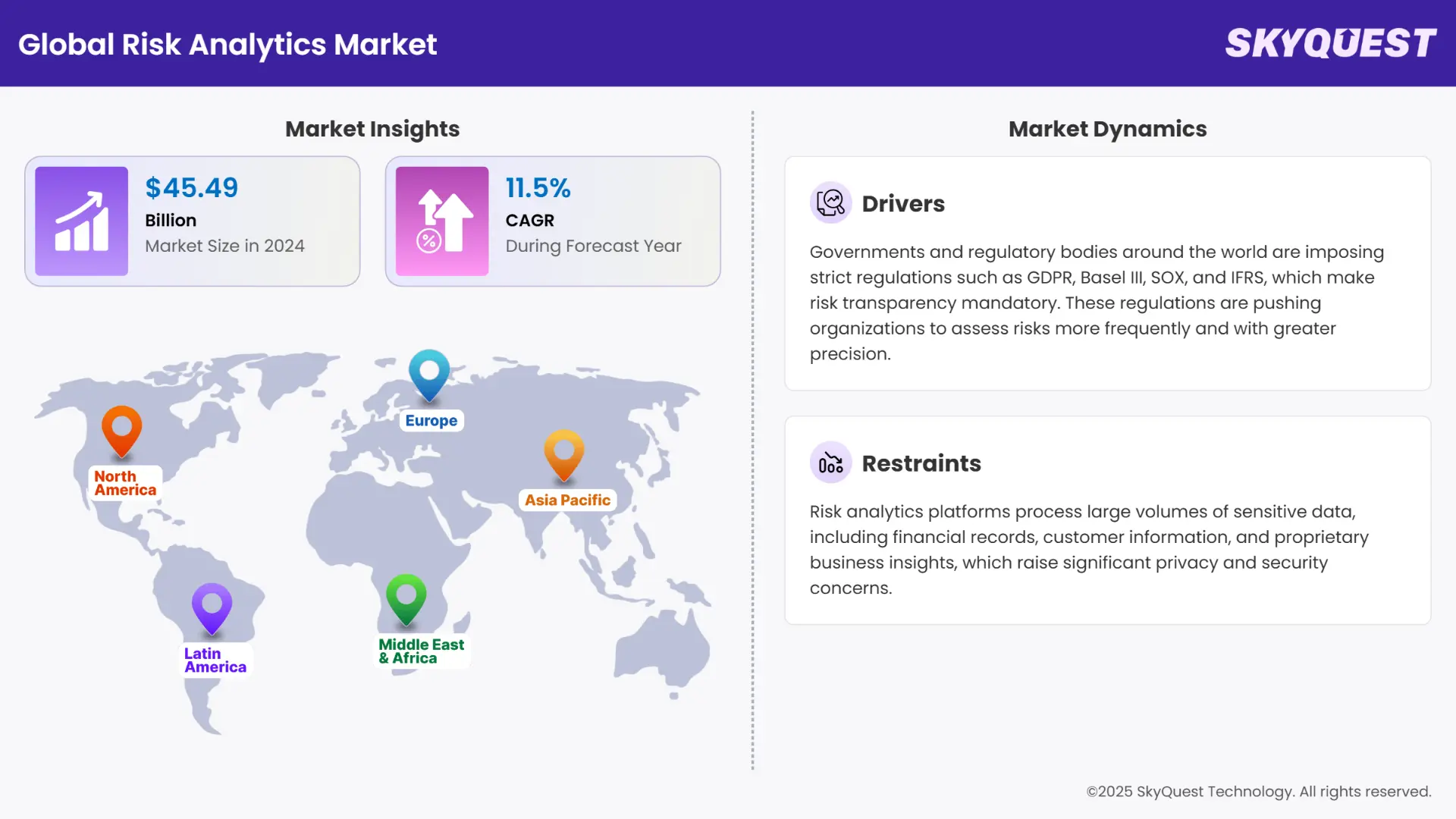
Global Risk Analytics Market size was valued at USD 45.49 Billion in 2024 and is poised to grow from USD 50.72 Billion in 2025 to USD 121.17 Billion by 2033, growing at a CAGR of 11.5% during the forecast period (2026–2033).
Surge in demand for real-time risk management, growing adoption of cloud-based risk solutions, rising incidence of cyberattacks and frauds, increasing digital transformation, and emphasis on improving regulatory compliance are forecasted to bolster market development in the future.
With the increasing digitization of business operations and the rise in cyberattacks, there is a growing need for advanced risk analytics in cybersecurity. Organizations across sectors face rapidly evolving risks due to volatile markets, cyber threats, and geopolitical instability. Real-time risk analytics tools help detect anomalies, measure exposure, and provide predictive insights to prevent losses. Cloud-based risk analytics platforms offer scalability, real-time collaboration, and reduced infrastructure costs. The global rise of FinTech firms and digital business models demand agile risk analytics systems capable of managing real-time data.
On the contrary, high costs of implementation and integration, data privacy and security concerns, dearth of skilled professionals, and resistance to organizational change are predicted to hamper risk analytics market penetration on a global level across the study period and beyond.
How Artificial Intelligence is Improving Risk Analytics?
Risk analytics platforms are increasingly incorporating AI and machine learning to enhance predictive accuracy and automate complex assessments. These technologies enable systems to learn from historical data, identify emerging risks, and adapt to evolving patterns in fraud, credit, operational, and cyber threats. AI-powered models can process unstructured data from multiple sources such as emails, social media, and transactions to deliver faster insights. This trend supports real-time decision-making, anomaly detection, and scenario simulation. By reducing human error and manual workload, AI-driven risk analytics is transforming how organizations proactively manage risks, particularly in dynamic sectors such as finance, insurance, e-commerce, and cybersecurity.
To get more insights on this market click here to Request a Free Sample Report
Global risk analytics market is segmented on the basis of component, deployment, vertical, organization size, risk type application, and region. By components, the market is segmented into software and services. By deployment, the market is segmented into on-premises and cloud. Based on vertical, the market is segmented into BFSI, retail, manufacturing, telecom & IT, energy and utilities, healthcare, and others. Based on organization size, the market is segmented into small and medium enterprises and large enterprises. Based on risk type application, the market is segmented into operational risk, financial risk, compliance risk, strategic risk, and others. By region, the market is segmented into North America, Europe, Asia Pacific, the Middle East and Africa, and Latin America.
Where is the Adoption of Risk Analytics High?
The BFSI segment is slated to spearhead the global risk analytics market revenue generation potential through 2032. Surging incidence of frauds and increasing frequency of cyberattacks on financial institutions are helping this segment emerge as the leading adopter of risk analytics solutions. Increasing emphasis on risk prevention and remediation is also helping further cement the high share of this segment going forward.
Meanwhile, the demand for risk analytics in the manufacturing industry is anticipated to rise at a robust pace in the future. Growing adoption of Industry 4.0 initiatives and high investments in the development of smart factories are also slated to further generate new opportunities across the study period.
Why Risk Analytics Companies Prefer On-premises Deployment?
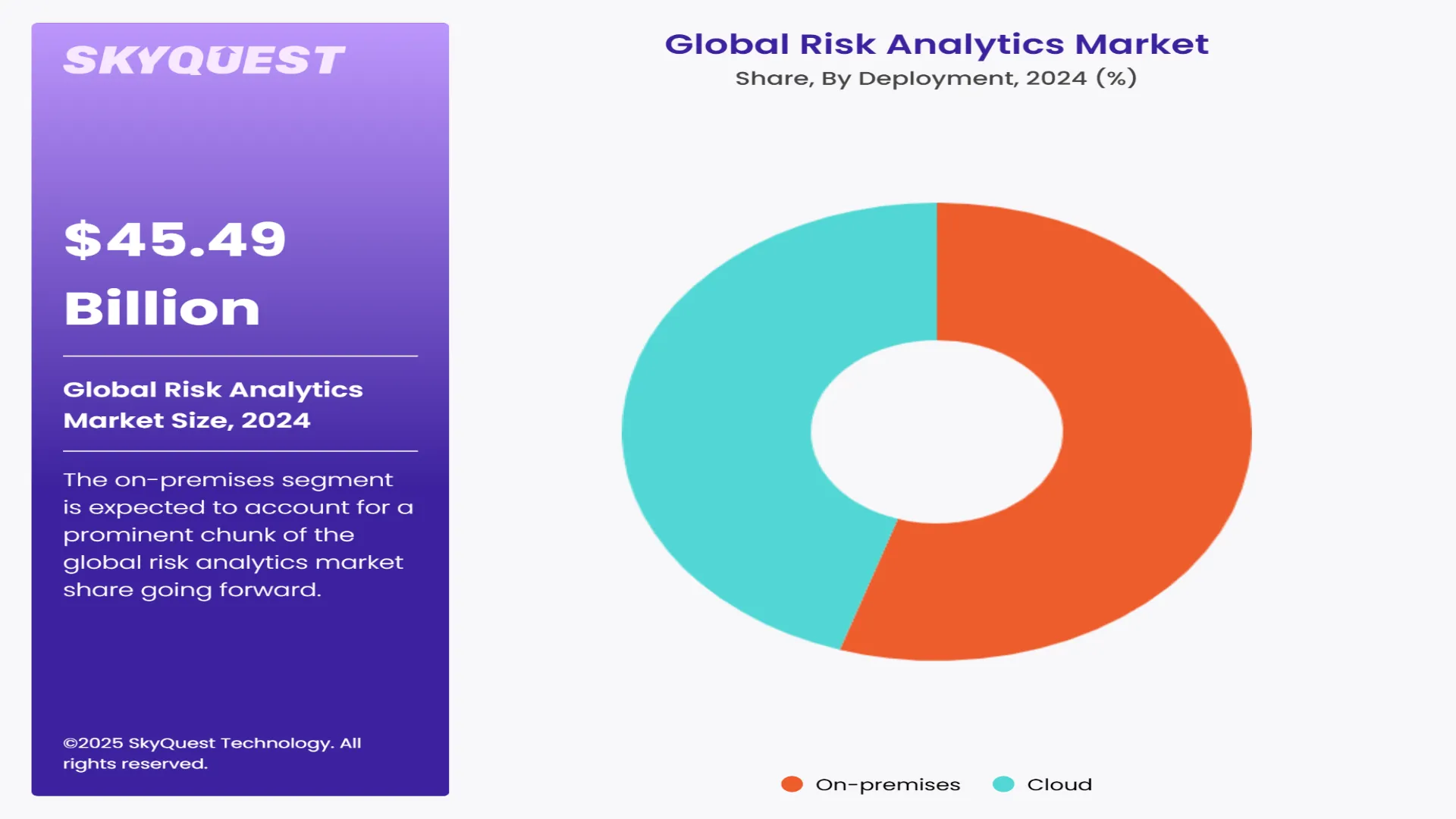
The on-premises segment is expected to account for a prominent chunk of the global risk analytics market share going forward. The ability to customize on-premises risk analytics solutions as per business requirements and risk strategies is helping this segment hold sway over others. Critical industries such as BFSI, government, and healthcare are expected to help this segment bolster its dominance in the future.
Cloud deployment is expected to gain massive popularity in the long run and emerge as the fastest growing segment as per this risk analytics industry analysis. Growing migration towards cloud technology and high scalability and flexibility offered by cloud-based risk analytics are helping create new business scope in the long run.
To get detailed segments analysis, Request a Free Sample Report
Why is North America the Center for Attraction for Companies?
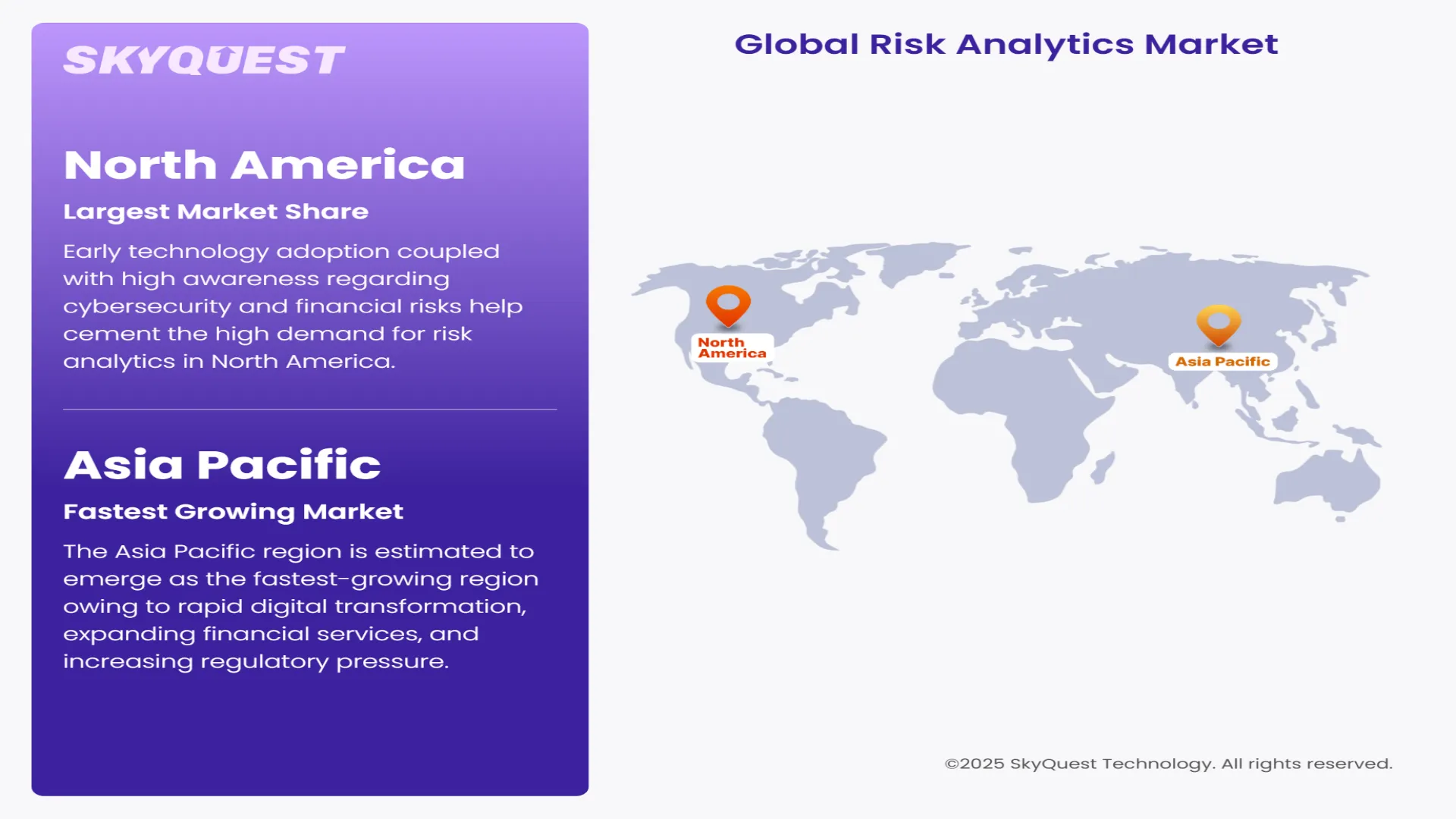
Early technology adoption coupled with high awareness regarding cybersecurity and financial risks help cement the high demand for risk analytics in North America. The presence of major analytics providers and AI innovators also ensures continual innovation of risk analytics technologies and solutions. The growing frequency of cyberattacks and use of advanced complex operational ecosystems in enterprises are also helping create new opportunities for risk analytics providers in the long run.
Risk Analytics Market in United States
The United States holds sway over global risk analytics deployment backed by early adoption of AI, stringent regulatory standards, and a mature financial ecosystem. The presence of major tech firms and analytics providers is helping the country stay on top risk analytics innovation. As digital transformation accelerates and cyber risks intensify, demand for AI-integrated, scalable risk analytics platforms continues to grow across the United States.
Risk Analytics Market in Canada
The presence of a robust financial sector, privacy regulations, and increased cybersecurity threats are helping drive risk analytics adoption in the country. Canadian banks and insurance firms are leading the demand for risk analytics for compliance enhancement, assess creditworthiness, and mitigate operational risks. With a tech-savvy economy and rising exposure to financial and cyber risks, Canada is expected to emerge as a significant revenue contributor in North America.
Why is the Adoption of Risk Analytics Rising Rapidly in Asia Pacific?
The Asia Pacific region is estimated to emerge as the fastest-growing region owing to rapid digital transformation, expanding financial services, and increasing regulatory pressure. Cybersecurity concerns and data privacy regulations, such as India’s DPDP Act and China’s Cybersecurity Law, are also playing a crucial role in promoting the popularity of advanced risk analytics solutions. Startups and SMEs are also leveraging affordable SaaS platforms to enhance resilience, which further creates new business scope for risk analytics companies focusing on this region.
Risk Analytics Market in South Korea
Proactive government initiatives and presence of a robust digital infrastructure are supporting the adoption of risk analytics in South Korea. Financial enterprises in the country are leading the demand for risk analytics for real-time analytics for fraud detection, credit scoring, and compliance with FSC regulations. South Korea’s tech-oriented culture and regulatory vigilance drive continued risk analytics market growth across the forecast period and beyond.
Risk Analytics Market in Japan
Risk-conscious corporate culture and technologically advanced infrastructure are helping boost risk analytics demand in Japan. Regulatory frameworks from FSA and APPI (data privacy) push organizations to adopt analytics for better oversight. Cybersecurity and natural disaster preparedness are major focus areas, encouraging investment in scenario-based and predictive analytics. As Japan’s corporate governance reforms and ESG commitments grow, demand for integrated, AI-powered risk analytics is also slated to rise rapidly through 2032.
Should Risk Analytics Companies Invest in Europe?
Strict compliance requirements under GDPR, MiFID II, and Basel III make Europe a haven for multiple risk analytics companies. Financial services, energy, and healthcare sectors are projected to spearhead the adoption of advanced risk analytics solutions in the region to ensure data governance. Emphasis on ethical AI and ESG-related risk assessments is also predicted to help generate more revenue for risk analytics providers operating in European countries over the coming years. Integrated risk analytics solutions are expected to be highly popular in this region.
Risk Analytics Market in Germany
The need for comprehensive risk oversight in banking, automotive, and industrial sectors is helping keep risk analytics demand afloat in the country. Germany is a key player in ESG risk analysis, integrating sustainability metrics into decision-making frameworks. Stringent regulations under BaFin, GDPR, and Basel III drive analytics adoption for compliance and internal audit purposes. With strong public-private collaboration and increasing automation across industries, Germany continues to invest in advanced, AI-enabled risk analytics.
Risk Analytics Market in United Kingdom
Global financial leadership and independent regulatory environment post-Brexit make United Kingdom a key market for risk analytics vendors operating in Europe. Mandating detailed risk assessments across banking, insurance, and fintech sectors by the Financial Conduct Authority (FCA) is also creating new business scope for risk analytics providers. London’s tech ecosystem and strong demand for RegTech tools further support innovation. As the UK refines its digital economy, risk analytics is central to secure, data-driven operations.
Risk Analytics Market in France
The presence of a strong financial industry and launch of national cybersecurity initiatives are helping uplift the demand for risk analytics solutions in the country through 2032. Enforcement of compliance with GDPR, MiFID II, and other frameworks through regulatory bodies like AMF and CNIL are also promoting the adoption of risk analytics. The French government supports AI integration in risk management through public funding and innovation hubs. Presence of a dynamic startup ecosystem is also helping make France a key country for market players.
To know more about the market opportunities by region and country, click here to
Buy The Complete Report
Drivers
Stringent Regulatory Compliance and Reporting Requirements
Adoption of Integrated Enterprise Risk Management (ERM)
Restraints
Data Security and Privacy Concerns
Resistance to Organizational Change
Request Free Customization of this report to help us to meet your business objectives.
Risk analytics companies need to focus on simplification of operations and bridging the skill gap to maximize their business scope. Integration of artificial intelligence is slated to be highly rewarding for all companies as per this global risk analytics market analysis. Targeting the BFSI and government sectors is expected to help boost revenue generation in the long run.
Startups are expected to focus on using unique technologies and approaches to stand out from established risk analytics companies. Here’s a startup that is expected to change the future of risk assessment.
Top Player’s Company Profiles
Recent Developments in Risk Analytics Market
SkyQuest’s ABIRAW (Advanced Business Intelligence, Research & Analysis Wing) is our Business Information Services team that Collects, Collates, Correlates, and Analyses the Data collected by means of Primary Exploratory Research backed by robust Secondary Desk research.
As per SkyQuest analysis, growing incidence of cyberattacks and stringent regulatory compliance requirements are anticipated to boost risk analytics demand through 2032. On the contrary, resistance to organizational change and data security concerns are estimated to impede the demand for risk analytics over the coming years. The presence of leading risk analytics providers and rising frequency of cyberattacks are helping North America cement its high share across the study period. Integration of edge computing in risk analytics and use of quantum computing can help enhance the adoption of risk analytics on a global level through 2032 and beyond. Use of RegTech technologies and development of cloud-based solutions are slated to be key trends driving the risk analytics sector in the future.
| Report Metric | Details |
|---|---|
| Market size value in 2024 | USD 45.49 Billion |
| Market size value in 2033 | USD 121.17 Billion |
| Growth Rate | 11.5% |
| Base year | 2024 |
| Forecast period | 2026-2033 |
| Forecast Unit (Value) | USD Billion |
| Segments covered |
|
| Regions covered | North America (US, Canada), Europe (Germany, France, United Kingdom, Italy, Spain, Rest of Europe), Asia Pacific (China, India, Japan, Rest of Asia-Pacific), Latin America (Brazil, Rest of Latin America), Middle East & Africa (South Africa, GCC Countries, Rest of MEA) |
| Companies covered |
|
| Customization scope | Free report customization with purchase. Customization includes:-
|
To get a free trial access to our platform which is a one stop solution for all your data requirements for quicker decision making. This platform allows you to compare markets, competitors who are prominent in the market, and mega trends that are influencing the dynamics in the market. Also, get access to detailed SkyQuest exclusive matrix.
Table Of Content
Executive Summary
Market overview
Parent Market Analysis
Market overview
Market size
KEY MARKET INSIGHTS
COVID IMPACT
MARKET DYNAMICS & OUTLOOK
Market Size by Region
KEY COMPANY PROFILES
Methodology
For the Risk Analytics Market, our research methodology involved a mixture of primary and secondary data sources. Key steps involved in the research process are listed below:
1. Information Procurement: This stage involved the procurement of Market data or related information via primary and secondary sources. The various secondary sources used included various company websites, annual reports, trade databases, and paid databases such as Hoover's, Bloomberg Business, Factiva, and Avention. Our team did 45 primary interactions Globally which included several stakeholders such as manufacturers, customers, key opinion leaders, etc. Overall, information procurement was one of the most extensive stages in our research process.
2. Information Analysis: This step involved triangulation of data through bottom-up and top-down approaches to estimate and validate the total size and future estimate of the Risk Analytics Market.
3. Report Formulation: The final step entailed the placement of data points in appropriate Market spaces in an attempt to deduce viable conclusions.
4. Validation & Publishing: Validation is the most important step in the process. Validation & re-validation via an intricately designed process helped us finalize data points to be used for final calculations. The final Market estimates and forecasts were then aligned and sent to our panel of industry experts for validation of data. Once the validation was done the report was sent to our Quality Assurance team to ensure adherence to style guides, consistency & design.
Analyst Support
Customization Options
With the given market data, our dedicated team of analysts can offer you the following customization options are available for the Risk Analytics Market:
Product Analysis: Product matrix, which offers a detailed comparison of the product portfolio of companies.
Regional Analysis: Further analysis of the Risk Analytics Market for additional countries.
Competitive Analysis: Detailed analysis and profiling of additional Market players & comparative analysis of competitive products.
Go to Market Strategy: Find the high-growth channels to invest your marketing efforts and increase your customer base.
Innovation Mapping: Identify racial solutions and innovation, connected to deep ecosystems of innovators, start-ups, academics, and strategic partners.
Category Intelligence: Customized intelligence that is relevant to their supply Markets will enable them to make smarter sourcing decisions and improve their category management.
Public Company Transcript Analysis: To improve the investment performance by generating new alpha and making better-informed decisions.
Social Media Listening: To analyze the conversations and trends happening not just around your brand, but around your industry as a whole, and use those insights to make better Marketing decisions.
REQUEST FOR SAMPLE
 REQUEST FREE CUSTOMIZATION
Global Risk Analytics Market size was valued at USD 45.49 Billion in 2024 and is poised to grow from USD 50.72 Billion in 2025 to USD 121.17 Billion by 2033, growing at a CAGR of 11.5% during the forecast period (2026–2033).
Risk analytics companies need to focus on simplification of operations and bridging the skill gap to maximize their business scope. Integration of artificial intelligence is slated to be highly rewarding for all companies as per this global risk analytics market analysis. Targeting the BFSI and government sectors is expected to help boost revenue generation in the long run. 'IBM (US)', 'SAS Institute (US)', 'Oracle (US)', 'FIS (US)', 'Moody's Analytics (US)', 'ProcessUnity (US)', 'ServiceNow (US)', 'Marsh McLennan (US)', 'Aon (UK)', 'MetricStream (US)', 'Resolver (Canada)', 'SAP (Germany)', 'Milliman (US)', 'LogicManager (US)', 'Provenir (US)', 'SAI360 (US)', 'Deloitte (UK)', 'OneTrust (US)', 'Diligent (US)', 'Alteryx1 (US)'
Governments and regulatory bodies around the world are imposing strict regulations such as GDPR, Basel III, SOX, and IFRS, which make risk transparency mandatory. These regulations are pushing organizations to assess risks more frequently and with greater precision. Risk analytics solutions automate regulatory reporting, audit trails, and risk assessments, minimizing manual errors and legal exposure. Growing regulatory complexity is expected to further bolster the risk analytics market outlook through 2032.
Use of Regulatory Technology (RegTech) in Risk Analytics: Risk analytics companies are focusing on integrating RegTech to reshape compliance and reporting practices across enterprises. Risk analytics integrated with RegTech can instantly interpret rule changes, assess compliance gaps, and recommend corrective actions. These integrated solutions can automate regulatory monitoring, data aggregation, and reporting—reducing manual effort and minimizing human error. Focusing on this risk analytics market trend enhances operational transparency, audit readiness, and long-term regulatory alignment.
Why is North America the Center for Attraction for Companies?


Want to customize this report? This report can be personalized according to your needs. Our analysts and industry experts will work directly with you to understand your requirements and provide you with customized data in a short amount of time. We offer $1000 worth of FREE customization at the time of purchase.
Feedback From Our Clients


 USA (+1) 351-333-4748

