Retrofitting Service Market
Report ID: SQMIG20C2194
Report ID: SQMIG20C2194
[email protected]
USA +1 351-333-4748
Report ID:
SQMIG20C2194 |
Region:
Global |
Published Date: March, 2026
Pages:
157
|Tables:
119
|Figures:
77


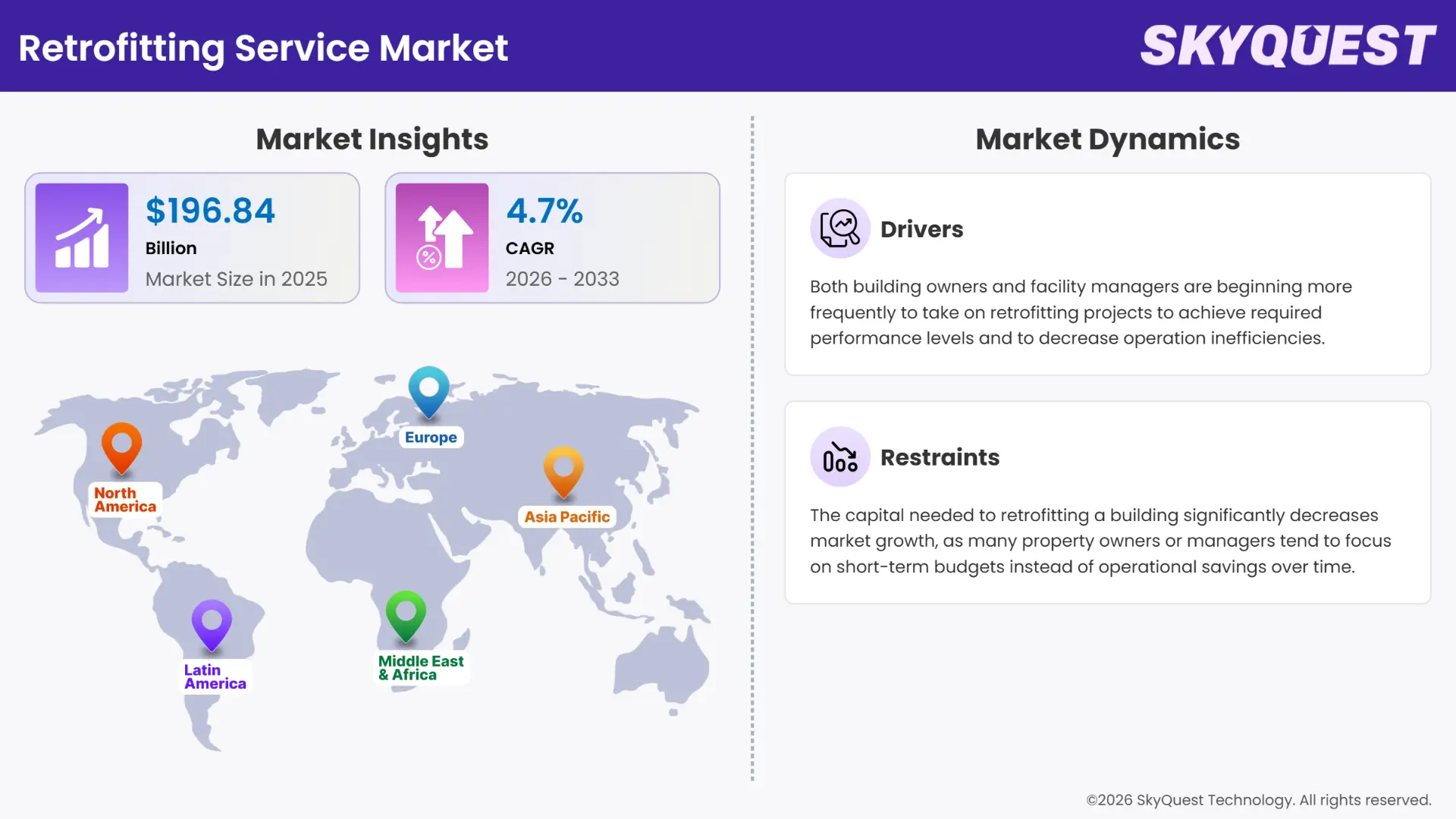
Global Retrofitting Service Market size was valued at USD 188.00 Billion in 2024 and is poised to grow from USD 196.84 Billion in 2025 to USD 284.24 Billion by 2033, growing at a CAGR of 4.7% during the forecast period (2026-2033).
Key Takeaways: Market Trends & Insights
The retrofitting service market is primarily driven by three forces the drive for energy efficiency, stricter regulations and standards; and the need to prolong the life of older buildings and infrastructure. Retrofitting services include assessing, designing and installing upgrades to buildings, industrial facilities and public infrastructure and reducing energy consumption, costs over their lifetime and possible hazards associated with the building operations, while allowing the avoidance of replacement costs.
The retrofitting service market has developed over the last two to three decades from an ad hoc approach to an integrated solution of energy efficiency using digital technologies to develop an integrated solution for energy efficiency through channels such as performance contracting, financing models, and technology roll outs.
Innovations in financing and policies are major contributors to the global retrofitting service market because they provide an incentive to overcome the upfront cost barrier to achieving energy savings and thus encourage the rapid execution of retrofit projects in both public and private sectors. By using financial incentives such as rebates, tax credits and performance contracting, the financial ability to implement improvements to the building shell, heat pumps or rewound industrial motors combine audits.
How is AI-driven Energy Optimization Changing the Commercial Building Retrofitting Services Market?
Using AI powered energy optimization has changed the way commercial buildings are being retrofitted using continuous data collection from machine learning based analytics and adaptive control to reveal where inefficiencies exist along with providing clarity on targeted upgrades. Key attributes include sensor based monitoring, predictive control, and digital twin scenario testing that allow property owners to prioritize interventions that require little or no disruption.
As a result, the market is transitioning from single large scale deep retrofits to a phased service model where the use of analytics will inform the project scope, sequence and performance verification. Retrofit providers are matching up software with installation and financing to make it easier to sell projects that will require less time to implement and still meet the expectations of both tenants and investors for improved performance.
R Zero announced their nationwide rollout of Prospector AI on March 2026, demonstrating how AI powered diagnostics help identify potential immediate savings within existing systems, and assist the retrofit company in recommending which high impact measures to implement first in order to reduce the time necessary to complete projects.
To get more insights on this market click here to Request a Free Sample Report
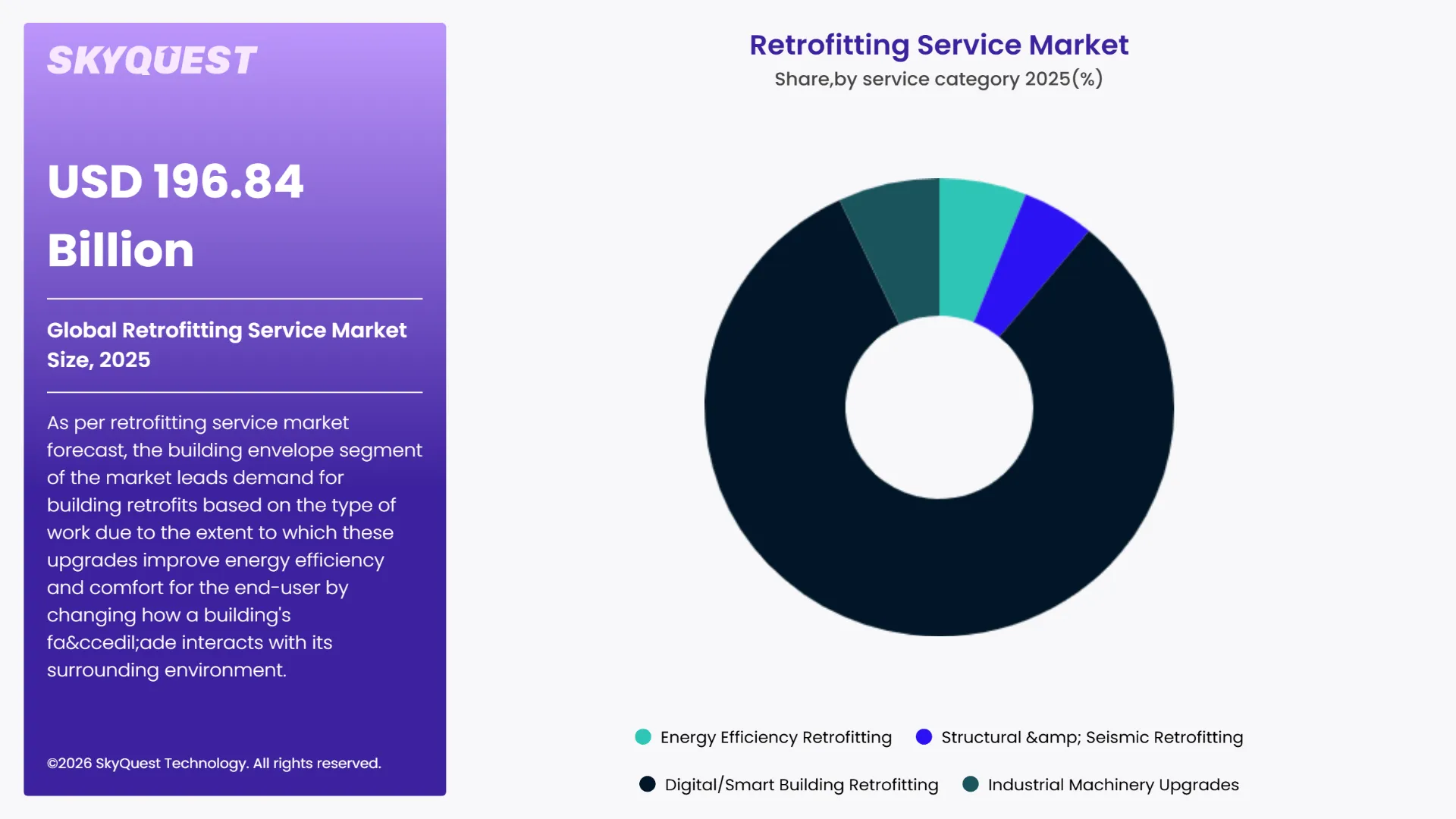
Global retrofitting service market is segmented by service category, building type, component focus, service model and region. Based on service category, the market is segmented into energy efficiency retrofitting, structural & seismic retrofitting, digital/smart building retrofitting and industrial machinery upgrades. Based on building type, the market is segmented into residential buildings, commercial offices & retail, industrial facilities/warehouses and institutional. Based on component focus, the market is segmented into building envelope, electrical & power systems and plumbing & water management. Based on service model, the market is segmented into design & consultation, implementation & contracting and post-retrofit maintenance. Based on region, the market is segmented into North America, Europe, Asia Pacific, Latin America and Middle East & Africa.
As per retrofitting service market forecast, the building envelope segment of the market leads demand for building retrofits based on the type of work due to the extent to which these upgrades improve energy efficiency and comfort for the end-user by changing how a building's façade interacts with its surrounding environment. The reason that they offer measurable financial and environmental energy savings, longer life expectancy of the asset being retrofitted, and provides a lower level of operating risk. The work will focus on building envelope products and will favor contractors who have significant experience with the materials being used and the skill to install them.
In contrast, the electrical and power systems segment is growing the fastest because of the electrification of new loads and the integration of the loads with the grid. There is more demand for resilient power, integrated control systems, and bundled service contracts based on the planned upgrade of buildings, ongoing operational monitoring, and performance optimization of new technologies.
As per retrofitting service market outlook, digital/smart building retrofitting is at the forefront of today's building retrofitting solutions for connectivity, and analytics provide clients with continuous performance platforms to help lower operating costs and improve the occupant’s experience. Service providers can charge higher service fees by bundling software, controls and analytics with physical upgrades allowing them to secure client lock-in and create a recurring revenue stream. This technology-driven value proposition will also lead to a shift in procurement so that providers will be seen as the key players to integrate IT, building system and long-term performance guarantees creating a shift in the competitive landscape.
As per retrofitting service market analysis, energy efficiency retrofitting is the second largest growing segment of building retrofitting, driven by owner's desire to meet tighter performance expectations and their corporate sustainability initiatives as it relates to upgrading the HVAC, lighting, and controls of their buildings. Additionally, owners of buildings are demanding verifiable reductions in energy consumption as well as clear business cases to support their investment in bundled retrofitting. As a result, energy efficiency retrofitting is being driven by bundled retrofit offerings and innovative financing that enables more suppliers to access this market and offer ongoing service opportunities.
To get detailed segments analysis, Request a Free Sample Report
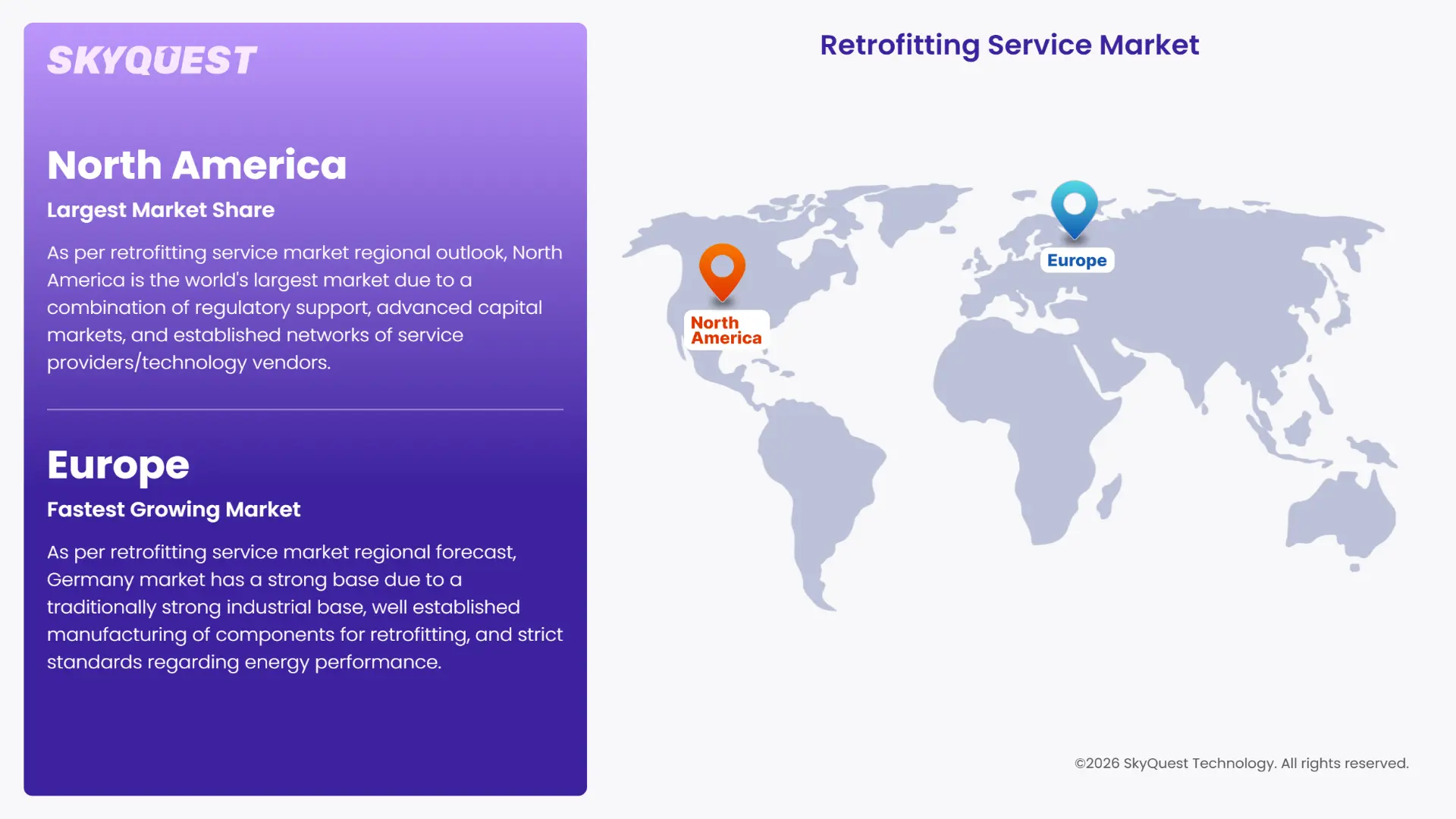
As per retrofitting service market regional outlook, North America is the world's largest market due to a combination of regulatory support, advanced capital markets, and established networks of service providers/technology vendors. The high level of awareness among property/asset owners regarding energy efficiency and resilience is combined with established funding mechanisms and public programs that have lowered barriers to adoption. There are many thousands of aging commercial and Industrial assets, which will continue to create a long-term demand for modernization projects. The availability and skill of the trades and construction workforce and the close collaboration between manufacturers, engineering consulting firms, and utilities mean that complex technical retrofitting solutions can be implemented and made available at a much faster pace.
As per retrofitting service industry analysis, U.S. market is characterized by extensive contractor networks, numerous funding options for customers, and the availability of integrated technology solutions from assessment to commissioning. Demand for retrofitting services is driven by the desire for operational and functional cost reductions and increased resilience from institutional owners. Successful commercialization of innovative retrofitting technologies is facilitated by the existence of performance contracting, established certifications, and active utility program incentives.
The Canada market has several distinct characteristics that set it apart from the US market. Canadian governments at all levels encourage equipment/asset retrofitting through funded provincial programs, with particular emphasis on addressing the building envelope. As a result, there is a coordinated effort between utility companies and private contractors to develop retrofitting solutions for their customers. The geographic and climatic diversity of Canada shapes the product and service offerings and priorities for retrofitting projects. In addition, many local businesses provide specialty services such as energy audits, building envelope retrofits, and pathways for decarbonization by offering integrated financing and maintenance solutions.
The retrofitting services industry in Europe is expanding at a rapid pace due to ambitious decarbonization agendas and a strong regulatory framework, as well as rising public and private investments into renovating commercial and residential buildings. The creation of national renovation strategies and favourable financing structures are creating a strong demand across all segments of the market. An increase in standardized energy performance protocols and certification is helping to build trust amongst consumers looking to participate in the projects. Furthermore, the existence of a dense network of specialist contractors, component manufacturers, and consultancy firms will allow large-scale delivery of retrofitting projects to be implemented effectively.
As per retrofitting service market regional forecast, Germany market has a strong base due to a traditionally strong industrial base, well established manufacturing of components for retrofitting, and strict standards regarding energy performance. A network of certified installation and engineering consultancies provides the foundation for delivery of complex retrofit projects. Policy driven renovation programmes and local government initiatives are creating a significant amount of demand across the various typologies of buildings within the market. Organizations within this market are placing a priority on integrated solutions that contain envelope improvements, efficient systems, and digital monitoring, so that the outcome of projects can be trusted and deliver sustainable results for years to come.
The United Kingdom's retrofitting service market is evolving through targeted policies and the growing popularity of retrofit networks based on residential as well as public sector buildings. Local authority programs are creating clearer demand signals for installers and financing providers. Market ecosystems are focusing on innovative business models, developing skills, and increasing supply chain co-ordination to enable scaling of interventions. Providers are providing a bundled service of assessments, project management, and post installation verification to increase confidence and help establish trust for repeat business.
In France, the retrofitting service market share is rapidly growing due to national renovation initiatives and large-scale municipal engagement in thermal improvement measures. There is strong demand from social housing, with the emphasis currently on occupant comfort and energy efficiency. Installer networks and new financing models are allowing more homeowners to take part. In addition, suppliers offer solutions for both heritage and new buildings by combining façades upgrading, systems replacement and digital monitoring, with a focus on workforce training also supporting scalable development of the market.
Through government policy and enhanced engagement from both the public and private sectors, the retrofitting service market in the Asia Pacific is becoming increasingly active as the market transitions to retrofitting of older buildings due to urban renewal initiatives. Policymakers are embedding retrofit priorities within the urban planning framework as well as energy efficiency initiatives across the region, which is further fueled by owners’ growing awareness of operational savings through retrofitting and their desire for buildings with resilient operating systems. Creating partnerships between local builders and global suppliers, providers are transferring their respective technologies to create new solutions for high-density urban areas. Workforce development and digital planning tools help with the speed of projects.
The primary drivers shaping Japan retrofit service market are high-quality engineering, improved seismic resilience, and energy efficiency improvements in high density urban areas. Local providers use advanced materials, systems integration capabilities, and project management/administration to facilitate low-impact retrofitting. Innovation through the collaboration of manufacturers, builders, and research institutions is creating new prefabricated systems and digital monitoring of the buildings in which they reside in.
The South Korea retrofitting service market continues to advance through urban renewal initiatives, high levels of industry participation, and the adoption of smart building systems. Many of the larger construction and engineering companies are partnering with technology providers to develop and deliver integrated retrofit/modernization packages for their commercial customers. Digital controls and prefabricated solutions are increasingly being used to reduce the timeframes involved in completing retrofits and increase predictability by using fewer trade alliances.
To know more about the market opportunities by region and country, click here to
Buy The Complete Report
Stringent Energy Efficiency Regulations
Growing Demand for More Sustainable Buildings
Significant Upfront Capital Requirements
Technical Complexity Causing Disruption
Request Free Customization of this report to help us to meet your business objectives.
The increasing competition among companies seeking to secure large retrofit projects in the global retrofitting services business has led to a rise in acquisitions and strategic partnerships among large companies, while new entrants continue to develop innovative technologies such as facade integrated HVAC systems and high temperature heat pumps. Some of the most recent examples include the acquisition of fleet retrofit company Retrofleet and several partnerships among the industry to help provide electric power for ships. Government-driven retrofit programs are creating demand for retrofit providers to deliver cost-effective, complete integrated products and services.
SkyQuest’s ABIRAW (Advanced Business Intelligence, Research & Analysis Wing) is our Business Information Services team that Collects, Collates, Correlates, and Analyses the Data collected by means of Primary Exploratory Research backed by robust Secondary Desk research.
As per SkyQuest analysis, the global retrofitting service industry is poised for steady growth as a key driver is stringent energy efficiency regulations that compel owners to upgrade assets, while a second driver is the growing availability of innovative financing and policy incentives that reduce upfront barriers. Growth is tempered by a major restraint in the form of significant upfront capital requirements, which can delay comprehensive projects. The dominating region is North America due to mature capital markets, regulatory support and a deep service ecosystem, and the dominating segment is building envelope upgrades which deliver the most immediate comfort and energy benefits, encouraging bundled digital and maintenance services.
| Report Metric | Details |
|---|---|
| Market size value in 2024 | USD 188.0 Billion |
| Market size value in 2033 | USD 284.24 Billion |
| Growth Rate | 4.7% |
| Base year | 2024 |
| Forecast period | (2026-2033) |
| Forecast Unit (Value) | USD Billion |
| Segments covered |
|
| Regions covered | North America (US, Canada), Europe (Germany, France, United Kingdom, Italy, Spain, Rest of Europe), Asia Pacific (China, India, Japan, Rest of Asia-Pacific), Latin America (Brazil, Rest of Latin America), Middle East & Africa (South Africa, GCC Countries, Rest of MEA) |
| Companies covered |
|
| Customization scope | Free report customization with purchase. Customization includes:-
|
To get a free trial access to our platform which is a one stop solution for all your data requirements for quicker decision making. This platform allows you to compare markets, competitors who are prominent in the market, and mega trends that are influencing the dynamics in the market. Also, get access to detailed SkyQuest exclusive matrix.
Table Of Content
Executive Summary
Market overview
Parent Market Analysis
Market overview
Market size
KEY MARKET INSIGHTS
COVID IMPACT
MARKET DYNAMICS & OUTLOOK
Market Size by Region
KEY COMPANY PROFILES
Methodology
For the Retrofitting Service Market, our research methodology involved a mixture of primary and secondary data sources. Key steps involved in the research process are listed below:
1. Information Procurement: This stage involved the procurement of Market data or related information via primary and secondary sources. The various secondary sources used included various company websites, annual reports, trade databases, and paid databases such as Hoover's, Bloomberg Business, Factiva, and Avention. Our team did 45 primary interactions Globally which included several stakeholders such as manufacturers, customers, key opinion leaders, etc. Overall, information procurement was one of the most extensive stages in our research process.
2. Information Analysis: This step involved triangulation of data through bottom-up and top-down approaches to estimate and validate the total size and future estimate of the Retrofitting Service Market.
3. Report Formulation: The final step entailed the placement of data points in appropriate Market spaces in an attempt to deduce viable conclusions.
4. Validation & Publishing: Validation is the most important step in the process. Validation & re-validation via an intricately designed process helped us finalize data points to be used for final calculations. The final Market estimates and forecasts were then aligned and sent to our panel of industry experts for validation of data. Once the validation was done the report was sent to our Quality Assurance team to ensure adherence to style guides, consistency & design.
Analyst Support
Customization Options
With the given market data, our dedicated team of analysts can offer you the following customization options are available for the Retrofitting Service Market:
Product Analysis: Product matrix, which offers a detailed comparison of the product portfolio of companies.
Regional Analysis: Further analysis of the Retrofitting Service Market for additional countries.
Competitive Analysis: Detailed analysis and profiling of additional Market players & comparative analysis of competitive products.
Go to Market Strategy: Find the high-growth channels to invest your marketing efforts and increase your customer base.
Innovation Mapping: Identify racial solutions and innovation, connected to deep ecosystems of innovators, start-ups, academics, and strategic partners.
Category Intelligence: Customized intelligence that is relevant to their supply Markets will enable them to make smarter sourcing decisions and improve their category management.
Public Company Transcript Analysis: To improve the investment performance by generating new alpha and making better-informed decisions.
Social Media Listening: To analyze the conversations and trends happening not just around your brand, but around your industry as a whole, and use those insights to make better Marketing decisions.
REQUEST FOR SAMPLE
 REQUEST FREE CUSTOMIZATION
Global Retrofitting Service Market size was valued at USD 188.0 Billion in 2024 and is poised to grow from USD 196.84 Billion in 2025 to USD 284.24 Billion by 2033, growing at a CAGR of 4.7% during the forecast period (2026-2033).
Competitive landscape in the global retrofitting service market is intensifying as incumbents pursue acquisitions and strategic partnerships to win large retrofit mandates, while startups push specific tech innovations such as facade integrated HVAC and high temperature heat pumps. Recent examples include the acquisition of fleet retrofit specialist Retrofleet and industry partnerships to electrify vessels. Policy driven retrofit programs are accelerating demand and pushing providers to offer integrated turnkey retrofit solutions. 'Johnson Controls', 'Schneider Electric', 'Siemens Smart Infrastructure', 'Honeywell', 'Carrier Global', 'AECOM', 'Jacobs Engineering', 'Fluor Corporation', 'Skanska', 'Bechtel', 'WSP Global', 'Trane Technologies', 'Ameresco', 'Daikin Industries', 'ABB Ltd.', 'Legrand', 'Eaton', 'Engie', 'Veolia', 'CBRE Group'
Stringent energy efficiency regulations at national and local levels are compelling building owners and facility managers to undertake retrofitting projects to meet mandated performance standards and reduce operational inefficiencies. Compliance requirements and improved standards drive demand for services ranging from insulation upgrades to HVAC modernization, while policy frameworks often encourage long term asset upgrades and maintenance. The regulatory impetus fosters a predictable pipeline of retrofitting work, stimulates service provider investment in skills and technology, and elevates market confidence in retrofit solutions.
Sustainability-Driven Demand: Clients across industries increasingly prioritize retrofit solutions that reduce environmental impact and extend asset life, creating demand for services that align with circular economy principles and decarbonization goals. Providers are responding by offering material reuse strategies, energy efficiency upgrades, and compatibility assessments that preserve value while meeting stakeholder expectations. This shift elevates lifecycle consulting, enhances cross functional coordination, and encourages partnerships with sustainability specialists, positioning retrofit services as strategic enablers of corporate environmental commitments rather than purely technical interventions overall.
North America dominates the retrofitting service market due to aging infrastructure, strict energy efficiency regulations, strong construction industry, advanced technology adoption, high investment capacity, and government sustainability initiatives driving upgrades.


Want to customize this report? This report can be personalized according to your needs. Our analysts and industry experts will work directly with you to understand your requirements and provide you with customized data in a short amount of time. We offer $1000 worth of FREE customization at the time of purchase.
Feedback From Our Clients


 USA (+1) 351-333-4748

