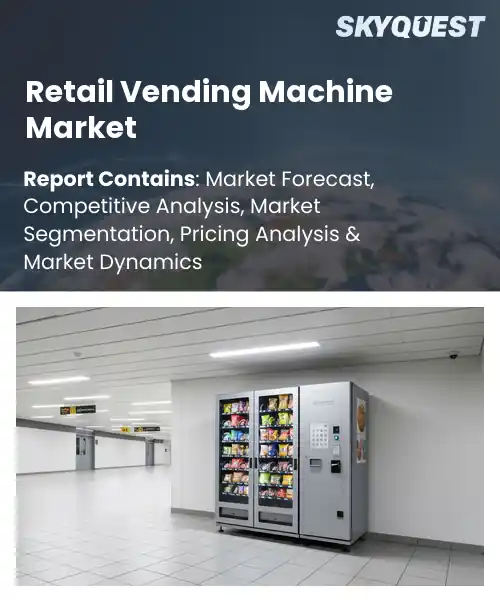
Retail Vending Machine Market
Report ID: SQMIG20G2123
Report ID: SQMIG20G2123
[email protected]
USA +1 351-333-4748
Report ID:
SQMIG20G2123 |
Region:
Global |
Published Date: May, 2026
Pages:
157
|Tables:
150
|Figures:
78


Global Retail Vending Machine Market size was valued at USD 65.9 Billion in 2024 and is poised to grow from USD 68.01 Billion in 2025 to USD 87.5 Billion by 2033, growing at a CAGR of 3.2% during the forecast period (2026-2033).
The increase of consumer wishing to have access to products on demand is axiomatically the catalyst for the growing vending machine industry; this has changed the way in which consumers purchase products. Hence, vending machine operators are investing in needing smarter and more accessible machines. The vending machine business is also defined as automated point-of-sale units that are located in workplaces, transportation terminals, educational campuses and event locations, as they represent a reduced cost of labor, while also expanding the retail reach into micro-locations where there is no other retail outlet.
Over the past several decades vending machines have progressed from just coin operated snack dispensing systems to cashless, connected vending machines that offer ready-prepared meals and cashless payment options; these innovations include rolling out grocery chain test units and installing kiosks at airports, all using connectivity through telemetry and dynamic pricing for improved inventory turnover. Digital connectivity spurns innovation through technology; as such, digitalization plays a vital role in growing the global retail vending machine market; connectivity allows operators to utilize most commonly collected data to define their method of merchandising; digital connectivity also diminishes out of stocks by utilizing predictive restocking methodology.
Lastly, IoT sensors and cloud based analytic platforms provide operators the ability to track sales through telemetry, thereby allowing operators to create smarter delivering or servicing patterns resulting in lower costs of operations (i.e., beverage manufacturers are eliminating labor and fuel costs using telemetry). Similarly cashless payment integration increases transaction speed and broadens user demographics, prompting retailers to place machines in high footfall micro markets like campuses and coworking spaces where convenience purchases generate incremental revenue and strengthen brand presence.
How is IoT Improving Inventory Management In The Retail Vending Machine Market?
Through providing retailers with 24/7 insights into machine health and stock status, IoT is changing how vending machines are managed and supported by creating an entire ecosystem. Device-level connectivity of sensors count products, communicate with a cloud based system and utilize software to turn data into information on reordering product and trends. There is a push out of manually checking stock on vending machines to planning out which route to take based on the data driven results and what products should be stocked. As a result, there is a higher probability of product being available and less likelihood of making unnecessary trips back to the warehouse. A good example of these systems is weight based sensors and/or camera counting systems; that utilize the collected data and present the information on dashboards to allow operators to proactively restock and rapidly identify equipment/fault issues.
HeroVend's (April 2026) launch of AI based vending intelligence platform is another example of how to eliminate manual inventory guesses. By linking the data from IoT devices with AI driven inventory recommendations; operators are able prioritise which products should be re-stocked and able to plan and manage their machines with less variability/unpredictability.
Market snapshot - (2026-2033)
Global Market Size
USD 65.9 Billion
Largest Segment
Beverage Vending Machines
Fastest Growth
Food Vending Machines
Growth Rate
3.2% CAGR
To get more insights on this market click here to Request a Free Sample Report
Global retail vending machine market is segmented by machine type, product category, deployment type, ownership model, end user and region. Based on machine type, the market is segmented into Beverage Vending Machines, Snack Vending Machines, Food Vending Machines, Combo Vending Machines and Others. Based on product category, the market is segmented into Cold Beverages, Hot Beverages, Snacks & Confectionery, Fresh Food, Frozen Products and Others. Based on deployment type, the market is segmented into Indoor Vending Machines and Outdoor Vending Machines. Based on ownership model, the market is segmented into Operator-Owned, Leased/Rental and Franchise-Based. Based on end user, the market is segmented into Retail Chains, Corporate Offices, Public Infrastructure Operators, Institutional Buyers and Others. Based on region, the market is segmented into North America, Europe, Asia Pacific, Latin America and Middle East & Africa.
As per retail vending machine market analysis, beverage vending machines are dominating the marketplace because they can provide an everlasting consumer demand while having easy stock replenishing capability and large number of sales, which is why both the operators and manufacturers focus a lot of their investments in this category. Their modularity allows for hot and cold drink end-users to easily market their brand and have simple logistics associated with their operation that will reduce operating complications and allow for deployable use in more than one retail location. The reliability of their operation will dictate a heavy priority to connection capability, payment integration, and remote monitoring so that they can always be improving their products/services.
As per retail vending machine market forecast, Combo Vending Machines represent the fastest growing segment of the vending category as operators look to expand their product offerings within a single footprint. Their ability to sell multiple types of products from one machine will help create impulsive purchases from consumers and help reduce the amount of time that they will have an empty shelf on display due to the flexible stocking capabilities of different products. In combination with this, intelligent shelving and robotic dispensing technology has provided those vending machines with new placement opportunities, new sources of revenue generation and an acceleration of the overall future growth of vending industry.
As per retail vending machine market outlook, indoor vending machines is leading the market. Due to the controlled indoor setting, consistent, climate control, and ease of maintenance, operators can provide customers with freshness and high margin products, as well as offer complex hot beverage options. The close proximity to store foot traffic and integration with store systems support real-time management of inventory, tailored merchandising, and improved customer experience. These operational strengths influence manufacturer research and development activities to provide compact refrigeration, improve hygiene, enable better dispensing processes, and support omnichannel payment options, all of which contribute to the preference for indoor vending operations.
At the same time, outdoor vending machines are experiencing the fastest growth. The increase in demand for 24/7 service at public sites has created demand and pressure for improvements in weatherproofing, energy efficient refrigeration, power generation via solar, and ruggedized cashless devices have lowered barriers to deployment of machines. These technical advancements give operators greater access to a larger number of high-traffic outdoor and transit adjacent locations by providing operators the ability to reach underserved flows of customers and create significant amounts of incremental market growth.
To get detailed segments analysis, Request a Free Sample Report
As per retail vending machine market regional outlook, due to a mix of city densities, consumers acceptance and the innovative uses of technology across a range of economies, the Asia-Pacific region is at the forefront of the global industry. There has been a rapid increase in the adoption of contactless payments, vending automation and integrated Internet of Things (IoT) solutions - creating optimal conditions for the development of innovative device formats and intelligent merchandising. There is a broadly dispersed manufacturing base, as well as an extensive network of suppliers helping facilitate rapid deployment and providing local businesses with the ability to customize their equipment to meet their unique needs. The vast majority of Asian consumers have a cultural affinity towards convenience retail and the use of extensive public transport systems to access their desired goods has also increased the occurrence in which consumers use vending machines outside traditional retail stores. Collaborative initiatives between vending machine operators, vending technology providers and retail chains accelerate product variety and service models, whilst many regulatory environments tend to support the testing of automated retail models to identify potential solutions that can enhance the overall customer experience. This structural advantage of Asia-pacific creates a resilient ecosystem where innovation and scale mutually reinforce one another and will continue to create regional dominance and lead to best practices being adopted across the globe.
The Retail Vending Machine Industry in Japan demonstrates overall acceptance of automated retail shopping and a desire for convenience-type shopping options among consumers. The advanced integration of payment methods and placement of vending machines in dense urban areas allow for common micro-purchases to be made frequently at transit systems or in high-traffic public venues. The quality of the manufacturing and operation of vending machines is centred on reliability, quality design and variety of product offerings to satisfy the discriminating tastes of Japanese consumers. Ongoing innovation in vending product and advanced practices in managing operations remotely are what make Japan a leader among countries for the implementation of advanced or complex vending solutions.
The Retail Vending Machine Industry in South Korea is characterised by a rapid rate of technological evolution, high levels of acceptance for cashless payments, and a strong demand for 'on-the-go' retail due to heavy urban population densities. Operators are utilising connected platforms with data driven methods of managing inventory to create a 'just-in-time' assortment of products in commuter corridors, universities, and mixed-use developments. The dynamic and innovative nature of South Korea's consumer culture supports the continual acceptance of new product offerings, as well as experimentation with the creation of new smart vending concepts and concepts with no previous existence in retailing . Collaborating between the manufacturers of electronics, providers of logistics, and retailers is supporting the continued implementation and enhancement of products features in the vending industry.
As per retail vending machine market regional analysis, the expansion of the North America market has been incredibly rapid and is largely due to changing consumer expectations around convenience (shopping across multiple channels) and also due to retailers focusing on operational efficiency (by adopting smarter retail solutions). As a result of these factors, both operators of vending machines and retailers are beginning to adopt “smart" technologies (e.g., machines that accept cashless payments, machines that can be monitored remotely, and machines that have dynamic product/merchandising capabilities) in order to service multiple areas (e.g., workplace campuses, leisure venues, last-mile retail points, etc.). The growing labor costs referenced above, and a push toward (automated) retail solutions as a way to address labor shortages and long service hours also lead to increased adoption of (automated) retail solutions. In addition, many companies have established partnerships with technology vendors, logistics providers, and traditional retail brands to create tailored deployments that reflect each company’s specific business model and needs. The nature of the product mix (vending products offered in a vending machine) is affected by the emphasis placed on the following dimensions: healthy options, premium products, and sustainability (product and/or packaging). Clarity in the regulatory framework and continued investment in digital infrastructure also provide support for the successful trial launch and subsequent large-scale rollout of different vending concepts, both in urban and suburban environments.
The Retail Vending Machine Market in the United States shows a strong growth of automated retail in places such as workplaces, transit hubs and corridors. The focus for operators is on utilizing integrated software with diagnostics capabilities and broad payment options in order to increase uptime and keep the assortment in touch with the local market. The demand for premium, healthy and niche products is also promoting many formats of Vending Machines to support this trend. As well, alignment with loyalty programs and omni-channel retail support the ability to create more targeted promotions. Lastly, working with logistics companies will support improved efficiency for replenishing product and operationally reaching areas that are scalable.
In Canada, the Retail Vending Machine Market reflects the growing use of automated retail in urban areas and rural communities. The operators tend to modify their offerings based on regional tastes and focus on sustainable packaging while providing fresh and healthy food choices to meet demand. Technology applications for operators include utilizing contactless payment, telematics and inventory visibility to provide efficient replenishment on long distance routes. Working with retailers and service providers allows operators to curate their offerings according to consumer preferences for that area as well as to logistical challenges and efficiencies.
The retail vending machine market is becoming increasingly competitive in Europe, focused on sustainability, quality of product and convenience of technology in the context of a coordinated approach to improving these three areas. Operators and manufacturers are making a concerted effort to provide energy efficient machines, recyclable packaging and a transparent supply chain that aligns with the changing values of consumers. In addition, cashless payment systems, telemetry and remote management are being experimented with widely to provide better assortment planning and more effective service within dense urban areas and transit systems. Collaborative projects between retail brands, municipalities and technology providers will establish standardised pilot programs that will demonstrate the potential for healthy and premium vending assortments. Manufacturers in Europe have become national leaders as a result of both strong consumer protections from regulation and the proliferation of advanced vending concepts, which positions the region at the forefront of practical, consumer-centric innovation. Investment in routing based on data analytics, access for all customers, and the ability to operate effectively across borders provides operators with increased operational capabilities, while also enabling consumers to access new products and services.
Retail Vending Machine Market in Germany is based on technical reliability, energy efficiency, and integration into logistical and recycling systems. Long-lasting and maintainable designs are sought after by manufacturers/operators to provide installations at transit hubs, corporate campuses, and public buildings. Curated configurations are influenced by preference for healthy or locally sourced items. Interoperability and practical deployments are advanced by collaborative trials between retail partners and technology companies, with an emphasis on rigorous operations, regulatory compliance and meeting consumer demands.
Retail Vending Machines Market (UK) is defined by experimentation in contactless payments, analytics, and experiential vending formats. Transportation hubs, leisure venues and mixed-use developments are the basis of operators’ deployment of solutions to facilitate transactional opportunities for customers. Increasing focus on healthier choices, sustainable packaging, and accessible design is consistent with consumer expectations and regulatory targets. As such, cooperation between technology providers, retail brands and local authorities is essential to supporting large-scale trial demonstrations of vending machine concepts within urban networks and areas.
The French retail vending machine industry has a distinct culinary flair with an emphasis on automation and design. Machines provide customers with pre-packaged assortments of high-quality fresh food and gourmet options that are tailored to local taste preferences. Operators pair refined aesthetics with hygienic and touchless dispensing systems in an effort to entice regular commuters and shoppers at retail establishments. Partnerships with municipalities allow operators to position their machines within cultural centers or transit hubs. Current trials are concentrating on seasonal assortments, recyclable packaging and machine design that relates to metropolitan areas.
To know more about the market opportunities by region and country, click here to
Buy The Complete Report
Rise In Cashless Payments
By accepting cashless payments from vending machines that operate with this type of payment method you are enhancing customer convenience and decreasing friction points at the point of sale, which will drive more frequent purchases and encourage wider acceptance in locations with high foot traffic. The ability to integrate with mobile wallets and contactless cards makes the transaction process easier, improves the ability to place machines in areas where cash handling is undesirable, and allows operators to increase route density and the service offerings provided. The modern, secure payment capability also adds to customer perception of trust and selection for products, allowing operators to place machines at various locations as well as experiment with product assortments and service models.
Advances In Machine Connectivity
High Initial Equipment Costs
The high initial costs of modern vending equipment pose barriers for small businesses and retailers who are interested in introducing new vending projects, despite their potential benefits from an operation viewpoint. The capital cost of hardware, integrated payment systems, and connectivity modules can be prohibitively expensive where the return on placing the equipment is not known, which leads operators to delay purchases and rely on legacy vending machines. This results in a low refresh rate for fleets, as well as lower acceptance of feature-rich vending machines, ultimately leading to a slower rate of overall market expansion and limiting the penetration of innovative vending products in many different types of locations.
Regulatory And Compliance Challenges
Request Free Customization of this report to help us to meet your business objectives.
At present, the competitive environment has been focused on differentiating the platform with different sensors as the operators of machines are competing to implement cashless, contactless, and AI enabled solutions. This allows them to increase their share by protecting their routes against potential loss. During this time, we see a great deal of consolidation and commercial alliances among companies in the industry. Examples include Glory’s acquisition of Flooid for their unified commerce software, along with partnerships like Imbera teaming up with Intuitivo to create a system to scale AI smart coolers, indicate that we are seeing the trend toward software led differentiation and payment integration.
SkyQuest’s ABIRAW (Advanced Business Intelligence, Research & Analysis Wing) is our Business Information Services team that Collects, Collates, Correlates, and Analyses the Data collected by means of Primary Exploratory Research backed by robust Secondary Desk research.
As per SkyQuest analysis, the global retail vending machine market is primarily driven by rapid consumer demand for convenience, which fuels deployment of accessible, cashless, and connected machines, while a second important driver is digitalization and IoT enabling data driven inventory management and predictive restocking. Growth is tempered by high initial equipment costs that hinder small operators and slow fleet refresh. Asia Pacific remains the dominating region thanks to dense urbanization, contactless payment adoption, and manufacturing scale. Beverage vending machines are the dominating segment due to high transaction volumes and straightforward restocking, making them the focus of investment and technological upgrades across operator networks.
| Report Metric | Details |
|---|---|
| Market size value in 2024 | USD 65.9 Billion |
| Market size value in 2033 | USD 87.5 Billion |
| Growth Rate | 3.2% |
| Base year | 2024 |
| Forecast period | (2026-2033) |
| Forecast Unit (Value) | USD Billion |
| Segments covered |
|
| Regions covered | North America (US, Canada), Europe (Germany, France, United Kingdom, Italy, Spain, Rest of Europe), Asia Pacific (China, India, Japan, Rest of Asia-Pacific), Latin America (Brazil, Rest of Latin America), Middle East & Africa (South Africa, GCC Countries, Rest of MEA) |
| Companies covered |
|
| Customization scope | Free report customization with purchase. Customization includes:-
|
To get a free trial access to our platform which is a one stop solution for all your data requirements for quicker decision making. This platform allows you to compare markets, competitors who are prominent in the market, and mega trends that are influencing the dynamics in the market. Also, get access to detailed SkyQuest exclusive matrix.
Table Of Content
Executive Summary
Market overview
Parent Market Analysis
Market overview
Market size
KEY MARKET INSIGHTS
COVID IMPACT
MARKET DYNAMICS & OUTLOOK
Market Size by Region
KEY COMPANY PROFILES
Methodology
For the Retail Vending Machine Market, our research methodology involved a mixture of primary and secondary data sources. Key steps involved in the research process are listed below:
1. Information Procurement: This stage involved the procurement of Market data or related information via primary and secondary sources. The various secondary sources used included various company websites, annual reports, trade databases, and paid databases such as Hoover's, Bloomberg Business, Factiva, and Avention. Our team did 45 primary interactions Globally which included several stakeholders such as manufacturers, customers, key opinion leaders, etc. Overall, information procurement was one of the most extensive stages in our research process.
2. Information Analysis: This step involved triangulation of data through bottom-up and top-down approaches to estimate and validate the total size and future estimate of the Retail Vending Machine Market.
3. Report Formulation: The final step entailed the placement of data points in appropriate Market spaces in an attempt to deduce viable conclusions.
4. Validation & Publishing: Validation is the most important step in the process. Validation & re-validation via an intricately designed process helped us finalize data points to be used for final calculations. The final Market estimates and forecasts were then aligned and sent to our panel of industry experts for validation of data. Once the validation was done the report was sent to our Quality Assurance team to ensure adherence to style guides, consistency & design.
Analyst Support
Customization Options
With the given market data, our dedicated team of analysts can offer you the following customization options are available for the Retail Vending Machine Market:
Product Analysis: Product matrix, which offers a detailed comparison of the product portfolio of companies.
Regional Analysis: Further analysis of the Retail Vending Machine Market for additional countries.
Competitive Analysis: Detailed analysis and profiling of additional Market players & comparative analysis of competitive products.
Go to Market Strategy: Find the high-growth channels to invest your marketing efforts and increase your customer base.
Innovation Mapping: Identify racial solutions and innovation, connected to deep ecosystems of innovators, start-ups, academics, and strategic partners.
Category Intelligence: Customized intelligence that is relevant to their supply Markets will enable them to make smarter sourcing decisions and improve their category management.
Public Company Transcript Analysis: To improve the investment performance by generating new alpha and making better-informed decisions.
Social Media Listening: To analyze the conversations and trends happening not just around your brand, but around your industry as a whole, and use those insights to make better Marketing decisions.
REQUEST FOR SAMPLE
 REQUEST FREE CUSTOMIZATION
Global Retail Vending Machine Market size was valued at USD 65.9 Billion in 2024 and is poised to grow from USD 68.01 Billion in 2025 to USD 87.5 Billion by 2033, growing at a CAGR of 3.2% during the forecast period (2026-2033).
Competitive landscape is centred on platform and sensor differentiation as operators race to deploy cashless, contactless and AI enabled solutions to protect and expand route share; active consolidation and commercial partnerships are shaping competition, for example Glory’s acquisition of Flooid to add unified commerce software and supplier alliances such as Imbera working with Intuitivo to scale AI smart coolers, reflecting a shift toward software led differentiation and payments integration. 'Fuji Electric Co., Ltd.', 'Sanden Holdings Corporation', 'Crane Company', 'Azkoyen Group', 'Seaga Manufacturing Inc.', 'Jofemar Corporation', 'Royal Vendors, Inc.', 'Westomatic Vending Services Ltd.', 'Bianchi Industry S.p.A.', 'FAS International S.p.A.', 'Sielaff GmbH & Co. KG', 'Nayax Ltd.', 'Glory Ltd.', 'Vendekin Technologies Pvt. Ltd.', 'AUCMA Co., Ltd.', 'TCN Vending Machine Co., Ltd.', 'Rhea Vendors Group S.p.A.', 'Evoca Group', 'Orasesta S.p.A.', 'Automatic Merchandising Systems, Inc.'
Vending machines accepting cashless payments improve customer convenience and reduce friction at the point of sale, which encourages more frequent purchases and broader adoption in high-traffic locations. Integration with mobile wallets and contactless cards simplifies transactions and supports placement in environments where cash handling is undesirable, helping operators expand route density and service offerings. The perception of modern, secure payment capability increases consumer trust and selection, enabling operators to deploy machines in varied venues and experiment with product assortments and service models.
Digital Integration For Omnichannel: Retail vending increasingly operates as an interoperable touchpoint within broader retail ecosystems, enabled by connected hardware, cloud platforms and unified inventory management. Operators use remote monitoring, dynamic pricing and personalized offers to align vending assortments with online demand and store promotions. Integration with loyalty programs and mobile wallets enhances customer experience while enabling seamless replenishment coordination across channels. This trend converts vending from isolated machines into strategic micro-fulfillment and experiential nodes in retailers' omnichannel strategies today.
Why does Asia Pacific Dominate the Global Retail Vending Machine Market? |@12


Want to customize this report? This report can be personalized according to your needs. Our analysts and industry experts will work directly with you to understand your requirements and provide you with customized data in a short amount of time. We offer $1000 worth of FREE customization at the time of purchase.
Feedback From Our Clients


 USA (+1) 351-333-4748

