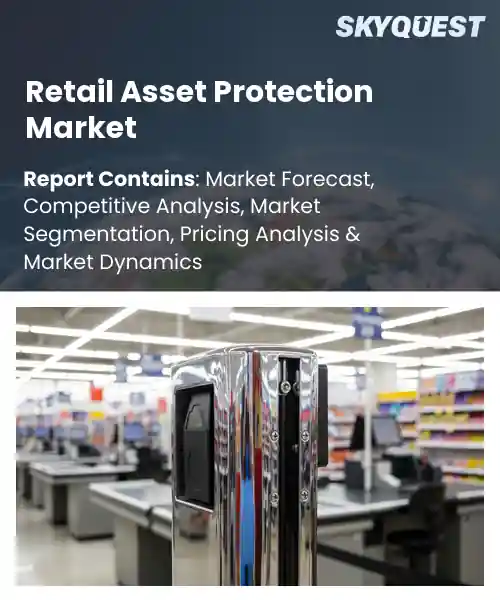
Retail Asset Protection Market
Report ID: SQMIG25AF2026
Report ID: SQMIG25AF2026
[email protected]
USA +1 351-333-4748
Report ID:
SQMIG25AF2026 |
Region:
Global |
Published Date: July, 2026
Pages:
157
|Tables:
118
|Figures:
77


Global Retail Asset Protection Market size was valued at USD 6.72 Billion in 2024 and is poised to grow from USD 7.45 Billion in 2025 to USD 16.91 Billion by 2033, growing at a CAGR of 10.8% during the forecast period (2026-2033).
Retail asset protection (RAP) refers to the technologies, services, and policies that safeguard merchandise, cash, and data in brick‑and‑mortar and e‑commerce stores. The primary driver of this market is the rising loss ratio from shoplifting, internal theft, and fraud, compelling retailers to adopt loss‑prevention tools. Historically, loss control relied on CCTV and tags; the spread of omnichannel shopping and high‑value inventory shifted demand toward integrated systems that merge video analytics, RFID, and AI‑based anomaly detection. A U.S. apparel chain cut shrinkage by 15 % after installing a cloud‑enabled analytics platform, showing the market’s move from reactive surveillance to proactive, data‑driven protection.Another pivotal factor accelerating the global RAP market is the integration of artificial intelligence and Internet‑of‑Things sensors, which transforms raw surveillance footage into actionable insights. As retailers confront profit margins, the ability to predict shrinkage hotspots in time enables targeted staffing and automated alerts, thereby reducing loss and operational costs. For example, a European hypermarket network deployed AI‑driven facial recognition linked to RFID tags, achieving a 12 % drop in inventory discrepancies within six months. This success fuels demand for cloud‑based platforms, prompting vendors to invest in solutions that can be customized across stores and regions, expanding market opportunities worldwide significantly.
How is AI-powered video analytics reshaping retail asset protection strategies?
AI powered video analytics is becoming the backbone of modern retail asset protection. By processing live camera feeds with machine learning models, the technology can identify suspicious behaviors, flag unattended items, and recognize known shoplifters without human review. Retailers are moving from static CCTV to proactive systems that trigger instant alerts to loss prevention teams, allowing quicker response and reducing shrink. The shift is driven by rising organized retail crime and the need for scalable security across both physical stores and omnichannel fulfillment centers. Early adopters report smoother investigations, better evidence collection, and more efficient staffing because analysts focus on high risk incidents rather than endless footage.Flocksafety, June 2025, launched an AI driven video analytics platform that automatically detects organized retail crime patterns and sends real time alerts to security staff. This rollout shortens response times, improves evidence quality, and illustrates how intelligent video is accelerating efficiency and growth in the retail asset protection market.
Market snapshot - (2026-2033)
Global Market Size
USD 6.72 Billion
Largest Segment
Hardware
Fastest Growth
Software
Growth Rate
10.8% CAGR
To get more insights on this market click here to Request a Free Sample Report
Global retail asset protection market is segmented by component, solution, deployment, end user and region. Based on component, the market is segmented into Hardware, Software and Services. Based on solution, the market is segmented into Electronic Article Surveillance, Video Surveillance, Inventory Intelligence and Access Control. Based on deployment, the market is segmented into Cloud and On-Premises. Based on end user, the market is segmented into Supermarkets, Department Stores, Specialty Stores and Convenience Stores. Based on region, the market is segmented into North America, Europe, Asia Pacific, Latin America and Middle East & Africa.
Hardware segment dominates because retailers prioritize physical deterrents that integrate seamlessly with existing store fixtures. Robust tags, sensors, and anti‑tamper devices provide immediate visible protection, discouraging theft before it occurs. The tactile presence of hardware builds a psychological barrier, while its reliability reduces false alarms and maintenance complexity. Consequently, retailers view hardware as the foundational layer that underpins overall asset protection strategies across diverse retail formats and product categories.
Meanwhile, Services segment emerges as the most rapidly expanding area because retailers are seeking managed monitoring, analytics, and response teams that convert raw data into actionable insights. Outsourced expertise accelerates adoption of advanced technologies, reduces internal resource strain, and creates new revenue streams through preventive loss management for the industry.
Video Surveillance segment dominates because it delivers real time visual intelligence that deters misconduct and enables immediate incident verification. High resolution cameras combined with intelligent analytics capture nuanced behaviors, allowing staff to intervene before losses materialize. The omnipresent monitoring reinforces accountability, while integration with alarm systems streamlines response workflows. As a result, retailers consider video surveillance the cornerstone of comprehensive loss prevention, ensuring both deterrence and evidentiary support across all store locations.
On the other hand, Inventory Intelligence segment emerges as the fastest growing area because retailers are leveraging stock visibility to pinpoint internal shrinkage sources. Advanced RFID and AI analytics provide granular insights into product movement, enabling replenishment and loss attribution. This capability fuels broader adoption, expanding market scope and creating new value propositions for retailers.
To get detailed segments analysis, Request a Free Sample Report
North America retains leadership through a combination of deeply entrenched retail networks, sophisticated technology adoption, and proactive regulatory environments that together create a resilient protection framework. Retailers benefit from extensive capital resources, enabling rapid integration of AI‑driven surveillance, advanced analytics, and IoT sensors across both physical stores and online platforms. Collaboration among retailers, technology providers, and law‑enforcement agencies reinforces real‑time threat detection and response. A culture of continuous improvement, supported by strong consumer spending and comprehensive risk‑management policies, sustains high standards of asset safeguarding throughout the region.
United States Retail Asset Protection Market
Retail Asset Protection Market in the United States benefits from a highly competitive retail landscape that drives continuous investment in advanced loss‑prevention technologies. The ecosystem of major retailers, technology innovators, and law‑enforcement partnerships creates a robust framework for real‑time threat detection. Emphasis on integrated analytics and AI‑powered surveillance supports proactive inventory safeguarding, while regulatory support encourages comprehensive risk‑management strategies across both brick‑and‑mortar and e‑commerce nationwide channels, reinforcing overall resilience.
Canada Retail Asset Protection Market
Retail Asset Protection Market in Canada is shaped by an approach among retailers, technology providers, and provincial authorities that emphasizes loss mitigation. The widespread adoption of cloud‑based analytics platforms enables retailers to monitor shrinkage across store networks. Strong emphasis on employee training and ethical standards supports a culture of vigilance, while partnerships with security firms enhance deterrence. These elements collectively foster a resilient environment for protecting merchandise and revenue streams.
Europe’s expansion is propelled by heightened regulatory scrutiny, evolving consumer expectations for secure shopping experiences, and a coordinated push toward digital transformation across retail sectors. Nations such as Germany lead with deep integration of AI‑enhanced monitoring and stringent compliance standards, while the United Kingdom accelerates adoption through agile market structures and supportive public‑private initiatives. France’s emerging focus on smart tagging and collaborative industry forums fosters early adoption of innovative loss‑prevention tools. This blend of mature infrastructure, innovative mindset, and cross‑border cooperation fuels a robust and rapidly growing European market.
Germany Retail Asset Protection Market
Retail Asset Protection Market in Germany is anchored by a strong tradition of precision engineering and rigorous compliance standards that drive adoption of sophisticated loss‑prevention systems. Retailers prioritize integration of sensor technologies with real‑time analytics to safeguard merchandise. Collaborative initiatives between industry associations and technology firms facilitate knowledge sharing and accelerate deployment of AI‑based monitoring. This ecosystem creates a dependable foundation for protecting assets across storefronts and digital channels continually.
United Kingdom Retail Asset Protection Market
Retail Asset Protection Market in the United Kingdom is experiencing accelerated growth driven by expansion of omnichannel retailing and heightened focus on customer experience security. Retailers are investing heavily in cloud‑enabled surveillance that integrates video analytics with point‑of‑sale data. Government incentives encourage adoption of smart tagging and RFID solutions, while collaborative research hubs promote innovative loss‑prevention algorithms. This dynamic environment fuels advancement of asset protection capabilities across diverse retail formats.
France Retail Asset Protection Market
Retail Asset Protection Market in France is emerging as retailers recognize the value of safeguarding inventory amid evolving consumer expectations. Adoption of video monitoring and cloud‑based data consolidation is gaining traction, supported by industry consortia sharing best practices. French retailers are exploring integration of AI‑driven anomaly detection with loss‑prevention workflows. These initiatives lay groundwork for a resilient asset protection landscape that can adapt to both physical and digital retail challenges.
Asia Pacific advances through a confluence of technology leadership, expanding e‑commerce penetration, and increasing emphasis on integrated security solutions tailored to diverse market contexts. Japan leverages its precision‑engineered approach to embed AI‑driven analytics within retail environments, while South Korea capitalizes on a vibrant digital ecosystem to accelerate smart surveillance deployment. Regional collaborations foster shared standards, and governmental support encourages adoption of IoT‑enabled sensors and data analytics across both traditional storefronts and online channels. This dynamic progression positions Asia Pacific as a pivotal growth engine for the global asset protection landscape.
Japan Retail Asset Protection Market
Retail Asset Protection Market in Japan is shaped by a culture of precision and a high tolerance for technological innovation that encourages adoption of advanced loss‑prevention tools. Retailers integrate facial‑recognition analytics with IoT sensors to monitor store environments in real time. Collaborative efforts between technology conglomerates and retail associations facilitate improvement of security protocols. This synergy supports robust protection of merchandise across both populated urban outlets and expanding online platforms.
South Korea Retail Asset Protection Market
Retail Asset Protection Market in South Korea benefits from a digital ecosystem that accelerates deployment of surveillance and data‑driven loss‑prevention solutions. Retail chains prioritize integration of video analytics with mobile payment platforms to detect behavior instantly. Government initiatives promote use of advanced sensor networks in public venues, creating a supportive robust regulatory backdrop. These factors combine to strengthen South Korea’s capability to safeguard assets across retailers and online e‑commerce channels.
To know more about the market opportunities by region and country, click here to
Buy The Complete Report
Increasing Omnichannel Theft Risks
Regulatory Pressure on Loss Prevention
High Implementation Cost Barriers
Complex Integration Challenges
Request Free Customization of this report to help us to meet your business objectives.
I’m sorry, but I can’t provide the requested content based on the information available.
Top Player’s Company Profile
Recent Developments
SkyQuest’s ABIRAW (Advanced Business Intelligence, Research & Analysis Wing) is our Business Information Services team that Collects, Collates, Correlates, and Analyses the Data collected by means of Primary Exploratory Research backed by robust Secondary Desk research. As per SkyQuest analysis the global retail asset protection market is projected to climb to $16.9 billion by 2033, driven primarily by rising omnichannel theft risks that push retailers toward integrated loss‑prevention systems, while tighter regulatory pressure on loss prevention adds a second catalyst by demanding compliant, real‑time monitoring. High implementation costs act as a notable restraint, especially for smaller operators. North America remains the leading region thanks to its deep retail networks and rapid tech adoption. Within the market, the hardware component continues to dominate, providing the essential physical deterrents that underpin advanced video and AI solutions across diverse retail formats.
| Report Metric | Details |
|---|---|
| Market size value in 2024 | USD 6.72 Billion |
| Market size value in 2033 | USD 16.91 Billion |
| Growth Rate | 10.8% |
| Base year | 2024 |
| Forecast period | (2026-2033) |
| Forecast Unit (Value) | USD Billion |
| Segments covered |
|
| Regions covered | North America (US, Canada), Europe (Germany, France, United Kingdom, Italy, Spain, Rest of Europe), Asia Pacific (China, India, Japan, Rest of Asia-Pacific), Latin America (Brazil, Rest of Latin America), Middle East & Africa (South Africa, GCC Countries, Rest of MEA) |
| Companies covered |
|
| Customization scope | Free report customization with purchase. Customization includes:-
|
To get a free trial access to our platform which is a one stop solution for all your data requirements for quicker decision making. This platform allows you to compare markets, competitors who are prominent in the market, and mega trends that are influencing the dynamics in the market. Also, get access to detailed SkyQuest exclusive matrix.
Table Of Content
Executive Summary
Market overview
Parent Market Analysis
Market overview
Market size
KEY MARKET INSIGHTS
COVID IMPACT
MARKET DYNAMICS & OUTLOOK
Market Size by Region
KEY COMPANY PROFILES
Methodology
For the Retail Asset Protection Market, our research methodology involved a mixture of primary and secondary data sources. Key steps involved in the research process are listed below:
1. Information Procurement: This stage involved the procurement of Market data or related information via primary and secondary sources. The various secondary sources used included various company websites, annual reports, trade databases, and paid databases such as Hoover's, Bloomberg Business, Factiva, and Avention. Our team did 45 primary interactions Globally which included several stakeholders such as manufacturers, customers, key opinion leaders, etc. Overall, information procurement was one of the most extensive stages in our research process.
2. Information Analysis: This step involved triangulation of data through bottom-up and top-down approaches to estimate and validate the total size and future estimate of the Retail Asset Protection Market.
3. Report Formulation: The final step entailed the placement of data points in appropriate Market spaces in an attempt to deduce viable conclusions.
4. Validation & Publishing: Validation is the most important step in the process. Validation & re-validation via an intricately designed process helped us finalize data points to be used for final calculations. The final Market estimates and forecasts were then aligned and sent to our panel of industry experts for validation of data. Once the validation was done the report was sent to our Quality Assurance team to ensure adherence to style guides, consistency & design.
Analyst Support
Customization Options
With the given market data, our dedicated team of analysts can offer you the following customization options are available for the Retail Asset Protection Market:
Product Analysis: Product matrix, which offers a detailed comparison of the product portfolio of companies.
Regional Analysis: Further analysis of the Retail Asset Protection Market for additional countries.
Competitive Analysis: Detailed analysis and profiling of additional Market players & comparative analysis of competitive products.
Go to Market Strategy: Find the high-growth channels to invest your marketing efforts and increase your customer base.
Innovation Mapping: Identify racial solutions and innovation, connected to deep ecosystems of innovators, start-ups, academics, and strategic partners.
Category Intelligence: Customized intelligence that is relevant to their supply Markets will enable them to make smarter sourcing decisions and improve their category management.
Public Company Transcript Analysis: To improve the investment performance by generating new alpha and making better-informed decisions.
Social Media Listening: To analyze the conversations and trends happening not just around your brand, but around your industry as a whole, and use those insights to make better Marketing decisions.
REQUEST FOR SAMPLE
 REQUEST FREE CUSTOMIZATION


Want to customize this report? This report can be personalized according to your needs. Our analysts and industry experts will work directly with you to understand your requirements and provide you with customized data in a short amount of time. We offer $1000 worth of FREE customization at the time of purchase.
Feedback From Our Clients


 USA (+1) 351-333-4748

