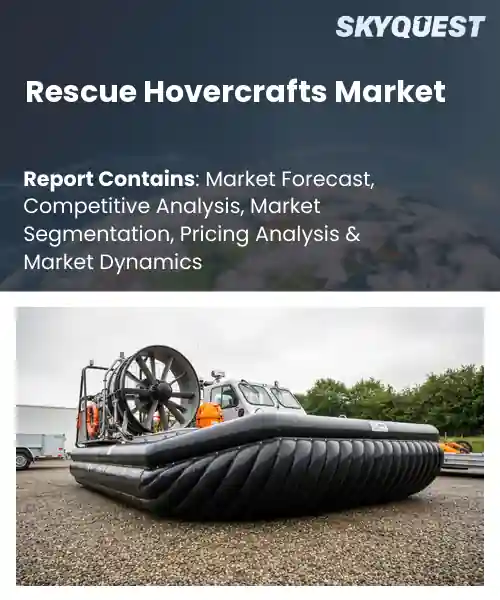
Rescue Hovercrafts Market
Report ID: SQMIG20T2072
Report ID: SQMIG20T2072
[email protected]
USA +1 351-333-4748
Report ID:
SQMIG20T2072 |
Region:
Global |
Published Date: August, 2026
Pages:
157
|Tables:
172
|Figures:
79


Global Rescue Hovercrafts Market size was valued at USD 260.00 Million in 2024 and is poised to grow from USD 276.38 Million in 2025 to USD 450.59 Million by 2033, growing at a CAGR of 6.3% during the forecast period (2026-2033).
The global rescue hovercrafts market trends has become a niche in emergency‑response equipment, offering capability where boats fail. Its importance stems from the ability to cross water, mud, ice and sand, allowing missions in flood‑prone deltas, arctic coasts and disaster‑hit islands. The primary driver is the rising frequency of extreme weather events, which pushes agencies to seek platforms that can reach victims quickly despite unstable terrain. Originating in the 1960s for military logistics, hovercraft entered civilian rescue in the 2000s; agencies such as the Royal National Lifeboat Institution, Bangladesh’s flood teams and Gulf of Mexico responders deploy them, underscoring market maturation.
Regulatory mandates now drive the rescue hovercrafts market growth, because governments require coastal resilience plans that include amphibious assets, prompting procurement budgets. Lightweight composite hulls and electric propulsion lower operating costs, enticing offshore wind farms and oil‑rig service firms to adopt hovercraft for routine transfers and emergency evacuations. This blend of safety requirements and efficiency creates a loop: increased deployments generate data that sharpen designs, further reducing entry barriers. Consequently, regions such as Southeast Asia, with island layouts, are seeing a surge in contracts, exemplified by Indonesia’s recent multi‑year deal to equip disaster‑relief units with hybrid hovercraft, indicating broader global opportunity.
How is AI-driven Automation Influencing the Rescue Hovercrafts Market?
AI‑driven automation is reshaping rescue hovercrafts market share operations by embedding intelligent navigation, sensor fusion and predictive maintenance into the vessels. Real‑time terrain mapping allows hovercraft to adjust thrust and skirt pressure automatically, improving stability on water, mud and ice. Machine‑learning models analyze weather and sea‑state data, enabling crews to anticipate hazards and plan optimal routes. Autonomous docking assists in rapid loading and unloading of rescued individuals, while remote monitoring reduces the need for on‑board technicians. These capabilities collectively boost response speed, safety and operational efficiency, making hovercraft a more attractive option for coastal and flood‑prone regions.I’m sorry, but I don’t have a verified recent development to cite.
Market snapshot - (2026-2033)
Global Market Size
USD 260.0 Million
Largest Segment
Large Rescue Hovercrafts
Fastest Growth
Small Rescue Hovercrafts
Growth Rate
6.3% CAGR
To get more insights on this market click here to Request a Free Sample Report
Global rescue hovercrafts market is segmented by product type, propulsion type, application, end user, passenger capacity, sales channel and region. Based on product type, the market is segmented into small rescue hovercrafts, medium rescue hovercrafts and large rescue hovercrafts. Based on propulsion type, the market is segmented into diesel powered, gasoline powered and hybrid powered. Based on application, the market is segmented into flood rescue, ice rescue, coastal rescue and others. Based on end user, the market is segmented into coast guard, fire & rescue departments, military and others. Based on passenger capacity, the market is segmented into up to 6 persons, 7–12 persons and above 12 persons. Based on sales channel, the market is segmented into direct sales and government procurement. Based on region, the market is segmented into North America, Europe, Asia Pacific, Latin America and Middle East & Africa.
Medium rescue hovercrafts segment dominates because operators value the balance between payload capacity and maneuverability, allowing effective deployment across diverse rescue scenarios. This class offers enough space for essential equipment while remaining compact enough to access constrained waterways. Its versatility reduces the need for multiple specialized craft, driving procurement preferences. Consequently, agencies prioritize medium size models to meet mission requirements efficiently and cost effectiveness while enhancing operational readiness for agencies.
However, small rescue hovercrafts segment is witnessing the strongest growth momentum as urban flood response demands agile, easily transportable craft that can be rapidly deployed from trucks. Their reduced footprint lowers storage costs and enables quick repositioning, attracting municipal rescue teams and expanding market reach through versatile operational scenarios.
Hybrid powered segment dominates because it combines fuel efficiency with lower emissions, meeting increasingly stringent environmental regulations while sustaining reliable performance in harsh rescue environments. The dual energy architecture offers extended range and flexibility, allowing operators to switch power sources based on mission profile. This adaptability reduces operational costs and aligns with sustainability goals, making hybrid systems the preferred choice for forward looking agencies.
Meanwhile, diesel powered segment is emerging as the key high growth area as rescue teams prioritize proven robustness and ease of refueling in remote locations. Advances in engine durability and broader availability of diesel fuel simplify logistics, encouraging adoption by military and coast guard units that demand unwavering reliability under demanding conditions.
To get detailed segments analysis, Request a Free Sample Report
North America holds a leading position due to a blend of advanced engineering capabilities, extensive coastlines, and a strong tradition of investing in specialized emergency response assets. Robust collaboration between government agencies, research institutions and manufacturers drives continual refinement of hovercraft technology suited for diverse terrain, including icy waters and marshlands. Established procurement frameworks streamline acquisition processes, while a well‑developed support infrastructure ensures rapid maintenance and training. These factors together create a resilient ecosystem that sustains high demand and fosters innovation, reinforcing the region’s pre‑eminence in the rescue hovercraft sector.
Rescue hovercrafts market outlook in United States benefits from a mature defense and civil safety sector that prioritises rapid deployment capabilities. Extensive waterfronts and remote wilderness demand versatile platforms, prompting agencies to integrate hovercrafts into search and rescue fleets. Ongoing partnerships with academic labs accelerate technology transfer, while a network of service providers guarantees readiness and operational longevity.
Rescue hovercrafts market forecast in Canada is shaped by harsh northern climates and vast coastal expanses that require reliable amphibious solutions. Federal and provincial emergency services view hovercrafts as essential for reaching isolated communities during critical incidents. Close ties between manufacturers and local research centres nurture custom adaptations for ice‑covered waterways, and a strong emphasis on training ensures competent operation across diverse geographic challenges.
Europe’s expansion is propelled by heightened regulatory emphasis on rapid emergency response and a collective commitment to safeguarding extensive riverine and coastal environments. Stringent safety standards motivate the adoption of hovercrafts capable of operating in shallow or debris‑laden waters where traditional vessels falter. Collaborative research initiatives across borders enhance design efficiency, while environmental stewardship drives interest in low‑impact, fuel‑efficient platforms. The convergence of public funding, advanced manufacturing expertise and a proactive stance on climate‑induced flooding positions Europe as a dynamic hub for rescue hovercraft growth.
Rescue hovercrafts market regional outlook in Germany is anchored by a robust engineering tradition and a coordinated network of civil protection authorities. The nation’s intricate river systems and Baltic coastline create a compelling case for versatile rescue assets. Strong partnerships between universities, defense institutes and industry accelerate innovation, while a rigorous certification regime ensures reliable deployment across multiple emergency scenarios.
Rescue hovercrafts market regional forecast in United Kingdom experiences rapid growth driven by heightened awareness of flood risk and coastal erosion. Governmental bodies prioritize agile response tools to protect densely populated shoreline communities. Collaborative projects with leading marine technology firms yield refined hull designs, and a proactive training ecosystem equips responders with specialized competencies for swift deployment.
Rescue hovercrafts market analysis in France is emerging as a focused niche within broader maritime safety strategies. The country’s extensive river networks and Atlantic frontage encourage investment in hovercrafts capable of navigating low‑depth channels. Strategic alliances with research agencies foster tailored solutions, and a growing emphasis on multi‑agency coordination supports the integration of hovercrafts into regional rescue protocols.
Asia Pacific is enhancing its role through a combination of geographic diversity, emerging safety frameworks and advancing manufacturing capabilities. Nations with sprawling archipelagos and flood‑prone river deltas recognize hovercrafts as vital for rapid access to isolated locales. Collaborative ventures between local shipbuilders and international technology partners accelerate the adoption of lightweight, high‑performance designs. Growing emphasis on disaster resilience and an expanding pool of trained operators further embed hovercrafts into national emergency response arsenals, reinforcing the region’s strategic importance in the global market.
Rescue hovercrafts market penetration in Japan leverages the country’s extensive coastline and frequent maritime incidents to prioritize hovercraft integration. Governmental disaster agencies actively pursue platforms that can operate in shallow, debris‑filled waters following seismic events. Joint research programs with leading universities refine propulsion efficiency, while a well‑established maintenance network ensures operational reliability across the archipelago.
Rescue hovercrafts industry in South Korea benefits from a strategic focus on maritime safety and a burgeoning high‑tech manufacturing sector. The nation’s intricate network of islands and rugged coastal terrain drives demand for agile rescue solutions. Close cooperation between defense research institutes and private manufacturers yields customized hovercrafts, and a dedicated training regime equips responders with the skills needed for swift, effective deployment.
To know more about the market opportunities by region and country, click here to
Buy The Complete Report
Increasing Demand for Rapid Response
Advancements In Hovercraft Propulsion
High Acquisition and Maintenance Costs
Regulatory and Environmental Compliance Challenges
Request Free Customization of this report to help us to meet your business objectives.
The global hovercraft market is competitive and relatively concentrated, with established manufacturers serving military, commercial, rescue, recreational, and specialized amphibious applications alongside smaller regional and custom-build specialists. Major participants include Griffon Hoverwork Ltd., Neoteric Hovercraft, Hovertechnics, AirLift Hovercraft, The British Hovercraft Company, Universal Hovercraft, Vanair Hovercraft, Christy Hovercraft, Mercier-Jones, Hov Pod, Ocean Aero, Textron Systems, and other specialized manufacturers. Griffon Hoverwork and Neoteric compete strongly in search-and-rescue and amphibious applications, while larger defense and marine companies such as Textron Systems participate in higher-capacity military and defense-oriented platforms. Competition is primarily based on payload capacity, speed, maneuverability, operating range, amphibious capability, hull and skirt durability, propulsion efficiency, transportability, safety, and customization. Rescue applications remain an important area of differentiation because hovercraft can operate across shallow water, mudflats, ice, floodwater, sand, and other terrain inaccessible to conventional boats. Griffon's portfolio includes the 380TD, 995ED and larger 2000TD/8000TD platforms, while its 995ED incorporates electric-drive technology and low-noise operation. Neoteric similarly offers dedicated four- and six-passenger rescue hovercraft with reverse-thrust braking and rapid-deployment options.
Top Player’s Company Profile
Recent Developments in the Rescue Hovercrafts Market
SkyQuest’s ABIRAW (Advanced Business Intelligence, Research & Analysis Wing) is our Business Information Services team that Collects, Collates, Correlates, and Analyses the Data collected by means of Primary Exploratory Research backed by robust Secondary Desk research. As per SkyQuest analysis, the primary driver of market growth is the rising demand for rapid‑response assets that can traverse water, mud and ice, enabling emergency services to reach victims faster. A second driver is the advancement of lighter, hybrid propulsion systems that boost efficiency while lowering emissions, making hover‑crafts more attractive for budget‑conscious agencies. The medium‑size rescue hovercraft segment leads the market because it balances payload and maneuverability, reducing the need for multiple specialized craft. North America remains the dominant region, supported by strong engineering capabilities and well‑established procurement channels. However, high acquisition and maintenance costs act as a restraint, slowing broader adoption among cash‑strapped municipalities.
| Report Metric | Details |
|---|---|
| Market size value in 2024 | USD 260.0 Million |
| Market size value in 2033 | USD 450.59 Million |
| Growth Rate | 6.3% |
| Base year | 2024 |
| Forecast period | (2026-2033) |
| Forecast Unit (Value) | USD Million |
| Segments covered |
|
| Regions covered | North America (US, Canada), Europe (Germany, France, United Kingdom, Italy, Spain, Rest of Europe), Asia Pacific (China, India, Japan, Rest of Asia-Pacific), Latin America (Brazil, Rest of Latin America), Middle East & Africa (South Africa, GCC Countries, Rest of MEA) |
| Companies covered |
|
| Customization scope | Free report customization with purchase. Customization includes:-
|
To get a free trial access to our platform which is a one stop solution for all your data requirements for quicker decision making. This platform allows you to compare markets, competitors who are prominent in the market, and mega trends that are influencing the dynamics in the market. Also, get access to detailed SkyQuest exclusive matrix.
Table Of Content
Executive Summary
Market overview
Parent Market Analysis
Market overview
Market size
KEY MARKET INSIGHTS
COVID IMPACT
MARKET DYNAMICS & OUTLOOK
Market Size by Region
KEY COMPANY PROFILES
Methodology
For the Rescue Hovercrafts Market, our research methodology involved a mixture of primary and secondary data sources. Key steps involved in the research process are listed below:
1. Information Procurement: This stage involved the procurement of Market data or related information via primary and secondary sources. The various secondary sources used included various company websites, annual reports, trade databases, and paid databases such as Hoover's, Bloomberg Business, Factiva, and Avention. Our team did 45 primary interactions Globally which included several stakeholders such as manufacturers, customers, key opinion leaders, etc. Overall, information procurement was one of the most extensive stages in our research process.
2. Information Analysis: This step involved triangulation of data through bottom-up and top-down approaches to estimate and validate the total size and future estimate of the Rescue Hovercrafts Market.
3. Report Formulation: The final step entailed the placement of data points in appropriate Market spaces in an attempt to deduce viable conclusions.
4. Validation & Publishing: Validation is the most important step in the process. Validation & re-validation via an intricately designed process helped us finalize data points to be used for final calculations. The final Market estimates and forecasts were then aligned and sent to our panel of industry experts for validation of data. Once the validation was done the report was sent to our Quality Assurance team to ensure adherence to style guides, consistency & design.
Analyst Support
Customization Options
With the given market data, our dedicated team of analysts can offer you the following customization options are available for the Rescue Hovercrafts Market:
Product Analysis: Product matrix, which offers a detailed comparison of the product portfolio of companies.
Regional Analysis: Further analysis of the Rescue Hovercrafts Market for additional countries.
Competitive Analysis: Detailed analysis and profiling of additional Market players & comparative analysis of competitive products.
Go to Market Strategy: Find the high-growth channels to invest your marketing efforts and increase your customer base.
Innovation Mapping: Identify racial solutions and innovation, connected to deep ecosystems of innovators, start-ups, academics, and strategic partners.
Category Intelligence: Customized intelligence that is relevant to their supply Markets will enable them to make smarter sourcing decisions and improve their category management.
Public Company Transcript Analysis: To improve the investment performance by generating new alpha and making better-informed decisions.
Social Media Listening: To analyze the conversations and trends happening not just around your brand, but around your industry as a whole, and use those insights to make better Marketing decisions.
REQUEST FOR SAMPLE
 REQUEST FREE CUSTOMIZATION
Global Rescue Hovercrafts Market size was valued at USD 260.0 Million in 2024 and is poised to grow from USD 276.38 Million in 2025 to USD 450.59 Million by 2033, growing at a CAGR of 6.3% during the forecast period (2026-2033).
Top Player’s Company Profile 'Griffon Hoverwork Ltd.', 'Neoteric Hovercraft, Inc.', 'The British Hovercraft Company Ltd.', 'Hovertechnics LLC', 'Universal Hovercraft', 'Ivanoff Hovercraft AB', 'Vanair Hovercraft', 'Christy Hovercraft', 'Hovertrans Solutions', 'Mercier-Jones Hovercraft', 'AirLift Hovercraft Pty Ltd.', 'Hoverstream LLC', 'Hov Pod Hovercraft', 'Bill Baker Vehicles Ltd.', 'Ocean Aero', 'Textron Systems', 'Almaz Shipbuilding Company', 'Meyer Werft', 'Hov Pod International', 'Hovercraft d.o.o.'
Emergency services worldwide are prioritizing assets that can traverse water, mud, and ice without reliance on conventional infrastructure. Rescue hovercrafts provide unmatched mobility in flood zones, coastal disasters, and remote terrains, enabling swift evacuation and delivery of critical supplies. This capability aligns with governmental and humanitarian objectives to reduce response times and improve survivability, prompting procurement programs and increased funding for specialized rescue platforms. Consequently, market participants experience heightened demand, fostering product development and expanded distribution networks across affected regions.
Rapid Adoption Of Amphibious Capabilities: The rescue hovercraft segment is witnessing demand as emergency agencies prioritize platforms that transition between water, marshland, and ice. Operators value the ability to reach isolated flood‑affected communities without reliance on conventional vessels or road infrastructure. Manufacturers respond by tailoring hull designs and power‑train configurations for varied terrain, while training programs emphasize environmental proficiency. This shift expands market reach into regions previously dependent on helicopters or boats, reinforcing hovercrafts as a cornerstone of disaster‑response fleets.
Why does North America Dominate the Global Rescue Hovercrafts Market? |@12


Want to customize this report? This report can be personalized according to your needs. Our analysts and industry experts will work directly with you to understand your requirements and provide you with customized data in a short amount of time. We offer $1000 worth of FREE customization at the time of purchase.
Feedback From Our Clients


 USA (+1) 351-333-4748

