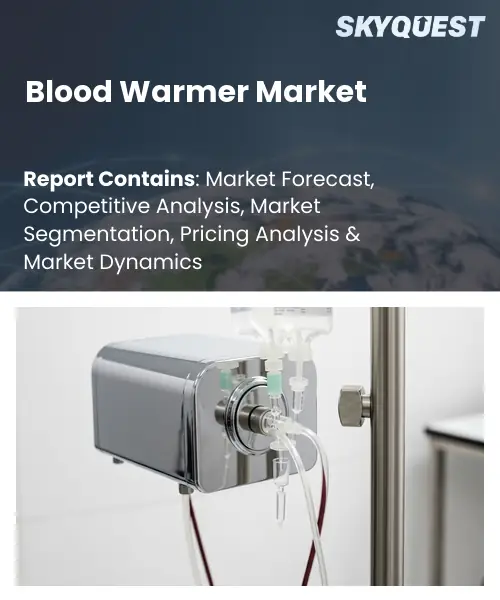
Blood Warmer Market
Report ID: SQMIG35A3789
Report ID: SQMIG35A3789
[email protected]
USA +1 351-333-4748
Report ID:
SQMIG35A3789 |
Region:
Global |
Published Date: June, 2026
Pages:
157
|Tables:
121
|Figures:
77


Global Blood Warmer Market size was valued at USD 1.25 Billion in 2024 and is poised to grow from USD 1.35 Billion in 2025 to USD 2.58 Billion by 2033, growing at a CAGR of 8.4% during the forecast period (2026-2033).
Increased emphasis on clinical guidelines and outcome data is the major force behind the rising global market for blood warmers since research demonstrating an association between peri-operative hypothermia and increased transfusion risks has led societies to promote active warming. Consequently, hospitals are increasingly procuring systems of both inline and portable types for ambulances and trauma centers. In this way, suppliers have been motivated to design single-use tubes, monitors, and services that ensure recurring revenue. Such dynamics present business possibilities for developing nations where more operations are being performed as well as in other settings, such as mass casualty scenarios and neonatal intensive care units.
How is AI Enhancing Safety and Compliance in the Blood Warmer Market?
The incorporation of AI into the blood warmer industry is increasing safety and compliance through continuous intelligence regarding temperature control monitoring and documentation. The most important elements include adaptive temperature control based on flow and fluid type anomaly detection of heating and sensor malfunctions and automated audit trails to simplify reporting requirements. There is a trend in this market towards using connectivity and cloud-based solutions as hospitals and emergency services need dependable handoff records and continuous temperature control while moving patients around and conducting surgeries. Examples of such AI-driven products include dashboards providing temperature records with timestamps predictive maintenance warnings for device servicing and connections with infusion systems to minimize manual verification. MEQU obtained FDA clearance for its M Station device in May 2026 and this accomplishment illustrates both market progress and potential safety and compliance improvements provided by AI-driven logging and alerting.
Market snapshot - (2026-2033)
Global Market Size
USD 1.25 Billion
Largest Segment
Consumables
Fastest Growth
IV-Fluid Tube Warmers
Growth Rate
8.4% CAGR
To get more insights on this market click here to Request a Free Sample Report
Global blood warmer market is segmented by system type, flow rate, application, end-user and region. Based on system type, the market is segmented into IV-Fluid Tube Warmers, Dry Heat Plate Warmers, Water Bath Warmers, Consumablesand Others. Based on flow rate, the market is segmented into Standard Flow Blood Warmers, Fast Flow Warmers and Others. Based on application, the market is segmented into Blood Transfusions, Surgical Procedures, Trauma and Emergency Care and Others. Based on end-user, the market is segmented into Hospitals and ASCs, Specialty Clinics, Blood Banks and Transfusion Centers and Others. Based on region, the market is segmented into North America, Europe, Asia Pacific, Latin America and Middle East & Africa.
Water Bath Warmer sub-segment leads due to reliance by physicians on the proven capability of providing consistent warming throughout lengthy blood transfusions and complicated surgical operations. This is based on proven capabilities to prevent hemolysis and hypothermia in patients. The proven clinical performance and compliance with hospital protocols regarding transfusions influence purchase decisions. Safety and compliance are emphasized by suppliers of this equipment.
Nevertheless, IV Fluid Tube Warmers exhibit the greatest potential for future growth with growing needs for portable units that can be used at the point of care. The development of one-time consumables and ease of operation, coupled with fewer risks of infections, are increasing its popularity in various medical departments.
Fast Flow Warmers have a commanding market share position since their technical capabilities meet the requirement of performing high flow volume transfusions under critical situations, which allow fast heat exchange at higher flow rates while preserving the structural integrity of blood. Their suitability in emergencies, compatibility with fast infusion systems, and clinicians' trust in offering thermal stabilization during resuscitation drive adoption in trauma processes; emphasis by manufacturers in terms of strength and compatibility ensure their supremacy in critical environments.
On the other hand, Standard Flow Blood Warmers are now the main high growth sector owing to increased use in conventional transfusions and ambulatory surgery procedures. Developments in compact designs, lower costs, and intuitive interfaces are driving their adoption across different medical fields and providing opportunities to extend into the market further.
To get detailed segments analysis, Request a Free Sample Report
North America emerges as the leader in the global market for blood warmers as a result of a combination of factors, including highly developed clinical infrastructure, increased demands for blood warmers in highly specialized healthcare facilities, and procurement policies that value patient safety and reliable medical devices. The presence of mature systems among manufacturers, highly developed distribution channels, and active regulatory systems ensures fast development of the market, since the evaluation process is highly facilitated. The priority of temperature maintenance during surgeries and blood transfusions in accordance with clinical guidelines contributes to the frequent application of these devices.
The market for blood warmers in the USA involves extensive usage within trauma centers, operating rooms, and intensive care units. Close alignment with the process of hospital procurement, active involvement of clinicians in selecting the right devices, as well as competition among manufacturers, promote product improvements. Training programs in patient safety ensure uniform application. Cooperative research projects and demonstration sites help confirm clinical effectiveness and aid purchase decisions at healthcare facilities.
Blood Warmer Industry in Canada illustrates focus on the central procurement in health system settings, creating uniform processes and extensive product evaluation. Clinical networks and regional hubs facilitate the promotion of best practicestraining. Small sizes of hospitals promote the usage of flexible devices to be easily integrated into current transfusion systems. Partnership with suppliers enables piloting and real-world evidence production to support future purchasing and guidelines creation for the whole system.
Fast growth in Europe is fueled by standardized clinical practices, an increased focus on patient safety during perioperative procedures, and enhanced cooperation between healthcare facilities and manufacturers of medical equipment that helps develop customized solutions for different facilities. The presence of robust networks of hospitals and effective reimbursement schemes in major countries stimulates uptake, and centralized purchasing in some health systems stimulates analysis of efficient and interoperable devices. Research consortia and clinical societies are involved in developing guidelines that emphasize the need for temperature control during transfusions and surgery. Well-established companies together with dynamic newcomers are contributing to a competitive market environment. Market leaders include companies that operate from regions with active clinical research, while new regions concentrate on customization of medical devices.
Germany’s Blood Warmer Industry relies on extensive cooperation between academic medical institutions and experienced manufacturers of medical equipment. Stressing the importance of clinical validation and integration into the hospitals’infrastructure promotes the use of devices in hospitals and clinics. Hospital network’s centralized purchasing process contributes to standardization of evaluation of devices. Clinician buy-in is enhanced by training and guidelines offered by professional societies. Engineering capabilities at the local level promote customized products and after-sales support.
Blood Warmer Market in the United Kingdom is characterized by fast adoption due to innovative health care environments and clinical networks that assess new products. The importance of showing clinical evidence and being cost-effective ensures that trials and pilots are common practice in the UK. Good connections between academic hospitals and suppliers of blood warmers make sure that products are improved continuously.
The French blood warmer market is developing as a result of investments into upgrading hospitals and their equipment, including through clinical evaluation studies. Regional healthcare centers and university hospitals play an important role in clinical evaluations at an early stage, which makes it possible to adjust the technology to fit the existing local medical process. Focus on integration within existing transfusion systems and active post-market monitoring adds to the credibility of clinicians.
The Asia Pacific region is gaining momentum by using innovation, local manufacturing capacities, and growing clinical understanding of the benefits of temperature management within the context of acute care. The healthcare industry is evolving with peri-operative procedures and transfusions, requiring products that offer optimized performance and usability in different settings. Companies focus on tailoring their products to clinical environments in specific regions as well as regulatory requirements, while at the same time developing sales support and training programs. Cooperation between companies in conducting research and forming partnerships with multinational companies promotes knowledge transfer and validation of products locally. Market centers in Japan and South Korea offer an ideal environment to raise standards and validate locally manufactured products.
Japan Blood Warmer Market showcases a keen interest in engineering expertise, clinical testing, and compatibility with sophisticated hospital management systems. The best hospitals and research institutes work together with the manufacturers for the proper evaluation of the devices and their seamless incorporation into clinical practices. A high emphasis on reliability, efficient temperature regulation, and maintenance ensures acceptance within treatment centers. Regulatory involvement and localized production help tailor solutions for healthcare providers.
The South Korean Blood Warmer market is evolving owing to robust relationships between the clinical organizations and the advanced manufacturing industry. Focus on small sizes and intuitive interfaces with quick after-sales assistanceaddressing the needs of tertiary care hospitals and smaller hospitals. Proactive involvement in research projects and trials at the regional level aids localization of the products' functionalities and service concepts. Effective regulatory interaction and procurement expertise at hospitals facilitate assessment of integrated temperature management systems.
To know more about the market opportunities by region and country, click here to
Buy The Complete Report
Growing Demand for Safe Transfusions
The rising focus on patient safety and maintaining the temperature of blood at controlled levels during transfusions has prompted healthcare professionals to embrace blood warming equipment extensively. Medical practitioners view the use of warmed blood as beneficial in minimizing complications and facilitating better results in surgical and traumatic situations, making it necessary for hospitals to procure the proper equipment. Such a focus makes it possible for demand for these products to be sustained, as well as extend the procurement cycle, thus facilitating growth in the market.
Technological Advancements in Devices
Innovations such as advancements in portability, improvements in temperature regulation accuracy, and compatibility with different types of blood have made blood warmers more functional and trustworthy. The inclusion of safety measures and improved user interface designs makes the usage of these devices less cumbersome and more appealing to potential users. As technology continues to improve the usability of blood warmers and complement other medical devices, purchases will be made based on the effectiveness and convenience provided by such innovations.
High Cost of Devices and Maintenance
The high initial cost required to invest in modern blood warming technology together with continuous expenditure related to maintenance and recalibration may prevent healthcare facilities with limited budgets from acquiring new technologydue to conflicting requirements. Financial constraints force prioritization of various capital investment projects, thus extending acquisition time and preventing adoption. Although there is evidence of clinical advantages, the process involved in procuring modern technology discourages immediate purchase. Thus, the demand for new innovation becomes fragmented.
Stringent Regulatory Approval Processes
Regulatory processes associated with device certification, continued compliance, and monitoring beyond the point of sale prolong the time-to-market process and increase development costs, potentially dissuading smaller firms and reducing the range of products that might be introduced into the market. Detailed record keeping and testing processes pose obstacles to prompt commercialization, and companies are compelled to invest substantial efforts in conformity exercises rather than product development and market entry. Such considerations make procurement organizations hesitant to purchase products without prior compliance histories.
Request Free Customization of this report to help us to meet your business objectives.
The competitive landscape is dominated by existing medical device companies with growing competition based on portability and FDA clearance milestones. Drivers of competition in the industry include fast FDA clearances and proven efficacy in the field. Actual strategies that can be identified from the industry include big-ticket mergers like the one between Baxter and Hillrom, new product development by existing firms like 3M, and regulation-driven commercialization seen through MEQU’s FDA 510k clearance.
Point of Care Integration: The integration of blood warmers with care points of access and information systems is now at the forefront of healthcare facilities as part of their efforts to automate the blood transfusion process for ease of administration. The focus on creating seamless interoperability between the technology being used for patient monitoring and inventory management systems contributes greatly towards effective decision making and efficiencies in operations. Vendors are coming up with devices that are modular and interoperable to suit different environments.
Smart Connected Devices: Connectivity features and sensors will be integrated into blood warming equipment for remote monitoring, maintenance, and data support for clinical protocols. These benefits include increasing uptime, promoting standardization in blood warming procedures, and supporting audits and clinical compliance. The growing focus on ease of use and secure data transmission encourages cooperation among the biomedical and IT communities, allowing manufacturers to provide service contracts and software updates that help add value to the product and adjust according to new needs.
SkyQuest’s ABIRAW (Advanced Business Intelligence, Research & Analysis Wing) is our Business Information Services team that Collects, Collates, Correlates, and Analyses the Data collected by means of Primary Exploratory Research backed by robust Secondary Desk research.
As per SkyQuest analysis, the demand for blood warming systems in the world is being pushed forward by improved clinical standards as well as increasing requirements for patients' body temperature control during the process of transfusion or surgeries, with high cost and expensive maintenance acting as barriers to adoption. North America is still the largest region because of its sophisticated clinical settings and fast adoption by hospitals, and water bath warming systems dominate the market because of their ability to operate efficiently for extended periods of time or complicated operations. In addition to this, another growth factor is quick technological development, such as intelligent temperature control devices based on AI technology.
| Report Metric | Details |
|---|---|
| Market size value in 2024 | USD 1.25 Billion |
| Market size value in 2033 | USD 2.58 Billion |
| Growth Rate | 8.4% |
| Base year | 2024 |
| Forecast period | (2026-2033) |
| Forecast Unit (Value) | USD Billion |
| Segments covered |
|
| Regions covered | North America (US, Canada), Europe (Germany, France, United Kingdom, Italy, Spain, Rest of Europe), Asia Pacific (China, India, Japan, Rest of Asia-Pacific), Latin America (Brazil, Rest of Latin America), Middle East & Africa (South Africa, GCC Countries, Rest of MEA) |
| Companies covered |
|
| Customization scope | Free report customization with purchase. Customization includes:-
|
To get a free trial access to our platform which is a one stop solution for all your data requirements for quicker decision making. This platform allows you to compare markets, competitors who are prominent in the market, and mega trends that are influencing the dynamics in the market. Also, get access to detailed SkyQuest exclusive matrix.
Table Of Content
Executive Summary
Market overview
Parent Market Analysis
Market overview
Market size
KEY MARKET INSIGHTS
COVID IMPACT
MARKET DYNAMICS & OUTLOOK
Market Size by Region
KEY COMPANY PROFILES
Methodology
For the Blood Warmer Market, our research methodology involved a mixture of primary and secondary data sources. Key steps involved in the research process are listed below:
1. Information Procurement: This stage involved the procurement of Market data or related information via primary and secondary sources. The various secondary sources used included various company websites, annual reports, trade databases, and paid databases such as Hoover's, Bloomberg Business, Factiva, and Avention. Our team did 45 primary interactions Globally which included several stakeholders such as manufacturers, customers, key opinion leaders, etc. Overall, information procurement was one of the most extensive stages in our research process.
2. Information Analysis: This step involved triangulation of data through bottom-up and top-down approaches to estimate and validate the total size and future estimate of the Blood Warmer Market.
3. Report Formulation: The final step entailed the placement of data points in appropriate Market spaces in an attempt to deduce viable conclusions.
4. Validation & Publishing: Validation is the most important step in the process. Validation & re-validation via an intricately designed process helped us finalize data points to be used for final calculations. The final Market estimates and forecasts were then aligned and sent to our panel of industry experts for validation of data. Once the validation was done the report was sent to our Quality Assurance team to ensure adherence to style guides, consistency & design.
Analyst Support
Customization Options
With the given market data, our dedicated team of analysts can offer you the following customization options are available for the Blood Warmer Market:
Product Analysis: Product matrix, which offers a detailed comparison of the product portfolio of companies.
Regional Analysis: Further analysis of the Blood Warmer Market for additional countries.
Competitive Analysis: Detailed analysis and profiling of additional Market players & comparative analysis of competitive products.
Go to Market Strategy: Find the high-growth channels to invest your marketing efforts and increase your customer base.
Innovation Mapping: Identify racial solutions and innovation, connected to deep ecosystems of innovators, start-ups, academics, and strategic partners.
Category Intelligence: Customized intelligence that is relevant to their supply Markets will enable them to make smarter sourcing decisions and improve their category management.
Public Company Transcript Analysis: To improve the investment performance by generating new alpha and making better-informed decisions.
Social Media Listening: To analyze the conversations and trends happening not just around your brand, but around your industry as a whole, and use those insights to make better Marketing decisions.
REQUEST FOR SAMPLE
 REQUEST FREE CUSTOMIZATION
Global Blood Warmer Market size was valued at USD 1.25 Billion in 2024 and is poised to grow from USD 1.35 Billion in 2025 to USD 2.58 Billion by 2033, growing at a CAGR of 8.4% during the forecast period (2026-2033).
Competitive landscape is concentrated among established medical device vendors while competition increasingly centres on portable pre-hospital solutions and regulatory milestones; competitive drivers include rapid FDA clearances and field-proven performance. Real strategies visible in the market include large-scale M&A such as Baxter’s acquisition of Hillrom, major product launches and partnerships from incumbents like 3M, and regulatory-led commercialization illustrated by MEQU’s recent FDA 510k clearance. '3M Company', 'Smiths Medical', 'Stryker Corporation', 'Geratherm Medical AG', 'Belmont Medical Technologies', 'Barkey GmbH & Co. KG', 'The 37Company', 'Keewell Medical Technology', 'Sino Medical-Device Technology', 'Biegler GmbH', 'Futuremed', 'Vyaire Medical', 'Mennen Medical', 'Estill Voice International', 'QED Scientific Ltd.', 'Enflow', 'Life-Warmer', 'Cincinnati Sub-Zero (CSZ)', 'EmTherm', 'Smisson-Cartledge Biomedical'
The increasing emphasis on patient safety and the need to maintain blood at controlled temperatures during transfusion has driven healthcare providers to adopt blood warmers more widely. Clinicians perceive warmed blood as reducing complications and improving outcomes during perioperative and trauma care, prompting hospitals to invest in appropriate devices and training. This clinical prioritization creates steady procurement demand, supports longer term purchasing cycles, and encourages suppliers to expand offerings, thereby reinforcing market expansion through greater institutional adoption and deeper integration into standard transfusion protocols.
Point Of Care Integration: Healthcare providers are prioritizing integration of blood warmers with point of care workflows and electronic systems to streamline transfusion processes, reduce manual steps, and improve traceability. Emphasis on seamless interoperability with monitoring equipment and inventory platforms enhances clinical decision making and operational efficiency. Vendors are responding with modular designs and compatibility layers that support diverse care settings, enabling faster adoption in emergency, perioperative, and critical care environments while aligning with institutional IT strategies and frontline staff preferences and workflow optimization.
Why does North America Dominate the Global Blood Warmer Market? |@12


Want to customize this report? This report can be personalized according to your needs. Our analysts and industry experts will work directly with you to understand your requirements and provide you with customized data in a short amount of time. We offer $1000 worth of FREE customization at the time of purchase.
Feedback From Our Clients


 USA (+1) 351-333-4748

