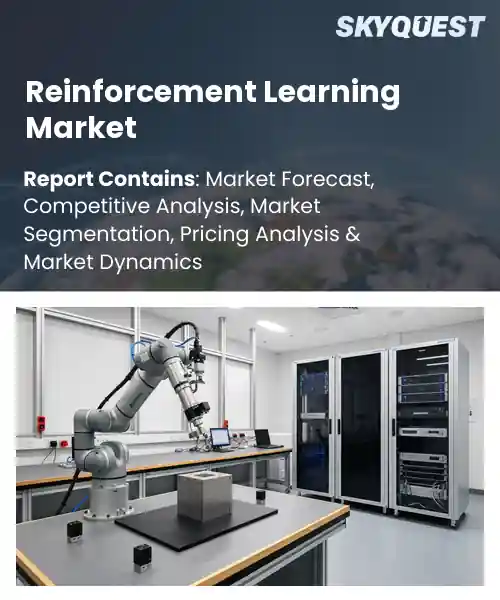
Reinforcement Learning Market
Report ID: SQMIG15E3401
Report ID: SQMIG15E3401
[email protected]
USA +1 351-333-4748
Report ID:
SQMIG15E3401 |
Region:
Global |
Published Date: April, 2026
Pages:
157
|Tables:
119
|Figures:
77


Global Reinforcement Learning Market size was valued at USD 4.82 Billion in 2024 and is poised to grow from USD 6.5 Billion in 2025 to USD 4.9 Billion by 2033, growing at a CAGR of 34.8% during the forecast period (2026-2033).
The primary driver of the reinforcement learning market is the rising availability of large-scale, high-quality data and computational power, which enables agents to learn complex policies through trial-and-error in realistic environments. Reinforcement learning market encompasses algorithms, platforms, and services that train autonomous systems to optimize sequential decision-making, and it matters because it can deliver adaptive automation across robotics, finance, healthcare, and recommendation systems. Historically the field evolved from tabular methods to deep reinforcement learning after breakthroughs like DeepMind’s Atari and AlphaGo demonstrations, which illustrated practical value and attracted investment, research collaborations, and commercial pilots that accelerated technology transfer into products.Building on those commercial pilots, a key factor shaping the global reinforcement learning market is the maturation of simulation-to-reality pipelines and scalable cloud compute, because better simulators and affordable GPUs reduce training costs and shorten development cycles, enabling enterprises to deploy RL in production. As a result logistics companies implement RL for dynamic routing that cuts fuel and delivery times, energy operators use it to balance grids and lower peak costs, and financial firms automate execution strategies to enhance returns; these successful deployments attract vendor investment and partnerships, which expand tool ecosystems and create further vertical solutions and customer adoption.
How is AI-driven reinforcement learning transforming automation in industrial robotics?
AI driven reinforcement learning is reshaping industrial robotics by teaching machines to learn from trial and error within simulated and real environments. Key aspects include policy learning for control, reward design to define task goals, and sim to real transfer so skills trained virtually generalize on hardware. The current state shows wider adoption as robots move beyond scripted motion to adaptive decision making. Market context points to growing demand for flexible automation that handles variability and unstructured tasks. Examples include robotic arms learning assembly, mobile manipulators optimizing warehouse flows, and collaborative robots adapting to human partners. This shift reduces engineering overhead and speeds deployment.NVIDIA January 2026, released new physical AI models and simulation frameworks that accelerate robot policy training and evaluation. By enabling more efficient reinforcement learning in simulation and smoother transfer to real hardware this development speeds deployment and reduces risk, supporting market growth and practical automation adoption.
Market snapshot - (2026-2033)
Global Market Size
USD 4.82 Billion
Largest Segment
Professional Managed AI Services
Fastest Growth
Cloud-based RL Training Platforms
Growth Rate
34.8% CAGR
To get more insights on this market click here to Request a Free Sample Report
Global reinforcement learning market is segmented by solution component, algorithm type, application vertical, deployment model and region. Based on solution component, the market is segmented into RL Software Frameworks & Libraries (OpenAI Gym, Ray Rllib), Cloud-based RL Training Platforms and Professional Managed AI Services. Based on algorithm type, the market is segmented into Model-based Reinforcement Learning, Model-free RL (Q-Learning, Policy Gradient) and Deep Reinforcement Learning (DRL). Based on application vertical, the market is segmented into Robotics & Industrial Automation (Motion Control), Autonomous Vehicles & ADAS Training, Algorithmic Trading & FinTech and Game Development & Simulation. Based on deployment model, the market is segmented into Edge-based RL (Real-time inference) and Cloud-centric Heavy Training Systems. Based on region, the market is segmented into North America, Europe, Asia Pacific, Latin America and Middle East & Africa.
Cloud-based RL Training Platforms segment leads because these platforms centralize high performance compute and orchestration for complex RL workloads, enabling enterprises to train agents at scale with lower operational complexity. By offering managed distributed training, automated experiment tracking, and seamless integration with popular frameworks, they reduce time to iteration and allow organizations to focus on algorithmic innovation rather than infrastructure, driving adoption across research and production use cases.
However, RL Software Frameworks & Libraries are emerging as the fastest growing area because open source toolkits lower barriers to trying algorithms and nurture community driven improvements. Their simulator compatibility and extensible APIs enable rapid prototyping by researchers and startups, fueling diverse applications and creating channels for commercial tools and services that expand market opportunity.
Deep Reinforcement Learning (DRL) segment stands out because its combination of deep neural function approximators with trial and error learning enables agents to solve high dimensional perception and control tasks that classical approaches cannot. Advances in representation learning, simulation fidelity, and hardware make DRL practical for real world applications, driving adoption in complex domains where rich sensory inputs and strategic decision making are essential.
On the other hand, Model based Reinforcement Learning is emerging as the fastest growing approach because its focus on learning environment dynamics reduces sample requirements and enables safer planning for physical systems. Improved environment models and hybrid methods are attracting interest from industrial applications where data efficiency and predictable behavior accelerate deployment, unlocking new commercial use cases and cost effective adoption paths.
To get detailed segments analysis, Request a Free Sample Report
North America benefits from a mature technology ecosystem, deep venture funding networks, and an ecosystem of research institutions that accelerate development and commercialization of reinforcement learning solutions. Strong industry-academia collaboration enables translation of experimental advances into enterprise applications across technology, finance, healthcare, and autonomous systems. A dense presence of leading cloud providers, specialized startups, and established software vendors fosters rapid testing, scalable deployment, and a competitive market for talent and tools. Robust regulatory dialogue and supportive corporate procurement practices further encourage early adoption by large enterprises. Concentration of key talent hubs and cross border collaboration further reinforce market leadership and innovation velocity.
Reinforcement Learning Market in United States is driven by concentration of leading research laboratories, prominent cloud and compute infrastructure providers, and a vibrant startup ecosystem focused on real world deployment. Enterprise demand from technology, autonomous vehicles, finance, and healthcare fuels productization and pilots. Availability of interdisciplinary talent pools and strong industry partnerships accelerates commercialization, enabling scalable implementations, robust tooling, and a competitive landscape that fosters ongoing innovation and collaboration.
Reinforcement Learning Market in Canada is shaped by a combination of strong academic research centers, government research labs, and a growing cohort of applied AI startups. Collaborative programs between universities and industry support translation of academic advances into practical solutions. Emphasis on ethical AI practices and sectoral partnerships in healthcare, resource management, and manufacturing encourages tailored reinforcement learning pilots. A supportive innovation ecosystem helps attract talent and international collaboration opportunities.
Asia Pacific expansion is driven by concentrated industrial demand for automation, robotics, and intelligent control systems across manufacturing, electronics, and automotive supply chains. Strong private and public investments in advanced semiconductors, robotics research, and AI infrastructure create favorable conditions for applied reinforcement learning experimentation and deployment. High adaptation of cloud and edge computing platforms along with specialized hardware ecosystems enables efficient training and inference for complex control tasks. Regional firms increasingly prioritize efficiency gains from adaptive decision making in logistics, predictive maintenance, and personalized services, while academic institutions and corporate research centers foster talent development and cross border partnerships that translate research prototypes into commercially viable solutions. Complementary ecosystems of startups, system integrators, and multinational research and development hubs accelerate commercialization and create a competitive landscape attractive to international collaboration.
Reinforcement Learning Market in Japan benefits from robotics expertise, advanced manufacturing practices, and strong corporate research centers focused on automation and intelligent control. Industry adoption emphasizes safe and reliable use in factory automation, logistics, and mobility. Close collaboration between universities and industrial consortia supports applied research and prototype deployment. A mature electronics and semiconductor supply chain and culture of continuous improvement enable integration of reinforcement learning into complex industrial systems.
Reinforcement Learning Market in South Korea is propelled by strengths in semiconductor manufacturing, consumer electronics, and connected mobility, supported by corporate research centers. Focus on high performance computing and edge deployment supports real time control. Collaborative initiatives between industry and academic institutions accelerate transfer of algorithms to commercial platforms. Supply chain integration and emphasis on export oriented innovation encourage deployment of reinforcement learning in manufacturing, logistics, and service robotics globally.
Europe is strengthening its role through a combination of robust academic research networks, industry specialization in sectors such as automotive, manufacturing, aerospace, and financial services, and an evolving policy environment that emphasizes trustworthy and explainable AI. Cross country collaborations between universities, national labs, and key industrial players facilitate knowledge sharing and joint development of applied reinforcement learning solutions. Strong systems integration capabilities and a focus on safety critical applications encourage careful validation and deployment. Growing involvement of system integrators, established enterprise software vendors, and research driven startups supports scalable adoption and positions the region as a source of high quality, regulation aware reinforcement learning solutions. Strategic public procurement, industry cluster initiatives, and intergovernmental research programs further incentivize pilots and cross border deployments, helping create interoperable standards and reinforcing market credibility.
Reinforcement Learning Market in Germany is anchored by a strong industrial base, particularly in automotive and manufacturing sectors that demand reliable control and optimization solutions. Research institutes and engineering firms collaborate with industrial companies to validate and deploy reinforcement learning in production environments. Emphasis on engineering rigor, safety certification practices, and process optimization drives cautious but impactful adoption. Integration with established automation suppliers and systems integrators supports scalable implementations nationwide.
Reinforcement Learning Market in United Kingdom benefits from leading financial services firms, active technology hubs and academic research centers that emphasize applied machine learning. Sector focus on finance, healthcare and autonomous systems drives practical deployments and pilots. Collaborative networks among universities and corporate partners support talent development and commercialization pathways. Emphasis on data governance and responsible AI practices, combined with startup activity, helps translate research into enterprise applications and partnerships.
Reinforcement Learning Market in France draws on prominent research institutions, research funding, and a startup community focused on applied AI. Industry strength in aerospace, energy, transportation, and healthcare creates demand for reinforcement learning solutions tailored to complex engineering challenges. Collaboration between national labs, universities, and industrial partners supports prototype validation and system integration. Policy emphasis on responsible AI and coordinated innovation programs encourages pilots and cross sector adoption and partnerships.
To know more about the market opportunities by region and country, click here to
Buy The Complete Report
Advances In Computational Power
Enterprise Adoption Across Industries
Data Quality and Availability
Complexity Of Model Development
Request Free Customization of this report to help us to meet your business objectives.
The competitive landscape centers on firms racing to deliver RLHF and RLOps for production LLMs, a market driver tied to enterprise demand for aligned agents. Incumbents pursue consolidation through acquisitions and internal mergers such as Google’s integration of DeepMind and Google Brain. Startups and vendors form partnerships with data and tooling providers while raising capital to commercialize RL tooling and accelerate deployments.
Top Player’s Company Profile
Recent Developments
SkyQuest’s ABIRAW (Advanced Business Intelligence, Research & Analysis Wing) is our Business Information Services team that Collects, Collates, Correlates, and Analyses the Data collected by means of Primary Exploratory Research backed by robust Secondary Desk research. As per SkyQuest analysis, a key driver is the rising availability of large-scale, high-quality data and computational power, while a major restraint remains uneven data quality and limited access to representative interaction datasets. The dominating region is North America due to concentrated research, cloud infrastructure and venture funding, and the dominating segment is cloud-based RL training platforms that centralize high-performance compute and orchestration. A second driver accelerating adoption is improved simulation-to-reality pipelines and scalable cloud compute that lower training cost and speed deployment across robotics, finance and enterprise automation. Together these forces shape vendor ecosystems, industry partnerships and verticalized solutions and create clearer enterprise value propositions.
| Report Metric | Details |
|---|---|
| Market size value in 2024 | USD 4.82 Billion |
| Market size value in 2033 | USD 4.9 Billion |
| Growth Rate | 34.8% |
| Base year | 2024 |
| Forecast period | (2026-2033) |
| Forecast Unit (Value) | USD Billion |
| Segments covered |
|
| Regions covered | North America (US, Canada), Europe (Germany, France, United Kingdom, Italy, Spain, Rest of Europe), Asia Pacific (China, India, Japan, Rest of Asia-Pacific), Latin America (Brazil, Rest of Latin America), Middle East & Africa (South Africa, GCC Countries, Rest of MEA) |
| Companies covered |
|
| Customization scope | Free report customization with purchase. Customization includes:-
|
To get a free trial access to our platform which is a one stop solution for all your data requirements for quicker decision making. This platform allows you to compare markets, competitors who are prominent in the market, and mega trends that are influencing the dynamics in the market. Also, get access to detailed SkyQuest exclusive matrix.
Table Of Content
Executive Summary
Market overview
Parent Market Analysis
Market overview
Market size
KEY MARKET INSIGHTS
COVID IMPACT
MARKET DYNAMICS & OUTLOOK
Market Size by Region
KEY COMPANY PROFILES
Methodology
For the Reinforcement Learning Market, our research methodology involved a mixture of primary and secondary data sources. Key steps involved in the research process are listed below:
1. Information Procurement: This stage involved the procurement of Market data or related information via primary and secondary sources. The various secondary sources used included various company websites, annual reports, trade databases, and paid databases such as Hoover's, Bloomberg Business, Factiva, and Avention. Our team did 45 primary interactions Globally which included several stakeholders such as manufacturers, customers, key opinion leaders, etc. Overall, information procurement was one of the most extensive stages in our research process.
2. Information Analysis: This step involved triangulation of data through bottom-up and top-down approaches to estimate and validate the total size and future estimate of the Reinforcement Learning Market.
3. Report Formulation: The final step entailed the placement of data points in appropriate Market spaces in an attempt to deduce viable conclusions.
4. Validation & Publishing: Validation is the most important step in the process. Validation & re-validation via an intricately designed process helped us finalize data points to be used for final calculations. The final Market estimates and forecasts were then aligned and sent to our panel of industry experts for validation of data. Once the validation was done the report was sent to our Quality Assurance team to ensure adherence to style guides, consistency & design.
Analyst Support
Customization Options
With the given market data, our dedicated team of analysts can offer you the following customization options are available for the Reinforcement Learning Market:
Product Analysis: Product matrix, which offers a detailed comparison of the product portfolio of companies.
Regional Analysis: Further analysis of the Reinforcement Learning Market for additional countries.
Competitive Analysis: Detailed analysis and profiling of additional Market players & comparative analysis of competitive products.
Go to Market Strategy: Find the high-growth channels to invest your marketing efforts and increase your customer base.
Innovation Mapping: Identify racial solutions and innovation, connected to deep ecosystems of innovators, start-ups, academics, and strategic partners.
Category Intelligence: Customized intelligence that is relevant to their supply Markets will enable them to make smarter sourcing decisions and improve their category management.
Public Company Transcript Analysis: To improve the investment performance by generating new alpha and making better-informed decisions.
Social Media Listening: To analyze the conversations and trends happening not just around your brand, but around your industry as a whole, and use those insights to make better Marketing decisions.
REQUEST FOR SAMPLE
 REQUEST FREE CUSTOMIZATION


Want to customize this report? This report can be personalized according to your needs. Our analysts and industry experts will work directly with you to understand your requirements and provide you with customized data in a short amount of time. We offer $1000 worth of FREE customization at the time of purchase.
Feedback From Our Clients


 USA (+1) 351-333-4748

