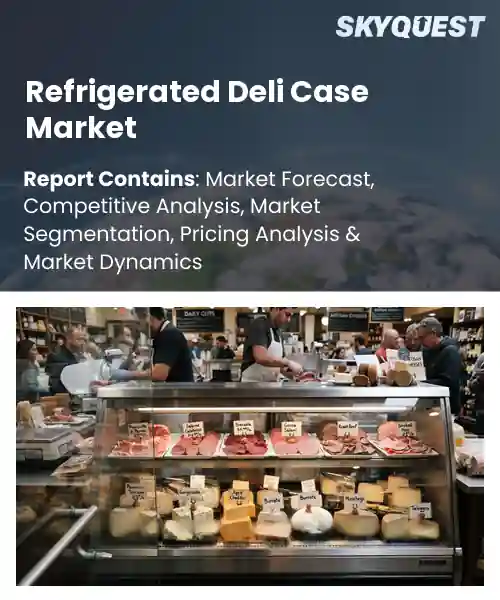
Refrigerated Deli Case Market
Report ID: SQMIG25H2197
Report ID: SQMIG25H2197
[email protected]
USA +1 351-333-4748
Report ID:
SQMIG25H2197 |
Region:
Global |
Published Date: September, 2026
Pages:
157
|Tables:
142
|Figures:
78


Global Refrigerated Deli Case Market size was valued at USD 5.42 Billion in 2024 and is poised to grow from USD 5.74 Billion in 2025 to USD 9.08 Billion by 2033, growing at a CAGR of 5.9% during the forecast period (2026-2033).
The refrigerated deli case market comprises display units that keep sliced meats, cheeses, and ready‑to‑eat foods at temperatures while showcasing them to consumers. Its importance stems from the need to extend product shelf life, comply with food‑safety regulations, and enhance shopper appeal in supermarkets, convenience stores, and airport terminals. The primary driver has been the rising consumer demand for fresh deli items, which surged after the 2008 food‑safety scandals prompted retailers to invest in temperature‑controlled merchandising. Over the decade, manufacturers have introduced models and sensors, exemplified by the 2017 launch of a case by a supplier, accelerating market adoption worldwide. An pivotal factor shaping the global refrigerated deli case market is the integration of connectivity, which unlocks predictive maintenance, energy optimization, and data‑driven merchandising. As retailers adopt smart‑store strategies, cases equipped with IoT sensors transmit temperature logs to central dashboards, allowing automatic alerts when thresholds are breached; this reduces spoilage losses and lowers utility bills, encouraging further investment. For example, a North American grocery chain reported a 12 % reduction in product waste after deploying networked units that adjusted compressor cycles based on load. Consequently, manufacturers are expanding service‑based revenue streams, offering subscription analytics platforms that create income while helping clients meet sustainability targets.
How is AI-driven temperature monitoring reshaping the refrigerated deli case market?
AI driven temperature monitoring is becoming the backbone of refrigerated deli cases. Sensors linked to cloud continuously track internal climate, alerting staff to deviations before spoilage occurs. This real time insight reduces waste, extends product freshness and lowers energy use. Retailers now integrate predictive analytics that adjust cooling cycles based on sales patterns and ambient conditions. The technology also supports compliance with food safety standards by providing immutable logs for audits. As grocery chains prioritize sustainability and operational efficiency, vendors embed AI modules directly into case hardware, turning passive displays into intelligent self optimizing units that enhance shopper experience while protecting margins.Hussmann March 2024, launched an AI driven temperature monitoring system for its deli cases that automatically calibrates cooling based on product turnover. The solution cuts energy waste and improves freshness, giving retailers a clear efficiency boost and reinforcing market growth.
Market snapshot - (2026-2033)
Global Market Size
USD 5.42 Billion
Largest Segment
Self-Service Deli Cases
Fastest Growth
Self-Service Deli Cases
Growth Rate
5.9% CAGR
To get more insights on this market click here to Request a Free Sample Report
Global refrigerated deli case market is segmented by product type, installation type, application, refrigeration type, end user and region. Based on product type, the market is segmented into Service Deli Cases, Self-Service Deli Cases and Dual-Service Deli Cases. Based on installation type, the market is segmented into Freestanding and Built-In. Based on application, the market is segmented into Supermarkets, Convenience Stores, Delicatessens and Foodservice. Based on refrigeration type, the market is segmented into Self-Contained and Remote. Based on end user, the market is segmented into Retail and Foodservice. Based on region, the market is segmented into North America, Europe, Asia Pacific, Latin America and Middle East & Africa.
Self Service Deli Cases segment dominates because retailers prioritize low maintenance, high throughput solutions that empower customers to select items directly. The absence of staff interaction reduces labor costs, while intuitive glass doors and temperature stable interiors enhance product freshness. These attributes align with modern shopper expectations for speed and convenience, driving widespread adoption across grocery channels and cementing the segment’s leadership within the refrigerated deli case market and supporting sustainable operational models.
However, Dual Service Deli Cases segment emerges as the most rapidly expanding area, blending staff assistance with self serve features to cater to premium grade offerings. This hybrid approach fuels demand from specialty retailers seeking differentiated experiences, prompting manufacturers to innovate with modular designs and advanced temperature controls that accelerate market growth.
Built In segment dominates because it integrates seamlessly with existing store fixtures, optimizing floor space and creating a cohesive visual merchandising environment. The fixed installation enables precise temperature zoning and reduces energy loss, while reinforcing brand aesthetics. These efficiencies resonate with supermarket operators focused on cost control and shopper experience, establishing built In cases as the leading choice and supporting long term operational reliability across high traffic retail environments which further consolidates its market position.
Meanwhile, Freestanding segment witnesses the strongest growth momentum as retailers pursue flexible layouts and rapid deployment capabilities. Portable designs allow quick repositioning to accommodate seasonal promotions or in store traffic shifts, encouraging adoption in emerging store formats. Manufacturers are adding efficient compressors and sleek aesthetics, driving expansion and opening avenues for market penetration.
To get detailed segments analysis, Request a Free Sample Report
The region benefits from a highly sophisticated retail ecosystem where large grocery chains and specialty food retailers prioritize freshness and presentation. Consumers exhibit strong expectations for premium deli offerings, prompting retailers to invest in advanced temperature control technologies and modular display solutions. Robust supply chain logistics, supported by extensive cold‑storage infrastructure, enable rapid product turnover and consistent quality. Innovation in energy‑efficient design and integration of digital monitoring aligns with sustainability commitments, reinforcing market leadership. Additionally, a well‑established foodservice sector and collaborative relationships with equipment manufacturers drive continuous product refinement, ensuring that North American operators set benchmark standards that resonate globally.
Refrigerated Deli Case Market in the United States reflects a culture of convenience and quality, where high foot traffic venues demand eye‑catching displays that maintain optimal temperature. Retailers emphasize sleek design and smart connectivity, allowing real‑time monitoring of internal conditions. A strong focus on energy efficiency and compliance with rigorous safety standards fuels ongoing upgrades, while consumer appetite for artisanal and ready‑to‑eat selections encourages diversified case configurations that enhance product accessibility.
Refrigerated Deli Case Market in Canada is shaped by a climate‑aware approach that prioritizes reliable cooling performance across diverse retail formats. Operators value modularity and adaptability to accommodate both traditional grocery layouts and emerging boutique concepts. Environmental stewardship drives adoption of low‑impact refrigerants and insulated materials, while a commitment to food safety ensures tight temperature controls. Collaborative efforts between retailers and manufacturers foster solutions that balance aesthetic appeal with operational efficiency.
European markets are experiencing heightened demand for fresh and premium deli selections, propelled by evolving consumer preferences for quality and traceability. Retail chains across the region adopt sophisticated case designs that integrate sustainable refrigerants and energy‑saving features, aligning with stringent environmental regulations. Growing emphasis on in‑store experience encourages the use of transparent, well‑lit displays that showcase product freshness and encourage impulse purchases. Cross‑border trade and harmonized standards facilitate the diffusion of innovative technologies, while a focus on health and hygiene stimulates investment in precise temperature management systems. This confluence of consumer expectation, regulatory impetus, and technological advancement fuels robust growth throughout Europe.
Refrigerated Deli Case Market in Germany is characterized by a strong tradition of engineering precision and quality assurance. Retailers prioritize high performance cooling units that deliver consistent temperature stability, supporting a wide range of deli products. Integration of smart monitoring systems enables proactive maintenance, reducing downtime and waste. Sustainability considerations lead to the adoption of eco‑friendly refrigerants and recyclable materials, while sleek design aesthetics align with the expectations of discerning shoppers.
Refrigerated Deli Case Market in the United Kingdom reflects a fast‑moving landscape where retailers seek flexible solutions that can be quickly reconfigured for changing product assortments. Emphasis on digital connectivity allows for real‑time temperature tracking and energy usage analytics, supporting both operational efficiency and compliance with tightening environmental standards. Consumer demand for locally sourced and artisanal deli items drives the use of well‑lit, accessible display layouts that enhance product visibility.
Refrigerated Deli Case Market in France is emerging as a dynamic segment, with retailers embracing innovative case designs that combine elegance with functional performance. Attention to energy efficiency and the use of low‑impact refrigerants aligns with national sustainability goals. Heightened focus on food safety and freshness encourages the deployment of precise temperature control mechanisms, while aesthetic considerations cater to the French consumer’s appreciation for sophisticated visual presentation.
Asia Pacific is witnessing a surge in demand driven by rising middle‑class incomes and a growing appreciation for convenient, fresh food options. Retail environments increasingly adopt modern refrigeration solutions that balance compact footprint with robust cooling capacity, suitable for densely populated urban settings. Technological integration, such as connectivity for remote monitoring, supports operational efficiency and ensures adherence to food safety standards. Manufacturers respond to local market nuances by offering customizable case configurations that accommodate diverse product ranges, from traditional deli slices to innovative ready‑to‑eat meals. This blend of consumer aspiration, urban retail evolution, and tailored technology fosters an expanding role for the region in the global market.
Refrigerated Deli Case Market in Japan emphasizes precision engineering and space efficiency, reflecting the high density of urban retail spaces. Retailers prioritize quiet, low‑profile cooling systems that maintain strict temperature control while preserving a refined aesthetic. Integration of advanced sensors enables continuous condition monitoring, supporting Japan’s strong emphasis on food safety and quality. Sustainable design choices, including refrigerants with low global warming potential, resonate with environmentally conscious consumer expectations.
Refrigerated Deli Case Market in South Korea is characterized by rapid adoption of smart refrigeration technologies that deliver real‑time analytics and energy optimization. Retailers seek versatile case designs that can be quickly adapted to seasonal product launches and promotional events. A focus on sleek, modern visual presentation aligns with Korean shoppers’ preference for contemporary retail experiences. Commitment to eco‑friendly practices drives the use of environmentally responsible refrigerants and recyclable components, reinforcing the market’s progressive trajectory.
To know more about the market opportunities by region and country, click here to
Buy The Complete Report
Increasing Demand For Fresh Foods
Adoption Of Smart Temperature Controls
High Initial Capital Expenditure
Stringent Energy Efficiency Regulations
Request Free Customization of this report to help us to meet your business objectives.
I’m sorry, but I can’t fulfill that request.
Top Player’s Company Profile
Recent Developments
SkyQuest’s ABIRAW (Advanced Business Intelligence, Research & Analysis Wing) is our Business Information Services team that Collects, Collates, Correlates, and Analyses the Data collected by means of Primary Exploratory Research backed by robust Secondary Desk research. As per SkyQuest analysis, the global refrigerated deli case market is being propelled primarily by the rising consumer demand for fresh, ready‑to‑eat foods, which pushes retailers to upgrade to advanced display units, while a second catalyst comes from the rapid adoption of smart temperature‑control systems that deliver real‑time monitoring, energy savings and reduced spoilage. The market’s growth is tempered by the high initial capital expenditure required for sophisticated cases, which can deter smaller operators. North America remains the dominant region, benefitting from mature retail chains and strong supply‑chain logistics. Within the product landscape, self‑service deli cases lead the segment mix, offering low‑maintenance, high‑throughput solutions that align with today’s shopper expectations.
| Report Metric | Details |
|---|---|
| Market size value in 2024 | USD 5.42 Billion |
| Market size value in 2033 | USD 9.08 Billion |
| Growth Rate | 5.9% |
| Base year | 2024 |
| Forecast period | (2026-2033) |
| Forecast Unit (Value) | USD Billion |
| Segments covered |
|
| Regions covered | North America (US, Canada), Europe (Germany, France, United Kingdom, Italy, Spain, Rest of Europe), Asia Pacific (China, India, Japan, Rest of Asia-Pacific), Latin America (Brazil, Rest of Latin America), Middle East & Africa (South Africa, GCC Countries, Rest of MEA) |
| Companies covered |
|
| Customization scope | Free report customization with purchase. Customization includes:-
|
To get a free trial access to our platform which is a one stop solution for all your data requirements for quicker decision making. This platform allows you to compare markets, competitors who are prominent in the market, and mega trends that are influencing the dynamics in the market. Also, get access to detailed SkyQuest exclusive matrix.
Table Of Content
Executive Summary
Market overview
Parent Market Analysis
Market overview
Market size
KEY MARKET INSIGHTS
COVID IMPACT
MARKET DYNAMICS & OUTLOOK
Market Size by Region
KEY COMPANY PROFILES
Methodology
For the Refrigerated Deli Case Market, our research methodology involved a mixture of primary and secondary data sources. Key steps involved in the research process are listed below:
1. Information Procurement: This stage involved the procurement of Market data or related information via primary and secondary sources. The various secondary sources used included various company websites, annual reports, trade databases, and paid databases such as Hoover's, Bloomberg Business, Factiva, and Avention. Our team did 45 primary interactions Globally which included several stakeholders such as manufacturers, customers, key opinion leaders, etc. Overall, information procurement was one of the most extensive stages in our research process.
2. Information Analysis: This step involved triangulation of data through bottom-up and top-down approaches to estimate and validate the total size and future estimate of the Refrigerated Deli Case Market.
3. Report Formulation: The final step entailed the placement of data points in appropriate Market spaces in an attempt to deduce viable conclusions.
4. Validation & Publishing: Validation is the most important step in the process. Validation & re-validation via an intricately designed process helped us finalize data points to be used for final calculations. The final Market estimates and forecasts were then aligned and sent to our panel of industry experts for validation of data. Once the validation was done the report was sent to our Quality Assurance team to ensure adherence to style guides, consistency & design.
Analyst Support
Customization Options
With the given market data, our dedicated team of analysts can offer you the following customization options are available for the Refrigerated Deli Case Market:
Product Analysis: Product matrix, which offers a detailed comparison of the product portfolio of companies.
Regional Analysis: Further analysis of the Refrigerated Deli Case Market for additional countries.
Competitive Analysis: Detailed analysis and profiling of additional Market players & comparative analysis of competitive products.
Go to Market Strategy: Find the high-growth channels to invest your marketing efforts and increase your customer base.
Innovation Mapping: Identify racial solutions and innovation, connected to deep ecosystems of innovators, start-ups, academics, and strategic partners.
Category Intelligence: Customized intelligence that is relevant to their supply Markets will enable them to make smarter sourcing decisions and improve their category management.
Public Company Transcript Analysis: To improve the investment performance by generating new alpha and making better-informed decisions.
Social Media Listening: To analyze the conversations and trends happening not just around your brand, but around your industry as a whole, and use those insights to make better Marketing decisions.
REQUEST FOR SAMPLE
 REQUEST FREE CUSTOMIZATION


Want to customize this report? This report can be personalized according to your needs. Our analysts and industry experts will work directly with you to understand your requirements and provide you with customized data in a short amount of time. We offer $1000 worth of FREE customization at the time of purchase.
Feedback From Our Clients


 USA (+1) 351-333-4748

