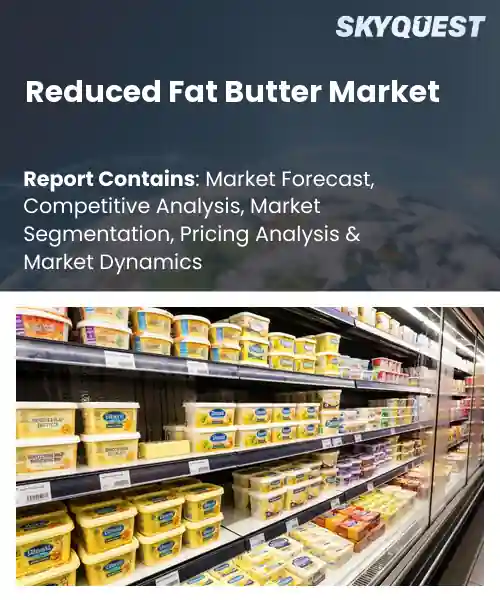
Reduced Fat Butter Market
Report ID: SQMIG30H2437
Report ID: SQMIG30H2437
[email protected]
USA +1 351-333-4748
Report ID:
SQMIG30H2437 |
Region:
Global |
Published Date: June, 2026
Pages:
157
|Tables:
171
|Figures:
79


Global Reduced Fat Butter Market size was valued at USD 1.5 Billion in 2024 and is poised to grow from USD 1.58 Billion in 2025 to USD 2.43 Billion by 2033, growing at a CAGR of 5.5% during the forecast period (2026-2033).
The main force behind the reduced fat butter market growth revolves around changing shopper preferences for better-for-you choices, like lower saturated fat and fewer calories, while still keeping that familiar butter taste and texture. Reduced fat butter is basically a reworked dairy spread that cuts fat, it does this by mixing milk solids with water and a few functional texturizers, so households and foodservice can still get the usual cooking and baking results but with less calorie weight. This segment matters because it stitches everyday culinary habits back together with public health advice, and it helps guide what shows up in retail shelves and on menus. Over time, dairy processors improved emulsification and stabilization know-how, plus they sharpened marketing tactics, so long-running brands could bring these reduced-fat options to consumers.
Furthermore, on top of those tech improvements, one major growth factor is the expansion of health-led demand across emerging markets. In those places, rising incomes and more urban living shift diets, and that tends to increase the use of packaged dairy. When consumers ask for lower-calorie spreads, manufacturers usually respond by scaling production and tightening their formulations. That can reduce per-unit costs and improve shelf visibility in supermarkets and quick-service restaurants. For instance, bakeries may adopt reduced-fat butter to push lower-calorie pastries but still aim for the same mouthfeel, so foodservice suppliers often start offering bulk formats. Also, clean-label style claims and fortification with vitamins support a more premium positioning, which draws wellness-focused shoppers and can even open export routes, because regulatory alignment makes cross-border trade smoother and margins can rise.
AI is reshaping development for reduced fat butter by speeding up formulation work, forecasting sensory results, and also helping teams uncover new ingredient options. One key piece is virtual formulation tooling that tries to mirror mouthfeel and melt behavior. Then there’s machine learning, which scans customer feedback to understand texture preference patterns. On top of that, generative approaches can propose natural fat replacers that act more like traditional fat in practice. Since shoppers still want lower fat spreads but also want them to feel creamy, AI helps reduce trial-and-error in the lab, and it helps teams choose functional ingredients that can imitate fat behavior.
Market snapshot - (2026-2033)
Global Market Size
USD 1.5 Billion
Largest Segment
Salted Reduced Fat Butter
Fastest Growth
Flavoured Reduced Fat Butter
Growth Rate
5.5% CAGR
To get more insights on this market click here to Request a Free Sample Report
The global reduced fat butter market is segmented by type, form, fat content, application, distribution channel, end-user, and region. Based on type, the market is categorized into salted reduced fat butter, unsalted reduced fat butter, flavoured reduced fat butter, and others. By form, the market is divided into spreadable and block formats. Based on fat content, the market is segmented into low-fat and reduced-fat butter. By application, the market is classified into household consumption, bakery & confectionery, foodservice, and the processed food industry. Based on distribution channel, the market is segmented into supermarkets & hypermarkets, convenience stores, online retail, and others. By end-user, the market is categorized into residential consumers and commercial users. Regionally, the market is analyzed across North America, Europe, Asia Pacific, Latin America, and the Middle East & Africa.
As per the reduced fat butter market analysis, the Spreadable segment dominates, because it’s ready to use texture, convenience, and all that little everyday momentum fits routine eating moments. It helps people try it, then come back again, even for reduced fat variants. Manufacturers keep refining the emulsion systems , along with the packaging, so the mouthfeel is preserved and the perceived tradeoffs in flavor or overall experience feel smaller. At retail, placement and marketing basically lean into “easy to use” for breakfasts and snacks, which ends up supporting household preference, and that then sustains demand for spreadable reduced fat offerings.
However, Block is starting to look like the fastest growing subcategory, since both professional bakers and home bakers are hunting for more stable fat systems for cooking and pastry work. The enhanced reduced fat formulations hold onto the functional properties people need for baking, which encourages wider adoption in culinary uses. Larger pack formats and value options make it easier to buy more at once, and endorsements from culinary professionals, plus foodservice procurement, are opening up additional development pathways and pushing commercial uptake.
According to the reduced fat butter market forecast, the household consumption still leads, mostly because daily meal prep plus snacking habits create consistent purchase cycles, and that anchors the bigger market volume. Brands tend to build familiar flavors, use family friendly pack sizes, and pair it with approachable health messaging so routine shoppers feel comfortable. That builds loyalty over time. Retail promotions, together with shelf strategies, keep spotlighting household SKUs, so manufacturers focus on taste retention and spreadability, to match the daily expectations consumers already have, and to keep market share steady.
Meanwhile, bakery & confectionery is seeing the strongest growth momentum, because commercial bakers and artisan producers are reformulating to deliver lower fat indulgent products. Technical improvements help preserve texture and structure in baked goods, which supports broader substitution using reduced fat butter inside recipes. Co-development with manufacturers, bulk supply deals, and the rising appetite for cleaner label lower fat fillings are speeding up product innovation, and they’re also opening up new procurement channels across industrial clients and specialty makers.
To get detailed segments analysis, Request a Free Sample Report
As per the reduced fat butter market regional forecast, North America is leading the market, because there’s this mix of a mature retail setup, lots of consumer awareness around health and nutrition, and supply chain know how that’s already well established. On the manufacturer side, they keep pushing advanced product innovation, plus diversified formulation skills, to meet the appetite for lower fat options while still keeping the taste and the practical behavior of butter. Retailers and foodservice folks also play along with broad distribution and very visible shelf placement, and that helps customers try it, then come back for more. There are strategic partnerships between dairy cooperatives and branded processors, which improve ingredient sourcing and quality control, in a steady way. Meanwhile, marketing leans hard on clean labeling and protein retention, it builds confidence. Then there’s regulatory clarity and food safety systems that are already in place, so product development stays consistent and scaling doesn’t feel risky. Plus, ongoing investments in research and development keeps improving texture and the nutritional profile over time.
United States Reduced Fat Butter Market
The reduced fat butter sector in the United States tends to benefit from smooth retail channels, and a strong private label presence. Manufacturers usually focus on flavor retention and easy spreadability, while aligning formulations with health oriented positioning. Foodservice demand for reduced fat options supports specialty formats, and even some culinary collaboration, that boosts trial. Integrated supply chains and wide distribution networks help keep product visibility strong in both mainstream and premium stores, so offerings can reach different consumer groups without too much friction, nationally.
Canada Reduced Fat Butter Market
In Canada, the reduced fat butter industry reflects a consumer trend toward balanced nutrition and clean labeling, so manufacturers lean into milder flavor profiles and simplified ingredient lists. Regional dairy cooperatives assist with local sourcing and traceability initiatives, and that really lands with shoppers. Retail happens through a mix of national chains and specialty grocers, offering both private label and branded alternatives. On top of that, foodservice programs and culinary education efforts help make reduced fat choices feel normal for everyday cooking.
Europe is seeing rapid reduced fat butter market penetration, partly due to changing consumer expectations, evolving formulation methods, and supportive retail strategies. Shoppers are looking for that indulgent texture but with moderated fat content, so manufacturers invest in emulsion technology and flavor enhancement. Retailers push adoption through targeted merchandising and a wider assortment across both mainstream and specialty channels. Policy frameworks and nutrition guidance encourage transparent labeling , which boosts trust in the reformulated dairy products. At the same time, strong culinary traditions plus a busy foodservice scene create demand for reduced fat options that still work professionally, for cooking and spreading. Cross border trade, along with collaboration among dairy processors, helps unlock ingredient innovation and supports regional adaptation. Marketing that stresses provenance, artisanal processing, and health messaging also speeds up consumer acceptance across different markets.
Germany Reduced Fat Butter Market
The reduced fat butter market outlook in Germany is shaped by strong dairy heritage and technical capability in fat reduction, while still holding onto the traditional flavor profile. Manufacturers use process optimization and ingredient know how to produce products that match expectations for spreadability and cooking performance. Retailers often lean into premium positioning, and foodservice demand backs up the need for stable formulations. Regional cooperative structures and quality assurance frameworks strengthen traceability and consistency, which supports retailer confidence and consumer confidence, at the same time.
United Kingdom Reduced Fat Butter Market
The reduced fat butter market in the United Kingdom shows fast paced innovation, driven by health oriented consumer interest. Brands and artisan producers keep experimenting with texture and flavor, while private label becomes more intense in competition. Retail merchandising and promotional activity encourage trial, and foodservice inclusion of reduced fat options reinforces familiarity. Agile supply chains plus marketing that highlights taste retention help reduced fat alternatives move from a niche situation to broader availability, across regional retail channels.
France Reduced Fat Butter Market
The reduced fat butter market in France is developing through a balance of culinary tradition and innovation, where taste preservation stays front and center alongside health messaging. Artisanal producers and industrial manufacturers explore subtle fat modification techniques, trying to keep the sensory profile that consumers already value. Retailers add reduced fat options into national assortments, and chefs and patissiers test formulations that perform well in baking. This blending of tradition with technical adaptation helps the category gain mainstream acceptance.
Asia Pacific is increasing its reduced fat butter market share, mainly by doing tailored product adaptation and also because people are getting more health conscious, plus retail is getting a bit more sophisticated overall. Manufacturers tend to concentrate on texture innovation, and flavor localization too, so it feels right for the many culinary habits across the region. At the same time partnerships with international ingredient suppliers help speed up formulation capabilities. Modern retail chains and ecommerce platforms basically make the category easier to find, and they also bring in broader assortments mixing imported items with local ones. On top of that, culinary education is growing, and foodservice diversification is pushing more use of reduced fat variants , even in professional kitchens. With investment in cold chain logistics and regional quality systems, manufacturers can keep consistency higher, then scale production and meet different taste plus functional needs in multiple markets. Finally localized marketing, along with collaborations with culinary influencers and nutrition professionals, helps translate those health advantages into daily usage, so consumers are more willing to switch without feeling like they lose the taste.
Japan Reduced Fat Butter Market
The reduced fat butter market in Japan leans heavily on precision in texture and a subtle flavor balance that matches local culinary expectations. Manufacturers put effort into refining emulsification and mouthfeel, mainly to fit cooking requirements. Retailers display reduced fat options right next to traditional butter, which is meant to encourage trial, and culinary professionals tweak recipes so sensory outcomes stay in a good place. There is also strong supply chain management plus a focus on ingredient provenance, and this supports consumer confidence in modified dairy offerings
South Korea Reduced Fat Butter Market
In South Korea the reduced fat butter market builds momentum via trend aware consumers and a retail scene that keeps innovating, usually with interest in novel textures and multifunction formats. Brands and manufacturers often experiment with flavor layering, and application specific formulations for baking, as well as for spreading. Ecommerce plus modern supermarkets support faster rollout and promotion cycles, while culinary influencers and bakeries help popularize reduced fat variants across everyday moments. Quality control, together with deliberate branding, also helps strengthen consumer trust.
To know more about the market opportunities by region and country, click here to
Buy The Complete Report
Rising Health Consciousness Among Consumers
Demand For Lower Calorie Alternatives
Perception Of Reduced Taste Quality
Regulatory And Labeling Challenges
Request Free Customization of this report to help us to meet your business objectives.
The competitive landscape is getting tighter, like incumbent spread makers are speeding up their plant based and reduced fat moves, while foodtech new entrants are rolling out more novel fat technologies to grab shelf space and foodservice share. The strategic playbook is basically a mix of product launches and portfolio deals from big companies plus more precision tech investments from startups, so the fight is shifting away from pure price and toward ingredient innovation and stronger B2B partnerships.
Top Player’s Company Profile
Recent Developments in the Reduced Fat Butter Market
SkyQuest’s ABIRAW (Advanced Business Intelligence, Research & Analysis Wing) is our Business Information Services team that Collects, Collates, Correlates, and Analyses the Data collected by means of Primary Exploratory Research backed by robust Secondary Desk research.
As per SkyQuest analysis, the reduced fat butter market is driven by changing consumer health habits, where lower saturated fat intake is the main driver, and emerging markets add more momentum with stronger demand for easy everyday, lower-calorie spreads as a second driver. North America stays the leading region, partly because of mature retail infrastructure, plus strong innovation cycles. Within the market, the spreadable form dominates, mainly because it’s convenient and gets repeat household use. Still, consumer perception about “inferior taste” and mouthfeel acts like a meaningful brake, limiting trial and cross occasion substitution. Manufacturers that focus on sensory-led reformulation, and also on clearer labeling should be the ones most likely to turn health-conscious trial into lasting adoption.
| Report Metric | Details |
|---|---|
| Market size value in 2024 | USD 1.5 Billion |
| Market size value in 2033 | USD 2.43 Billion |
| Growth Rate | 5.5% |
| Base year | 2024 |
| Forecast period | (2026-2033) |
| Forecast Unit (Value) | USD Billion |
| Segments covered |
|
| Regions covered | North America (US, Canada), Europe (Germany, France, United Kingdom, Italy, Spain, Rest of Europe), Asia Pacific (China, India, Japan, Rest of Asia-Pacific), Latin America (Brazil, Rest of Latin America), Middle East & Africa (South Africa, GCC Countries, Rest of MEA) |
| Companies covered |
|
| Customization scope | Free report customization with purchase. Customization includes:-
|
To get a free trial access to our platform which is a one stop solution for all your data requirements for quicker decision making. This platform allows you to compare markets, competitors who are prominent in the market, and mega trends that are influencing the dynamics in the market. Also, get access to detailed SkyQuest exclusive matrix.
Table Of Content
Executive Summary
Market overview
Parent Market Analysis
Market overview
Market size
KEY MARKET INSIGHTS
COVID IMPACT
MARKET DYNAMICS & OUTLOOK
Market Size by Region
KEY COMPANY PROFILES
Methodology
For the Reduced Fat Butter Market, our research methodology involved a mixture of primary and secondary data sources. Key steps involved in the research process are listed below:
1. Information Procurement: This stage involved the procurement of Market data or related information via primary and secondary sources. The various secondary sources used included various company websites, annual reports, trade databases, and paid databases such as Hoover's, Bloomberg Business, Factiva, and Avention. Our team did 45 primary interactions Globally which included several stakeholders such as manufacturers, customers, key opinion leaders, etc. Overall, information procurement was one of the most extensive stages in our research process.
2. Information Analysis: This step involved triangulation of data through bottom-up and top-down approaches to estimate and validate the total size and future estimate of the Reduced Fat Butter Market.
3. Report Formulation: The final step entailed the placement of data points in appropriate Market spaces in an attempt to deduce viable conclusions.
4. Validation & Publishing: Validation is the most important step in the process. Validation & re-validation via an intricately designed process helped us finalize data points to be used for final calculations. The final Market estimates and forecasts were then aligned and sent to our panel of industry experts for validation of data. Once the validation was done the report was sent to our Quality Assurance team to ensure adherence to style guides, consistency & design.
Analyst Support
Customization Options
With the given market data, our dedicated team of analysts can offer you the following customization options are available for the Reduced Fat Butter Market:
Product Analysis: Product matrix, which offers a detailed comparison of the product portfolio of companies.
Regional Analysis: Further analysis of the Reduced Fat Butter Market for additional countries.
Competitive Analysis: Detailed analysis and profiling of additional Market players & comparative analysis of competitive products.
Go to Market Strategy: Find the high-growth channels to invest your marketing efforts and increase your customer base.
Innovation Mapping: Identify racial solutions and innovation, connected to deep ecosystems of innovators, start-ups, academics, and strategic partners.
Category Intelligence: Customized intelligence that is relevant to their supply Markets will enable them to make smarter sourcing decisions and improve their category management.
Public Company Transcript Analysis: To improve the investment performance by generating new alpha and making better-informed decisions.
Social Media Listening: To analyze the conversations and trends happening not just around your brand, but around your industry as a whole, and use those insights to make better Marketing decisions.
REQUEST FOR SAMPLE
 REQUEST FREE CUSTOMIZATION
Global Reduced Fat Butter Market size was valued at USD 1.5 Billion in 2024 and is poised to grow from USD 1.58 Billion in 2025 to USD 2.43 Billion by 2033, growing at a CAGR of 5.5% during the forecast period (2026-2033).
Competitive landscape is tightening as incumbent spread makers accelerate plant based and reduced fat launches while foodtech entrants deploy novel fat technologies to gain shelf and foodservice share. Strategic moves include product launches and portfolio deals by large players and precision technology investments by startups, shifting competition from price to ingredient innovation and B2B partnerships. 'Arla Foods', 'Land O'Lakes Inc.', 'Ornua Co-operative Limited', 'Upfield', 'Fonterra Co-operative Group', 'Lactalis Group', 'Saputo Inc.', 'Amul (GCMMF)', 'Kerry Group plc', 'Finlandia Cheese Inc.', 'Aurivo Co-operative Society Ltd.', 'Palsgaard A/S', 'Agral S.A.', 'Lam Soon Group', 'Rockview Farms', 'Meiji Holdings Co., Ltd.', 'Yili Group', 'Danone S.A.', 'FrieslandCampina', 'Nestlé S.A.'
Consumers increasingly prioritize healthier dietary choices, driving greater interest in reduced fat butter as a perceived balance between taste and nutrition. Food purchasers and household decision makers view reduced fat butter as a way to lower saturated fat intake while retaining familiar culinary applications, encouraging repeat purchases and broader adoption across meal occasions. Retailers and manufacturers respond by expanding shelf space, product variants, and visibility, which reinforces consumer trial and acceptance and supports sustained category growth through enhanced availability and consumer awareness.
Health-Focused Product Innovation: Manufacturers are expanding reduced fat butter portfolios with functional ingredients and reformulation strategies to meet evolving health-conscious consumer preferences. Emphasis on clean-label claims, natural ingredients, and balanced nutrition supports repositioning reduced fat butter as a desirable choice for cooking and baking. Product development prioritizes sensory retention and versatility, enabling culinary professionals and home cooks to maintain texture and flavor while reducing saturated fat perception. Collaboration with nutritionists and culinary teams accelerates credible messaging and differentiation in a crowded dairy segment.
Why does North America Dominate the Global Reduced Fat Butter Market? |@12


Want to customize this report? This report can be personalized according to your needs. Our analysts and industry experts will work directly with you to understand your requirements and provide you with customized data in a short amount of time. We offer $1000 worth of FREE customization at the time of purchase.
Feedback From Our Clients


 USA (+1) 351-333-4748

