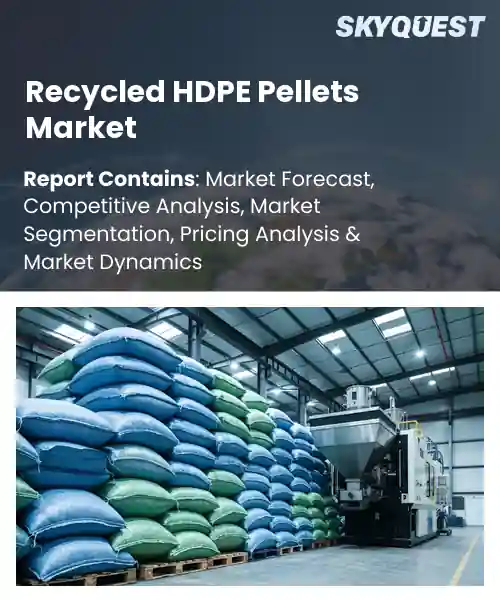
Recycled HDPE Pellets Market
Report ID: SQMIG20I2964
Report ID: SQMIG20I2964
[email protected]
USA +1 351-333-4748
Report ID:
SQMIG20I2964 |
Region:
Global |
Published Date: April, 2026
Pages:
157
|Tables:
89
|Figures:
76


Global Recycled Hdpe Pellets Market size was valued at USD 5.24 Billion in 2024 and is poised to grow from USD 5.73 Billion in 2025 to USD 5.2 Billion by 2033, growing at a CAGR of 9.4% during the forecast period (2026-2033).
The driver of the recycled HDPE pellets market is the convergence of regulatory pressure and sustainability commitments that compel manufacturers to replace virgin polymers with reclaimed resin. Recycled HDPE pellets are polyethylene obtained from post consumer and post industrial waste streams, repurposed for reuse in packaging, piping and goods, and this circular materials market matters because it reduces landfill burden and lowers upstream carbon emissions. Over the past decade collection systems, sorting technologies and washing processes have improved, for example advanced near infrared sorting enabled higher purity bales for pelletization while brand adoption by goods firms has accelerated demand globally.Building on improved feedstock quality, the growth factor is cost competitiveness which causes manufacturers to favor recycled HDPE when price parity or savings exist versus virgin resin. As recycling scale increases, pellet producers lower production costs via economies of scale and optimization, and buyers in industries like packaging, agricultural tubing and construction benefit by reducing material expenses while meeting sustainability targets. This dynamic creates opportunities for investment in localized wash plants and supply chain partnerships because proximity to waste sources reduces logistics costs and contamination risk, and pilots show recyclate bottles and fittings achieving performance parity that unlocks broader adoption.
How is AI optimizing quality control in the recycled HDPE pellets market?
AI is optimizing quality control in the recycled HDPE pellets market by tackling feedstock variability and contamination and by enabling traceability across the value chain. Key aspects include intelligent optical sorting, sensor fusion with near infrared and spectroscopic analytics, and machine learning models that classify impurities and material grade. In a market where brands and regulators demand consistent recycled content, AI brings real time monitoring of flake and pellet properties, adaptive process control that reduces off spec output, and data driven traceability that increases buyer confidence. Practical examples range from deep learning enhanced sorters to robotic pickers that recover higher purity HDPE streams for pellet production.Tomra October 2025, published an e book highlighting its GainNext and PolyPerception AI tools that improve HDPE separation and real time material analytics and help processors deliver more consistent pellet feedstock with less rework and greater market acceptance.
Market snapshot - (2026-2033)
Global Market Size
USD 5.24 Billion
Largest Segment
Through-beam Ultrasonic Fork Sensors
Fastest Growth
High-speed Detection Sensors
Growth Rate
9.4% CAGR
To get more insights on this market click here to Request a Free Sample Report
Global recycled hdpe pellets market is segmented by operational mode, functional focus, end-use industry and region. Based on operational mode, the market is segmented into Through-beam Ultrasonic Fork Sensors and High-speed Detection Sensors. Based on functional focus, the market is segmented into Transparent & Glossy Label Detection, Splice & Tear Detection (Web/Film) and Others (Edge & Level Monitoring). Based on end-use industry, the market is segmented into Packaging & Labeling Industry, Printing & Paper Industry and Others (Automotive & Electronics Assembly). Based on region, the market is segmented into North America, Europe, Asia Pacific, Latin America and Middle East & Africa.
Through-beam Ultrasonic Fork Sensors segment leads because these sensors provide robust, non-contact detection of pellet flow and presence in dusty recycling lines, enabling consistent feed into extrusion and pelletizing stages. Their tolerance to contamination and simplicity of installation reduce downtime and maintenance, which improves throughput and product uniformity. Recyclers prefer this reliability to protect melt quality and downstream equipment, making adoption widespread across reclaim operations and stabilizing supply of recycled HDPE pellets.
However, High-speed Detection Sensors are emerging as the most rapidly expanding focus, driven by demand for higher throughput and real-time quality grading. Advances in sensor sampling, machine vision integration and faster response enable precise contaminant and color detection, accelerating adoption in modern recycling plants and opening premium end-use opportunities for recycled HDPE pellets.
Splice & Tear Detection (Web/Film) segment dominates because it directly addresses the frequent interruptions and contamination risks inherent in recycling film feedstock, ensuring continuous web handling through reliable detection and automatic splicing. By preventing unplanned tears and minimizing material loss, these systems stabilize feed rates into washing and pelletizing, which preserves polymer integrity and reduces off-grade output. Processors prioritize these capabilities to maintain consistent pellet quality and optimize yields from recycled HDPE films.
However, Transparent & Glossy Label Detection is witnessing the strongest growth as recyclers adopt optical and spectral systems to eliminate label residues that degrade color and melt quality. Demand for cleaner regrind in packaging and regulatory emphasis on contaminant control drive investment, unlocking higher-value applications and broader demand for recycled HDPE pellets.
To get detailed segments analysis, Request a Free Sample Report
Asia Pacific dominates the global recycled HDPE pellets market due to a combination of robust manufacturing clusters, extensive feedstock availability, and integrated recycling infrastructure that supports closed loop supply chains. Regional manufacturers benefit from strong demand across packaging, consumer goods, and industrial applications, while policy frameworks and public awareness encourage material recovery and reuse. Leading procurement networks and proximity to large consumer markets reduce logistics complexity and enable scale advantages. Innovation in recycling technologies and partnerships between converters and brand owners foster higher quality recycled resin suitable for diverse end uses. Collectively, these elements create a resilient ecosystem that sustains high volumes of recycled HDPE pellet production and positions the region as a reference point for circular economy practices globally.
Recycled HDPE Pellets Market in Japan is characterized by advanced materials engineering, strong collaboration between recyclers and manufacturers, and high standards for product quality. Mature collection systems and technology adoption enable production of consistent recycled resin for packaging and durable goods. Corporate sustainability commitments and circular procurement practices stimulate demand for recycled content. Continued focus on product safety, traceability, and performance supports positioning of recycled HDPE pellets within domestic supply chains.
Recycled HDPE Pellets Market in South Korea reflects strong industrial support, advanced collection and sorting technologies, and active collaboration between recyclers and consumer brands. Emphasis on material quality and traceability drives uptake in packaging electronics and automotive components. Strategic investments in recycling infrastructure and supply chain integration improve consistency of recycled resin, supporting both domestic demand and export opportunities across regional markets, while regulatory encouragement promotes circular procurement practices broadly
Europe is experiencing rapid expansion in the recycled HDPE pellets market due to a convergence of stringent regulatory measures, proactive industry commitments, and well developed waste management systems that prioritize material recovery. Consumer brands and retail groups are integrating recycled content into product design and procurement policies, stimulating consistent demand for high quality recycled resin. Advanced sorting and washing technologies, alongside collaborative recycling schemes, raise the availability of homogeneous feedstock suitable for diverse applications. Cross border harmonization of standards and growing supplier networks enable efficient trade in recycled pellets, while innovation in additive and compatibilizer use improves performance for demanding end uses. Public private partnerships and long term procurement incentives further underpin infrastructure upgrades and supply chain resilience. These dynamics collectively accelerate market maturation and broaden adoption across sectors.
Recycled HDPE Pellets Market in Germany is defined by extensive collection and sorting networks, strong industrial demand, and rigorous regulatory frameworks that support high quality recycled resin. Mature converter capabilities and close proximity between recyclers and brand owners enable collaborative product development and efficient logistics. Focus on traceability and standardized quality grades ensures reliable supply for packaging, automotive, and industrial applications, reinforcing Germany market leadership within the regional landscape.
Recycled HDPE Pellets Market in United Kingdom is marked by rapid expansion, driven by strong consumer demand, dynamic corporate sustainability commitments, and evolving collection schemes. Investment in sorting technology and innovative recycling partnerships improves feedstock quality and supports development of food contact and high performance applications. Active engagement between regulators, industry, and retail networks accelerates market maturation and expands opportunities across domestic and international supply chains, boosting commercial adoption broadly
Recycled HDPE Pellets Market in France is emerging through targeted circular economy initiatives, growing municipal collection programs, and increasing collaboration between designers and recyclers. Focus on eco design and recycled content requirements encourages development of specialized grades for cosmetics, household goods, and niche industrial uses. Small and medium sized recyclers contribute innovation in sorting and compatibilization, while public procurement signals support for wider adoption across domestic markets and value chains
North America is strengthening its position in the recycled HDPE pellets market through coordinated efforts among industry stakeholders, waste managers, and brand owners that focus on improving feedstock quality and scaling post consumer recycling. Investment in advanced sorting, washing, and pelletizing capabilities increases consistency of recycled resin, while pilot programs and collaborative procurement reduce market friction. Retail and packaging sectors are prioritizing recycled content and close collaboration with recyclers enables tailored material specifications. Harmonization of quality standards and expanded logistics networks facilitate efficient domestic and cross border supply flows. Emphasis on performance parity with virgin resin and transparent certification practices further builds end user confidence and encourages broader adoption across applications. Public private partnerships, workforce development initiatives, and innovation in compatibilizers and blend optimization enhance the market readiness of recycled HDPE for demanding sectors.
Recycled HDPE Pellets Market in United States is driven by extensive private sector investment, strong demand from packaging and industrial users, and a growing focus on standardized quality specifications. Advanced sorting and pelletizing capabilities support consistent feedstock, while collaboration between recyclers, converters, and major brands enables tailored material grades for demanding applications. Emphasis on certification and transparent supply chains enhances buyer confidence and encourages wider commercial adoption across markets domestically
Recycled HDPE Pellets Market in Canada benefits from strong municipal collection initiatives, focused investment in sorting infrastructure, and close cooperation between recyclers and industry. Emphasis on material quality and traceability supports development of grades suitable for packaging and specialty industrial uses. Cross border partnerships and export channels enhance market opportunities, while policy encouragement and procurement preferences stimulate broader adoption across domestic value chains and regional networks broadly through coordinated efforts
To know more about the market opportunities by region and country, click here to
Buy The Complete Report
Rising Demand From Packaging Industry
Favorable Regulatory And Policy Support
Feedstock Quality Variability Challenges
Limited Collection And Infrastructure
Request Free Customization of this report to help us to meet your business objectives.
Competitive landscape in recycled HDPE pellets is driven by capacity investments, brand offtake and technology differentiation. Large recyclers use M&A and strategic partnerships to secure feedstock and scale markets, for example Borealis’s majority stake in Renasci and ALPLA’s rHDPE investment in Toluca. Tech-led challengers win OEM contracts through certified ocean bound feedstock and compounding innovation.
Top Player’s Company Profile
Recent Developments
SkyQuest’s ABIRAW (Advanced Business Intelligence, Research & Analysis Wing) is our Business Information Services team that Collects, Collates, Correlates, and Analyses the Data collected by means of Primary Exploratory Research backed by robust Secondary Desk research. As per SkyQuest analysis, the global recycled HDPE pellets market is propelled primarily by regulatory pressure and corporate sustainability commitments that drive demand for reclaimed resin, with cost competitiveness from scale and improved processing as a second major driver. Growth is tempered by feedstock quality variability, which limits high-value applications and complicates processing. Asia Pacific remains the dominant region thanks to dense manufacturing, strong feedstock availability and integrated recycling infrastructure. On the technology side, through-beam ultrasonic fork sensors stand out as the leading operational segment for reliable pellet flow and contamination-tolerant detection, supporting stable production and broader adoption across packaging and industrial end uses.
| Report Metric | Details |
|---|---|
| Market size value in 2024 | USD 5.24 Billion |
| Market size value in 2033 | USD 5.2 Billion |
| Growth Rate | 9.4% |
| Base year | 2024 |
| Forecast period | (2026-2033) |
| Forecast Unit (Value) | USD Billion |
| Segments covered |
|
| Regions covered | North America (US, Canada), Europe (Germany, France, United Kingdom, Italy, Spain, Rest of Europe), Asia Pacific (China, India, Japan, Rest of Asia-Pacific), Latin America (Brazil, Rest of Latin America), Middle East & Africa (South Africa, GCC Countries, Rest of MEA) |
| Companies covered |
|
| Customization scope | Free report customization with purchase. Customization includes:-
|
To get a free trial access to our platform which is a one stop solution for all your data requirements for quicker decision making. This platform allows you to compare markets, competitors who are prominent in the market, and mega trends that are influencing the dynamics in the market. Also, get access to detailed SkyQuest exclusive matrix.
Table Of Content
Executive Summary
Market overview
Parent Market Analysis
Market overview
Market size
KEY MARKET INSIGHTS
COVID IMPACT
MARKET DYNAMICS & OUTLOOK
Market Size by Region
KEY COMPANY PROFILES
Methodology
For the Recycled HDPE Pellets Market, our research methodology involved a mixture of primary and secondary data sources. Key steps involved in the research process are listed below:
1. Information Procurement: This stage involved the procurement of Market data or related information via primary and secondary sources. The various secondary sources used included various company websites, annual reports, trade databases, and paid databases such as Hoover's, Bloomberg Business, Factiva, and Avention. Our team did 45 primary interactions Globally which included several stakeholders such as manufacturers, customers, key opinion leaders, etc. Overall, information procurement was one of the most extensive stages in our research process.
2. Information Analysis: This step involved triangulation of data through bottom-up and top-down approaches to estimate and validate the total size and future estimate of the Recycled HDPE Pellets Market.
3. Report Formulation: The final step entailed the placement of data points in appropriate Market spaces in an attempt to deduce viable conclusions.
4. Validation & Publishing: Validation is the most important step in the process. Validation & re-validation via an intricately designed process helped us finalize data points to be used for final calculations. The final Market estimates and forecasts were then aligned and sent to our panel of industry experts for validation of data. Once the validation was done the report was sent to our Quality Assurance team to ensure adherence to style guides, consistency & design.
Analyst Support
Customization Options
With the given market data, our dedicated team of analysts can offer you the following customization options are available for the Recycled HDPE Pellets Market:
Product Analysis: Product matrix, which offers a detailed comparison of the product portfolio of companies.
Regional Analysis: Further analysis of the Recycled HDPE Pellets Market for additional countries.
Competitive Analysis: Detailed analysis and profiling of additional Market players & comparative analysis of competitive products.
Go to Market Strategy: Find the high-growth channels to invest your marketing efforts and increase your customer base.
Innovation Mapping: Identify racial solutions and innovation, connected to deep ecosystems of innovators, start-ups, academics, and strategic partners.
Category Intelligence: Customized intelligence that is relevant to their supply Markets will enable them to make smarter sourcing decisions and improve their category management.
Public Company Transcript Analysis: To improve the investment performance by generating new alpha and making better-informed decisions.
Social Media Listening: To analyze the conversations and trends happening not just around your brand, but around your industry as a whole, and use those insights to make better Marketing decisions.
REQUEST FOR SAMPLE
 REQUEST FREE CUSTOMIZATION


Want to customize this report? This report can be personalized according to your needs. Our analysts and industry experts will work directly with you to understand your requirements and provide you with customized data in a short amount of time. We offer $1000 worth of FREE customization at the time of purchase.
Feedback From Our Clients


 USA (+1) 351-333-4748

