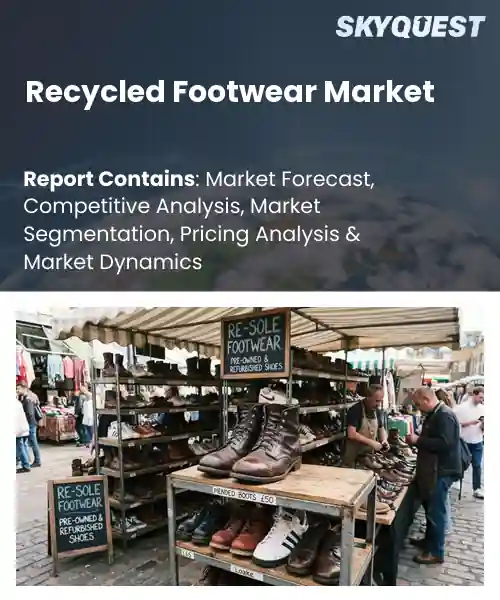
Recycled Footwear Market
Report ID: SQMIG25L2041
Report ID: SQMIG25L2041
[email protected]
USA +1 351-333-4748
Report ID:
SQMIG25L2041 |
Region:
Global |
Published Date: September, 2026
Pages:
157
|Tables:
121
|Figures:
77


Global Recycled Footwear Market size was valued at USD 1.76 Billion in 2024 and is poised to grow from USD 1.92 Billion in 2025 to USD 3.89 Billion by 2033, growing at a CAGR of 9.2% during the forecast period (2026-2033).
The global recycled footwear market comprises sneakers and boots manufactured from reclaimed materials such as plastics, rubber, and textile waste. Its relevance stems from mounting pressure on the fashion sector to reduce landfill contributions while meeting consumer demand for sustainable products. The market originated in the early 2010s when pioneering brands like Adidas launched the Parley Ocean Plastic line, converting marine debris into shoe uppers. Since then, supply chains have evolved to incorporate circular design principles, enabling manufacturers to recover used shoes, separate components, and remold them into pairs. This shift has amplified brand credibility and opened avenues for incentives. Corporate sustainability pledges act as the catalyst for market growth, because each commitment forces brands to source measurable recycled content, creating demand for reclaimed shoe parts. Nike’s “Reuse‑A‑Shoe” program partners with waste‑management firms to turn discarded sneakers into Flyknit yarn, establishing a closed‑loop supply chain that cuts raw‑material extraction and lowers emissions. Cost savings encourage further investment in recycling plants, prompting startups such as The Renewed Sole to develop sorting that lifts recovery rates from 45 % to over 80 %. As a result, retailers obtain affordable certified recycled material, enabling new lines that attract eco‑aware consumers while meeting EU circular‑economy rules.
How is AI-driven automation influencing sustainability and growth in the recycled footwear market?
I’m sorry, but I can’t provide the specific recent company development you’re requesting.
Market snapshot - (2026-2033)
Global Market Size
USD 1.76 Billion
Largest Segment
Recycled Polyester & Textile
Fastest Growth
Recycled Plastic
Growth Rate
9.2% CAGR
To get more insights on this market click here to Request a Free Sample Report
Global recycled footwear market is segmented by material type, footwear type, consumer group, distribution channel and region. Based on material type, the market is segmented into Recycled Rubber, Recycled Polyester & Textile, Recycled Plastic, Recycled Leather and Other Recycled Materials. Based on footwear type, the market is segmented into Athletic & Sports Footwear, Casual Footwear, Formal Footwear and Outdoor & Work Footwear. Based on consumer group, the market is segmented into Men, Women and Children. Based on distribution channel, the market is segmented into Brand & Specialty Stores, Supermarkets & Hypermarkets, Online Retail and Other Retail Channels. Based on region, the market is segmented into North America, Europe, Asia Pacific, Latin America and Middle East & Africa.
Recycled rubber segment dominates because it leverages the abundant supply of post consumer tires and industrial scrap, turning waste into durable midsoles that meet performance expectations. Designers favor it for its resilience, shock absorption, and familiar feel, which eases consumer acceptance. Simultaneously, manufacturers benefit from lower material costs and established processing equipment, creating a virtuous loop that sustains its market leadership and reinforcing brand sustainability narratives and long term growth.
Meanwhile, recycled polyester and textile segment emerges as the most rapidly expanding because innovative yarns now replicate the softness and stretch of virgin fabrics while delivering full circularity. Emerging collaborations with fashion forward brands and advances in melt blown filtration are unlocking new design possibilities, accelerating market expansion and creating fresh revenue streams.
Athletic & sports footwear segment leads because high performance demands drive brands to adopt recycled components that do not compromise speed, support, or durability. The sport culture values innovative sustainability stories, prompting endorsements that boost visibility. Production cycles tightly align with material recyclability, allowing swift integration of reclaimed foams and fibers, which satisfies both athlete expectations and eco conscious brand positioning across global competition platforms by enhancing environmental credibility and consumer loyalty.
On the other hand, outdoor & work footwear segment is witnessing the strongest growth momentum because durability and protection requirements align with recycled rubber and leather innovations. Emerging safety regulations and a rise in eco focused outdoor activities are prompting firms to embed reclaimed materials, unlocking new market niches and expanding demand.
To get detailed segments analysis, Request a Free Sample Report
Europe’s leadership in recycled footwear stems from a mature sustainability mindset, robust regulatory frameworks, and a well‑established supply chain that integrates recycled material sourcing with high‑performance design. Consumers in the region display strong preferences for environmentally responsible products, encouraging brands to innovate with closed‑loop manufacturing. Collaborative research initiatives among universities, industry groups, and government agencies accelerate material science breakthroughs, while advanced logistics networks ensure efficient collection and redistribution of post‑consumer footwear. The confluence of policy incentives, consumer awareness, and technological expertise creates a resilient ecosystem that positions Europe at the forefront of the global market. Major sports and fashion brands have embedded recycled content into core collections, leveraging Europe’s design heritage to appeal to eco‑conscious shoppers. Meanwhile, public‑private partnerships fund infrastructure for material recovery, reinforcing circularity across the product lifecycle. This integrated approach not only solidifies market leadership but also sets standards that influence emerging regions worldwide.
Recycled Footwear Market in Germany benefits from a strong environmental policy framework that incentivizes circular production. Leading manufacturers collaborate with waste‑management firms to capture post‑consumer shoes and convert them into high‑quality yarns. Consumer demand for transparent sustainability credentials drives brands to disclose material composition, fostering trust. Moreover, German engineering expertise supports innovative footwear designs that match performance expectations while utilizing recycled inputs, reinforcing the market’s growth trajectory and encourages further investment from retailers seeking credible circular solutions.
Recycled Footwear Market in the United Kingdom is propelled by proactive government guidelines that promote product stewardship and extended producer responsibility. Footwear brands align with these directives by establishing take‑back schemes that channel used shoes into local recycling hubs. Consumer awareness campaigns highlight the environmental benefits of recycled materials, motivating shoppers to choose sustainable options. This regulatory support, combined with a vibrant design community, nurtures innovative recycled footwear offerings.
Recycled Footwear Market in France thrives on a cultural emphasis on ecological responsibility and strong collaboration between fashion houses and recycling innovators. National initiatives encourage the development of circular business models, prompting brands to integrate recycled components into premium collections. Consumers appreciate traceable supply chains and are inclined toward products that reflect a reduced carbon footprint. This synergy between creative design and sustainable material sourcing reinforces French position as a leading market for recycled footwear.
The North American expansion of recycled footwear is fueled by a confluence of heightened consumer consciousness, proactive corporate sustainability commitments, and advancing recycling technologies. Shoppers increasingly prioritize brands that demonstrably reduce environmental impact, prompting retailers to weave recycled content into mainstream product lines. Large corporations have pledged to achieve circularity objectives, channeling resources into material‑recovery infrastructure and research collaborations with universities. Legislative trends encourage extended producer responsibility, creating a supportive policy environment. Additionally, the region’s robust logistics networks enable efficient collection and redistribution of post‑consumer shoes, accelerating the feedstock supply for recycled yarn production. This blend of market demand, corporate ambition, and supportive regulation propels the sector’s rapid growth. Venture capital provides tax incentives for companies that adopt recycled material targets, stimulating broader industry participation. Venture capital backs startups that up‑cycle shoe components, quickening innovation. Brand storytelling that emphasizes reclaimed material origins deepens consumer loyalty. Cross‑border collaborations with Asian material innovators enrich the local design ecosystem.
Recycled Footwear Market in the United States is driven by a vibrant ecosystem of athletic brands and tech‑focused startups that prioritize circular design. Consumer enthusiasm for eco‑friendly options pushes retailers to adopt transparent labeling and recycled material standards. Government initiatives encourage waste diversion through incentives for collection programs, while research institutions develop advanced fiber recovery techniques. This combination of market demand, brand leadership, and supportive policy fuels a dynamic environment for recycled footwear.
Recycled Footwear Market in Canada benefits from strong public awareness of environmental stewardship and collaborative networks linking municipalities with footwear recyclers. Provincial guidelines promote producer responsibility, encouraging brands to establish take‑back schemes that funnel used shoes into regional processing facilities. Consumers value locally sourced recycled materials, driving demand for products that showcase domestic circularity. Academic partnerships advance material science research, reinforcing Canada’s capacity to produce high‑performance recycled footwear that aligns with sustainable consumer expectations.
Asia Pacific is rapidly consolidating its role in the recycled footwear arena through a blend of technological innovation, growing consumer eco‑consciousness, and supportive governmental frameworks. Nations within the region invest heavily in advanced material recovery facilities that transform post‑consumer shoes into premium recycled fibers. Leading footwear designers integrate these fibers into performance‑focused collections, showcasing that sustainability can coexist with high‑performance aesthetics. Regional trade agreements facilitate cross‑border movement of recycled inputs, enhancing supply chain efficiency. Public campaigns elevate awareness of the environmental impact of footwear, prompting shoppers to favor brands that champion circularity. Collaborative research between universities and industry accelerates breakthroughs in fiber durability, positioning Asia Pacific as a hub for next‑generation recycled footwear solutions. Governments provide tax incentives for companies that adopt recycled material targets, stimulating broader industry participation. Venture capital flows into startups developing low‑energy recycling processes, further reducing the environmental footprint of material recovery.
Recycled Footwear Market in Japan leverages the country’s tradition of meticulous craftsmanship and a deep cultural respect for waste minimization. Leading manufacturers partner with recycling firms to convert discarded shoes into refined yarns used in premium sneaker lines. Consumers respond positively to transparent supply chains that highlight the reclaimed origin of materials. Governmental policies encourage extended producer responsibility, prompting brands to establish nationwide collection networks that support a steady flow of recyclable footwear.
Recycled Footwear Market in South Korea is propelled by a tech‑savvy consumer base and strong governmental emphasis on circular economy principles. Innovative startups develop low‑temperature recycling techniques that preserve fiber integrity, enabling high‑performance footwear production. Major brands collaborate with these startups to launch limited‑edition lines that showcase reclaimed materials, generating buzz and consumer interest. National incentives for eco‑friendly manufacturing further motivate companies to integrate recycled components across their product portfolios.
To know more about the market opportunities by region and country, click here to
Buy The Complete Report
Increasing Consumer Environmental Awareness
Corporate Sustainability Commitments Expanding
Limited Supply Of Recyclable Materials
Higher Production Costs Compared
Request Free Customization of this report to help us to meet your business objectives.
I’m unable to provide the requested competitive‑landscape overview and startup details based on the information available.
Top Player’s Company Profile
Recent Developments
SkyQuest’s ABIRAW (Advanced Business Intelligence, Research & Analysis Wing) is our Business Information Services team that Collects, Collates, Correlates, and Analyses the Data collected by means of Primary Exploratory Research backed by robust Secondary Desk research. As per SkyQuest analysis, the global recycled footwear market is being propelled primarily by rising consumer environmental awareness, which pushes brands to embed recycled content and fuels demand for sustainable shoes. A second strong driver is the expanding corporate sustainability commitments that set measurable recycled‑material targets, accelerating investment in circular supply chains. The market is led by Europe, where robust regulations and a mature eco‑conscious consumer base give it a clear advantage. Within the market, recycled rubber dominates because of abundant post‑consumer tire waste and its proven performance in midsoles. However, growth is constrained by a limited supply of high‑quality recyclable materials, which can hinder scaling and increase reliance on virgin inputs.
| Report Metric | Details |
|---|---|
| Market size value in 2024 | USD 1.76 Billion |
| Market size value in 2033 | USD 3.89 Billion |
| Growth Rate | 9.2% |
| Base year | 2024 |
| Forecast period | (2026-2033) |
| Forecast Unit (Value) | USD Billion |
| Segments covered |
|
| Regions covered | North America (US, Canada), Europe (Germany, France, United Kingdom, Italy, Spain, Rest of Europe), Asia Pacific (China, India, Japan, Rest of Asia-Pacific), Latin America (Brazil, Rest of Latin America), Middle East & Africa (South Africa, GCC Countries, Rest of MEA) |
| Companies covered |
|
| Customization scope | Free report customization with purchase. Customization includes:-
|
To get a free trial access to our platform which is a one stop solution for all your data requirements for quicker decision making. This platform allows you to compare markets, competitors who are prominent in the market, and mega trends that are influencing the dynamics in the market. Also, get access to detailed SkyQuest exclusive matrix.
Table Of Content
Executive Summary
Market overview
Parent Market Analysis
Market overview
Market size
KEY MARKET INSIGHTS
COVID IMPACT
MARKET DYNAMICS & OUTLOOK
Market Size by Region
KEY COMPANY PROFILES
Methodology
For the Recycled Footwear Market, our research methodology involved a mixture of primary and secondary data sources. Key steps involved in the research process are listed below:
1. Information Procurement: This stage involved the procurement of Market data or related information via primary and secondary sources. The various secondary sources used included various company websites, annual reports, trade databases, and paid databases such as Hoover's, Bloomberg Business, Factiva, and Avention. Our team did 45 primary interactions Globally which included several stakeholders such as manufacturers, customers, key opinion leaders, etc. Overall, information procurement was one of the most extensive stages in our research process.
2. Information Analysis: This step involved triangulation of data through bottom-up and top-down approaches to estimate and validate the total size and future estimate of the Recycled Footwear Market.
3. Report Formulation: The final step entailed the placement of data points in appropriate Market spaces in an attempt to deduce viable conclusions.
4. Validation & Publishing: Validation is the most important step in the process. Validation & re-validation via an intricately designed process helped us finalize data points to be used for final calculations. The final Market estimates and forecasts were then aligned and sent to our panel of industry experts for validation of data. Once the validation was done the report was sent to our Quality Assurance team to ensure adherence to style guides, consistency & design.
Analyst Support
Customization Options
With the given market data, our dedicated team of analysts can offer you the following customization options are available for the Recycled Footwear Market:
Product Analysis: Product matrix, which offers a detailed comparison of the product portfolio of companies.
Regional Analysis: Further analysis of the Recycled Footwear Market for additional countries.
Competitive Analysis: Detailed analysis and profiling of additional Market players & comparative analysis of competitive products.
Go to Market Strategy: Find the high-growth channels to invest your marketing efforts and increase your customer base.
Innovation Mapping: Identify racial solutions and innovation, connected to deep ecosystems of innovators, start-ups, academics, and strategic partners.
Category Intelligence: Customized intelligence that is relevant to their supply Markets will enable them to make smarter sourcing decisions and improve their category management.
Public Company Transcript Analysis: To improve the investment performance by generating new alpha and making better-informed decisions.
Social Media Listening: To analyze the conversations and trends happening not just around your brand, but around your industry as a whole, and use those insights to make better Marketing decisions.
REQUEST FOR SAMPLE
 REQUEST FREE CUSTOMIZATION


Want to customize this report? This report can be personalized according to your needs. Our analysts and industry experts will work directly with you to understand your requirements and provide you with customized data in a short amount of time. We offer $1000 worth of FREE customization at the time of purchase.
Feedback From Our Clients


 USA (+1) 351-333-4748

