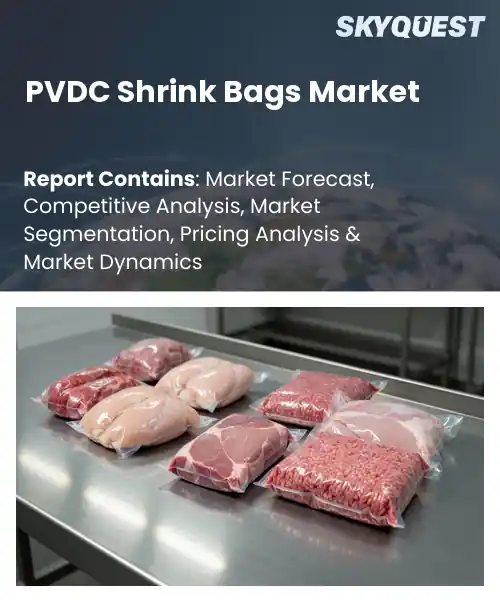
PVDC Shrink Bags Market
Report ID: SQMIG25I2060
Report ID: SQMIG25I2060
[email protected]
USA +1 351-333-4748
Report ID:
SQMIG25I2060 |
Region:
Global |
Published Date: March, 2026
Pages:
157
|Tables:
115
|Figures:
77


Global PVDC Shrink Bags Market size was valued at USD 1.0 Million in 2024 and is poised to grow from USD 1.08 Million in 2025 to USD 1.97 Million by 2033, growing at a CAGR of 7.8% during the forecast period (2026-2033).
Key Takeaways: Market Trends & Insights
The primary driver of the PVDC shrink bags market is the rising demand for high-barrier flexible packaging that preserves perishable goods and reduces food waste. PVDC shrink bags, made from polyvinylidene chloride formulations applied as coatings or films, provide exceptional oxygen and moisture barriers and tight conformity through heat-shrink processes. This market matters because retail supply chains and processors need extended shelf life without compromising appearance; for example, vacuum skin packs for deli meats and skin-packaged seafood expanded after PVDC largely replaced conventional PVC in the 1990s. Through global advancements in co-extrusion and barrier coatings, there has been an extensive acceleration of product acceptance/usage by consumers worldwide.
Building on global adoption, the key trend driving the global PVDC shrink bags sector growth is evolving regulatory and supply-chain demands that prioritize shelf life and product safety. Producers are limited by increased food safety and extended distribution distance due to more stringent regulations against entry of both oxygen and moisture. Therefore, they utilize PVDC formulations for products such as deli meat, cheese, smoked fish and ready meals, resulting in investments being made into higher-speed shrink equipment and co-extrusion line equipment. Consequently, opportunities arise in value-added services such as barrier optimization, light weighting lowering transportation emissions, and recycling programs; for example, processors in Brazil and Southeast Asia upgrade packaging to access export markets and reduce spoilage losses.
How is AI Optimizing Production Efficiency in the PVDC Shrink Bags Market?
In the PVDC Shrink Bags industry, AI technologies such as machine vision, predictive (condition-based) maintenance and adaptive process controls are being implemented to enhance productivity, decrease waste and ensure consistency of the quality of products produced. Key aspects include inline defect detection for seals and clarity, AI guided adjustments that keep barrier properties consistent, and data driven scheduling that reduces downtime. The present market still values PVDC for high barrier performance while facing pressure to lower scrap and energy use. Real world examples show converters adding vision systems on automated baggers and integrating optimization software on PVDC and PVDC free lines to raise uptime and yield.
In February 2026, Amcor announced expanded shrink capacity and production investments that leverage AI driven vision and automation to reduce film waste, speed changeovers and increase consistent barrier quality. This development supports market efficiency and helps processors meet tighter performance and sustainability expectations while raising throughput and preserving product appearance and shelf life.
Market snapshot - 2026-2033
Global Market Size
USD 1.0 Million
Largest Segment
Standard Shrink Bags
Fastest Growth
Custom Shrink Bags
Growth Rate
7.8% CAGR
To get more insights on this market click here to Request a Free Sample Report
Global PVDC Shrink Bags market is segmented by product type, end-use industry, material thickness, application method and region. Based on product type, the market is segmented into standard shrink bags and custom shrink bags. Based on end-use industry, the market is segmented into food packaging, consumer goods and pharmaceuticals. Based on material thickness, the market is segmented into lightweight thickness, medium thickness and heavy thickness. Based on application method, the market is segmented into hand sealing and machine sealing. Based on region, the market is segmented into North America, Europe, Asia Pacific, Latin America and Middle East & Africa.
Based on the global PVDC shrink bags market growth, custom shrink bags segment dominates because pharmaceutical companies demand tailored PVDC constructions that meet strict sterility, barrier and compatibility requirements. With custom designs, it is possible to integrate serialization, provide evidence of tampering, and create specific seal profiles (covert attributes). PVDC chemistry provides the capability to achieve this by using specific formulations and lamination methods. Aligning with your regulatory and quality priorities will lower contamination risks, extend your product shelf life, and drive manufacturers toward choosing a customizable packaging solution that requires suppliers to invest in customization.
However, standard shrink bags are emerging as the most rapidly expanding area, driven by demand for simpler, cost effective PVDC formats that streamline production. The increased compatibility of high-speed sealers with these forms of materials and ease of sourcing for manufacturers has created a rapid increase in manufacturers' desire to adopt scalable types of protective packages in the market.
Heavy thickness segment dominates because customers prioritize PVDC options that deliver enhanced mechanical protection and barrier performance for sensitive or bulky products. The use of thicker materials will increase the ability to resist punctures, also making it more difficult for seals to fail during transport or while being handled; this is very much in line with the risk management plans of brand owners. That reliability encourages manufacturers to choose heavier gauge PVDC for premium or mission critical items, prompting suppliers to scale production of robust formulations.
Meanwhile, lightweight thickness is witnessing the strongest growth momentum as producers pursue material efficiency while retaining PVDC barrier performance. It will enhance single serve and consumer goods uses of PVDC packaging and move PVDC into more affordable ranges by using less material, working on high speed lines, and aligning with sustainability efforts.
To get detailed segments analysis, Request a Free Sample Report
As per the global PVDC shrink bags market share, Asia Pacific leads due to concentrated manufacturing capacity in packaging films, deep integration between polymer producers and food processors, and strong demand for high-barrier flexible packaging across perishable segments. Scaling combines large-scale production capability, specialized knowledge about PVDC coatings, and regional supplier ability to provide customized solutions to food/seafood and ready meals markets through shrink-wrapping. Many major manufacturing regions maintain strong supply chain networks, delivering flexibility/cost savings for manufacturers, besides efficient contacts with established technical service/test networks that help reduce lead times for converters/brands. Regional policies and evolving retail formats also help create demand for high-end packaging, keeping the region at the forefront/competitive in the export market.
PVDC shrink bags market in Japan is characterized by advanced conversion capabilities, a strong focus on quality and food hygiene, and close collaboration between polymer innovators and packaging converters. Opportunities for local technical assistance and strict compliance expectations from government agencies also help support and develop strong supplier relationships and specialized formats. In addition, brand owners value presentation of product and the integrity of the product on the shelf and therefore want to utilize custom barrier technologies.
PVDC shrink bags market in South Korea reflects strong integration between food processing clusters and packaging converters, with emphasis on barrier performance and shrinking properties. Demand arises for processed meats and convenience foods, where both shelf-life and appearance of the package are important to retailers. Manufacturers located in the local market make significant investments to develop films specifically formulated, processed and finished to meet the specifications of the retailers. Cooperation with end users accelerates product refinement and supports applications requiring reliable gas and moisture protection.
Based on global PVDC shrink bags market regional forecast, North America has experienced fast expansion due to growing demand for high-barrier flexible packaging from mainstream retail, foodservice, and specialty processors seeking improved shelf performance and attractive pack presentation. The modern converting industry has the latest machinery and knowledge to assist brand owners in making changes to specifications very quickly and offering customization. Converters work closely with producers and retailers, which speeds up trials and the acceptance of new products. Reliability in the supply chain along with locally produced products and good after-sales support builds confidence in the marketplace. Environmental and regulatory pressures on suppliers have caused them to improve their formulations and films while maintaining their barriers, allowing local suppliers to meet customer needs while still meeting future expectations for sustainability. Well-established distribution systems and converter service centers allow for short lead times and support regional sourcing needs.
PVDC shrink bags market in the United States is shaped by large-scale food processors, a retail landscape and demand for premium presentation and extended shelf life. The existence of strong distribution networks will assist converters with their ability to develop applications as a means to more effectively rollout applicable formats. Material optimization due to sustainability related discussions continues to be a driver of maintaining the required barriers and has resulted in close collaboration with suppliers in the creation of custom formulations and additional support products/services associated with the formulation processes.
PVDC shrink bags market in Canada benefits from close ties with regional food processors, a preference for locally sourced packaging, and demand for reliable barrier solutions in chilled supply chains. Converters place a high emphasis upon creating customized options and providing technical assistance to help accommodate each retailer’s requirements as well as the changing nature of their products throughout the various product life cycles. Distribution networks and supplier responsiveness support batch requirements and formats. Sustainability conversations shape material selection while maintaining functional performance, encouraging collaborative development between suppliers and end users.
As per global PVDC shrink bags market regional outlook, Europe is strengthening its position through a combination of technical refinement, close engagement between converters and brand owners, and targeted efforts to reconcile high barrier performance with evolving sustainability expectations. Leading converters prioritize material science improvements and process control to optimize shrink characteristics while minimizing material usage. As regulations become more focused on recyclable materials and circularity, suppliers also need to develop ways to change their formulations and use multilayer structures while still obtaining the benefits of PVDC. Strong manufacturing capabilities in key global markets also support rapid development of product specifications in the context of cross-border supply chains, and allow for increased alignment between the innovation of raw materials and the needs of end users. Collaborative research initiatives and application labs in Germany, the U.K., and France help quickly validate new film constructions. The continuing focus on food safety and the high-end presentation of goods within premium segments continue to drive the demand for PVDC shrink products even as consumers change their priorities towards sustainability.
PVDC shrink bags market in Germany is anchored by strong converting base, application development facilities and food safety expectations. The growing demand for film in the meat, deli, and convenience sectors continues to emphasize the importance of barrier performance and consistent shrink performance. Suppliers are working closely with converters to develop packaging film constructions and specify the processing parameters that will allow them to maximize process efficiency and material optimization.
PVDC shrink bags market in United Kingdom combines strong retail innovation, flexible converting capacity, and emphasis on product appearance for chilled and convenience categories. Converters provide prototyping and pack development support to meet private label requirements. Attention to supply chain transparency and end user expectations drives specification clarity. Suppliers and converters work with retailers to balance barrier performance with recyclability considerations, enabling fit-for-purpose shrink solutions for premium and product ranges.
PVDC shrink bags market in France is driven by gourmet food sectors that value presentation and high barrier performance. Converters and suppliers are developing custom package designs with accurate aesthetics (film design, seal integrity) and dependable shrink performance to service the deli, cheese, and charcuterie vertical markets through cooperation with the brand owner to establish compatibility between the final package's design and food safety standards.
To know more about the market opportunities by region and country, click here to
Buy The Complete Report
Rising Demand For Flexible Packaging
PVDC shrink bags are increasingly preferred as flexible packaging demand grows because their superior barrier properties protect goods from moisture, oxygen and contaminants, allowing manufacturers to present lightweight, space-efficient formats while maintaining product integrity. The fact that PVDC definitely meets requirements for fragile or sensitive products encourages brand owners to utilize PVDC solutions for reducing their spoilage rates and enhancing visual product appeal, which ultimately assists in broader use throughout both food and non-food product categories. PVDC’s compatibility with high-speed automated packaging equipment as well as its multiple seal methods will also help facilitate scaling-up and more widespread adoption into marketplaces.
Enhanced Barrier and Preservation
The barrier characteristics of PVDC are so good at slowing down oxidative and moisture driven degradation of products that they allow manufactures to extend the perceived quality of product without having to use heavier outer packaging. This preservation quality makes PVDC shrink bags the preferred packaging for retailers and producers of more delicate or premium products allowing for longer distribution chains and increased market reach. The result has been more brands being able to protect their product's flavor, texture, and appearance through storage and transportation, thus increasing their procurement and supporting innovation in package design through PVDC's properties.
High Material Cost and Availability
Higher raw material costs and limited availability of certain PVDC grades can discourage manufacturers from switching from more economical films, increasing procurement complexity and raising production expenses. Such cost sensitivity influences purchasing decisions upstream and can constrain adoption among price-driven brands and smaller producers with tight margins. The presence of supply chain variability and the requirement for specialized handling or sourcing arrangements can add additional operational burdens, prompting some companies to either postpone or avoid investing in the PVDC shrink bag technology due to their efficacy, which ultimately moderates overall market growth potential.
Environmental Concerns and Recycling
As end-of-life options for PVDC-based films and their recycling are considered, the environmentally minded consumer and brands may omit these options because they feel they can easily replace them with materials perceived to offer better end-of-life options. Because recycling can be very challenging for some people to find, companies risk facing reputational issues due to their companies using these materials. They may also affect the purchasing policies of both the company using the material and that of retail. As sustainability criteria dictate an increasing number of companies' suppliers, companies will likely wait for clearly established recycling/collection infrastructures for PVDC to commit to increasing their use of the material.
Request Free Customization of this report to help us to meet your business objectives.
Competition in the global PVDC shrink bags market outlook is intensifying as incumbents use targeted M&A, retailer partnerships, and material innovation to protect margin in protein and dairy segments. Recent moves include acquisitions to secure coating and resin capabilities, retailer rollouts to lock shelf space, and launches of bio based or PVDC free barrier films as direct competitive responses to sustainability and shelf life demands.
SkyQuest’s ABIRAW (Advanced Business Intelligence, Research & Analysis Wing) is our Business Information Services team that Collects, Collates, Correlates, and Analyses the Data collected by means of Primary Exploratory Research backed by robust Secondary Desk research.
As per SkyQuest analysis, the global PVDC shrink bags industry is driven primarily by rising demand for high-barrier flexible packaging that preserves perishables and reduces food waste, while a secondary driver is evolving regulatory and supply-chain requirements that push producers toward longer shelf life and improved product safety. Because of environmental impacts and difficulties recycling PVDC films, companies are facing limits on how fast they expand, with impacts to their image and an inability to establish any form of circularity for their products. APAC has the largest market share of all regions owing to having the largest amount of manufacturing capability and integrated supply chains. Also while Custom Shrink Bags provide the highest level of performance in regards to the barrier, sterility and serialization requirements of both the pharmaceutical and premium food industries.
| Report Metric | Details |
|---|---|
| Market size value in 2024 | USD 1.0 Million |
| Market size value in 2033 | USD 1.97 Million |
| Growth Rate | 7.8% |
| Base year | 2024 |
| Forecast period | 2026-2033 |
| Forecast Unit (Value) | USD Million |
| Segments covered |
|
| Regions covered | North America (US, Canada), Europe (Germany, France, United Kingdom, Italy, Spain, Rest of Europe), Asia Pacific (China, India, Japan, Rest of Asia-Pacific), Latin America (Brazil, Rest of Latin America), Middle East & Africa (South Africa, GCC Countries, Rest of MEA) |
| Companies covered |
|
| Customization scope | Free report customization with purchase. Customization includes:-
|
To get a free trial access to our platform which is a one stop solution for all your data requirements for quicker decision making. This platform allows you to compare markets, competitors who are prominent in the market, and mega trends that are influencing the dynamics in the market. Also, get access to detailed SkyQuest exclusive matrix.
Table Of Content
Executive Summary
Market overview
Parent Market Analysis
Market overview
Market size
KEY MARKET INSIGHTS
COVID IMPACT
MARKET DYNAMICS & OUTLOOK
Market Size by Region
KEY COMPANY PROFILES
Methodology
For the PVDC Shrink Bags Market, our research methodology involved a mixture of primary and secondary data sources. Key steps involved in the research process are listed below:
1. Information Procurement: This stage involved the procurement of Market data or related information via primary and secondary sources. The various secondary sources used included various company websites, annual reports, trade databases, and paid databases such as Hoover's, Bloomberg Business, Factiva, and Avention. Our team did 45 primary interactions Globally which included several stakeholders such as manufacturers, customers, key opinion leaders, etc. Overall, information procurement was one of the most extensive stages in our research process.
2. Information Analysis: This step involved triangulation of data through bottom-up and top-down approaches to estimate and validate the total size and future estimate of the PVDC Shrink Bags Market.
3. Report Formulation: The final step entailed the placement of data points in appropriate Market spaces in an attempt to deduce viable conclusions.
4. Validation & Publishing: Validation is the most important step in the process. Validation & re-validation via an intricately designed process helped us finalize data points to be used for final calculations. The final Market estimates and forecasts were then aligned and sent to our panel of industry experts for validation of data. Once the validation was done the report was sent to our Quality Assurance team to ensure adherence to style guides, consistency & design.
Analyst Support
Customization Options
With the given market data, our dedicated team of analysts can offer you the following customization options are available for the PVDC Shrink Bags Market:
Product Analysis: Product matrix, which offers a detailed comparison of the product portfolio of companies.
Regional Analysis: Further analysis of the PVDC Shrink Bags Market for additional countries.
Competitive Analysis: Detailed analysis and profiling of additional Market players & comparative analysis of competitive products.
Go to Market Strategy: Find the high-growth channels to invest your marketing efforts and increase your customer base.
Innovation Mapping: Identify racial solutions and innovation, connected to deep ecosystems of innovators, start-ups, academics, and strategic partners.
Category Intelligence: Customized intelligence that is relevant to their supply Markets will enable them to make smarter sourcing decisions and improve their category management.
Public Company Transcript Analysis: To improve the investment performance by generating new alpha and making better-informed decisions.
Social Media Listening: To analyze the conversations and trends happening not just around your brand, but around your industry as a whole, and use those insights to make better Marketing decisions.
REQUEST FOR SAMPLE
 REQUEST FREE CUSTOMIZATION
Global Pvdc Shrink Bags Market size was valued at USD 1.0 Million in 2024 and is poised to grow from USD 1.08 Million in 2025 to USD 1.97 Million by 2033, growing at a CAGR of 7.8% during the forecast period (2026-2033).
Competition in the global PVDC shrink bags market is intensifying as incumbents use targeted M&A, retailer partnerships, and material innovation to protect margin in protein and dairy segments. Recent moves include acquisitions to secure coating and resin capabilities, retailer rollouts to lock shelf space, and launches of bio based or PVDC free barrier films as direct competitive responses to sustainability and shelf life demands. 'Berry Global', 'Sealed Air Corporation', 'AEP Industries', 'Intertape Polymer Group', 'Klöckner Pentaplast', 'Rapak', 'Sigma Plastics Group', 'Clpack', 'Coveris', 'Bemis Company', 'Schur Packaging', 'Selig Group', 'ULINE', 'ProAmpac', 'Transcendia', 'Novolex', 'Placon Corporation', 'Packtech', 'Jindal Poly Films', 'FlexPak'
PVDC shrink bags are increasingly preferred as flexible packaging demand grows because their superior barrier properties protect goods from moisture, oxygen and contaminants, allowing manufacturers to present lightweight, space-efficient formats while maintaining product integrity. This suitability for delicate or perishable items encourages brand owners to adopt PVDC solutions to reduce spoilage risk and enhance shelf appeal, which in turn supports wider use across food and nonfood categories. The material’s compatibility with automated packaging lines and varied sealing methods further enables scale-up and broader market uptake.
Sustainable Packaging Innovation: Manufacturers are exploring alternative PVDC formulations and multilayer designs that maintain barrier performance and shelf life while reducing inputs derived from fossil sources and enabling easier end of life pathways. Brand owners demand materials that align with sustainability commitments without compromising product protection. This trend drives collaboration between material scientists, converters and brands to develop conversion friendly films that integrate recycled and bio based content. Emphasis is on lifecycle thinking, supply chain transparency, and communicating sustainability benefits to end consumers.
Asia Pacific Dominate the Global PVDC Shrink Bags Market.
The market is segmented by product type (standard shrink bags, custom shrink bags), end-use industry (food packaging, consumer goods, pharmaceuticals), material thickness (lightweight, medium, heavy), and application method (hand sealing, machine sealing).
AI is used to improve production efficiency through machine vision, predictive maintenance, and adaptive process controls. It helps in inline defect detection, seal and clarity inspection, optimizing barrier consistency, reducing downtime, and minimizing waste. AI-driven automation and vision systems also improve yield, speed, and overall manufacturing efficiency.


Want to customize this report? This report can be personalized according to your needs. Our analysts and industry experts will work directly with you to understand your requirements and provide you with customized data in a short amount of time. We offer $1000 worth of FREE customization at the time of purchase.
Feedback From Our Clients


 USA (+1) 351-333-4748

