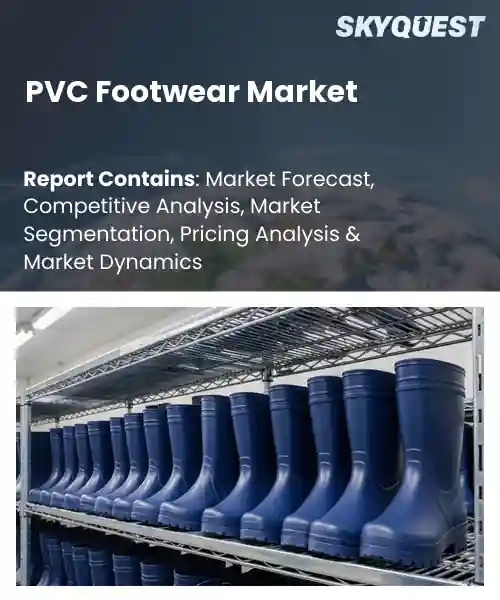
PVC Footwear Market
Report ID: SQMIG25L2035
Report ID: SQMIG25L2035
[email protected]
USA +1 351-333-4748
Report ID:
SQMIG25L2035 |
Region:
Global |
Published Date: June, 2026
Pages:
157
|Tables:
178
|Figures:
79


Global PVC Footwear Market size was valued at USD 59.10 Billion in 2024 and is poised to grow from USD 62.17 Billion in 2025 to USD 93.19 Billion by 2033, growing at a CAGR of 5.19% during the forecast period (2026-2033).
PVC footwear market growth is shoes made from polyvinyl chloride, a polymer that enabled cheap, watertight, and durable products for a variety of markets. This section is important because it provides low-cost protective footwear for healthcare and hospitality, and it also meets fashion and seasonal needs with multi-purpose designs. Over time the industry moved from rudimentary molded clogs to precision injection-molded sandals and boots as processing methods advanced and Asian supply chains matured. For instance manufacturers in China and Vietnam scaled exports rapidly while Western brands collaborated on limited-edition styles, illustrating how production efficiency paired with design experimentation has expanded consumer acceptance globally across urban markets.
Building on expanded consumer acceptance, a central growth driver is cost-efficient manufacturing that lowers unit prices and enables distribution, because processing improvements reduce waste and cycle times manufacturers can target new segments with offerings. As cost structures improve, companies reinvest in sustainability and design, which leads to recyclable PVC blends, take-back programs, and premium limited runs that appeal to eco-conscious buyers. Another example, hospitals use slip resistant PVC clogs for their staff because of the hygiene factor and the economics of replacing them. Retailers on the coast would sell waterproof sandals for tourists . Today , with lower production costs , it translates to higher volume sales and diverse revenue streams all over the world .
How is AI Improving Production Efficiency in the PVC Footwear Market?
AI offers solutions to the main manufacturing bottlenecks in the PVC footwear market trends to improve production efficiency. Intelligent process optimization, automated quality inspection and predictive maintenance are key aspects. Today, manufacturers utilize artificial intelligence (AI) in finding the most effective molding parameters, detecting defects early, and providing robots with instructions for both trimming and assembling. This also reduces waste, decreases time during setup, and results in a more consistent end product. In addition, manufacturers face an increasing market environment filled with demands for faster cycle times, tighter quality control, and a decreased availability of skilled labor. For example, large scale manufacturers can use an injection molding controller with AI input to help improve the reliability and scalability possibility of running PVC shoes.
Additionally, in April of 2026, Haitian released their X-Injection Deep-AI technology allowing for mold setup through AI connected to their systems as well as defect detection and early warning capabilities. This AI capability streamlines parameter setup and reduces dependency on specialist operators, enabling faster, more consistent PVC footwear production and supporting market growth through easier scaling.
Market snapshot - (2026-2033)
Global Market Size
USD 59.1 Billion
Largest Segment
Sandals & Slippers
Fastest Growth
Sports Shoes
Growth Rate
5.19% CAGR
To get more insights on this market click here to Request a Free Sample Report
Global PVC footwear market is segmented by product type, end user, application, distribution channel, price range, material type and region. Based on by product type, the market is segmented into sandals & slippers, boots, casual shoes, sports shoes, work & safety footwear and others. Based on by end user, the market is segmented into men, women and children. Based on by application, the market is segmented into casual wear, industrial & safety use, outdoor & recreational use, fashion & lifestyle and others. Based on by distribution channel, the market is segmented into online retail, supermarkets & hypermarkets, specialty footwear stores, brand outlets and others. Based on by price range, the market is segmented into economy, mid-range and premium. Based on by material type, the market is segmented into flexible PVC, rigid PVC and recycled PVC. Based on region, the market is segmented into North America, Europe, Asia Pacific, Latin America and Middle East & Africa.
Sandals & slippers segment dominates because its lightweight, low-cost PVC construction aligns with mass consumer preferences for comfortable, water resistant everyday footwear in the PVC footwear market, enabling widespread adoption across diverse age groups and retail channels. Manufacturers favor this design for ease of molding and rapid production cycles, driving high volume supply and frequent style refreshes. The product’s low maintenance and versatility for casual, beach and household use sustain steady demand and broad market penetration.
However, work & safety footwear is the fastest growing sector. This is supported by growing employer emphasis on protective personal equipment, increased specification of slip resistant and chemical resistant PVC boots and the use of durable, easy to clean materials in industrial hygiene programs. This demand creates product innovation and institutional buying opportunities.
The flexible PVC segment has a dominant position due to its flexibility and comfortable attributes, making it the most suitable material for many different types of PVC shoes where comfort and fit are of utmost importance for the wearer. In addition, the ease of processing the material allows for intricate designs, changing surface profiles and multiple color options, which appeal to brand designers, as well as simplifying production processes. Lastly, reliable supply chains and cost-effective manufacturing systems will continue to severely limit this material’s use across all casual and mass market footwear brands in the overall PVC footwear market.
Meanwhile, recycled PVC is the fastest growing material type as sustainability mandates and consumer demand for greener products encourage brands to adopt reclaimed resin. Better recycling technologies and improved quality allow a wider use in molded footwear, creating new sourcing channels and making PVC footwear ready for sustainable growth.
To get detailed segments analysis, Request a Free Sample Report
Asia Pacific leads the global PVC footwear market share due to an integrated combination of manufacturing capability, diversified supply chains, and market demand dynamics. Dense manufacturing ecosystems support large scale production, while established raw material processing and logistics networks reduce lead times and enhance cost efficiency. Consumer preferences in multiple markets within the region favor durable and affordable synthetic footwear, creating stable domestic demand that complements export orientation. Investment in product adaptation and design for regional tastes, together with supplier concentration and clustering, sustains innovation in materials and processes. Policy environments in several jurisdictions also encourage industrial development and trade facilitation, reinforcing the region's role as both a production hub and a source of market trends that influence global supply and competitive positioning.
PVC footwear market outlook in Japan reflects a mature consumer base with emphasis on quality, technical performance and brand reputation. Manufacturers concentrate on refined materials, ergonomic design and compliance with stringent domestic standards. Distribution channels blend traditional retail and specialized outlets with selective online presence for premium segments. Product development emphasizes durability, comfort and aesthetic detail tailored to commuter and professional use, while value oriented segments seek functional and affordable PVC.
PVC footwear market forecast in South Korea is defined by strong design focus and fast trend adoption among fashion oriented consumers. Local manufacturers and brands prioritize stylish silhouettes, color diversity and collaborations with lifestyle labels. Channels merge modern retail formats with vibrant online platforms, enabling quick roll out of new collections. Targeting youth and urban segments encourages niche offerings, while attention to material finish and ergonomic comfort broadens overall mainstream acceptance.
In the European PVC shoe industry, you will find that many factors play a role in the growth of this market, the main ones being both demand from consumers for low priced and multi-purpose shoes as well as the industry trying to find ways to differentiate themselves from each other through styles and complying with various regulations. Some of the places where you will find established fashion centers and an extensive retail network is where many brands will develop products that have a good mix of style and function to bring together multiple styles in different varieties. The manufacturers use advanced formulations of raw materials and manufacturing processes to provide the consumers with higher-quality performance and also push the envelope in terms of sustainable sourcing and messaging within the market. There is also cross-border trade throughout the region and there is a great deal of support for manufacturers to produce their products efficiently so that they can be responsive to their customers. Other trends are showing an increase in urbanization and growing demand for casual and functional footwear that can be used across all footwear lines, including both casual and formal footwear. Collaboration between long-established brands and many smaller and more innovative brands have allowed for an ever-changing product offering within the EU and the EU Market.
PVC footwear market regional outlook in Germany Growing manufacturing quality, practical design, and consumer expectations for durability and comfort. Producers focus on material standards that can be relied upon and production methods that are efficient. Distribution is through specialized retail and industrial channels for various end-use needs. Product development aims at a fine balance between functional performance and restrained styling in order to serve the professional and everyday segments. Industry players are focused on compliance with regulatory norms and stable quality assurance across the supply chain.
PVC footwear market regional forecast in United Kingdom reflects a blend of fashion driven demand and appetite for versatile, weather resistant options. Retail and online channels support trend diffusion and brand experimentation. Designers and manufacturers focus on contemporary styling, practical detailing and seasonal color ranges tailored to urban consumers. Collaboration between high street labels and independent makers fuels product diversity, while consumer interest in durable, easy care footwear underpins ongoing category relevance.
PVC footwear industry trends in France is reflects the combination of the growing need for practical shoes and the fashion sense of individuals. On a local level, many independent designers are motivated by fashion detailing, elegance, and excellent material quality in their creations. For distribution, designers use both e-commerce and local boutiques as vehicles to present a curated collection. With consumers looking for functional and stylish alternatives, this creates opportunities for both traditional artisanal designers and new brands to partner together - enriching product stories through exploration beyond just seasonal trends.
The demand for PVC footwear continues to rise in North America due to several factors including product innovation, increased distribution channels, direct reach to consumers and strong positioning in the market. Due to consumers trends towards casual and functional footwear, both brands and manufacturers have made significant improvements in aesthetics and comfort of materials used for footwear. To meet demand across a wide range of demographic segments, retail strategies include big box stores, specialty retail chains and e-commerce outlets. Supply chain resiliency, through partnerships with select suppliers, enables manufacturers to meet the ever-changing demands of the market. Value, ease of care and lifestyle association are the primary focus of PVC footwear marketing efforts, thus allowing for continued growth within the categories of work footwear, leisure footwear and recreational/outdoor footwear. Assortment growth is driven by partnerships between legacy firms and agile designers and consumer confidence is maintained by focus on regulatory and quality standards.
PVC footwear industry analysis in United States emphasizes versatile, low maintenance footwear for casual, work and outdoor use. Producers improve comfort, aesthetics and performance to meet different consumer preferences. Distribution is through mass retail, specialty stores and e commerce channels to reach broad audiences. Brand narratives are centered on practicality and lifestyle fit, while designer partnerships and private label initiatives broaden assortment and enable faster iteration based on consumer feedback.
PVC footwear market in Canada is showing strong demand for practical and weather-resistant shoes that suit a variety of geographic locations and types of outdoor lifestyles. Manufacturers design their products with special materials and styles that offer a practical use, while still being visually appealing. There are multiple ways of getting their products to consumers through retail store chains, outdoor sports specialty retailers, and through more of the growing number of online channels to urban and rural customers. The product features of durable, easy to care for, and comfortable footwear lend themselves to being used in multiple ways for recreation, as well as in occupational and everyday environments. Companies selling PVC footwear are also emphasizing the practicality and value of their products through design features.
To know more about the market opportunities by region and country, click here to
Buy The Complete Report
Rising Consumer Demand For Affordable Footwear
Expansion Of Retail and E Commerce
Environmental Regulatory Pressures on PVC
Volatility In Raw Material Supply Chains
Request Free Customization of this report to help us to meet your business objectives.
Competitive landscape in the global PVC footwear market is defined by consolidation, material innovation and sustainability pressure driving competitive moves. Strategic M&A such as Rocky Brands acquisition of Honeywell’s performance footwear portfolio has reallocated PVC boot assets. Large manufacturers are deploying new PVC composites and comfort technologies, while challenger brands push PVC reduction and transparent life cycle measures.
Top Player’s Company Profile
Recent Developments in the PVC Footwear Key Market
SkyQuest’s ABIRAW (Advanced Business Intelligence, Research & Analysis Wing) is our Business Information Services team that Collects, Collates, Correlates, and Analyses the Data collected by means of Primary Exploratory Research backed by robust Secondary Desk research. As per SkyQuest analysis, the global PVC footwear market is propelled by cost efficient manufacturing that lowers unit prices and expands access while retail and e commerce expansion accelerates reach and product discovery. Growth faces a major restraint from tightening environmental regulations and scrutiny over PVC production and disposal, prompting investment in recycling and reformulation. Asia Pacific remains the dominating region due to concentrated manufacturing ecosystems, supply chain depth and strong domestic demand. Sandals and slippers are the dominating segment because lightweight, low cost and water resistant PVC fits mass consumer needs and high production efficiency. Continued material innovation and circular initiatives will shape competitive positioning and long term sustainability.
| Report Metric | Details |
|---|---|
| Market size value in 2024 | USD 59.1 Billion |
| Market size value in 2033 | USD 93.19 Billion |
| Growth Rate | 5.19% |
| Base year | 2024 |
| Forecast period | (2026-2033) |
| Forecast Unit (Value) | USD Billion |
| Segments covered |
|
| Regions covered | North America (US, Canada), Europe (Germany, France, United Kingdom, Italy, Spain, Rest of Europe), Asia Pacific (China, India, Japan, Rest of Asia-Pacific), Latin America (Brazil, Rest of Latin America), Middle East & Africa (South Africa, GCC Countries, Rest of MEA) |
| Companies covered |
|
| Customization scope | Free report customization with purchase. Customization includes:-
|
To get a free trial access to our platform which is a one stop solution for all your data requirements for quicker decision making. This platform allows you to compare markets, competitors who are prominent in the market, and mega trends that are influencing the dynamics in the market. Also, get access to detailed SkyQuest exclusive matrix.
Table Of Content
Executive Summary
Market overview
Parent Market Analysis
Market overview
Market size
KEY MARKET INSIGHTS
COVID IMPACT
MARKET DYNAMICS & OUTLOOK
Market Size by Region
KEY COMPANY PROFILES
Methodology
For the PVC Footwear Market, our research methodology involved a mixture of primary and secondary data sources. Key steps involved in the research process are listed below:
1. Information Procurement: This stage involved the procurement of Market data or related information via primary and secondary sources. The various secondary sources used included various company websites, annual reports, trade databases, and paid databases such as Hoover's, Bloomberg Business, Factiva, and Avention. Our team did 45 primary interactions Globally which included several stakeholders such as manufacturers, customers, key opinion leaders, etc. Overall, information procurement was one of the most extensive stages in our research process.
2. Information Analysis: This step involved triangulation of data through bottom-up and top-down approaches to estimate and validate the total size and future estimate of the PVC Footwear Market.
3. Report Formulation: The final step entailed the placement of data points in appropriate Market spaces in an attempt to deduce viable conclusions.
4. Validation & Publishing: Validation is the most important step in the process. Validation & re-validation via an intricately designed process helped us finalize data points to be used for final calculations. The final Market estimates and forecasts were then aligned and sent to our panel of industry experts for validation of data. Once the validation was done the report was sent to our Quality Assurance team to ensure adherence to style guides, consistency & design.
Analyst Support
Customization Options
With the given market data, our dedicated team of analysts can offer you the following customization options are available for the PVC Footwear Market:
Product Analysis: Product matrix, which offers a detailed comparison of the product portfolio of companies.
Regional Analysis: Further analysis of the PVC Footwear Market for additional countries.
Competitive Analysis: Detailed analysis and profiling of additional Market players & comparative analysis of competitive products.
Go to Market Strategy: Find the high-growth channels to invest your marketing efforts and increase your customer base.
Innovation Mapping: Identify racial solutions and innovation, connected to deep ecosystems of innovators, start-ups, academics, and strategic partners.
Category Intelligence: Customized intelligence that is relevant to their supply Markets will enable them to make smarter sourcing decisions and improve their category management.
Public Company Transcript Analysis: To improve the investment performance by generating new alpha and making better-informed decisions.
Social Media Listening: To analyze the conversations and trends happening not just around your brand, but around your industry as a whole, and use those insights to make better Marketing decisions.
REQUEST FOR SAMPLE
 REQUEST FREE CUSTOMIZATION
Global Pvc Footwear Market size was valued at USD 59.1 Billion in 2024 and is poised to grow from USD 62.17 Billion in 2025 to USD 93.19 Billion by 2033, growing at a CAGR of 5.19% during the forecast period (2026-2033).
Competitive landscape in the global PVC footwear market is defined by consolidation, material innovation and sustainability pressure driving competitive moves. Strategic M&A such as Rocky Brands acquisition of Honeywell’s performance footwear portfolio has reallocated PVC boot assets. Large manufacturers are deploying new PVC composites and comfort technologies, while challenger brands push PVC reduction and transparent life cycle measures. 'Bata Corporation', 'Crocs', 'Relaxo Footwears', 'Liberty Shoes', 'Paragon Footwear', 'Havaianas', 'Grendene', 'Khadim India', 'Action Shoes', 'VKC Group', 'Skechers', 'Nike', 'Adidas', 'Puma', 'Deichmann', 'Birkenstock', 'Wolverine World Wide', 'Levi Strauss', 'Arezzo & Co', 'Metro Brands'
PVC footwear’s affordability and accessibility make it a preferred option for value conscious consumers, driving broader adoption across demographic groups. Manufacturers can offer diverse designs at lower production cost, enabling retailers to stock ranges that meet daily wear and fashion needs, which increases product visibility and trial. The perception of acceptable durability and ease of maintenance reinforces repeat purchases and word of mouth recommendation. Together, these factors create a reinforcing cycle of demand that supports market expansion through broader consumer acceptance and retail penetration.
Sustainable Material Innovation: Manufacturers prioritize formulations and recycled content to reduce environmental footprint preserving performance and cost efficiency. Collaboration with material scientists and designers produces PVC blends offering improved durability, softer handfeel and enhanced recyclability that support circular strategies. Brands emphasize material choices in marketing to satisfy evolving consumer expectations for responsible sourcing and longer lived products. Investment in closed loop initiatives and take back programs strengthens supplier relationships, creating value propositions, differentiating offers beyond price and widening appeal among sustainability conscious buyers.
Why does Asia Pacific Dominate the Global PVC Footwear Market? |@12


Want to customize this report? This report can be personalized according to your needs. Our analysts and industry experts will work directly with you to understand your requirements and provide you with customized data in a short amount of time. We offer $1000 worth of FREE customization at the time of purchase.
Feedback From Our Clients


 USA (+1) 351-333-4748

