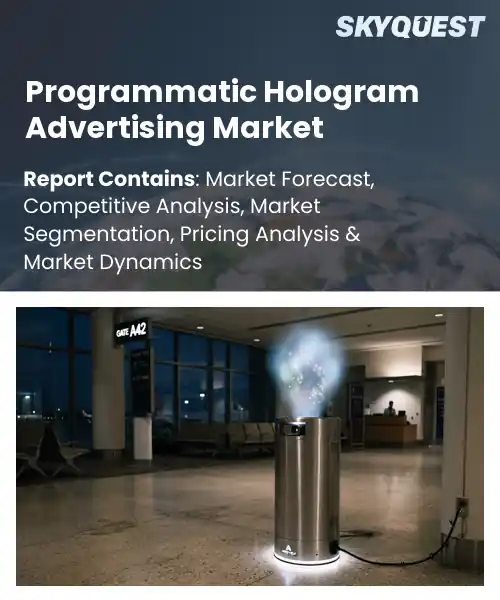
Programmatic Hologram Advertising Market
Report ID: SQMIG50T2022
Report ID: SQMIG50T2022
[email protected]
USA +1 351-333-4748
Report ID:
SQMIG50T2022 |
Region:
Global |
Published Date: August, 2026
Pages:
157
|Tables:
118
|Figures:
77


Global Programmatic Hologram Advertising Market size was valued at USD 963.0 Million in 2024 and is poised to grow from USD 1148.86 Million in 2025 to USD 4714.01 Million by 2033, growing at a CAGR of 19.3% during the forecast period (2026-2033).
The programmatic hologram advertising market consists of buying and placement of three‑dimensional visual content on transparent or volumetric displays that react to viewer movement. Its significance lies in converting static billboards into immersive experiences that capture attention far longer than traditional media. The primary driver has been rapid progress in rendering engines combined with cloud‑based data pipelines, which allow advertisers to trigger holographic assets in time based on demographic signals. Early pilots in Tokyo’s Shibuya crossing and Shanghai’s Expo Center demonstrated proof of concept, while the past three years have seen platform integrations with DSPs, turning installations into scalable campaigns. Building on that foundation, the market’s next key factor is audience targeting, which turns holograms into measurable ROI for brands. As retailers and entertainment venues adopt sensors that capture foot‑traffic heat maps, advertisers can programmatically allocate holographic spots where conversion potential is highest, prompting higher spend and faster adoption. For instance, a fashion house deployed a cloud‑linked hologram in a Paris mall, synchronizing product rotation with purchase intent signals and reporting a 30 percent lift in trial visits. These dynamics encourage platform providers to integrate analytics dashboards, unlocking significant revenue streams and cementing hologram ads as a mainstream global programmatic channel.
How is AI-driven automation reshaping programmatic hologram advertising?
AI‑driven automation is turning programmatic hologram advertising into a real‑time, data‑rich experience. Machine‑learning models analyze viewer behavior, location and context to select the most compelling holographic creative in milliseconds. This enables dynamic bidding that matches inventory with audience intent, reducing waste and boosting relevance. Integrated AI pipelines also generate personalized 3D visuals on the fly, allowing brands to tailor messages for each passerby without manual redesign. The market is expanding rapidly as advertisers seek immersive formats that combine the reach of programmatic buying with the impact of holographic displays, creating a seamless loop of data, decision and delivery that feels both futuristic and efficient.In October 2025, a leading hologram advertising platform introduced AI‑powered real‑time creative optimization, streamlining campaign setup and cutting manual effort, which accelerates market adoption and improves overall efficiency.
Market snapshot - (2026-2033)
Global Market Size
USD 963.0 Million
Largest Segment
Software Platforms
Fastest Growth
Services
Growth Rate
19.3% CAGR
To get more insights on this market click here to Request a Free Sample Report
Global programmatic hologram advertising market is segmented by offering, deployment, advertising format, end use industry and region. Based on offering, the market is segmented into Software Platforms and Services. Based on deployment, the market is segmented into Cloud-Based and On-Premises. Based on advertising format, the market is segmented into Indoor Holographic Displays, Outdoor Holographic Displays and Event & Experiential Advertising. Based on end use industry, the market is segmented into Retail, Media & Entertainment, Automotive, Consumer Electronics, Healthcare and Other Industries. Based on region, the market is segmented into North America, Europe, Asia Pacific, Latin America and Middle East & Africa.
Software Platforms segment dominates because it supplies the essential orchestration layer that connects real‑time inventory, audience data, and dynamic creative generation for holographic ads. Its modular design merges data feeds, AI analytics, and billing functions, enabling advertisers to automate campaign execution at scale. This integration eliminates manual workflows, speeds time‑to‑market, and encourages brands to experiment with immersive storytelling, thereby solidifying its leadership in the programmatic hologram advertising market. This synergy creates a feedback loop that continuously refines audience targeting.
However, Services segment is witnessing the strongest growth momentum as advertisers seek specialized creative production, hologram rendering, and campaign management expertise. The rise of experiential brands and demand for turnkey solutions accelerates service adoption, unlocking new revenue streams and expanding the overall market footprint through customized, high‑impact holographic experiences.
Indoor Holographic Displays segment leads because they offer controlled lighting, high resolution, and proximity to shoppers, enabling visual impact and measurable interaction. Brands can integrate sensor data and facial recognition to tailor content in real time, driving higher recall and conversion rates within retail environments. Such environments also facilitate integration with existing point‑of‑sale systems, further enhancing campaign efficiency and ROI. This synergy creates a feedback loop that continuously refines audience targeting.
Meanwhile, Outdoor Holographic Displays segment emerges as the high‑growth area as municipalities and event venues adopt projections for engagement. Advances in weather‑resistant hardware and solar‑powered installations lower deployment barriers, prompting brands to extend programmatic reach beyond indoor spaces. This expansion fuels inventory sources and unlocks untapped audiences, accelerating market growth.
To get detailed segments analysis, Request a Free Sample Report
North America maintains leadership through a confluence of advanced digital infrastructure, deep investment in immersive media, and a culture that embraces technological experimentation. Leading advertising agencies and technology firms collaborate closely, fostering rapid integration of holographic formats into programmatic workflows. Consumer familiarity with interactive experiences drives demand, while a supportive regulatory climate encourages innovative deployments across retail, entertainment, and public venues. The region’s talent pool, strong creative ecosystems, and extensive data analytics capabilities enable precise targeting and measurement, reinforcing confidence among advertisers to allocate substantial resources toward holographic campaigns and cementing North America’s dominant position.
Programmatic Hologram Advertising Market in United States benefits from a vibrant ecosystem where tech giants, media agencies, and marquee brands converge to pilot cutting‑edge holographic experiences. The market thrives on sophisticated demand‑side platforms that seamlessly blend real‑time data with three‑dimensional creative, allowing advertisers to deliver personalized holograms at scale. Strong consumer appetite for novel interactive content, coupled with extensive retail networks eager to differentiate storefronts, fuels continual experimentation and investment in immersive formats across multiple channels.
Programmatic Hologram Advertising Market in Canada draws strength from a collaborative environment linking research institutions, creative studios, and forward‑looking advertisers. Emphasis on experiential retail and cultural events creates opportunities for holographic displays that enhance brand storytelling. The market leverages robust data privacy frameworks and high broadband penetration to assure seamless delivery of holographic ads, while government initiatives supporting digital innovation encourage early adoption among media planners seeking differentiated audience engagement.
Europe’s expansion is propelled by a synergistic blend of creative expertise, strong demand for premium experiential media, and a regulatory landscape that supports data‑driven personalization while safeguarding consumer rights. Leading brands across fashion, automotive, and tourism sectors view holographic storytelling as a means to differentiate in saturated markets, prompting agencies to embed holography within programmatic buying tools. Collaborative innovation hubs in key economies accelerate technology standardization, enabling cross‑border campaign execution. Consumer openness to immersive experiences, along with a mature digital advertising infrastructure, creates fertile ground for rapid market scaling throughout the continent.
Programmatic Hologram Advertising Market in Germany is anchored by a robust engineering base and a strong tradition of precision marketing. Leading automotive and technology firms partner with creative studios to embed holographic content within programmatic channels, leveraging high‑resolution display networks in urban centers. A well‑established data ecosystem facilitates granular audience segmentation, allowing advertisers to serve contextually relevant holograms that resonate with sophisticated consumer expectations.
Programmatic Hologram Advertising Market in United Kingdom experiences swift growth driven by a thriving creative sector and early adopter mindset among advertisers. London’s concentration of media agencies and tech start‑ups accelerates the development of plug‑in solutions that integrate holographic assets into existing programmatic platforms. The market benefits from strong demand for immersive experiences in retail and live events, prompting brands to experiment with dynamic holograms that capture attention in high‑traffic public spaces.
Programmatic Hologram Advertising Market in France is emerging as fashion houses and luxury brands explore holographic showcases to enhance storytelling. Creative agencies collaborate with technology providers to embed holographic experiences within programmatic campaigns, targeting culturally attuned audiences through sophisticated data insights. The market’s evolution is supported by a vibrant art and design community that embraces experimental formats, encouraging advertisers to adopt holographic media as a means of differentiating brand narratives.
Asia Pacific advances its position through aggressive adoption of next‑generation display technologies, strong consumer enthusiasm for novel visual experiences, and strategic investments by governments and corporations in smart city infrastructures. The region’s dense urban environments provide ideal canvases for large‑scale holographic installations, while leading electronics manufacturers supply high‑performance projection hardware that integrates seamlessly with programmatic platforms. Collaborative ecosystems linking technology startups, advertising agencies, and retailers foster rapid prototyping and rollout of holographic campaigns. Cultural affinity for cutting‑edge entertainment and a youthful demographic further amplify demand, positioning Asia Pacific as a hotbed for innovative programmatic hologram deployments.
Programmatic Hologram Advertising Market in Japan leverages a deep appreciation for futuristic aesthetics and a technology‑savvy consumer base. Major retailers and entertainment venues integrate holographic displays into programmatic ad stacks, delivering synchronized visual experiences that align with real‑time audience data. Partnerships between electronics manufacturers and creative agencies accelerate the deployment of high‑definition holograms, while cultural events provide platforms for large‑scale immersive storytelling that reinforces brand engagement.
Programmatic Hologram Advertising Market in South Korea is propelled by rapid broadband diffusion and a vibrant gaming and pop‑culture scene that embraces immersive media. Advertisers collaborate with telecom operators to embed holographic content within programmatic channels, reaching audiences through dynamic storefronts and transit hubs. The market benefits from strong R&D capabilities in display technology, enabling crisp, responsive holograms that adapt to real‑time audience cues and elevate the overall advertising experience.
To know more about the market opportunities by region and country, click here to
Buy The Complete Report
Rising Consumer Demand For Immersive Experiences
Advancements In Real‑Time Rendering Technology
High Production Costs Limit Adoption
Regulatory Uncertainty Around Data Privacy
Request Free Customization of this report to help us to meet your business objectives.
The competitive landscape of the global programmatic hologram advertising market is shaped by a handful of established players such as Daktronics Inc., Vizrt Group, Appier Group Inc. and Firefly Inc., each leveraging technology innovation, strategic partnerships and selective acquisitions to differentiate their holographic ad solutions and capture high‑value contracts in retail, events and transportation venues.
Top Player’s Company Profile
Recent Developments
SkyQuest’s ABIRAW (Advanced Business Intelligence, Research & Analysis Wing) is our Business Information Services team that Collects, Collates, Correlates, and Analyses the Data collected by means of Primary Exploratory Research backed by robust Secondary Desk research. As per SkyQuest analysis the programmatic hologram advertising market is being propelled mainly by rising consumer demand for immersive experiences which pushes brands toward three‑dimensional real‑time ads, and a second important driver is the rapid advancement in real‑time rendering technology that reduces latency and enables seamless integration with existing programmatic platforms. The software platforms segment leads the market because it orchestrates data, AI and creative delivery, while North America remains the dominant region thanks to its advanced digital infrastructure and strong ecosystem of advertisers and tech firms. However, high production costs for holographic content act as a restraint, slowing broader adoption until cost efficiencies improve.
| Report Metric | Details |
|---|---|
| Market size value in 2024 | USD 963.0 Million |
| Market size value in 2033 | USD 4714.01 Million |
| Growth Rate | 19.3% |
| Base year | 2024 |
| Forecast period | (2026-2033) |
| Forecast Unit (Value) | USD Million |
| Segments covered |
|
| Regions covered | North America (US, Canada), Europe (Germany, France, United Kingdom, Italy, Spain, Rest of Europe), Asia Pacific (China, India, Japan, Rest of Asia-Pacific), Latin America (Brazil, Rest of Latin America), Middle East & Africa (South Africa, GCC Countries, Rest of MEA) |
| Companies covered |
|
| Customization scope | Free report customization with purchase. Customization includes:-
|
To get a free trial access to our platform which is a one stop solution for all your data requirements for quicker decision making. This platform allows you to compare markets, competitors who are prominent in the market, and mega trends that are influencing the dynamics in the market. Also, get access to detailed SkyQuest exclusive matrix.
Table Of Content
Executive Summary
Market overview
Parent Market Analysis
Market overview
Market size
KEY MARKET INSIGHTS
COVID IMPACT
MARKET DYNAMICS & OUTLOOK
Market Size by Region
KEY COMPANY PROFILES
Methodology
For the Programmatic Hologram Advertising Market, our research methodology involved a mixture of primary and secondary data sources. Key steps involved in the research process are listed below:
1. Information Procurement: This stage involved the procurement of Market data or related information via primary and secondary sources. The various secondary sources used included various company websites, annual reports, trade databases, and paid databases such as Hoover's, Bloomberg Business, Factiva, and Avention. Our team did 45 primary interactions Globally which included several stakeholders such as manufacturers, customers, key opinion leaders, etc. Overall, information procurement was one of the most extensive stages in our research process.
2. Information Analysis: This step involved triangulation of data through bottom-up and top-down approaches to estimate and validate the total size and future estimate of the Programmatic Hologram Advertising Market.
3. Report Formulation: The final step entailed the placement of data points in appropriate Market spaces in an attempt to deduce viable conclusions.
4. Validation & Publishing: Validation is the most important step in the process. Validation & re-validation via an intricately designed process helped us finalize data points to be used for final calculations. The final Market estimates and forecasts were then aligned and sent to our panel of industry experts for validation of data. Once the validation was done the report was sent to our Quality Assurance team to ensure adherence to style guides, consistency & design.
Analyst Support
Customization Options
With the given market data, our dedicated team of analysts can offer you the following customization options are available for the Programmatic Hologram Advertising Market:
Product Analysis: Product matrix, which offers a detailed comparison of the product portfolio of companies.
Regional Analysis: Further analysis of the Programmatic Hologram Advertising Market for additional countries.
Competitive Analysis: Detailed analysis and profiling of additional Market players & comparative analysis of competitive products.
Go to Market Strategy: Find the high-growth channels to invest your marketing efforts and increase your customer base.
Innovation Mapping: Identify racial solutions and innovation, connected to deep ecosystems of innovators, start-ups, academics, and strategic partners.
Category Intelligence: Customized intelligence that is relevant to their supply Markets will enable them to make smarter sourcing decisions and improve their category management.
Public Company Transcript Analysis: To improve the investment performance by generating new alpha and making better-informed decisions.
Social Media Listening: To analyze the conversations and trends happening not just around your brand, but around your industry as a whole, and use those insights to make better Marketing decisions.
REQUEST FOR SAMPLE
 REQUEST FREE CUSTOMIZATION


Want to customize this report? This report can be personalized according to your needs. Our analysts and industry experts will work directly with you to understand your requirements and provide you with customized data in a short amount of time. We offer $1000 worth of FREE customization at the time of purchase.
Feedback From Our Clients


 USA (+1) 351-333-4748

