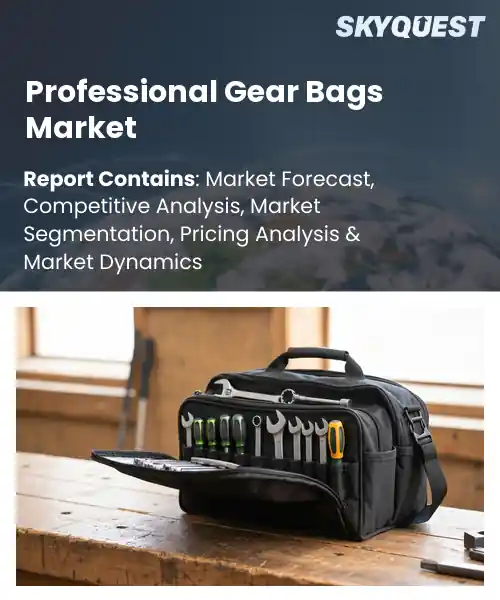
Professional Gear Bags Market
Report ID: SQMIG25K2198
Report ID: SQMIG25K2198
[email protected]
USA +1 351-333-4748
Report ID:
SQMIG25K2198 |
Region:
Global |
Published Date: June, 2026
Pages:
157
|Tables:
119
|Figures:
77


Global Professional Gear Bags Market size was valued at USD 3.52 Billion in 2024 and is poised to grow from USD 3.72 Billion in 2025 to USD 5.85 Billion by 2033, growing at a CAGR of 5.82% during the forecast period (2026-2033).
The main push behind the professional gear bags market growth is the rise in how much equipment is worth now, plus how specialized it’s become across sectors. That combination naturally lifts demand for purpose-made containment that both guards assets and keeps day-to-day work moving without friction. So the market is basically backpacks, hard cases, and modular systems, made for photographers, medical responders, tradespeople, and audio visual teams, and it matters because replacing gear and handling downtime is expensive, like expensive.
Taking that growth forward, the pivotal factor is differentiation, especially via modular design, protective engineering, and smarter integration. Suppliers who can translate user pain points into configurable solutions tend to unlock higher margins and wider adoption. When manufacturers include foam inserts, weather resistant seals, battery-ready compartments, and even integrated GPS, professionals, freelance cinematographers, emergency medical teams, and field technicians, tend to see less equipment damage, quicker setup, and traceability that’s more consistent. Then corporations and rental houses buy more often, because the whole chain becomes easier to manage. In other words, the cause and effect loop creates room for premium brand lines, software-enabled aftercare, sourcing that leans toward sustainable materials, and direct-to-professional channels, all of which expands market share and revenue.
IoT is changing product tracking in the professional gear bags industry by connecting tiny location tags sensors with cloud platforms, so teams get continuous visibility and alerts they can actually act on. Think real time positioning using proximity beacons, which helps people find a bag locally fast, along with environmental sensing that reduces risk for delicate equipment. Right now, the state of play is fairly broad, with adoption from bag makers, rental operations and logistics partners who use tracking to cut loss rates, speed up returns, and raise asset utilization. For photographers, technicians, and musicians, these systems help reduce downtime and support more proactive maintenance. Practical examples include camera packs that log impacts, and flight cases that can verify what’s inside before shipping, making day-to-day logistics more dependable.
Market snapshot - (2026-2033)
Global Market Size
USD 3.52 Billion
Largest Segment
Sports Equipment Bags
Fastest Growth
Medical & First Aid Kit Bags
Growth Rate
5.82% CAGR
To get more insights on this market click here to Request a Free Sample Report
The global professional gear bags market is segmented based on product type, material, end-user, distribution channel, and region. By product type, the market is categorized into Camera & Photography Bags, DJ & Audio Equipment Bags, Sports Equipment Bags, Medical & First Aid Kit Bags, and Tactical/Military Bags. Based on material, the market is divided into Nylon, Canvas, and Ballistic Fabric. By end-user, the market is segmented into Professional Photographers, Athletes, and Military & Law Enforcement personnel. Based on distribution channel, the market is classified into Specialty Stores, Online Channels, and Brand Stores. Geographically, the market is analyzed across North America, Europe, Asia Pacific, Latin America, and the Middle East & Africa.
As per the professional gear bags market analysis, the Camera & Photography Bags segment dominates because professional photographers, videographers ( and the people behind them ) need super protective, adjustable ways to carry gear, so they can grab stuff fast when the shoot starts. The inside layout, like that modular organization, plus weather resistance and built in cushioning, makes the whole thing feel more functional, manufacturers then push harder on design tweaks and accessory ecosystems. So the desire for dependable protection and smoother workflow keeps pushing product differentiation, brand loyalty, and companies to keep investing in specialized features that make them feel like market leaders.
Meanwhile, DJ & Audio Equipment Bags seem to be the area that’s growing quickest, mainly because mobile DJs and streaming creators want rugged yet compact carrying options for controllers, mixers and all that. Things like quick access panels, organized cable routing, and lightweight protection help with portability and daily use flow. This is why adoption is rising among live entertainers and rental providers, and it’s also why more new product development is seen.
According to the professional gear bags market forecast, the Ballistic Fabric segment leads, in large part because its high tensile strength plus abrasion resistance gives a durability level that tactical users and heavy duty professionals really care about. When puncture resistance and wear resistance stay high, replacements happen less often, which lowers lifecycle costs too, and that encourages procurement teams that focus on reliability. Suppliers also invest in laminated coatings and layered weaves, which improves weather tolerance and helps reduce impact transmission. As a result designers can build compact, mission ready bags, and those bags often gain professional trust.
On the other hand, the Nylon category is predicted to have the largest professional gear bags market share as demand rises for lightweight, water resistant, yet affordable professional bags. Fabric engineering improvements and polymer coatings raise abrasion resistance and keep colors from fading too quickly, while simpler manufacturing makes customization faster and easier. Those advantages expand the appeal to creators and rental operators, which then forms new product tiers and makes scalable production feel more realistic.
To get detailed segments analysis, Request a Free Sample Report
As per the professional gear bags market regional forecast, North America is leading , because the pro demand is concentrated , and it spans a lot of spaces like photography , healthcare public safety trades, and even corporate travel. Established brands pour money into product development , which ends up with specialized setups , certain materials, and ergonomic touches that are held to strict industry expectations. There are strong retail networks plus digital channels too, so finding a product and then actually buying it feels faster. On top of that , partnerships between makers, professional associations, and distributors help with specification and procurement. Consumers expect durability , some level of personalization, and honest after sales support, so the whole thing leans toward premiumization. Also regional manufacturing know how, and the fact that many buyers are close by at big institutional locations, makes it easier to iterate quickly and deliver tailored solutions. Investment in materials research and supply chain resilience keeps innovation moving, especially for light weight weather proof and modular designs.
United States Professional Gear Bags Market
The United States Professional Gear Bags industry is usually described through a patchwork of professional groups, each one asking for specialized solutions, from field technicians to media professionals and the like. Brands tend to focus on modular practicality, tough builds, and advanced materials, because the daily use can be demanding, like demanding. Retail plus online channels are also more sophisticated here, so distribution stays quick and the products can be positioned as premium. Corporate buying and rental fleets bring steady institutional demand, while product support networks and a real emphasis on innovation keep the competitive edge from fading.
Canada Professional Gear Bags Market
In Canada, the Professional Gear Bags Market penetration depends hard into durability and weather resistance, mostly because climates can be variable and outdoor work can be rough. Buyers like designs that are adapted locally , and they want robustness without losing the sustainability angle. Demand is also pulled by niche areas such as medical response, film production, and resource sector operations, where bespoke solutions are more than a bonus. Cross border trade and ongoing manufacturer collaboration help buyers access better materials and customization options. Then strong after sales service and repair channels help reinforce brand trust, like for real.
Europe is seeing expansion because several things line up at once , design minded thinking, sustainability rules that keep getting more attention , and professional lifestyles that now prefer gear that can do multiple jobs. Both consumers and institutional buyers increasingly ask for products that look more polished , but still perform in practice. So manufacturers start mixing premium materials with recyclable components. Urban commuting habits plus a lively creative economy are pushing demand for compact, stylish, and modular options across media, technical services, and events. Manufacturing clusters in the region help with rapid prototyping, and they make it easier for designers to collaborate closely with industrial suppliers. Add integrated retail channels and cross border distribution , and access widens. Also policy and certification systems push traceability and lifecycle thinking, which encourages innovation in repairability and material selection, so Europe ends up feeling like a dynamic market for differentiated professional gear bags.
Germany Professional Gear Bags Market
The Germany’s Professional Gear Bags industry mixes engineering strengths with demand from industrial and trade occupations, where high performance and long lasting equipment matter. Manufacturers often stress precise construction, certified safety elements, and integration with industrial tool systems. Relationships between suppliers and corporate procurement channels also matter, because they let companies specify tailored products for maintenance and logistics professionals. With an export orientation and a reputation for solid support, brands often secure a premium position. Local testing and certification practices further reinforce confidence in long term product life.
United Kingdom Professional Gear Bags Market
In the United Kingdom, the Professional Gear Bags Market shows fast uptake of versatile, design led solutions. This is shaped by a creative sector that’s pretty active, plus a growing freelance workforce. The demand leans toward lightweight modularity and ergonomics that work well in cities. E commerce keeps expanding, and influencer driven discovery boosts visibility for innovative offerings. At the same time, startups and manufacturers keep testing smart integrations and bespoke configurations. Corporate procurement, and also event production, increasingly ask for customizable premium gear backed by responsive support.
France Professional Gear Bags Market
The French Professional Gear Bags Market is influenced by a mix of fashion sensibility and craftsmanship , which raises the profile of premium and niche options for professional users. Demand typically favors refined looks alongside functional detailing, especially in culinary work, film production, and luxury services. Manufacturers and designers often collaborate on limited lines, where sustainable materials and careful finishing are part of the pitch. Boutique retailers and professional buyers value provenance, repairability, and design led meaningful differences, not just “another bag."
Asia Pacific is strengthening its role, not just by one thing but a mix of rapid urbanization among professional groups expanding local manufacturing capacity, and then also that real appetite for design plus technology integration. Regional suppliers lean on cost competitive production, material innovation, and quick fit supply chains, to get specialized but still scalable solutions out the door. Local brands are increasingly folding in smart features, modularity and sustainability credentials, in order to respond to varied professional needs from precision trades to creative industries. Meanwhile, e commerce infrastructure and fairly sophisticated logistics widen market reach across both city hubs and regional centers, and collaborations with global licensors , as well as component suppliers, speed up how fast features get adopted. On top of that supportive industrial policy and targeted skills development programs help grow a base of specialized end users who keep asking for purpose built solutions, while cross border partnerships plus export focused strategies lift product sophistication and global competitiveness.
Japan Professional Gear Bags Market
The Professional Gear Bags Market in Japan centers on compact precision engineered solutions for photographers, electronics technicians, and urban professionals who are working in tight spaces where every inch matters. Domestic manufacturers tend to prioritize careful material selection, fine tolerances , and integration with protective systems for delicate equipment. Demand gravitates toward space efficient organization, restrained style choices, and reliability under heavy use. Partnerships with component suppliers bring higher quality closures, padding, and modular inserts, and the presence of established repair networks keeps the product lifecycle feeling longer and more dependable.
South Korea Professional Gear Bags Market
The Professional Gear Bags Market in South Korea shows up as trend driven design, fast integration of smart features, and strong e commerce pull that speeds up adoption among creative professionals and events teams. Manufacturers try out modularity, connectivity, and urban styling, to match shifting preferences that arrive basically every season. Demand usually wants visibility of the technical functionality, but balanced with contemporary aesthetics. At the same time, agile supply chains and an export orientation help scale innovative product ideas into wider regional markets.
To know more about the market opportunities by region and country, click here to
Buy The Complete Report
Rising Corporate Travel Demand
Growth In Outdoor Recreational Activities
High Material Production Costs
Supply Chain Disruptions And Delays
Request Free Customization of this report to help us to meet your business objectives.
Competition in the global professional gear bags market seems to revolve around consolidation through strategic M and A, plus co branded tie-ups with tech and fitness platforms. At the same time, product engineering keeps leaning into modular access and sustainable materials, so incumbents can widen premium and corporate paths via acquisitions, while challengers grab share through collaborations and focused product innovation like modular dividers and vegan performance textiles.
Top Player’s Company Profile
Recent Developments in the Professional Gear Bags Market
SkyQuest’s ABIRAW (Advanced Business Intelligence, Research & Analysis Wing) is our Business Information Services team that Collects, Collates, Correlates, and Analyses the Data collected by means of Primary Exploratory Research backed by robust Secondary Desk research.
As per SkyQuest analysis, the global professional gear bags market is being pushed mostly by rising equipment value and industry specialization, because teams need purpose built, protective, workflow enhancing carrying solutions that don’t fail at the wrong time. Another strong driver is IoT enabled tracking and sensing, since it improves asset visibility and cuts downtime. On the restraint side, rising material production costs are squeezing margins, and that also pressures consumer pricing. North America still holds the dominant spot, mostly due to concentrated professional demand, well known brands, and supportive retail and service networks. As for the segments, camera and photography bags dominate, because photographers and videographers require highly protective, configurable options—those options justify premium pricing and also keep investors and buyers willing to stay in the market longer.
| Report Metric | Details |
|---|---|
| Market size value in 2024 | USD 3.52 Billion |
| Market size value in 2033 | USD 5.85 Billion |
| Growth Rate | 5.82% |
| Base year | 2024 |
| Forecast period | (2026-2033) |
| Forecast Unit (Value) | USD Billion |
| Segments covered |
|
| Regions covered | North America (US, Canada), Europe (Germany, France, United Kingdom, Italy, Spain, Rest of Europe), Asia Pacific (China, India, Japan, Rest of Asia-Pacific), Latin America (Brazil, Rest of Latin America), Middle East & Africa (South Africa, GCC Countries, Rest of MEA) |
| Companies covered |
|
| Customization scope | Free report customization with purchase. Customization includes:-
|
To get a free trial access to our platform which is a one stop solution for all your data requirements for quicker decision making. This platform allows you to compare markets, competitors who are prominent in the market, and mega trends that are influencing the dynamics in the market. Also, get access to detailed SkyQuest exclusive matrix.
Table Of Content
Executive Summary
Market overview
Parent Market Analysis
Market overview
Market size
KEY MARKET INSIGHTS
COVID IMPACT
MARKET DYNAMICS & OUTLOOK
Market Size by Region
KEY COMPANY PROFILES
Methodology
For the Professional Gear Bags Market, our research methodology involved a mixture of primary and secondary data sources. Key steps involved in the research process are listed below:
1. Information Procurement: This stage involved the procurement of Market data or related information via primary and secondary sources. The various secondary sources used included various company websites, annual reports, trade databases, and paid databases such as Hoover's, Bloomberg Business, Factiva, and Avention. Our team did 45 primary interactions Globally which included several stakeholders such as manufacturers, customers, key opinion leaders, etc. Overall, information procurement was one of the most extensive stages in our research process.
2. Information Analysis: This step involved triangulation of data through bottom-up and top-down approaches to estimate and validate the total size and future estimate of the Professional Gear Bags Market.
3. Report Formulation: The final step entailed the placement of data points in appropriate Market spaces in an attempt to deduce viable conclusions.
4. Validation & Publishing: Validation is the most important step in the process. Validation & re-validation via an intricately designed process helped us finalize data points to be used for final calculations. The final Market estimates and forecasts were then aligned and sent to our panel of industry experts for validation of data. Once the validation was done the report was sent to our Quality Assurance team to ensure adherence to style guides, consistency & design.
Analyst Support
Customization Options
With the given market data, our dedicated team of analysts can offer you the following customization options are available for the Professional Gear Bags Market:
Product Analysis: Product matrix, which offers a detailed comparison of the product portfolio of companies.
Regional Analysis: Further analysis of the Professional Gear Bags Market for additional countries.
Competitive Analysis: Detailed analysis and profiling of additional Market players & comparative analysis of competitive products.
Go to Market Strategy: Find the high-growth channels to invest your marketing efforts and increase your customer base.
Innovation Mapping: Identify racial solutions and innovation, connected to deep ecosystems of innovators, start-ups, academics, and strategic partners.
Category Intelligence: Customized intelligence that is relevant to their supply Markets will enable them to make smarter sourcing decisions and improve their category management.
Public Company Transcript Analysis: To improve the investment performance by generating new alpha and making better-informed decisions.
Social Media Listening: To analyze the conversations and trends happening not just around your brand, but around your industry as a whole, and use those insights to make better Marketing decisions.
REQUEST FOR SAMPLE
 REQUEST FREE CUSTOMIZATION
Global Professional Gear Bags Market size was valued at USD 3.52 Billion in 2024 and is poised to grow from USD 3.72 Billion in 2025 to USD 5.85 Billion by 2033, growing at a CAGR of 5.82% during the forecast period (2026-2033).
Competition in the global professional gear bags market centers on consolidation via strategic M and A, co branded partnerships with tech and fitness platforms, and product engineering that emphasizes modular access and sustainable materials; incumbents use acquisitions to broaden premium and corporate channels while challengers win share through collaborations and targeted product innovation such as modular dividers and vegan performance textiles. 'Lowepro (Daymen Group)', 'Pelican Products', 'SKB Cases', 'Think Tank Photo', 'F-Stop Gear', 'Gura Gear', 'Billingham (Billingham Leathercraft)', 'Tenba Tools', 'Case Logic (V7)', 'Manfrotto (Vitec Group)', 'Tamrac', 'KATA (Manfrotto)', 'Chrome Industries', 'Timbuk2', 'Deuter Sport', 'Osprey Packs', 'Gregory Mountain Products', 'Eagle Creek (VF Corp)', '5.11 Tactical', 'Condor Outdoor Products'
Corporate travel and business commuting increase demand for professional gear bags that combine durability, organization, and professional appearance. Businesses prioritize reliable luggage for employees to transport electronics, documents, and garments, encouraging manufacturers to innovate features such as padded compartments, modular organizers, and enhanced carry comfort. Procurement policies and corporate gifting further encourage bulk purchases and specification-driven product development, prompting brands to focus on premium materials and service offerings. This sustained commercial requirement directly supports market expansion by creating predictable demand streams and incentivizing product differentiation across price and feature segments.
Sustainable Materials Adoption: Manufacturers and brands are prioritizing eco conscious materials and circular design principles to meet evolving buyer expectations and regulatory pressures. Emphasis on recyclable fabrics, low impact coatings and responsibly sourced trims drives product differentiation and lifecycle thinking. Designers collaborate with suppliers to integrate durability and repairability without sacrificing aesthetics or functionality. Retailers promote transparency through storytelling and certifications, influencing purchase decisions and positioning. This shift fosters innovation in material science and creates new value chains focused on sustainability and trust.
Why does North America Dominate the Global Professional Gear Bags Market? |@12


Want to customize this report? This report can be personalized according to your needs. Our analysts and industry experts will work directly with you to understand your requirements and provide you with customized data in a short amount of time. We offer $1000 worth of FREE customization at the time of purchase.
Feedback From Our Clients


 USA (+1) 351-333-4748

