Polydioxanone Suture Market
Report ID: SQMIG35B2299
Report ID: SQMIG35B2299
[email protected]
USA +1 351-333-4748
Report ID:
SQMIG35B2299 |
Region:
Global |
Published Date: March, 2026
Pages:
157
|Tables:
116
|Figures:
77


Global Polydioxanone Suture Market size was valued at USD 1.5 Billion in 2024 and is poised to grow from USD 1.6 Billion in 2025 to USD 2.73 Billion by 2033, growing at a CAGR of 6.9% during the forecast period (2026-2033).
The rising need for improved absorbable sutures used in minimally invasive and aesthetic surgeries drives the global polydioxanone suture market growth. The synthetic polymer of polydioxanone PDO sutures functions as an absorbable material which doctors use to close wounds because it supports tissue development during vital healing times before the body starts to break it down to reduce foreign body reactions. The market exists because aging populations and increased elective procedures and demand for rapid recovery have changed the way doctors select materials which show consistent resorption rates. PDO started its journey as a specialized material for cardiac and pediatric medicine which has now spread to dermatology and plastic surgery with PDO becoming a global standard for thread lifting that doctors use in facial procedures and laparoscopic operations.
The key factor for the global polydioxanone suture market penetration exists because its extended tensile strength allows doctors to use it in procedures which need ongoing tissue support to improve patient outcomes by reducing complications and follow-up surgeries. PDO functions as a durable support resource which doctors prefer to use for laparoscopic port closure and hernia reinforcement and facial thread lifts because it results in lower complication expenses and higher hospital purchases.
How is AI Improving Supply Chain Efficiency in the Polydioxanone Suture Market?
The polydioxanone suture industry benefits from AI technology, which enhances supply chain operations by improving demand prediction accuracy and maintaining smoother inventory transitions. The system uses machine learning demand signals which activate automatic order creation while it assesses supplier risk through its digital system which tracks inventory from manufacturing to hospital use. AI technology helps production teams balance their resources against surgical needs because hospitals experience unpredictable surgical requirements and face numerous regulatory challenges. RFID systems and digital twin models which link to AI technology help decrease expiry waste while preventing stockouts. The tools help identify vital inventory components while they improve regulatory tracing speed, which results in a market that operates efficiently and reliably.
Market snapshot - (2026-2033)
Global Market Size
USD 1.5 Billion
Largest Segment
Monofilament PDO
Fastest Growth
Barbed PDO
Growth Rate
6.9% CAGR
To get more insights on this market click here to Request a Free Sample Report
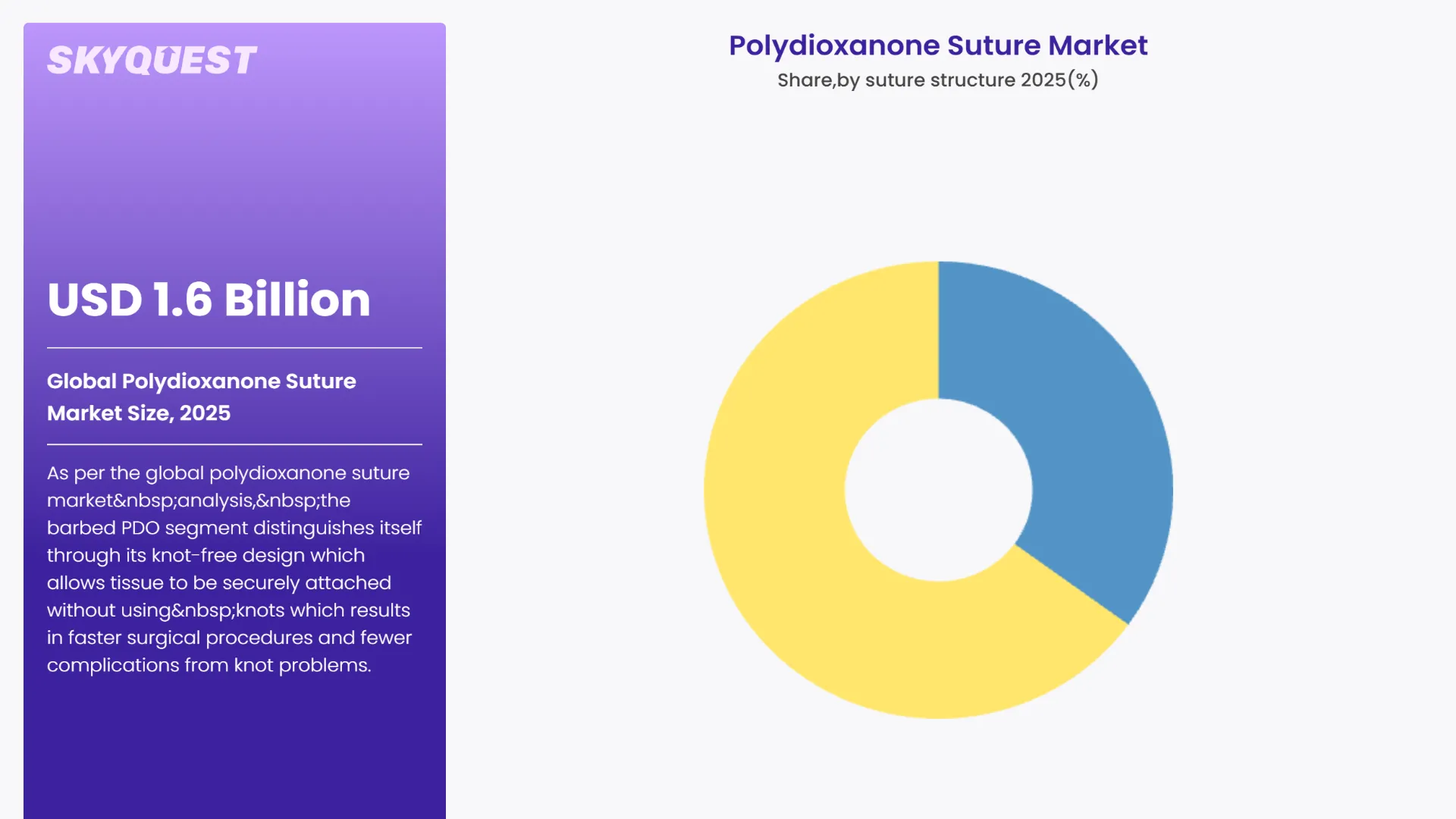
The global polydioxanone (PDO) suture market is categorized based on suture structure, type, application vertical, end user, and region. In terms of structure, the market is divided into monofilament PDO and barbed PDO sutures. Based on suture type, it includes absorbable PDO and coated or antibacterial PDO sutures. By application vertical, the market covers general surgery, cardiovascular surgery, aesthetic and plastic surgery, and orthopedic surgery. Depending on end users, the market is segmented into multi-specialty hospitals, aesthetic and cosmetic clinics, and ambulatory surgical centers (ASCs). Regionally, the market is analyzed across North America, Europe, Asia Pacific, Latin America, and the Middle East & Africa.
As per the global polydioxanone suture market analysis, the barbed PDO segment distinguishes itself through its knot-free design which allows tissue to be securely attached without using knots which results in faster surgical procedures and fewer complications from knot problems. The distribution of tensile forces along the wound minimizes localized tension, which leads to improved cosmetic outcomes and better patient comfort, resulting in surgeons selecting this method. Surgeons now accept the newest barb designs which create different absorbable profiles for specific tissues, which leads to purchasing decisions and training actions that support adoption across various surgical domains.
However, surgeons prefer Monofilament PDO because it has become the most popular material due to its smooth profile which creates less friction with tissue and its similar handling characteristics to regular sutures. The latest surface treatment improvements together with advanced polymer processing techniques enable better handling results, which lets orthopedic surgeons use the system for both general and orthopedic operational needs while manufacturers can create more products to meet the increased demand for lightweight absorbable sutures.
According to the global polydioxanone suture market forecast, the Coated/Antibacterial PDO segment holds the top position because its antimicrobial coatings solve essential problems regarding surgical site infections, which matches product features with hospital regulations that prioritize patient safety during procurement. The antimicrobial coatings for PDO establish an absorbable core which delivers antimicrobial agents in a controlled manner to lower infection perception while enabling patients to recover from surgery more quickly. Healthcare professionals developed their purchasing habits between two oppositional forces, which stemmed from product market health and market competition, which made the business investment patterns lead to product design advancements that brought about product regulatory compliance.
Whereas the absorbable PDO products category is anticipated to have the highest polydioxanone suture market share because doctors now prefer materials which are fully resorbable for their potential to eliminate long-term foreign body presence in their patients. Advances in polymer chemistry and tailored degradation profiles have created an extended use range in aesthetic, orthopedic, and cardiovascular procedures, which enables manufacturers to create distinctive products while they explore business opportunities in outpatient and minimally invasive procedures.
To get detailed segments analysis, Request a Free Sample Report
As per the polydioxanone suture market regional forecast, the advanced clinical infrastructure and large hospital systems who make bulk purchases and the tradition of rapid clinical implementation of new treatments combine to establish North America as the top market in the industry. The region operates a complete regulatory framework which enables smooth product approval processes and effective post-market product monitoring, thus establishing trust among medical professionals and buyers. The research networks together with industry-academia partnerships boost the speed of clinical research and guideline development. The existing manufacturing and distribution network functions to provide hospitals with both consistent product delivery and specialized products that meet various surgical requirements. The emphasis on maintaining top standards for product quality and safety and developing new technologies results in product differentiation which enables companies to charge higher prices, while global manufacturers and local distributors establish strategic partnerships that enhance their market presence and ability to provide services in all healthcare environments.
The United States Polydioxanone Suture sector exhibits extensive use of Polydioxanone sutures across different surgical fields within its advanced hospital purchasing system. Medical researchers and professional organizations establish product evaluation methods through their research work and development of medical standards, while major companies build strong market access systems for their surgical product training and medical education activities. Group purchasing organizations together with integrated health systems determine product pricing and authorized item lists, while acute care and outpatient surgery facilities continue to adopt devices because of established device standards and their requirements for high-quality products.
The Polydioxanone Suture Market in Canada operates under a structured acquisition system, which provincial and institutional authorities use to select clinical solutions that deliver optimal results at economical costs. Hospitals work together with national distributors to create a reliable supply chain, which provides educational programs to enhance surgical performance. Tendering procedures require organizations to adopt advanced suture technologies because clinical guideline development and health technology assessment processes play a crucial role in shaping their selection of medically essential devices. The market benefits suppliers who prove their clinical value through targeted educational programs, which they provide to both urban healthcare facilities and regional medical centers.
European expansion occurs because clinical facilities modernize their operations; medical establishments use multiple types of surgical services, and industrial firms invest in building local business capacity. Surgeons who perform complex reconstructive surgeries and minimally invasive operations demonstrate higher acceptance of absorbable suture technology. European countries align their regulatory framework, which provides established and new suppliers with well-defined procedures to enter the market, while specialized hospital networks together with center of excellence models fast-track clinician training and peer-to-peer information sharing. Manufacturers develop product lines that adapt to different national reimbursement models and purchasing methods used in various countries. Leading institutions engage in clinical partnerships and cross-border trading activities, which lead to swift adoption of innovative suture materials and surgical techniques, thereby increasing competition within the market and spurring regional technological advancement.
The Polydioxanone Suture Market in Germany maintains its operation through its established medical manufacturing sector, which drives clinician demand for exceptional product performance and quality standards. Hospitals together with specialized surgical centers evaluate surgical performance results before they adopt new suture systems into their operations. The supply chain needs both reliable delivery systems together with enduring supplier connections, which procurement teams use to choose suppliers who can provide effective technical support and product adaptation for specialized surgical needs. The market environment exists to support high-end product development which conforms to established clinical procedures and hospital quality control systems.
The Polydioxanone Suture Market in the United Kingdom experiences active purchasing changes together with simultaneous adoption of new products by public and private medical facilities. The surgical practice of hospitals has changed to focus more on achieving better surgical results, which drives them to acquire new absorbable suture technologies. Surgical teams start using new procedures after suppliers teach them through their educational programs, and suppliers produce real life proof of their product effectiveness. The market evolves to meet new commissioning requirements, while better clinician education programs speed up new suture technology adoption into routine medical care and specialized treatment fields.
The Polydioxanone Suture Market in France develops as hospitals enhance their surgical services by adding reconstructive and cosmetic procedures to their existing operations. The clinical centers want to use absorbable suture innovations, which deliver better operational results and greater patient comfort. The suppliers and regional centers develop localized clinical evidence together with training programs. Organizations make purchasing choices based on clinical legitimacy and national guidelines, which creates opportunities for businesses to engage customers and show their clinical superiority, which leads to more market adoption.
The market position of Asia Pacific countries improves through three factors which include developing regulatory systems, building medical manufacturing capabilities and increased clinical requirements from expanding surgical operations. Medical technology ecosystems receive support from both regional governments and industry partners who create systems for local manufacturing and quality testing and international trade activities. Advanced absorbable sutures become more acceptable in private hospitals and specialty clinics which focus on minimally invasive and reconstructive procedures. The market competitiveness of regional manufacturers improves through their investment in clinician education and their participation in global clinical trials and their commitment to foreign market development. The establishment of better logistics and distribution systems throughout metropolitan and rural areas leads to better distribution of products, which in turn supports more product usage.
The Polydioxanone Suture Market in Japan operates under two essential factors which include superior clinical accuracy and the implementation of strict regulatory standards that guarantee device dependability. The clinic operates domestic manufacturers who produce high-quality products through constant product development while doctors choose advanced suture materials which fit their complex surgical methods. The established distribution channels guarantee special surgical centers and hospitals will receive continuous access to innovative niche medical products which hospitals and industry partners develop through their research partnerships.
The South Korean Polydioxanone Suture Market operates through an active medtech ecosystem which enables companies to develop new suture products within short market entry periods. The demand for absorbable sutures increases because of the focus on aesthetic and reconstructive surgery, which leads to clinical partnerships between suppliers and medical professionals who need to demonstrate their product benefits. Manufacturing operations which focus on exports together with venture capital funding drive constant product innovation while targeted educational programs and distributor networks to enhance market penetration in private hospitals and specialty clinics.
To know more about the market opportunities by region and country, click here to
Buy The Complete Report
Increasing Demand for Minimally Invasive Surgery
Clinicians now prefer absorbable surgical materials because these materials create fewer needs for their secondary removal while they help treat tissue injuries which increases the usage of polydioxanone sutures. Their properties make them suitable for multiple surgical specialties because they maintain their strength during essential healing times, and they absorb at a known rate while their strength remains through vital healing periods. The increased usage of PDO sutures in medical care combined with the need for various surgical procedures results in higher demand for these sutures because surgeons want to provide their patients with better comfort which reduces the need for follow-up sessions.
Technological Improvements in Suture Design
The latest advances in material processing and fabrication techniques have enabled scientist to create polydioxanone sutures which use advanced knot security and handling methods to improve surgeon trust while clinical preference for these sutures increased. The latest advancements in coating technologies together with sterile packaging systems enhance product functionality while helping hospitals and procurement teams choose these products over their original versions. The system for manufacturing controls and quality assurance processes maintains regulatory approval standards while delivering dependable product supply which enables wider use across medical specialties and supports market growth.
Regulatory Approval Complexities and Delays
The regulatory pathways for medical devices and surgical materials require extended time periods which create obstacles for the market launch of new polydioxanone products because they restrict the pace at which new medical technologies can reach hospitals. Manufacturers face challenges because they must handle three different requirements which include various national standards and clinical evaluation rules and postmarket monitoring responsibilities while requiring extra time and resources to meet these requirements which do not assist with product adoption. The administrative duties lead to smaller suppliers pulling back from the market, which decreases product variety while creating higher entry costs which hurt market development and slow PDO suture adoption by hospitals and doctors.
Manufacturing Cost and Complexity
The manufacturing of polydioxanone sutures becomes more difficult and expensive because their specialized production needs and strict sterilization standards and their requirement for uniform polymer production results in higher manufacturing costs which results in increased product prices and fewer purchases from cost-sensitive institutions. Small manufacturers face challenges because they cannot achieve cost advantages which every industry needs to become profitable while the investments in quality systems and validated sterilization create fixed costs which stay high until the company reaches its break-even point. The economic conditions create barriers which stop new companies from entering the market while maintaining high product prices which restrict customer product access in healthcare facilities that operate under tight budget constraints.
Request Free Customization of this report to help us to meet your business objectives.
The global polydioxanone suture market experiences competitive pressure because companies use the three methods of product differentiation, the acquisition of regulatory approvals, and their process of business consolidation. The 2023 acquisition of BENEV by ExoCoBio and Croma's joint venture with Hugel show how M&A activities and ownership changes lead to business consolidation. Product innovation through MINT PDO's US 510k approvals for its barbed and cannula delivered PDO threads shows companies develop unique products which help them enter new markets.
Minimally Invasive Surgery Uptake: The need for polydioxanone sutures, which offer durability and controlled absorption together with minimal tissue reaction, continues to grow because more medical facilities perform minimally invasive procedures. The surgeons choose materials that enable secure internal closure and deliver faster recovery times with reduced scarring. The increasing number of outpatient and cosmetic procedures leads to more frequent usage in various medical fields, which drives manufacturers to develop better suture designs and give educational programs. Polydioxanone has become the top choice among doctors because of its ability to combine with sophisticated delivery systems and its capacity to provide extended tensile support.
Strategic Industry Collaborations: Suture manufacturers and surgical device makers together with healthcare providers, create an environment that accelerates both product development and market introduction. The joint development initiatives work to develop specific filament properties and create packaging solutions and delivery systems that enhance operational efficiency in operating rooms. The partnerships create new educational opportunities for clinicians through shared product development and bundled purchasing systems that make buying easier. The improved supply chain coordination system allows companies to quickly implement new product formulations, which enables them to sell regionally by establishing distribution networks and institutional partnerships.
SkyQuest’s ABIRAW (Advanced Business Intelligence, Research & Analysis Wing) is our Business Information Services team that Collects, Collates, Correlates, and Analyses the Data collected by means of Primary Exploratory Research backed by robust Secondary Desk research.
As per SkyQuest analysis, The global polydioxanone suture market experiences growth because more advanced absorbable sutures are needed for minimally invasive and aesthetic procedures, while the complex process of obtaining regulatory approvals together with delays continues to function as a major barrier that hinders product development and entry into the market. The North American market leads because its healthcare system offers advanced medical facilities and centralized purchasing. The Coated/Antibacterial PDO segment leads market adoption because hospitals prefer infection control. Ongoing technological advancement functions as a second growth driver because it includes better coating technologies and AI-powered supply chain optimization, which helps reduce waste and ensures on-time delivery to various clinical sites and manufacturing facilities.
| Report Metric | Details |
|---|---|
| Market size value in 2024 | USD 1.5 Billion |
| Market size value in 2033 | USD 2.73 Billion |
| Growth Rate | 6.9% |
| Base year | 2024 |
| Forecast period | (2026-2033) |
| Forecast Unit (Value) | USD Billion |
| Segments covered |
|
| Regions covered | North America (US, Canada), Europe (Germany, France, United Kingdom, Italy, Spain, Rest of Europe), Asia Pacific (China, India, Japan, Rest of Asia-Pacific), Latin America (Brazil, Rest of Latin America), Middle East & Africa (South Africa, GCC Countries, Rest of MEA) |
| Companies covered |
|
| Customization scope | Free report customization with purchase. Customization includes:-
|
To get a free trial access to our platform which is a one stop solution for all your data requirements for quicker decision making. This platform allows you to compare markets, competitors who are prominent in the market, and mega trends that are influencing the dynamics in the market. Also, get access to detailed SkyQuest exclusive matrix.
Table Of Content
Executive Summary
Market overview
Parent Market Analysis
Market overview
Market size
KEY MARKET INSIGHTS
COVID IMPACT
MARKET DYNAMICS & OUTLOOK
Market Size by Region
KEY COMPANY PROFILES
Methodology
For the Polydioxanone Suture Market, our research methodology involved a mixture of primary and secondary data sources. Key steps involved in the research process are listed below:
1. Information Procurement: This stage involved the procurement of Market data or related information via primary and secondary sources. The various secondary sources used included various company websites, annual reports, trade databases, and paid databases such as Hoover's, Bloomberg Business, Factiva, and Avention. Our team did 45 primary interactions Globally which included several stakeholders such as manufacturers, customers, key opinion leaders, etc. Overall, information procurement was one of the most extensive stages in our research process.
2. Information Analysis: This step involved triangulation of data through bottom-up and top-down approaches to estimate and validate the total size and future estimate of the Polydioxanone Suture Market.
3. Report Formulation: The final step entailed the placement of data points in appropriate Market spaces in an attempt to deduce viable conclusions.
4. Validation & Publishing: Validation is the most important step in the process. Validation & re-validation via an intricately designed process helped us finalize data points to be used for final calculations. The final Market estimates and forecasts were then aligned and sent to our panel of industry experts for validation of data. Once the validation was done the report was sent to our Quality Assurance team to ensure adherence to style guides, consistency & design.
Analyst Support
Customization Options
With the given market data, our dedicated team of analysts can offer you the following customization options are available for the Polydioxanone Suture Market:
Product Analysis: Product matrix, which offers a detailed comparison of the product portfolio of companies.
Regional Analysis: Further analysis of the Polydioxanone Suture Market for additional countries.
Competitive Analysis: Detailed analysis and profiling of additional Market players & comparative analysis of competitive products.
Go to Market Strategy: Find the high-growth channels to invest your marketing efforts and increase your customer base.
Innovation Mapping: Identify racial solutions and innovation, connected to deep ecosystems of innovators, start-ups, academics, and strategic partners.
Category Intelligence: Customized intelligence that is relevant to their supply Markets will enable them to make smarter sourcing decisions and improve their category management.
Public Company Transcript Analysis: To improve the investment performance by generating new alpha and making better-informed decisions.
Social Media Listening: To analyze the conversations and trends happening not just around your brand, but around your industry as a whole, and use those insights to make better Marketing decisions.
REQUEST FOR SAMPLE
 REQUEST FREE CUSTOMIZATION
Global Polydioxanone Suture Market size was valued at USD 1.5 Billion in 2024 and is poised to grow from USD 1.6 Billion in 2025 to USD 2.73 Billion by 2033, growing at a CAGR of 6.9% during the forecast period (2026-2033).
Competition in the global polydioxanone suture market is driven by consolidation, regulatory approvals, and product differentiation. Recent M&A and ownership moves such as ExoCoBio's 2023 acquisition of BENEV and Croma's joint venture with Hugel illustrate consolidation. Product innovation including MINT PDO's multiple US 510k clearances and launches of barbed and cannula delivered PDO threads is intensifying competitive differentiation and market entry strategies. 'Ethicon', 'B. Braun Melsungen', 'Medtronic', 'Peters Surgical', 'Surgical Specialties Corp', 'Dolphin Sutures', 'Samyang Biopharm', 'Demetech Corporation', 'Lotus Surgicals', 'Internatioal Sutures', 'Assut Medical Sarl', 'Futura Surgicare', 'GMD Group', 'Kono Seisakusho', 'Riverpoint Medical', 'Advanced Medical Solutions', 'Sutures India', 'CP Medical', 'Vital Sutures', 'Unimed'
Increased preference for less invasive surgical techniques has led clinicians to favor absorbable materials that reduce the need for secondary removal procedures and support tissue healing, which directly benefits adoption of polydioxanone sutures. Their predictable absorption profile, tensile strength retention during critical healing phases and compatibility with various tissue types make them suitable across many surgical specialties, encouraging procurement by hospitals and outpatient centers. As surgeons prioritize patient comfort and reduced follow up interventions, demand for PDO sutures rises through expanded clinical use and procedural choice.
Minimally Invasive Surgery Uptake: Growth in minimally invasive procedures is driving demand for polydioxanone sutures due to their strength, predictable absorption, and low tissue reactivity. Surgeons favor materials that support secure internal closures while enabling faster patient recovery and reduced scarring. Expansion of outpatient and cosmetic interventions increases routine use across specialties, encouraging manufacturers to optimize suture profiles and provide training. Integration with advanced delivery devices and clinician preference for long-term tensile support further positions polydioxanone as a preferred option in evolving procedural workflows.
Why does North America Dominate the Global Polydioxanone Suture Market? |@12


Want to customize this report? This report can be personalized according to your needs. Our analysts and industry experts will work directly with you to understand your requirements and provide you with customized data in a short amount of time. We offer $1000 worth of FREE customization at the time of purchase.
Feedback From Our Clients


 USA (+1) 351-333-4748

