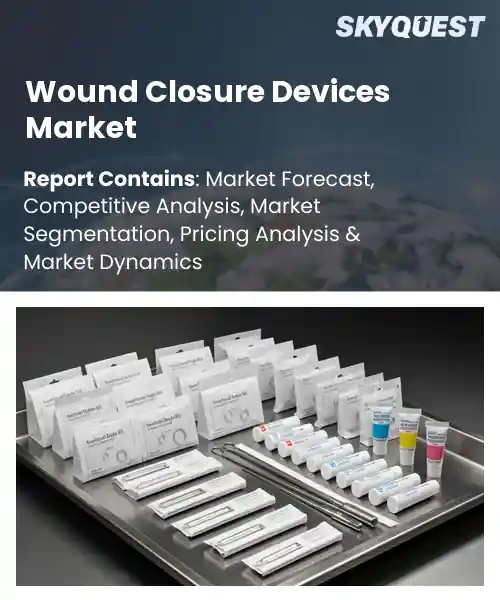
Wound Closure Devices Market
Report ID: SQMIG35A3899
Report ID: SQMIG35A3899
[email protected]
USA +1 351-333-4748
Report ID:
SQMIG35A3899 |
Region:
Global |
Published Date: June, 2026
Pages:
157
|Tables:
172
|Figures:
79


Global Wound Closure Devices Market size was valued at USD 15.3 Billion in 2024 and is poised to grow from USD 16.37 Billion in 2025 to USD 28.13 Billion by 2033, growing at a CAGR of 7.0% during the forecast period (2026-2033).
This market is significant because effective closure reduces infection, shortens hospital stay and enables minimally invasive procedures to scale, which in turn lowers overall healthcare costs. Historically closure evolved from natural fibers and rudimentary needles to synthetic absorbable sutures and mechanical staplers in the twentieth century, then to cyanoacrylate adhesives and zip-type devices in recent decades; these innovations reflect clinical demand for speed, safety and improved cosmetic outcomes.
These developments set the stage for a primary market driver: technological innovation intersecting with a shift to ambulatory surgery and value-based care. As novel products such as barbed sutures, antimicrobial-impregnated materials and tissue adhesives reduce operating time and infection rates, hospitals and payers favor shorter stays and outpatient pathways, which expands demand for faster closure systems. Consequently manufacturers pursue opportunities in point-of-care devices, telemedicine-enabled wound monitoring and emerging markets where surgical volumes are rising. Practical use cases include faster cesarean skin closure with tissue adhesives, laparoscopic port-site closure using barbed sutures and field trauma kits relying on adhesive systems today.
How is AI improving clinical outcomes in the wound closure devices market?
AI is improving clinical outcomes in the wound closure devices market by making decision making more objective and reproducible. Key aspects include image driven assessment to guide choice of closure method, predictive models that identify patients at risk of poor healing, and AI assisted robotic suturing that standardizes stitch placement. Today the market is moving from manual judgment toward data informed care pathways. This reduces complications and speeds recovery for common procedures and complex wounds alike. Examples range from advanced wound imaging to AI guided suturing tools that help clinicians achieve consistent tissue approximation and reduce variability in healing.
Endo Tools Therapeutics in March 2026, received FDA 510k clearance for a next generation suturing system that streamlines soft tissue approximation and usability. This development shows how AI enabled and device focused innovations can improve procedural efficiency and support wider adoption of advanced closure techniques.
Market snapshot - (2026-2033)
Global Market Size
USD 15.3 Billion
Largest Segment
Sutures
Fastest Growth
Tissue Adhesives & Sealants
Growth Rate
7.0% CAGR
To get more insights on this market click here to Request a Free Sample Report
Global wound closure devices market is segmented by product type, material type, application, wound type, mode of application, end-user and region. Based on product type, the market is segmented into Sutures, Surgical Staples, Tissue Adhesives & Sealants, Wound Closure Strips and Others. Based on material type, the market is segmented into Absorbable Materials and Non-Absorbable Materials. Based on application, the market is segmented into Surgical Wounds, Traumatic Wounds, Chronic Wounds and Burns. Based on wound type, the market is segmented into Acute Wounds and Chronic Wounds. Based on mode of application, the market is segmented into Manual Closure Devices and Automated / Mechanical Closure Devices. Based on end-user, the market is segmented into Hospitals, Ambulatory Surgical Centers, Clinics and Others. Based on region, the market is segmented into North America, Europe, Asia Pacific, Latin America and Middle East & Africa.
Tissue adhesives & sealants segment dominates with large global wound closure devices market share because clinicians increasingly prefer noninvasive, sutureless approaches that simplify closure and reduce procedure time. Their adhesive chemistry enables rapid sealing of diverse wound types, lowering infection risk and improving cosmetic outcomes, which drives hospital and outpatient adoption. Continuous formulation advances and broader indications cause procurement preference among providers, creating steady demand across surgical and traumatic wound care and entrenching these products in treatment protocols.
As per global wound closure devices market outlook, wound closure strips are emerging as the fastest growing product due to ease of use and suitability for minor and home-based wound care, driving uptake. Advances in adhesive technology and simpler supply logistics expand their use in ambulatory and first-response settings, enabling consumer-oriented offerings and creating new channels for wound management.
As per global wound closure devices market forecast, manual closure devices segment dominates because practitioners rely on proven techniques that require minimal capital investment and fit existing surgical workflows. Their versatility across wound types and straightforward handling lower training barriers and cost of care, encouraging routine procurement by hospitals and clinics. Robust clinician familiarity and broad supplier availability cause steady preference, while incremental product refinements maintain clinical relevance and support continued use in diverse care settings.
However, automated/mechanical closure devices are the fastest growing segment as automation delivers consistent closure quality and shorter procedure times, appealing to high volume surgical settings. Ongoing innovation in handheld and robotic assisted closure tools, combined with favorable clinical evidence and vendor investment, accelerates adoption and creates opportunities for standardized workflows and higher value bundled solutions.
To get detailed segments analysis, Request a Free Sample Report
North America dominates the global wound closure devices industry fueled by the convergence of a robust healthcare infrastructure, a high concentration of technological leadership, and a mature commercialization landscape. Established reimbursement frameworks and integrated hospital procurement systems, supported by leading medtech businesses and research institutions in the region, encourage continual product innovation and early clinical adoption. Clinicians’ strong preference for minimally invasive, time-saving closure techniques has led to uptake across surgical specialties. Well functioning clinical trial networks and sound regulatory processes help to allow market introduction and product refining. Additionally, the widespread distribution channels and strategic alliances between device manufacturers and healthcare providers increase the market penetration. Clinician comfort with emerging closure techniques across care settings is accelerating with investment in training and adoption programs.
U.S. market has a mature medtech ecosystem with prominent manufacturers, considerable clinical research and established hospital procurement. The broad clinical need across surgical specialties is the impetus for the introduction of improved closure techniques and minimally invasive approaches. Working together, device developers, physician opinion leaders and payers may assist evidence generation and market access. Focused training and integration into surgical workflows support sustained adoption across hospital and outpatient settings.
As per global wound closure devices market regional outlook, Canada is shaped by a publicly oriented healthcare system with centralized procurement and emphasis on cost-effective, evidence-backed solutions. Hospitals and regional health authorities prioritize devices that improve operating room efficiency and patient recovery. Manufacturers partner on clinician training and targeted pilots to demonstrate value across acute and outpatient settings. Alignment with international regulatory standards and proximity to innovation hubs support access to advanced closure technologies.
As per global wound closure devices market regional forecast, the market is witnessing strong growth in Europe thanks to a confluence of clinical demand, regulatory alignment and active industry engagement. As regional healthcare systems are focusing more on solutions that cut operating time, complication rates and recovery times, sophisticated closure technologies are becoming more widely accepted. A concentrated medtech manufacturing and research base fosters innovation in sutures, staples, adhesives, and automated systems and cross-border clinical collaborations speed up evidence production and best practice dissemination. Procurement methods focusing on value and lifetime costs and increased private-sector capacity in important markets also help market penetration. The harmonized regulatory processes and focused reimbursement strategies in various countries provide a climate that is favorable for commercialization and further market growth across the Europe. Robust physician engagement in technology assessment and post-market surveillance further strengthens confidence in innovative modalities of closure.
As per global wound closure devices industry analysis, Germany is anchored by a sophisticated healthcare infrastructure and a strong medtech industry that prioritizes quality and clinical evidence. Hospitals and clinics favor durable, high-performance closure solutions that enhance surgical efficiency and reduce complications. Collaboration among manufacturers, clinician investigators, and procurement teams supports rigorous evaluation and adoption. Established distribution networks and emphasis on engineering excellence position Germany as a leading market for advanced closure systems.
United Kingdom exhibits rapid expansion driven by healthcare modernization across public and private providers. Emphasis on reducing hospital stays and advancing outpatient surgery drives demand for efficient closure solutions. Engagement of clinician innovators and emerging medtech firms encourages trials of novel adhesives and automated systems. Procurement pilots and innovation funding mechanisms support market entry and rapid scaling, while established distribution channels enable wider clinical adoption.
France is emerging as providers pursue modernization and efficiency across hospitals and private clinics. Rising interest in minimally invasive procedures and faster recovery encourages evaluation of advanced closure options. Local medtech firms and multinational companies run clinical pilots and training to build evidence and clinician acceptance. Supportive regulatory frameworks and targeted procurement in regional centers facilitate gradual scaling, increasing market appeal for innovative closure technologies.
Asia Pacific is fortifying its position in the wound closure devices market by the adoption of indigenous innovation, smart investment in healthcare infrastructure and strategic industrial alliances. Regional leaders are building up local manufacturing capabilities and are also tapping global innovations through licensing and joint development. As the surgical capacity grows and the trend toward minimally invasive procedures continues, the clinical demand for efficient closure solutions is increasing. Governments and healthcare institutions are increasingly supporting adoption with procurement campaigns and clinician training programs. Active clinical research centers and enhanced regulatory systems generate evidence and market access. The manufacturers are focusing on cost-effective varieties of the product that are adapted to the regional care pathways, and the increased distribution networks improve the access in hospital and ambulatory settings, which together increase the importance of the regional market. Investor interest and rising local regulatory harmonization are further accelerating commercialization and cross-border adoption across the area.
Japan benefits from a highly advanced healthcare ecosystem, strong manufacturing, and a culture of clinical rigor that favors proven technologies. Hospitals and surgical centers emphasize high-quality closure solutions that support precise procedures and favorable patient outcomes. Close collaboration between clinicians and developers accelerates refinement of product design, while supportive regulatory processes and investment in clinical research promote further evaluation and adoption of innovative closure devices.
South Korea wound closure devices market is characterized by a strong technological and manufacturing base and clinician participation that allows the evaluation of innovative closure methods. Tertiary hospitals and specialist centers prefer modern technology, since they help increase procedural efficiency and patient recovery. Local developers cooperate with international players to co-develop and commercialize technologies. Targeted clinical research and government initiatives assist technology transfer and wider application across care settings.
To know more about the market opportunities by region and country, click here to
Buy The Complete Report
Technological Advances In Closure Devices
Expanding Surgical Procedures Requiring Closure
Reimbursement and Cost Constraints
Regulatory Approval Complexity and Delays
Request Free Customization of this report to help us to meet your business objectives.
The competitive landscape is consolidation driven, with established medtech executing acquisitions such as 3M's 2019 purchase of Acelity while niche innovators pursue differentiation through minimally invasive and automated closure technology. Strategic activity centers on M&A to broaden portfolios, hospital partnerships for clinical validation, and product innovation exemplified by automated laparoscopic suturing and noninvasive anchor closures developed by specialty units and startups.
SkyQuest’s ABIRAW (Advanced Business Intelligence, Research & Analysis Wing) is our Business Information Services team that Collects, Collates, Correlates, and Analyses the Data collected by means of Primary Exploratory Research backed by robust Secondary Desk research.
As per SkyQuest analysis, the global wound closure devices market growth is set for steady expansion driven primarily by rapid technological advances that improve device performance and procedural efficiency and by a parallel shift toward ambulatory surgery and valuebased care that favors faster, less invasive closure options. However, inconsistent reimbursement and high upfront costs remain a key restraint that can slow adoption in budget‑constrained settings. North America continues to dominate the market due to advanced healthcare infrastructure and strong medtech commercialization, while tissue adhesives and sealants are the leading product segment as clinicians increasingly prefer noninvasive, sutureless approaches. This dynamic opens opportunities for automated devices, home‑based care and integrated digital monitoring if manufacturers and payers align on value.
| Report Metric | Details |
|---|---|
| Market size value in 2024 | USD 15.3 Billion |
| Market size value in 2033 | USD 28.13 Billion |
| Growth Rate | 7.0% |
| Base year | 2024 |
| Forecast period | (2026-2033) |
| Forecast Unit (Value) | USD Billion |
| Segments covered |
|
| Regions covered | North America (US, Canada), Europe (Germany, France, United Kingdom, Italy, Spain, Rest of Europe), Asia Pacific (China, India, Japan, Rest of Asia-Pacific), Latin America (Brazil, Rest of Latin America), Middle East & Africa (South Africa, GCC Countries, Rest of MEA) |
| Companies covered |
|
| Customization scope | Free report customization with purchase. Customization includes:-
|
To get a free trial access to our platform which is a one stop solution for all your data requirements for quicker decision making. This platform allows you to compare markets, competitors who are prominent in the market, and mega trends that are influencing the dynamics in the market. Also, get access to detailed SkyQuest exclusive matrix.
Table Of Content
Executive Summary
Market overview
Parent Market Analysis
Market overview
Market size
KEY MARKET INSIGHTS
COVID IMPACT
MARKET DYNAMICS & OUTLOOK
Market Size by Region
KEY COMPANY PROFILES
Methodology
For the Wound Closure Devices Market, our research methodology involved a mixture of primary and secondary data sources. Key steps involved in the research process are listed below:
1. Information Procurement: This stage involved the procurement of Market data or related information via primary and secondary sources. The various secondary sources used included various company websites, annual reports, trade databases, and paid databases such as Hoover's, Bloomberg Business, Factiva, and Avention. Our team did 45 primary interactions Globally which included several stakeholders such as manufacturers, customers, key opinion leaders, etc. Overall, information procurement was one of the most extensive stages in our research process.
2. Information Analysis: This step involved triangulation of data through bottom-up and top-down approaches to estimate and validate the total size and future estimate of the Wound Closure Devices Market.
3. Report Formulation: The final step entailed the placement of data points in appropriate Market spaces in an attempt to deduce viable conclusions.
4. Validation & Publishing: Validation is the most important step in the process. Validation & re-validation via an intricately designed process helped us finalize data points to be used for final calculations. The final Market estimates and forecasts were then aligned and sent to our panel of industry experts for validation of data. Once the validation was done the report was sent to our Quality Assurance team to ensure adherence to style guides, consistency & design.
Analyst Support
Customization Options
With the given market data, our dedicated team of analysts can offer you the following customization options are available for the Wound Closure Devices Market:
Product Analysis: Product matrix, which offers a detailed comparison of the product portfolio of companies.
Regional Analysis: Further analysis of the Wound Closure Devices Market for additional countries.
Competitive Analysis: Detailed analysis and profiling of additional Market players & comparative analysis of competitive products.
Go to Market Strategy: Find the high-growth channels to invest your marketing efforts and increase your customer base.
Innovation Mapping: Identify racial solutions and innovation, connected to deep ecosystems of innovators, start-ups, academics, and strategic partners.
Category Intelligence: Customized intelligence that is relevant to their supply Markets will enable them to make smarter sourcing decisions and improve their category management.
Public Company Transcript Analysis: To improve the investment performance by generating new alpha and making better-informed decisions.
Social Media Listening: To analyze the conversations and trends happening not just around your brand, but around your industry as a whole, and use those insights to make better Marketing decisions.
REQUEST FOR SAMPLE
 REQUEST FREE CUSTOMIZATION
Global Wound Closure Devices Market size was valued at USD 15.3 Billion in 2024 and is poised to grow from USD 16.37 Billion in 2025 to USD 28.13 Billion by 2033, growing at a CAGR of 7.0% during the forecast period (2026-2033).
The competitive landscape is consolidation driven, with established medtech executing acquisitions such as 3M's 2019 purchase of Acelity while niche innovators pursue differentiation through minimally invasive and automated closure technology. Strategic activity centers on M&A to broaden portfolios, hospital partnerships for clinical validation, and product innovation exemplified by automated laparoscopic suturing and noninvasive anchor closures developed by specialty units and startups. 'Johnson & Johnson', 'Medtronic plc', '3M Company', 'B. Braun Melsungen AG', 'Smith & Nephew plc', 'Baxter International Inc.', 'Boston Scientific Corporation', 'Integra LifeSciences', 'Zimmer Biomet', 'Teleflex Incorporated', 'ConvaTec Group plc', 'Coloplast A/S', 'Cardinal Health', 'Derma Sciences', 'Advanced Medical Solutions Group plc', 'Chemence Medical Inc.', 'Dolphin Sutures', 'Sutures India Pvt. Ltd.', 'Peters Surgical', 'KCI'
Advances in materials science, device design, and minimally invasive delivery methods have improved the performance and ease of use of wound closure devices, encouraging clinician preference and adoption. Better biocompatibility, reduced tissue trauma, and simplified application workflows lower procedural difficulty and broaden suitability across specialties, which supports wider clinical acceptance. Enhanced device reliability and improved aesthetic outcomes increase clinician confidence in choosing advanced closure options over traditional methods, prompting hospitals and surgical centers to integrate these technologies into practice and thereby expanding market demand and product uptake.
Digital Integration In Care: Advances in sensor-enabled dressings, telemedicine platforms and interoperable health records are enabling continuous monitoring and remote management of wounds, shifting emphasis from episodic clinic visits to proactive, data-informed care pathways. This trend fosters multidisciplinary collaboration, supports timely personalized therapy adjustments, and improves visibility into healing trajectories across care settings. Vendors and providers are prioritizing integrated offerings that combine device capabilities with software analytics, creating opportunities for service-oriented models and stronger patient engagement throughout the treatment lifecycle.
Why does North America Dominate the Global Wound Closure Devices Market? |@12


Want to customize this report? This report can be personalized according to your needs. Our analysts and industry experts will work directly with you to understand your requirements and provide you with customized data in a short amount of time. We offer $1000 worth of FREE customization at the time of purchase.
Feedback From Our Clients


 USA (+1) 351-333-4748

