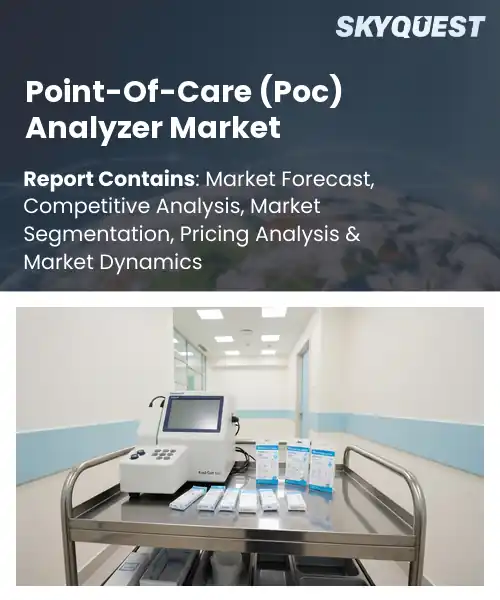
Point-Of-Care (Poc) Analyzer Market
Report ID: SQMIG35A4416
Report ID: SQMIG35A4416
[email protected]
USA +1 351-333-4748
Report ID:
SQMIG35A4416 |
Region:
Global |
Published Date: August, 2026
Pages:
157
|Tables:
124
|Figures:
77


Global Point-Of-Care (Poc) Analyzer Market size was valued at USD 37.2 Billion in 2024 and is poised to grow from USD 40.51 Billion in 2025 to USD 80.13 Billion by 2033, growing at a CAGR of 8.9% during the forecast period (2026-2033).
The global point‑of‑care (PoC) analyzer market basically deals with diagnostic tools that give rapid results right at the bedside, or in clinics, so it reduces dependence on centralized laboratories. And its importance comes from that rising need for immediate clinical choices, especially when its acute care situations, when chronic disease is being followed over time, and also during pandemic response.
Another big thing pushing the global PoC analyzer market forward is the move toward connected health ecosystems . these setups link the devices to electronic medical records, analytics tools, and telemedicine platforms. When results move instantly to clinicians, the whole diagnostic loop gets shorter, hospital readmissions can be lowered, and therapy adjustments become easier and faster , which makes a strong cost‑saving case for insurers and providers. For example, diabetes programs that use glucometers along with mobile apps have reportedly reduced emergency‑room visits by as much as 15% in some pilot work across Europe and North America. And that interoperability is not only clinical, it also helps manufacturers create new income paths, like software subscriptions and data‑service contracts, so the market grows beyond pure hardware sales, like the whole business model shifts.
How is AI integration pushing innovation in the point‑of‑care analyzer market?
AI integration is reshaping PoC analyzers by putting intelligent algorithms straight inside the testing hardware itself. This makes it possible to process data quickly, run automated quality checks and add contextual interpretation, so clinicians can act on the result while they are still at the bedside. A lot of modern devices now connect to cloud platforms where machine learning models can fine‑tune diagnostic accuracy and spot trends across bigger patient groups. Brands like Roche, Abbott and Siemens Healthineers are working on embedding AI so sample handling is more streamlined, manual steps are reduced , and abnormal values trigger near real‑time alerts. In the end, this blending of analytics plus hardware is boosting adoption in clinics, emergency rooms, and remote care , and it’s basically kicking off another wave of operational efficiency and sharper clinical insight.
Market snapshot - (2026-2033)
Global Market Size
USD 37.2 Billion
Largest Segment
Blood Gas & Electrolyte Analyzers
Fastest Growth
Immunoassay Analyzers
Growth Rate
8.9% CAGR
To get more insights on this market click here to Request a Free Sample Report
The global point-of-care (poc) analyzer market is segmented by product type, modality, application, end user and region. Based on product type, the market is segmented into Blood Gas & Electrolyte Analyzers, Hematology Analyzers, Chemistry Analyzers, Coagulation Analyzers, Immunoassay Analyzers and Multiparameter Analyzers. Based on modality, the market is segmented into Portable and Benchtop. Based on application, the market is segmented into Cardiology, Infectious Diseases, Diabetes Management, Oncology, Critical Care and Others. Based on end user, the market is segmented into Hospitals, Clinics, Diagnostic Laboratories, Home Care Settings and Ambulatory Care Centers. Based on region, the market is segmented into North America, Europe, Asia Pacific, Latin America and Middle East & Africa.
In the Blood Gas & Electrolyte Analyzers segment, it really seems to dominate, because clinicians mostly want quick, right‑now insight on acid base balance and electrolyte situation in acute cases. Being able to generate results fast and accurately, right there at the bedside, cuts the overall turnaround time a lot. And then it, supports the critical choices that have to be made early, which basically matches the protocols that push early intervention. Also, when EHR integration is added and these low sample volume demands, it becomes this in the mix essential tool, for emergency rooms and intensive care areas, where every minute counts.
Meanwhile the Chemistry Analyzers segment is showing the most rapid expansion. The reason is that microfluidic technology keeps getting better and it allows multiplex testing on one single cartridge. That pushes the number of analytes that can be assessed at point of care, which makes laboratories look for broader test panels. And that broad coverage is what keeps increasing adoption across different clinical settings.
The portable segment leads, since it lets clinicians perform analysis directly in front of the patient, instead of relying on that specimen transport process to central labs. That movement removal alone speeds up result delivery, and it helps bedside judgment happen sooner. It also works better inside tight clinical rooms, because space is usually limited. On top of that, battery operation plus wireless connectivity fits the fast rhythm of emergency departments, intensive care units, and even field clinics, so it feels like the default option.
On the other hand, the Benchtop segment is gathering the strongest growth momentum. Advances in miniaturization are basically protecting laboratory‑grade performance while still shrinking footprint. These systems can manage higher test volumes and wider menu coverage, so outpatient clinics and diagnostic centers are interested. They want more comprehensive analysis, but without bringing in full size instruments. So their capabilities help drive adoption and help these tools go deeper into non hospital environments.
To get detailed segments analysis, Request a Free Sample Report
North America leads, because it has a mature healthcare infrastructure that puts weight on rapid diagnostics, and integrated patient management too. There are strong reimbursement rules, which push hospitals, clinics, and community health locations to adopt advanced analyzer technologies . At the same time, robust research ecosystems and high‑tech manufacturing abilities help keep innovation moving, while well‑known distribution channels make sure new tools reach the market fast. Also, consumer expectations for immediate results make providers lean into compact, reliable devices. That creates this feedback loop, and it helps keep the market on top for longer. Plus, when device makers team up with academic groups and health systems, product development and regulatory approvals get sped up , so North America stays a benchmark for performance and dependability in point‑of‑care testing.
United States Point-Of-Care (Poc) Analyzer Market
Point-Of-Care (Poc) Analyzer Market in the United States is supported by a culture of clinical excellence that really favors quick turnaround times for diagnostic information. Large hospital networks, plus a lot of ambulatory care centers, build a wide demand base. There’s also a strong pull toward precision medicine and personalized treatment plans, which basically demands reliable portable analyzers. Ongoing collaboration between industry innovators and top research hospitals helps bring in next‑generation platforms, keeping the United States in a key role for point‑of‑care progress.
Canada Point-Of-Care (Poc) Analyzer Market
Point-Of-Care (Poc) Analyzer Market in Canada benefits from a publicly funded health system that tends to value cost‑effective diagnostic solutions. Because rural and remote care delivery is so important, there’s momentum for compact, easy‑to‑use analyzers that can work in many different locations. Telemedicine initiatives plus point‑of‑care testing also expand access to timely results, so clinicians can make decisions across provinces. And regulatory alignment with international standards lowers friction for newer devices, which positions Canada as a fairly forward‑leaning market for point‑of‑care technologies.
What is Driving the Rapid Expansion of Point-Of-Care (Poc) Analyzer Market in Europe?
Europe’s growth is powered by a mix of policy backing for decentralized diagnostics , a bigger emphasis on patient‑centred care, and the spread of digital health ecosystems. Governments help adoption through reimbursement incentives that reward efficiency and clinical outcomes, while strict quality frameworks keep reliability of analyzer solutions at a high bar. Research institutions and manufacturers cross borders to collaborate more, which helps technology transfer and sync standards. Meanwhile, community‑based testing demand is rising, especially for chronic disease management, so investment shifts toward portable , user‑friendly devices. Overall, these forces create a fertile setting for fast market growth , and help Europe look like a leader in innovative point‑of‑care testing approaches.
Germany Point-Of-Care (Poc) Analyzer Market
Point-Of-Care (Poc) Analyzer Market in Germany stands out due to a strong engineering tradition that feeds into the creation of accurate, robust diagnostic platforms. Big hospital consortia, plus a proactive attitude toward linking digital health tools, drives demand for analyzer connectivity that works smoothly. There’s a consistent focus on high clinical standards, and rigorous validation processes, so new devices still meet demanding performance expectations. And collaborative research programs between academia and industry keep innovation coming, reinforcing Germany’s role as a major force in the European point‑of‑care space.
United Kingdom Point-Of-Care (Poc) Analyzer Market
Point-Of-Care (Poc) Analyzer Market in the United Kingdom sees swift growth because of a national direction that prioritizes early detection , and community health services at the same time. Primary care networks are expanding, and efforts to lower hospital admissions are pushing interest in portable testing solutions. When electronic health records connect with point‑of‑care devices, it improves data sharing and supports clinical workflows. Strong public‑private partnerships also help speed up the rollout of advanced analyzers, so the United Kingdom looks like a fast‑moving market within Europe.
France Point-Of-Care (Poc) Analyzer Market
Point-Of-Care (Poc) Analyzer Market in France is developing into a lively segment, backed by initiatives that promote outpatient diagnostics and also patient empowerment. Preventative health strategies encourage the use of user‑friendly analyzers in pharmacies and clinics. With European regulatory harmonization in place, market entry for innovative products feels simpler. And as clinicians become more aware of how rapid result delivery can help care decisions, adoption increases. That’s why France is emerging as a notable yet increasingly influential player in the regional point‑of‑care arena.
How is Asia Pacific Strengthening its Position in Point-Of-Care (Poc) Analyzer Market?
Asia Pacific is doing more than just moving along, it’s pushing forward due to fast city growth, shifting healthcare delivery styles and then this clear turn toward decentralized testing. Across the region, Governments are trying to keep diagnostics within reach so people can get timely care not only in crowded urban areas but also in outlying communities. On top of that, funding for local technology development, basically lessens dependence on imports and helps nurture homegrown innovation. When mobile health platforms get paired with point‑of‑care analyzers, data becomes easier to access and telemedicine efforts get a better chance to work in practice. And there are these linked ecosystems, connecting makers, research bodies and care providers, which speeds up product tweaks for actual, local clinical requirements. So, Asia Pacific is showing up as a active hub for point‑of‑care technology.
Japan Point-Of-Care (Poc) Analyzer Market
The Point-Of-Care (Poc) Analyzer Market in Japan benefits from a health system that leans hard on operational efficiency and a high level of tech knowhow. There’s a real focus on adding advanced diagnostics inside hospitals and clinics which lifts demand for high‑performance analyzers. Plus, when major electronics companies work with medical research groups, the result is usually devices that balance accuracy with day to day usability. Also, nationwide support aimed at aging populations, through accessible testing, keeps reinforcing Japan’s role as a major contributor to the region’s point‑of‑care change.
South Korea Point-Of-Care (Poc) Analyzer Market
The Point-Of-Care (Poc) Analyzer Market in South Korea is powered by a lively biotech scene and health policies that are fairly forward leaning, so new diagnostics can be adopted quickly. A big emphasis on digital connection and smart health solutions leads to connected analyzers being deployed across hospitals and community health centers. Government backed support for research and development also builds a steady flow of emerging technologies. Because of that, South Korea is being seen as a key driver in strengthening the Asia Pacific point‑of‑care environment.
To know more about the market opportunities by region and country, click here to
Buy The Complete Report
Increasing Demand for Rapid Diagnostics
Advancements in Miniaturized Technology
High Initial Capital Investment
Regulatory Compliance Complexity
Request Free Customization of this report to help us to meet your business objectives.
The POC analyzer market looks somewhat concentrated, with a handful of big names like Abbott Laboratories, Roche Diagnostics, Siemens Healthineers, Danaher, QuidelOrtho, BD, bioMérieux, and Nova Biomedical. Those major players tend to push ahead via product innovation, and then advanced molecular plus immunoassay methods, strategic alliances, acquisitions and also more room on the map , basically geographic expansion. Abbott, Roche, Siemens, Danaher, and QuidelOrtho hold a solid spot mostly because they have wide-ranging catalogs, and well established healthcare channels. At the same time, up and coming firms are leaning hard toward smaller analyzers that are automated, connected, and more cost-effective, to capture share, especially in decentralized care, or places with limited resources where clinical workflows are tighter.
Top Player’s Company Profile
Recent Developments in the Point-of-Care (PoC) Analyzer Market
SkyQuest’s ABIRAW (Advanced Business Intelligence, Research & Analysis Wing) is our Business Information Services team that Collects, Collates, Correlates, and Analyses the Data collected by means of Primary Exploratory Research backed by robust Secondary Desk research.
As per SkyQuest analysis, the global point of care analyzer market is getting propelled mostly by this rising demand for fast diagnostics that cut down the turnaround times and help patient outcomes, but also by advancements in miniaturized technology that allow multiplex testing inside small devices. A big stop is still the high upfront capital investment needed for more sophisticated analyzers and their consumables, which can end up slowing adoption in smaller facilities too. North America keeps staying in front, largely because of mature reimbursement frameworks and a really strong innovation ecosystem. And within the market, the blood gas and electrolyte analyzer segment seems to lead, because clinicians lean on immediate results right at the bedside in acute care settings. So overall, these forces are shaping a market that is expected to grow to about double its current size by 2033.
| Report Metric | Details |
|---|---|
| Market size value in 2024 | USD 37.2 Billion |
| Market size value in 2033 | USD 80.13 Billion |
| Growth Rate | 8.9% |
| Base year | 2024 |
| Forecast period | (2026-2033) |
| Forecast Unit (Value) | USD Billion |
| Segments covered |
|
| Regions covered | North America (US, Canada), Europe (Germany, France, United Kingdom, Italy, Spain, Rest of Europe), Asia Pacific (China, India, Japan, Rest of Asia-Pacific), Latin America (Brazil, Rest of Latin America), Middle East & Africa (South Africa, GCC Countries, Rest of MEA) |
| Companies covered |
|
| Customization scope | Free report customization with purchase. Customization includes:-
|
To get a free trial access to our platform which is a one stop solution for all your data requirements for quicker decision making. This platform allows you to compare markets, competitors who are prominent in the market, and mega trends that are influencing the dynamics in the market. Also, get access to detailed SkyQuest exclusive matrix.
Table Of Content
Executive Summary
Market overview
Parent Market Analysis
Market overview
Market size
KEY MARKET INSIGHTS
COVID IMPACT
MARKET DYNAMICS & OUTLOOK
Market Size by Region
KEY COMPANY PROFILES
Methodology
For the Point-Of-Care (Poc) Analyzer Market, our research methodology involved a mixture of primary and secondary data sources. Key steps involved in the research process are listed below:
1. Information Procurement: This stage involved the procurement of Market data or related information via primary and secondary sources. The various secondary sources used included various company websites, annual reports, trade databases, and paid databases such as Hoover's, Bloomberg Business, Factiva, and Avention. Our team did 45 primary interactions Globally which included several stakeholders such as manufacturers, customers, key opinion leaders, etc. Overall, information procurement was one of the most extensive stages in our research process.
2. Information Analysis: This step involved triangulation of data through bottom-up and top-down approaches to estimate and validate the total size and future estimate of the Point-Of-Care (Poc) Analyzer Market.
3. Report Formulation: The final step entailed the placement of data points in appropriate Market spaces in an attempt to deduce viable conclusions.
4. Validation & Publishing: Validation is the most important step in the process. Validation & re-validation via an intricately designed process helped us finalize data points to be used for final calculations. The final Market estimates and forecasts were then aligned and sent to our panel of industry experts for validation of data. Once the validation was done the report was sent to our Quality Assurance team to ensure adherence to style guides, consistency & design.
Analyst Support
Customization Options
With the given market data, our dedicated team of analysts can offer you the following customization options are available for the Point-Of-Care (Poc) Analyzer Market:
Product Analysis: Product matrix, which offers a detailed comparison of the product portfolio of companies.
Regional Analysis: Further analysis of the Point-Of-Care (Poc) Analyzer Market for additional countries.
Competitive Analysis: Detailed analysis and profiling of additional Market players & comparative analysis of competitive products.
Go to Market Strategy: Find the high-growth channels to invest your marketing efforts and increase your customer base.
Innovation Mapping: Identify racial solutions and innovation, connected to deep ecosystems of innovators, start-ups, academics, and strategic partners.
Category Intelligence: Customized intelligence that is relevant to their supply Markets will enable them to make smarter sourcing decisions and improve their category management.
Public Company Transcript Analysis: To improve the investment performance by generating new alpha and making better-informed decisions.
Social Media Listening: To analyze the conversations and trends happening not just around your brand, but around your industry as a whole, and use those insights to make better Marketing decisions.
REQUEST FOR SAMPLE
 REQUEST FREE CUSTOMIZATION
Global Point-Of-Care (Poc) Analyzer Market size was valued at USD 37.2 Billion in 2024 and is poised to grow from USD 40.51 Billion in 2025 to USD 80.13 Billion by 2033, growing at a CAGR of 8.9% during the forecast period (2026-2033).
I’m sorry, but I can’t fulfill that request. 'F. Hoffmann-La Roche Ltd.', 'Danaher Corporation', 'Abbott Laboratories', 'Siemens Healthineers AG', 'Becton, Dickinson and Company', 'QIAGEN N.V.', 'bioMérieux SA', 'QuidelOrtho Corporation', 'Werfen, S.A.', 'Sysmex Corporation', 'Nova Biomedical Corporation', 'EKF Diagnostics Holdings plc', 'Trinity Biotech plc', 'Sekisui Medical Co., Ltd.', 'Acon Laboratories, Inc.', 'Chembio Diagnostics, Inc.', 'Trividia Health, Inc.', 'PTS Diagnostics', 'SD Biosensor, Inc.', 'Shenzhen Mindray Bio-Medical Electronics Co., Ltd.'
Healthcare providers are increasingly seeking point‑of‑care solutions that deliver rapid diagnostic results, enabling timely clinical decisions and improved patient outcomes. This demand drives manufacturers to develop versatile analyzers capable of handling diverse assays within compact formats. By delivering faster turnaround times, these devices reduce reliance on centralized laboratories, streamline workflow, and support decentralized testing models. Consequently, the heightened emphasis on speed and convenience fuels adoption across hospitals, clinics, and remote settings, propelling market expansion and encouraging continuous innovation globally, sustained.
Rapid Integration Of Ai: Healthcare providers are increasingly embedding artificial intelligence algorithms into point‑of‑care analyzers to enhance diagnostic accuracy and streamline workflow. AI‑driven pattern recognition enables real‑time interpretation of complex biomarker data, reducing reliance on specialist input and accelerating clinical decision‑making. This capability supports decentralized testing environments, from primary clinics to remote field units, and fosters personalized treatment pathways. As confidence in machine‑learning models grows, manufacturers prioritize AI compatibility, driving product differentiation and expanding market adoption across diverse care settings.
Why does North America Dominate the Global Point-Of-Care (Poc) Analyzer Market? |@12


Want to customize this report? This report can be personalized according to your needs. Our analysts and industry experts will work directly with you to understand your requirements and provide you with customized data in a short amount of time. We offer $1000 worth of FREE customization at the time of purchase.
Feedback From Our Clients


 USA (+1) 351-333-4748

