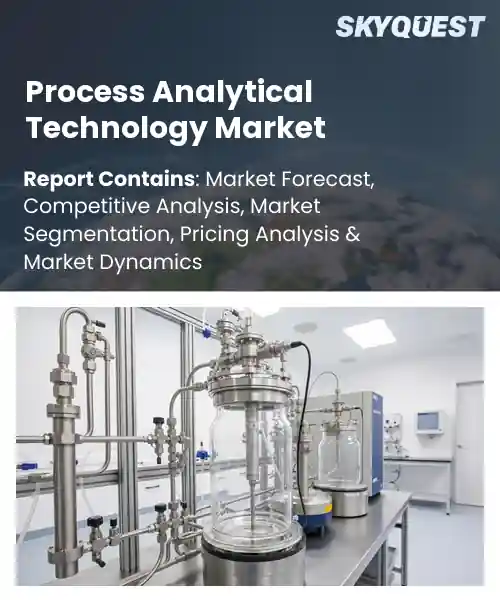
Process Analytical Technology Market
Report ID: SQMIG35H2578
Report ID: SQMIG35H2578
[email protected]
USA +1 351-333-4748
Report ID:
SQMIG35H2578 |
Region:
Global |
Published Date: June, 2026
Pages:
157
|Tables:
147
|Figures:
78


Global Process Analytical Technology Market size was valued at USD 6.0 Billion in 2024 and is poised to grow from USD 6.51 Billion in 2025 to USD 12.5 Billion by 2033, growing at a CAGR of 8.5% during the forecast period (2026-2033).
High emphasis on product quality and process efficiency, increasing adoption of continuous manufacturing, rising regulatory focus on quality-by-design practices, advancements in analytical instrumentation, and growing integration of automation technologies are driving sales of process analytical technology solutions.
The increasing need for real-time process monitoring and consistent product quality is expected to primarily drive process analytical technology market growth. Enhanced adoption of high-end analysis devices like near-infrared spectroscopy, Raman spectroscopy, and in-line sensors are providing producers with extensive control over main process parameters and will lead toward optimization in process performance in future. Surging regulatory approval and industry adoption of quality-by-design concept and continuous manufacturing strategy has been contributing toward giant investment flows toward Process Analytical Technology market in anticipated years. Advancement in automation techniques, effective data analysis, sophisticated process automation system, will help eliminate batch-to-batch variation in raw material, lower waste generation and shorten development time. Better implementation of predictive maintenance and adoption of cloud computing based real-time process automation system will complement the industry growth in general.
On the contrary, high implementation costs, complexity of system integration, shortage of skilled personnel, and challenges associated with data management and validation are anticipated to slow down process analytical technology market penetration across the study period and beyond.
How is AI Enhancing Real-time Decision-making In Process Analytical Technology Systems?
AI is revolutionizing the process analytical technology market by providing quick, in-depth analysis of manufacturing data. Process analytical technology involves the use of automated analytical instruments and sensors for monitoring critical quality attributes of products. This technology aids manufacturers in reduction in batch processing times, management of process variation, and in ensuring quality is maintained. Modern manufacturing plants are heading towards continuous processing and in-line analytical tools like Raman and Near infrared (NIR) spectroscopy along with mass spectrometry with AI-enabled analytics and chemometric models can analyze enormous quantities of data coming from the processes in-line. It provides information for predictive alarms, abnormality detection, or automated process control systems so that the operator can make quick real-time adjustments and make sure abnormalities don't occur.
Market snapshot - (2026-2033)
Global Market Size
USD 6.0 Billion
Largest Segment
Spectroscopy
Fastest Growth
Mass Spectrometry
Growth Rate
8.5% CAGR
To get more insights on this market click here to Request a Free Sample Report
Global process analytical technology market is segmented by technique, product type, measurement mode, application, end-use industry, and region. Based on technique, the market is segmented into spectroscopy, chromatography, particle size analysis, and mass spectrometry. Based on product type, the market is segmented into analyzers, sensors & probes, and software & services. Based on measurement mode, the market is segmented into in-line, on-line, at-line, and off-line. Based on application, the market is segmented into process monitoring & control, quality assurance, and continuous manufacturing. Based on end-use industry, the market is segmented into pharmaceuticals & biotechnology, chemicals, food & beverage, and oil & gas. Based on region, the market is segmented into North America, Europe, Asia Pacific, Latin America, and Middle East & Africa.
The spectroscopy segment is anticipated to account for the highest global process analytical technology market share going forward. It provides rapid, non-destructive molecular and compositional information at process points, allowing close loop feedback control and less variation over time. Its ability to be used via fiber optic probes and a variety of spectral techniques, together with its existing instrument hardware, calibration protocols and industry acceptance, lead to existing use throughout manufacturing processes so it offers a focus for process engineers wanting to monitor quality on-line.
However, chromatography is the fastest growing segment as its separation power is suited for increasing demands for complex mixture analysis. A drive toward discrete, automated systems are occurring. Development of quick column technology coupled with automated sample processing and coupling to digital analysis is enabling applications on continuous manufacturing and quality critical processing providing new opportunities for equipment update and new services.
The in-line segment is predicted to lead the global process analytical technology market revenue generation across the study period. It offers an instant, real time measurement right in the stream of production, with no sampling lag and immediate control actions which dampen processes. Its integration into a distributed control system with a low contamination risk is appealing for continuous manufacturing applications, together with improved ruggedized probes and process metadata interoperability build reliability and trust to operators, and the in-line capabilities are implemented as a central process control tool.
Meanwhile, at-line is emerging as the most rapidly expanding measurement mode as per this process analytical technology market forecast, as it offers the right mix of speed and ease of set-up so that installation is easier and quicker when installing in retrofit or hybrid manufacturing. Growth is driven by portable analyzer innovations, simplified sample handling procedures, and needs for near real-time quality monitoring resulting in wider adoption of PAT in more extensive manufacturing operations and services.
To get detailed segments analysis, Request a Free Sample Report
Advanced pharmaceutical and biotechnology manufacturing, proactive regulatory frameworks, and a dense ecosystem of instrumentation vendors, system integrators, and service providers support the dominance of this region. High investments in automation, analytics to process data and continuous improvement of processes enable industry to adopt and utilize these technologies more readily. Industry, academic and start-up networks of collaborative partners enable rapid product development through the identification of new technologies or processes. Delivery at scale is supported by the technical talent available to develop solutions and the extensive after-sale infrastructure that supports solution implementation. Additionally, partnerships with providers of solutions provide local offerings to support complex validation and compliance requirements. The high number of services and industrial companies that are contracted manufacturers is driving a rise in demand for process intensification. Consultancies and specialized integrators further reduce the barrier of implementing PAT and allow for integration of PAT into overall quality and manufacturing execution system by providing an opportunity to solidify its position as a leader.
Process analytical technology market in the United States is characterized by deep manufacturing bases, extensive R&D centers and high concentration of instrument manufacturers and software specialists. A regulatory interest and the demand for early buy-in of continuous processing and advanced analytics is provided by a large contract developer base. Service networks and system integrators assist in complex implementations, and strong venture and corporate funding provides the innovation and commercialization of integrated PAT solutions to fit the production environment.
Process analytical technology demand in Canada reflects a mature technical services sector with close collaboration across industry, research institutions and solution providers.Pproximity to significantly larger North American manufacturing clusters that support knowledge transfer and scalable field deployment. Federal and provincial innovation initiatives, as well as contract manufacturing and analytical instrumentation companies, serve as additional anchors for implementation. Focus on low-cost scalable PAT solutions and high after sales support help position Canada as a key regional hub for adoption of advances and operational excellence.
Regulatory harmonization, strong industrial base in pharmaceuticals and specialty chemicals, and targeted national initiatives that promote smart manufacturing drive steady process analytical technology demand in the region. At the forefront of Europe is Germany, which continues to provide the region with engineering excellence, precision instrument manufacturing, and a history of industrial integration. The United Kingdom is also an important contributor to Europe's success, providing innovative ecosystems for the collaboration and deployment of agile solutions. France has begun to emerge as a key player in Europe due to their increased focus on bioprocessing and a collaborative approach to research. Manufacturing systems also achieve economies of scale and increase demand for alternative manufacturing models through the standardization of cross-border manufacturing, an abundance of specialist service providers, and growing emphasis on sustainability and process efficiency. Manufacturers, service providers, and technology SMEs will all benefit from investments made in digital platforms, analytical instrument development and integration services, and strategic partnerships among large manufacturers, research institutions, and technology SMEs, which will accelerate the momentum for PAT practices throughout European supply chains. In addition to the above benefits, the availability of mature well developed training programs and consulting expertise provide further benefits in reducing the commercialization barrier for SMEs in less mature industrial hubs.
Process analytical technology market in Germany is underpinned by strong engineering capabilities, a dense base of instrument manufacturers and systems integration specialists. Ties between industrial producers, technical universities and automation vendors encourage bespoke PAT implementations for chemical and pharmaceutical production. Local expertise in sensor development, process control and industrial software enables advanced monitoring, while consulting firms support validation and rollout. This combination sustains Germany as technology and integration leader in Europe.
Process analytical technology market in the United Kingdom is driven by vibrant innovation clusters, strong capabilities in life sciences and analytics, and a growing community of startups and specialist integrators that pilot novel PAT methodologies. These pilots lead to scalable solutions for bioprocess and pharmaceutical makers. Engagement with regulators and a comprehensive range of deployment options promote early innovation, consortia and technology collaborations give certainty to scale up as validation becomes faster, helping sustain competitiveness of the sector.
Process analytical technology demand in France is emerging through focused investment in biopharmaceuticals, strong public private research collaborations and growing adoption among specialty chemical producers. Regional innovation hubs and national programs promote innovation and pilot projects that prove benefits in process effectiveness and quality assurance. Regional analytical service providers, integrators and instrument dispersers drive customized PAT adoption and growing industry-academic collaboration enhances skill enhancement and spread of best practices in the manufacturing networks.
Concentrated investment in manufacturing modernization, indigenous instrumentation development and close alignment of industrial strategies with smart factory initiatives are supporting process analytical technology demand in the region. Japan contributes a wealth of knowledge in designing precision sensors, analytical instruments, and process control systems. South Korea's strong electronics manufacturing capabilities and adoption of digital technologies allow for quick integration of PAT in automation and data platform. Manufacturers and solution providers throughout the region are increasingly customising their offerings to local process needs, while the geographical proximity of global vendors and local firms accelerates the transfer of technology. The support of governments for advanced manufacturing, workforce upskilling programs, and collaborative research will further increase capacity for validation and scale up. The result will be a region that is transitioning from a selective adoption of PAT to a more widespread, systems-based integration of PAT in the pharmaceutical, chemical, and high-value manufacturing industries.
Process analytical technology demand in Japan benefits from a mature instrumentation industry, strong precision engineering capabilities and deep expertise in sensor and control technologies. Established manufacturers and system integrators deliver robust, validated solutions tailored to quality requirements of pharmaceutical producers. Local emphasis on reliability and service support encourages adoption of integrated PAT architectures, while collaborative programs between manufacturers, research institutes and technology vendors foster improvement and customization for complex processing environments.
Process analytical technology adoption in South Korea builds on strengths in electronics, automation and data connectivity to integrate PAT into advanced manufacturing environments. National technology firms and system integrators modify sensor/analysis platforms for fast implementation with the support of local feed mill Biotech manufacturers. Government programs such as promotion of smart factory and collaborative research are sources of Validation activities; moreover, the closeness with industry universities generates skilled people and a Future Food tech to control the Quality production system with PAT solutions.
To know more about the market opportunities by region and country, click here to
Buy The Complete Report
Advanced Analytical Instrumentation
Real Time Quality Monitoring
High Implementation Complexity
Regulatory Compliance Burden
Request Free Customization of this report to help us to meet your business objectives.
Competition in the global process analytical technology market is intensifying as manufacturers demand inline continuous manufacturing and regulatory pressure for real time quality control. This drives consolidation, partnerships, and platform moves. For example AspenTech acquired Camo Analytics to add PAT analytics, while Bio-Techne joined the Cell and Gene Therapy Catapult PAT consortium to co develop standards. Vendors now compete on AI analytics, inline spectroscopy, and systems integration capabilities.
SkyQuest’s ABIRAW (Advanced Business Intelligence, Research & Analysis Wing) is our Business Information Services team that Collects, Collates, Correlates, and Analyses the Data collected by means of Primary Exploratory Research backed by robust Secondary Desk research.
As per SkyQuest analysis, increasing adoption of continuous manufacturing, and rising regulatory focus on quality-by-design practices are anticipated to drive the demand for Process Analytical Technology solutions going forward. However, high implementation costs and complexity associated with system integration are slated to slow down the adoption of Process Analytical Technology solutions in the future. North America is slated to spearhead the demand for Process Analytical Technology solutions owing to its advanced pharmaceutical manufacturing sector, strong regulatory framework, and high adoption of automation technologies. AI-driven process analytics and the integration of real-time monitoring systems with advanced analytical instruments are anticipated to be key trends driving the process analytical technology sector in the long run.
| Report Metric | Details |
|---|---|
| Market size value in 2024 | USD 6.0 Billion |
| Market size value in 2033 | USD 12.5 Billion |
| Growth Rate | 8.5% |
| Base year | 2024 |
| Forecast period | (2026-2033) |
| Forecast Unit (Value) | USD Billion |
| Segments covered |
|
| Regions covered | North America (US, Canada), Europe (Germany, France, United Kingdom, Italy, Spain, Rest of Europe), Asia Pacific (China, India, Japan, Rest of Asia-Pacific), Latin America (Brazil, Rest of Latin America), Middle East & Africa (South Africa, GCC Countries, Rest of MEA) |
| Companies covered |
|
| Customization scope | Free report customization with purchase. Customization includes:-
|
To get a free trial access to our platform which is a one stop solution for all your data requirements for quicker decision making. This platform allows you to compare markets, competitors who are prominent in the market, and mega trends that are influencing the dynamics in the market. Also, get access to detailed SkyQuest exclusive matrix.
Table Of Content
Executive Summary
Market overview
Parent Market Analysis
Market overview
Market size
KEY MARKET INSIGHTS
COVID IMPACT
MARKET DYNAMICS & OUTLOOK
Market Size by Region
KEY COMPANY PROFILES
Methodology
For the Process Analytical Technology Market, our research methodology involved a mixture of primary and secondary data sources. Key steps involved in the research process are listed below:
1. Information Procurement: This stage involved the procurement of Market data or related information via primary and secondary sources. The various secondary sources used included various company websites, annual reports, trade databases, and paid databases such as Hoover's, Bloomberg Business, Factiva, and Avention. Our team did 45 primary interactions Globally which included several stakeholders such as manufacturers, customers, key opinion leaders, etc. Overall, information procurement was one of the most extensive stages in our research process.
2. Information Analysis: This step involved triangulation of data through bottom-up and top-down approaches to estimate and validate the total size and future estimate of the Process Analytical Technology Market.
3. Report Formulation: The final step entailed the placement of data points in appropriate Market spaces in an attempt to deduce viable conclusions.
4. Validation & Publishing: Validation is the most important step in the process. Validation & re-validation via an intricately designed process helped us finalize data points to be used for final calculations. The final Market estimates and forecasts were then aligned and sent to our panel of industry experts for validation of data. Once the validation was done the report was sent to our Quality Assurance team to ensure adherence to style guides, consistency & design.
Analyst Support
Customization Options
With the given market data, our dedicated team of analysts can offer you the following customization options are available for the Process Analytical Technology Market:
Product Analysis: Product matrix, which offers a detailed comparison of the product portfolio of companies.
Regional Analysis: Further analysis of the Process Analytical Technology Market for additional countries.
Competitive Analysis: Detailed analysis and profiling of additional Market players & comparative analysis of competitive products.
Go to Market Strategy: Find the high-growth channels to invest your marketing efforts and increase your customer base.
Innovation Mapping: Identify racial solutions and innovation, connected to deep ecosystems of innovators, start-ups, academics, and strategic partners.
Category Intelligence: Customized intelligence that is relevant to their supply Markets will enable them to make smarter sourcing decisions and improve their category management.
Public Company Transcript Analysis: To improve the investment performance by generating new alpha and making better-informed decisions.
Social Media Listening: To analyze the conversations and trends happening not just around your brand, but around your industry as a whole, and use those insights to make better Marketing decisions.
REQUEST FOR SAMPLE
 REQUEST FREE CUSTOMIZATION
Global Process Analytical Technology Market size was valued at USD 6.0 Billion in 2024 and is poised to grow from USD 6.51 Billion in 2025 to USD 12.5 Billion by 2033, growing at a CAGR of 8.5% during the forecast period (2026-2033).
Competition in the global process analytical technology market is intensifying as manufacturers demand inline continuous manufacturing and regulatory pressure for real time quality control. This drives consolidation, partnerships, and platform moves. For example AspenTech acquired Camo Analytics to add PAT analytics, while Bio-Techne joined the Cell and Gene Therapy Catapult PAT consortium to co develop standards. Vendors now compete on AI analytics, inline spectroscopy, and systems integration capabilities. 'Thermo Fisher Scientific Inc.', 'Agilent Technologies Inc.', 'Bruker Corporation', 'PerkinElmer Inc.', 'Danaher Corporation', 'Siemens AG', 'ABB Ltd.', 'Emerson Electric Co.', 'Honeywell International Inc.', 'Yokogawa Electric Corporation', 'Carl Zeiss AG', 'Mettler-Toledo International Inc.', 'Sartorius AG', 'Endress+Hauser Group', 'Shimadzu Corporation', 'Metrohm AG', 'Horiba Ltd.', 'Waters Corporation', 'JEOL Ltd.', 'Malvern Panalytical Ltd.'
Advanced instrumentation innovations enhance detection sensitivity, selectivity, and reliability in process analytical technology, enabling more precise monitoring and control of manufacturing processes. Improved sensor performance and compact spectroscopic systems facilitate seamless incorporation into production lines, reducing downtime associated with manual sampling. Integration with data management platforms allows real time insights that support rapid decision making and process optimization. These technological improvements lower operational barriers and increase confidence among manufacturers and regulators, thereby encouraging broader adoption and fostering market expansion across diverse industrial sectors.
𝐃𝐢𝐠𝐢𝐭𝐚𝐥 𝐓𝐰𝐢𝐧 𝐈𝐧𝐭𝐞𝐠𝐫𝐚𝐭𝐢𝐨𝐧: Digital twin integration is driving closer alignment between virtual process models and live production environments, enabling stakeholders to simulate scenarios, validate control strategies, and anticipate process deviations before they occur. By linking experimental knowledge with operational data, organizations can accelerate development cycles, improve transfer of methods between sites, and support continuous improvement initiatives. This trend fosters multidisciplinary collaboration across development, quality, and manufacturing teams, yielding more robust process understanding and supporting proactive decision making throughout the product lifecycle, operational resilience.
Why does North America Dominate the Global Process Analytical Technology Market? |@12


Want to customize this report? This report can be personalized according to your needs. Our analysts and industry experts will work directly with you to understand your requirements and provide you with customized data in a short amount of time. We offer $1000 worth of FREE customization at the time of purchase.
Feedback From Our Clients


 USA (+1) 351-333-4748

