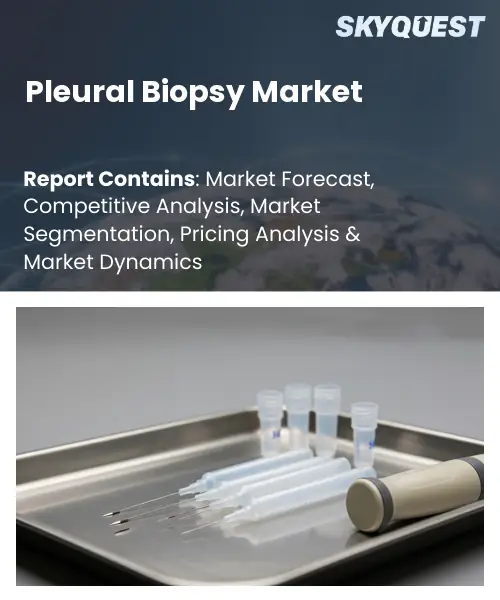
Pleural Biopsy Market
Report ID: SQMIG35D2410
Report ID: SQMIG35D2410
[email protected]
USA +1 351-333-4748
Report ID:
SQMIG35D2410 |
Region:
Global |
Published Date: March, 2026
Pages:
157
|Tables:
116
|Figures:
77


Global Pleural Biopsy Market size was valued at USD 330.40 Million in 2024 and is poised to grow from USD 350.88 Million in 2025 to USD 567.75 Million by 2033, growing at a CAGR of 6.2% during the forecast period (2026-2033).
The pleural biopsy market includes instruments, consumables, and services to obtain tissue from the pleural space for histopathology and molecular testing, and it matters because accurate diagnosis directs therapy for conditions such as malignant pleural effusion, tuberculosis, and mesothelioma. The main reasons are the increasing number of cases of these diseases along with increasing demand for less invasive surgical options, e.g., some physicians have changed from using blind needles to CT-guided core biopsies and thoracoscopic techniques which provide greater diagnostic yield. Technological innovations such as cryobiopsy and improved imaging have further expanded clinical adoption, shaped market growth and procurement patterns, and enabling personalized treatment decisions globally.
As the need for molecular and biomarker testing continues to rise in thoracic oncology, the global pleural biopsy market is experiencing significant growth. This has resulted in higher-quality pleural tissue and more advanced biopsy solutions being demanded from clinicians who perform precision therapies. In addition to providing genomic information through testing, many clinicians are now performing image-guided core and thoracoscopic sampling to obtain enough specimen from their patients prompting the need to invest in equipment, training, and pathology workflows. To help meet this demand, manufacturers of cryoprobes (probes that use cold temperatures to rapidly freeze tissue), coaxial systems have created new commercial opportunities for hospitals and outpatient facilities.
How is AI Improving Diagnostic Accuracy in the Pleural Biopsy Market?
AI is improving diagnostic accuracy in the pleural biopsy market by combining advanced image analysis procedural guidance and digital pathology support. Key aspects include automated detection of pleural fluid and algorithmic review of biopsy slides to reduce non diagnostic samples. Over the last few years, the use of bedside ultrasound AI to further enhance decision making by clinicians has resulted in improved levels of diagnostic certainty as well as a reduction in repeat procedures. Cloud-based AI workflows are being implemented by laboratories in collaboration with industry to facilitate slide interpretation and speed the process of making treatment decisions.
In June 2025, Exos FDA cleared ultrasound AI for pleural effusion clearance helps providers detect fluid at the bedside and more accurately direct biopsies. This will improve market growth by increasing diagnostic yield and improving the efficiency of patient triage.
Market snapshot - 2026-2033
Global Market Size
USD 330.4 Million
Largest Segment
CT-guided Biopsy
Fastest Growth
Ultrasound-guided Biopsy
Growth Rate
6.2% CAGR
To get more insights on this market click here to Request a Free Sample Report
Global pleural biopsy market is segmented by biopsy techniques, product types, applications, end users and region. Based on biopsy techniques, the market is segmented into CT-guided biopsy, ultrasound-guided biopsy and bronchoscopy-assisted biopsy. Based on product types, the market is segmented into biopsy needles, biopsy kits and forceps. Based on applications, the market is segmented into cancer diagnosis and infection assessment. Based on end users, the market is segmented into hospitals, diagnostic laboratories and outpatient clinics. Based on region, the market is segmented into North America, Europe, Asia Pacific, Latin America and Middle East & Africa.
Based on the global pleural biopsy market growth, CT-guided biopsy segment dominates because it provides precise visualization of pleural lesions and enables accurate needle trajectory planning, reducing sampling error and improving tissue retrieval from difficult anatomical locations. Clinicians are increasingly relying on this technique because it accurately differentiates between small and/or deep pleural nodules. This factor promotes its expanded application for complex diagnostic procedures by interventional radiologists. Additionally, the development of improved imaging technologies and established clinical workflow procedures has further strengthened the implementation of this technique as the primary form of diagnosis for performing pleural biopsies.
However, ultrasound-guided biopsy is emerging as the fastest growing area due to portable imaging, and lower procedural costs enabling wider adoption in point of care settings. With advancements in high-resolution ultrasound probes and further increasing operator training competency, there are greater opportunities for performing procedures at the bedside or in an outpatient environment.
Biopsy needles segment dominates because needle design improvements directly affect sample quality and procedural ease, making them central to pleural biopsy outcomes. Improvements in tip design, cutting methods and materials are reducing trauma to the tissue and allowing for better core retrievals; therefore, clinicians are likely to choose high-performance needles during diagnostic work. Manufacturers are also focusing on the compatibility of needles with imaging guidance systems, as well as providing safety features for single-use needles, which are strong determinants for clinicians when making procedural decisions.
However, biopsy kits are witnessing the strongest growth momentum because integrated trays combine needles, guides and consumables to streamline procedures, reduce setup time and support standardized protocols. Regulatory approvals and clinician preference for ready to use solutions boost adoption in ambulatory and hospital settings, enabling faster procedure turnover and creating new procurement opportunities for suppliers.
To get detailed segments analysis, Request a Free Sample Report
As per the global pleural biopsy market share, North America dominates the global pleural biopsy market because of a robust clinical ecosystem that aligns advanced hospital infrastructure, concentrated specialist expertise, and proactive technology adoption. Reimbursement guidelines have been established to assist with procedural uptake; clinical guidelines provide clarity regarding recommended guidelines for procedures. Furthermore, the presence of major manufacturers and well-defined regional training programs/consolidation also ensures that the market leaders are able to provide validated tools, educational resources, and operational support that assist in the implementation of widespread clinical adoption of minimally invasive biopsy techniques.
Pleural biopsy market in United States reflects a mature clinical environment with deep specialty networks, rapid technology adoption, and well developed procedural pathways. Thoracic oncology centers and interventional lung experts are both highly concentrated, which supports the management of complex clinical cases and the use of various devices. Manufacturers emphasize providing localized training programs and creating evidence to support clinician needs. The way that devices are reimbursed, as well as how institutions purchase products, creates a framework for how devices are adopted.
Pleural biopsy market in Canada benefits from integrated public healthcare delivery and regional centers of excellence that support standardized diagnostic pathways. Clinician networks and provincial procurement favor adoption of advanced biopsy platforms, while emphasis on cross institution training improves procedural competency. Logistics and education barriers have been addressed through collaboration between hospitals and manufacturers. The current dynamics of the market require a sustained effort to evaluate the value of various products by clinicians and drive their use within the healthcare system.
Based on global pleural biopsy regional forecast, across Europe, the pleural biopsy market is expanding rapidly due to centralized healthcare structures, coordinated clinical networks, and targeted investments in diagnostic modernization. Collaborative efforts at hospitals and national references will assist in developing best practices and multidisciplinary pathways for dissemination. The harmonized clinical guidance will support a consistent approach to performing procedures. Engaging vendors in a competitive manner and conducting clinical research will promote device enhancement and develop specific training programs. Health technology assessment processes will prioritize demonstrating clinical value, so manufacturers will align their evidence generation with local priorities. Evolving the regulatory process to be more harmonized across healthcare markets and establishing active engagement with payers will provide a pathway for the established and structured adoption of advanced techniques through investment in regional training hubs.
Pleural biopsy market in Germany features strong clinical leadership, integrated oncology centers, and established referral pathways that support adoption of advanced biopsy platforms. Focus on diagnostic quality and collaboration between pathology and interventional teams enhances procedural utilization. Manufacturers partner with academic centers for evidence generation and clinician training. Using procurement guides from both national and regional sources helps ensure that products are used consistently throughout all levels of the healthcare delivery system, including primary, acute, and long-term care.
Pleural biopsy market in United Kingdom is experiencing uptake driven by agile clinical networks, targeted training initiatives, and an openness to novel minimally invasive techniques. Support from Interventional Pulmonary teams facilitates rapid implementation of new devices by providing high levels of engagement. Focused investment in procedural training and developing regional centers will facilitate wider adoption. Expansion of availability is a function of health systems’ procurement strategies and Clinician advocacy.
Pleural biopsy market in France is emerging through focused investments in tertiary care centers, increased clinician training, and adoption of advanced minimally invasive platforms. Emphasis on coordinated diagnostic pathways and multidisciplinary tumor boards supports selective implementation in hospitals. Partnerships between device suppliers and academic centers facilitate clinical evaluation and practitioner education. Procurement processes and regional healthcare priorities influence rollout pace, while growing clinical familiarity broadens access to enhanced diagnostic procedures.
As per global pleural biopsy regional outlook, Asia Pacific is strengthening its position in the pleural biopsy market through targeted capacity building, expanding clinical expertise, and strategic adoption of minimally invasive diagnostic technologies. The development of specialized thoracic centres combined with structured training programmes will increase practitioner procedural competency. Local investigators are also providing locally meaningful evidence to support practice. Global manufacturers and regional distributors are collaborating to provide market access and locally tailored support services. Health systems are prioritising diagnostic efficiency and patient-centred pathways, therefore, the integration of advanced biopsy solutions is encouraged. Regulatory harmonisation between jurisdictions and the development of local manufacturing capabilities will aid in the improvement of consistency in supply and provide a means for managing costs.
Pleural biopsy market in Japan is supported by advanced hospital infrastructure, strong clinical research networks, emphasis on precision diagnostics that favors adoption of refined biopsy techniques. Collaboration between academic centers and industry can help validate procedures through education and training of clinicians, while hospitals are focused on providing the best possible procedural quality and experience for patients. Clear regulatory guidelines for institutions are needed to encourage the implementation of advanced technologies for pleural biopsy procedures within clinical workflow.
Pleural biopsy market in South Korea is advancing through investment in specialized hospital units, strong procedural training, collaboration between clinicians and technology providers. Distribution channels, as well as training programs by manufacturers, can provide greater access for clinicians to utilize these innovative biopsy platforms. Health authorities and professional organizations will help establish standard diagnostic pathways and standards of care; therefore, diagnostic pathways will result in more consistent implementation and quality assurance and procedural competency across various types of healthcare delivery.
To know more about the market opportunities by region and country, click here to
Buy The Complete Report
Imaging and Navigation Improvements
Increasing Prevalence Of Pleural Diseases
Limited Reimbursement and Cost Barriers
Limited Specialist Training Availability
Request Free Customization of this report to help us to meet your business objectives.
The competitive landscape in the global pleural biopsy market outlook is shaped by consolidation and technology differentiation, with companies using targeted acquisitions, platform partnerships, and integration of devices and diagnostics to secure diagnostic yield advantages. Demand for actionable molecular material from pleural fluid drives deal activity and product convergence. Recent examples include Maverix Medical's acquisition of Cirrus Bio and BIOCAPTIVA advancing cfDNA capture work in pleural fluid studies.
SkyQuest’s ABIRAW (Advanced Business Intelligence, Research & Analysis Wing) is our Business Information Services team that Collects, Collates, Correlates, and Analyses the Data collected by means of Primary Exploratory Research backed by robust Secondary Desk research.
As per SkyQuest analysis, the global pleural biopsy industry is poised for steady growth driven primarily by rising demand for molecular and biomarker testing that requires higher quality tissue samples. Rapid advancements in imaging and navigation technologies are a second driver that enhances the ability to accurately target and obtain accurate diagnoses for lesions. Limited reimbursement procedures is a key restraint; high procedural costs also contribute to the slow rate of adoption for new technologies in cost-sensitive settings. North America is the largest region due to their advanced clinical infrastructure and high adoption rates of minimally invasive techniques. The dominating technique (i.e., method used) is the use of CT-guided biopsy because it provides expensive, precise visualizations and high-quality samples.
| Report Metric | Details |
|---|---|
| Market size value in 2024 | USD 330.40 Million |
| Market size value in 2033 | USD 567.75 Million |
| Growth Rate | 6.2% |
| Base year | 2024 |
| Forecast period | 2026-2033 |
| Forecast Unit (Value) | USD Million |
| Segments covered |
|
| Regions covered | North America (US, Canada), Europe (Germany, France, United Kingdom, Italy, Spain, Rest of Europe), Asia Pacific (China, India, Japan, Rest of Asia-Pacific), Latin America (Brazil, Rest of Latin America), Middle East & Africa (South Africa, GCC Countries, Rest of MEA) |
| Companies covered |
|
| Customization scope | Free report customization with purchase. Customization includes:-
|
To get a free trial access to our platform which is a one stop solution for all your data requirements for quicker decision making. This platform allows you to compare markets, competitors who are prominent in the market, and mega trends that are influencing the dynamics in the market. Also, get access to detailed SkyQuest exclusive matrix.
Table Of Content
Executive Summary
Market overview
Parent Market Analysis
Market overview
Market size
KEY MARKET INSIGHTS
COVID IMPACT
MARKET DYNAMICS & OUTLOOK
Market Size by Region
KEY COMPANY PROFILES
Methodology
For the Pleural Biopsy Market, our research methodology involved a mixture of primary and secondary data sources. Key steps involved in the research process are listed below:
1. Information Procurement: This stage involved the procurement of Market data or related information via primary and secondary sources. The various secondary sources used included various company websites, annual reports, trade databases, and paid databases such as Hoover's, Bloomberg Business, Factiva, and Avention. Our team did 45 primary interactions Globally which included several stakeholders such as manufacturers, customers, key opinion leaders, etc. Overall, information procurement was one of the most extensive stages in our research process.
2. Information Analysis: This step involved triangulation of data through bottom-up and top-down approaches to estimate and validate the total size and future estimate of the Pleural Biopsy Market.
3. Report Formulation: The final step entailed the placement of data points in appropriate Market spaces in an attempt to deduce viable conclusions.
4. Validation & Publishing: Validation is the most important step in the process. Validation & re-validation via an intricately designed process helped us finalize data points to be used for final calculations. The final Market estimates and forecasts were then aligned and sent to our panel of industry experts for validation of data. Once the validation was done the report was sent to our Quality Assurance team to ensure adherence to style guides, consistency & design.
Analyst Support
Customization Options
With the given market data, our dedicated team of analysts can offer you the following customization options are available for the Pleural Biopsy Market:
Product Analysis: Product matrix, which offers a detailed comparison of the product portfolio of companies.
Regional Analysis: Further analysis of the Pleural Biopsy Market for additional countries.
Competitive Analysis: Detailed analysis and profiling of additional Market players & comparative analysis of competitive products.
Go to Market Strategy: Find the high-growth channels to invest your marketing efforts and increase your customer base.
Innovation Mapping: Identify racial solutions and innovation, connected to deep ecosystems of innovators, start-ups, academics, and strategic partners.
Category Intelligence: Customized intelligence that is relevant to their supply Markets will enable them to make smarter sourcing decisions and improve their category management.
Public Company Transcript Analysis: To improve the investment performance by generating new alpha and making better-informed decisions.
Social Media Listening: To analyze the conversations and trends happening not just around your brand, but around your industry as a whole, and use those insights to make better Marketing decisions.
REQUEST FOR SAMPLE
 REQUEST FREE CUSTOMIZATION
Global Pleural Biopsy Market size was valued at USD 330.4 Million in 2024 and is poised to grow from USD 350.88 Million in 2025 to USD 567.75 Million by 2033, growing at a CAGR of 6.2% during the forecast period (2026-2033).
The competitive landscape in the global pleural biopsy market is shaped by consolidation and technology differentiation, with companies using targeted acquisitions, platform partnerships, and integration of devices and diagnostics to secure diagnostic yield advantages. Demand for actionable molecular material from pleural fluid drives deal activity and product convergence. Recent examples include Maverix Medical's acquisition of Cirrus Bio and BIOCAPTIVA advancing cfDNA capture work in pleural fluid studies. 'Medtronic', 'Boston Scientific', 'Johnson & Johnson', 'Cook Medical', 'Becton, Dickinson and Company', 'Olympus Corporation', 'Integra LifeSciences', 'Siemens Healthineers', 'Hologic, Inc.', 'AbbVie Inc.', 'Bio-Rad Laboratories', 'Philips Healthcare', 'Varian Medical Systems', 'Bracco Imaging', 'Medline Industries', 'Stryker Corporation', 'Canon Medical Systems', 'Cardinal Health', 'GE Healthcare', 'Hitachi Medical Systems'
Advanced imaging and navigation technologies have enhanced the accuracy of pleural lesion localization and procedural guidance, reducing uncertainty during biopsy procedures and improving clinician confidence. These enhancements enable more precise targeting of small or difficult to access lesions, support minimally invasive approaches, and broaden clinical indications by making procedures safer and more reproducible across centers. Improved visualization fosters wider adoption among interventional pulmonologists and thoracic surgeons, encourages investment in compatible biopsy instruments, and stimulates integration of multimodal workflows that collectively strengthen market demand for pleural biopsy solutions.
Minimally Invasive Techniques Rise: The clinical shift toward less invasive pleural access methods is reshaping procurement and practice. Clinicians increasingly prefer image-guided core needle and thoracoscopic approaches that reduce patient discomfort and accelerate recovery, prompting hospitals to prioritize devices that enable these procedures. Manufacturers refine needle design and imaging compatibility while expanding training. This trend fosters closer collaboration between device makers and healthcare providers, drives product differentiation, and encourages adoption across a range of care settings, enhancing diagnostic consistency and patient experience.
North America Dominate the Global Pleural Biopsy Market.


Want to customize this report? This report can be personalized according to your needs. Our analysts and industry experts will work directly with you to understand your requirements and provide you with customized data in a short amount of time. We offer $1000 worth of FREE customization at the time of purchase.
Feedback From Our Clients


 USA (+1) 351-333-4748

