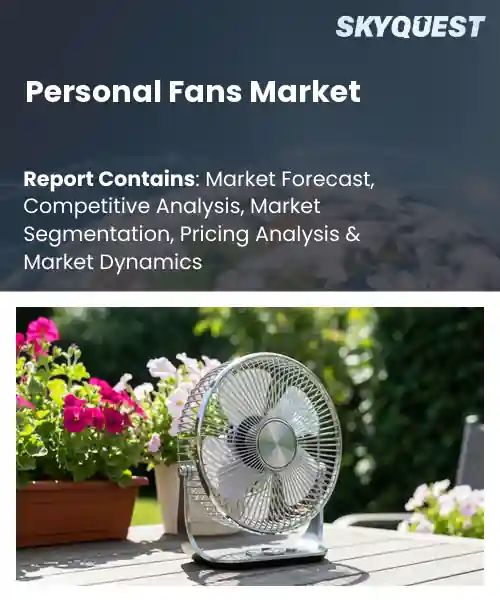
Personal Fans Market
Report ID: SQMIG20I2876
Report ID: SQMIG20I2876
[email protected]
USA +1 351-333-4748
Report ID:
SQMIG20I2876 |
Region:
Global |
Published Date: April, 2026
Pages:
157
|Tables:
88
|Figures:
76


Global Personal Fans Market size was valued at USD 1.12 Billion in 2024 and is poised to grow from USD 1.17 Billion in 2025 to USD 1.1 Billion by 2033, growing at a CAGR of 4.8% during the forecast period (2026-2033).
As a research analyst examining the personal fans market, I identify climate variability and urbanization as the primary driver reshaping demand globally. The personal fans market comprises handheld, wearable, desk and portable units designed to provide localized cooling in homes, offices and public spaces, and its importance grows as consumers seek affordable, energy-efficient comfort alternatives to full-scale air conditioning. Over time the market evolved from simple corded blades to battery-operated, USB-powered and bladeless designs exemplified by compact neck fans and innovative models from companies such as Dyson and Xiaomi. This evolution reflects shifting consumer preferences toward mobility, convenience and sustainability.Building on that evolution, the key factor driving the global personal fans market is rapid technological innovation responding to intensified heat exposure and shifting consumer behavior. As average temperatures rise and urban dwellers seek portable cooling, manufacturers invest in efficient brushless motors, longer-lasting batteries and smart controls, which in turn make devices practical for commuting, outdoor labor and sporting events. Improved durability and connectivity reduce total cost of ownership, encouraging adoption in emerging markets where air conditioning is limited. These cause-and-effect dynamics create opportunities for integrated IoT products, sustainable materials and direct-to-consumer channels, enabling scalable growth through targeted use cases.
How will IoT integration reshape the personal fans market?
IoT integration will reshape the personal fans market by adding connectivity sensors automation and smarter controls. Key aspects include app and voice control seamless integration with home ecosystems adaptive speed based on occupancy and environmental sensing and remote firmware updates. The current market still has many low tech models but smart towers and compact connected fans are growing in appeal. In this context brands can offer services like usage based maintenance and tailored comfort profiles. Real world instances include fans that adjust when a room is occupied or when indoor temperature changes. These shifts make personal fans integral to whole home comfort strategies.Xiaomi February 2026, launched the Mijia Smart Inverter Circulating Fan Pro with app connectivity and low power operation which shows how IoT capabilities enable remote control predictive comfort tuning and over the air improvements. This innovation supports market growth by raising consumer expectations for connectivity and service driven value.
Market snapshot - (2026-2033)
Global Market Size
USD 1.12 Billion
Largest Segment
Ready-to-Drink (RTD) Tea (Vending/Convenience)
Fastest Growth
Freshly Brewed Tea (Cafes/QSRs)
Growth Rate
4.8% CAGR
To get more insights on this market click here to Request a Free Sample Report
Global personal fans market is segmented by beverage format, service type, tea variant focus and region. Based on beverage format, the market is segmented into Freshly Brewed Tea (Cafes/QSRs) and Ready-to-Drink (RTD) Tea (Vending/Convenience). Based on service type, the market is segmented into Tea Rooms & Specialty Cafes, Quick Service Restaurants (QSRs) and Corporate Offices & Vending Solutions. Based on tea variant focus, the market is segmented into Herbal & Specialty Tea and Traditional/Black Tea Mixes. Based on region, the market is segmented into North America, Europe, Asia Pacific, Latin America and Middle East & Africa.
Tea Rooms & Specialty Cafes segment dominates because these venues prioritize curated customer comfort and aesthetic integration, making fans both functional and design elements. Longer dwell times and emphasis on ambiance drive demand for quiet, stylish personal fans that blend with interiors and enhance perceived comfort. Operators favor discreet, reliable products with adjustable airflow to protect aromas and maintain pleasant microclimates, which pushes manufacturers to prioritize premium, form-focused fan offerings.
However, Corporate Offices & Vending Solutions is the most rapidly expanding area as workplaces and automated points emphasize individualized climate control. Demand for compact desk and vending-compatible fans, integration with facility systems, and focus on employee wellbeing accelerate adoption, creating opportunities for modular, energy-efficient personal fans in professional and retail automation contexts.
Freshly Brewed Tea (Cafes/QSRs) segment dominates because on-site brewing creates specific thermal and sensory conditions that require tailored airflow and quiet operation. High customer turnover and visible service areas push owners to select durable, easy-to-clean personal fans that preserve beverage aromas while improving comfort. Demand for versatile mounting, spill-resistant designs, and low-maintenance motors drives manufacturers to prioritize robustness, hygienic materials in product design, and energy efficiency for continuous operation.
Meanwhile, Ready-to-Drink (RTD) Tea (Vending/Convenience) is witnessing the strongest growth momentum because on-the-go consumption fuels demand for portable, battery-powered personal fans and promotional collaborations at convenience points. Innovations in compact, rechargeable designs and co-branding opportunities at vending channels accelerate adoption and create new retail touchpoints for personal fan products.
To get detailed segments analysis, Request a Free Sample Report
Asia Pacific dominates the global personal fans market due to a convergence of favorable demand conditions, manufacturing strength and rapid adoption of consumer electronics. Large urban populations with high density create persistent demand for compact cooling solutions, while advanced manufacturing ecosystems in regional hubs enable cost efficient production and swift innovation cycles. Leading domestic brands focus on design, battery efficiency and multiuse functionality that resonate with tech savvy consumers. Well established supply chain networks support scale, availability and export orientation, while vibrant e-commerce channels and widespread retail distribution accelerate product reach. Seasonal and indoor comfort considerations, together with incremental upgrades and accessory ecosystems, reinforce sustained consumer interest and position the region as the primary source of product development and market expansion.
Personal Fans Market Japan benefits from strong consumer emphasis on compact, high performance electronics and refined industrial design. Domestic manufacturers prioritize quiet operation, energy efficiency and premium materials, appealing to discerning buyers. Distribution blends traditional retail with sophisticated online channels, enabling product discovery. Aftermarket support and service networks reinforce brand loyalty, while collaboration between design houses and technology providers fosters incremental innovation and niche product differentiation across diverse urban segments.
Personal Fans Market South Korea reflects strong consumer appetite for cutting edge features, compact form factors and integrated connectivity. Domestic firms leverage advanced component capabilities and agile manufacturing to introduce modern designs that align with mobility trends. Retail ecosystems combine flagship stores with digital marketplaces, enhancing product visibility. Brand engagement through cultural and media channels drives premiumization, while aftersales services and localized product iterations sustain repeat purchases and channel partnerships.
North America is experiencing rapid expansion in the personal fans market driven by evolving consumer lifestyles, emphasis on convenience and broad retail reach. Diverse usage occasions spanning personal, outdoor and workplace settings encourage demand for portable, rechargeable and multifunctional solutions that prioritize quiet operation and safety. Strong aftermarket frameworks and service orientation increase consumer confidence in premium offerings. Retail ecosystems blend large format retail, specialty stores and digital marketplaces to support wide product exposure, while marketing through experiential events and social channels accelerates adoption. Regulatory attention to safety standards and emphasis on energy efficient components further shape product development, enabling vendors to introduce differentiated designs that respond to regional comfort preferences and varied usage environments. Collaborations between established brands and agile startups foster modular platforms and customization, while investments in user experience and packaging enhance trial and repeat purchase.
Personal Fans Market United States reflects broad demand driven by diverse climate zones and a strong culture of outdoor living. Consumers favor versatility, long runtime and silent performance for using fans across home, travel and work contexts. Distribution combines national retail chains, specialty outlets and e-commerce platforms, supporting broad assortment. Product development emphasizes safety compliance and user friendly controls to capture varied consumer segments. Marketing leverages lifestyle partnerships and influencers.
Personal Fans Market Canada is characterized by consumer focus on durability and energy conscious operation suited to varied indoor environments. Demand is shaped by urban and rural mobility needs, prompting interest in portable solutions and dependable aftersales support. Retail penetration includes national chains, local specialists and growing online channels that prioritize product information and consumer service. Manufacturers emphasize ruggedization, efficient motors and clear compliance to regional safety and quality expectations.
Europe is strengthening its position in the personal fans market through an emphasis on sustainable design, technical refinement and regulatory alignment that together elevate product quality and consumer trust. Manufacturers and brands are integrating energy efficient motors, recyclable materials and quieter operation to meet evolving household expectations and regulatory standards. Diverse retail landscapes, including specialist stores and digitally savvy platforms, enable targeted marketing and premium positioning. Cross country collaborations foster harmonized certifications and logistics efficiency, supporting wider distribution. Emerging preferences for smart home compatibility and integrated comfort solutions encourage product convergence with air treatment and personal climate control segments, while focused brand narratives and aftersales service accelerate acceptance among discerning consumers. Investments in research and development, stronger local manufacturing networks and partnerships with HVAC players support tailored solutions and regional customization.
Personal Fans Market Germany is shaped by rigorous technical standards, emphasis on durability and a strong engineering tradition that drives efficient quality solutions. Manufacturers prioritize robust materials, precise component integration and compliance messaging to meet discerning buyer expectations. Distribution includes specialty dealers, industrial suppliers and digital channels that cater to consumer and professional segments. Product positioning focuses on longevity, energy conscious operation and certified safety, reinforcing trust in premium offerings.
Personal Fans Market United Kingdom reflects strong consumer preference for stylish, compact and connected designs that suit urban living. Brands emphasize aesthetics, intuitive controls and smart integration to meet lifestyle buyers. Retail mix includes department stores, specialist lifestyle retailers and online marketplaces that support trial and customer education. Sustainability messages and efficient operation resonate with conscious consumers, while service offerings and collaborations help differentiate products in a competitive landscape overall.
Personal Fans Market France favors design led, compact solutions that combine functionality with strong aesthetic appeal for urban apartment living. Consumers appreciate premium materials, quiet operation and multifunction features that fit interiors. Distribution channels include boutique retailers, department stores and digital platforms that highlight styling and product stories. Local collaborations with design studios and focused marketing toward lifestyle segments support premium positioning, while regulatory emphasis on efficiency informs engineering choices.
To know more about the market opportunities by region and country, click here to
Buy The Complete Report
Rising Demand For Energy Efficiency
Integration With Smart Home Systems
Price Sensitivity Among Consumers
Component Availability and Pricing
Request Free Customization of this report to help us to meet your business objectives.
The competitive landscape for global personal fans is dominated by differentiated strategies where incumbents use M&A and distribution deals, OEMs pursue smart home integrations with platform partners, and premium brands push technology led product launches that raise category expectations. Recent examples include Lasko’s 2019 acquisition of B Air to expand channel reach, Midea’s smart home integrations with Google and Matter, and Dyson’s April 2026 handheld HushJet launch that signals premium tech competition.
Top Player’s Company Profile
Recent Developments
SkyQuest’s ABIRAW (Advanced Business Intelligence, Research & Analysis Wing) is our Business Information Services team that Collects, Collates, Correlates, and Analyses the Data collected by means of Primary Exploratory Research backed by robust Secondary Desk research. As per SkyQuest analysis, the global personal fans market is being driven primarily by climate variability and rapid urbanization, which increase demand for affordable, localized cooling solutions, while IoT integration and technological innovation act as a secondary driver by enabling smarter, energy-efficient and connected products. Price sensitivity among consumers remains a key restraint, limiting uptake of premium, feature-rich models. Asia Pacific dominates the market thanks to dense urban populations, strong manufacturing ecosystems and e-commerce reach. The Tea Rooms and Specialty Cafes segment leads adoption as venues favor quiet, design-focused fans that enhance ambiance and guest comfort, creating demand for premium and aesthetically integrated personal cooling solutions.
| Report Metric | Details |
|---|---|
| Market size value in 2024 | USD 1.12 Billion |
| Market size value in 2033 | USD 1.1 Billion |
| Growth Rate | 4.8% |
| Base year | 2024 |
| Forecast period | (2026-2033) |
| Forecast Unit (Value) | USD Billion |
| Segments covered |
|
| Regions covered | North America (US, Canada), Europe (Germany, France, United Kingdom, Italy, Spain, Rest of Europe), Asia Pacific (China, India, Japan, Rest of Asia-Pacific), Latin America (Brazil, Rest of Latin America), Middle East & Africa (South Africa, GCC Countries, Rest of MEA) |
| Companies covered |
|
| Customization scope | Free report customization with purchase. Customization includes:-
|
To get a free trial access to our platform which is a one stop solution for all your data requirements for quicker decision making. This platform allows you to compare markets, competitors who are prominent in the market, and mega trends that are influencing the dynamics in the market. Also, get access to detailed SkyQuest exclusive matrix.
Table Of Content
Executive Summary
Market overview
Parent Market Analysis
Market overview
Market size
KEY MARKET INSIGHTS
COVID IMPACT
MARKET DYNAMICS & OUTLOOK
Market Size by Region
KEY COMPANY PROFILES
Methodology
For the Personal Fans Market, our research methodology involved a mixture of primary and secondary data sources. Key steps involved in the research process are listed below:
1. Information Procurement: This stage involved the procurement of Market data or related information via primary and secondary sources. The various secondary sources used included various company websites, annual reports, trade databases, and paid databases such as Hoover's, Bloomberg Business, Factiva, and Avention. Our team did 45 primary interactions Globally which included several stakeholders such as manufacturers, customers, key opinion leaders, etc. Overall, information procurement was one of the most extensive stages in our research process.
2. Information Analysis: This step involved triangulation of data through bottom-up and top-down approaches to estimate and validate the total size and future estimate of the Personal Fans Market.
3. Report Formulation: The final step entailed the placement of data points in appropriate Market spaces in an attempt to deduce viable conclusions.
4. Validation & Publishing: Validation is the most important step in the process. Validation & re-validation via an intricately designed process helped us finalize data points to be used for final calculations. The final Market estimates and forecasts were then aligned and sent to our panel of industry experts for validation of data. Once the validation was done the report was sent to our Quality Assurance team to ensure adherence to style guides, consistency & design.
Analyst Support
Customization Options
With the given market data, our dedicated team of analysts can offer you the following customization options are available for the Personal Fans Market:
Product Analysis: Product matrix, which offers a detailed comparison of the product portfolio of companies.
Regional Analysis: Further analysis of the Personal Fans Market for additional countries.
Competitive Analysis: Detailed analysis and profiling of additional Market players & comparative analysis of competitive products.
Go to Market Strategy: Find the high-growth channels to invest your marketing efforts and increase your customer base.
Innovation Mapping: Identify racial solutions and innovation, connected to deep ecosystems of innovators, start-ups, academics, and strategic partners.
Category Intelligence: Customized intelligence that is relevant to their supply Markets will enable them to make smarter sourcing decisions and improve their category management.
Public Company Transcript Analysis: To improve the investment performance by generating new alpha and making better-informed decisions.
Social Media Listening: To analyze the conversations and trends happening not just around your brand, but around your industry as a whole, and use those insights to make better Marketing decisions.
REQUEST FOR SAMPLE
 REQUEST FREE CUSTOMIZATION


Want to customize this report? This report can be personalized according to your needs. Our analysts and industry experts will work directly with you to understand your requirements and provide you with customized data in a short amount of time. We offer $1000 worth of FREE customization at the time of purchase.
Feedback From Our Clients


 USA (+1) 351-333-4748

