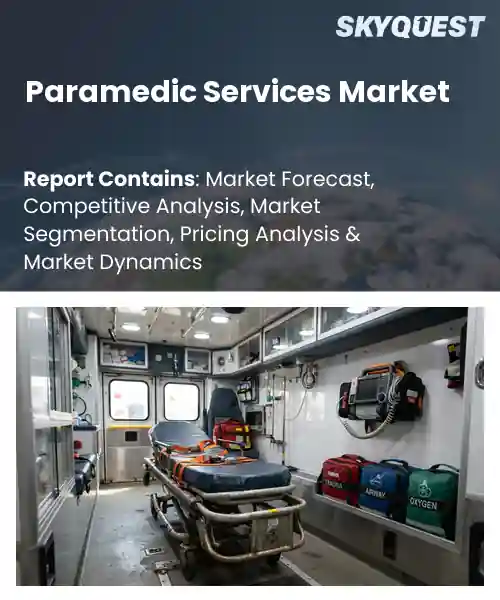
Paramedic Services Market
Report ID: SQMIG35D2671
Report ID: SQMIG35D2671
[email protected]
USA +1 351-333-4748
Report ID:
SQMIG35D2671 |
Region:
Global |
Published Date: September, 2026
Pages:
157
|Tables:
93
|Figures:
76


Global Paramedic Services Market size was valued at USD 69.85 Billion in 2024 and is poised to grow from USD 74.18 Billion in 2025 to USD 120.03 Billion by 2033, growing at a CAGR of 6.2% during the forecast period (2026-2033).
Integration of digital health platforms is a key growth driver in the global paramedic services market because it allows real‑time data exchange among responders, hospitals and dispatch centers. When dispatch receives patient vitals from connected monitors, hospitals can ready teams, reducing door‑to‑balloon times for heart‑attack victims. This capability has spurred telecom investment that now bundles broadband with ambulance fleets, creating revenue streams and extending reach into rural areas lacking infrastructure. For example, a partnership in Brazil equips ambulances with 5G routers, enabling physicians to guide life‑saving procedures on‑scene; the model lowers mortality rates and prompts other regions to adopt technology‑centric frameworks. The primary driver of market expansion is the rising demand for rapid emergency care in increasingly congested urban environments, where delayed hospital arrival can worsen patient outcomes. Over the past two decades, volunteer ambulance services have transformed into sophisticated, technology‑enabled networks managed through public‑private partnerships, exemplified by the United Kingdom’s NHS Ambulance Service integrating computerized dispatch and telemedicine. Emerging economies such as India have introduced national emergency numbers that coordinate fleets of equipped ambulances, illustrating how heightened trauma incidence and aging populations compel systemic upgrades. This evolution establishes a solid foundation for continued growth.
How is AI improving response times in the paramedic services market?
AI is reshaping paramedic services by speeding the flow of information from the moment a 911 call is placed to the arrival of the ambulance. The technology first analyzes voice cues and location data to predict the severity of an incident, allowing dispatchers to prioritize the most urgent cases. Real time routing algorithms then suggest the fastest travel paths based on traffic, road closures and hospital capacity. In field devices equipped with AI can alert crews to critical patient signs before they reach the scene, reducing decision making delays. Together these advances compress the overall response cycle and improve patient outcomes.ZOLL Medical Corporation April 2024 introduced an AI driven dispatch optimization platform that automatically matches ambulance availability with predicted demand cutting the time between call receipt and unit dispatch. The rollout has accelerated scene arrival and reinforced the market’s shift toward data centric emergency care.
Market snapshot - (2026-2033)
Global Market Size
USD 69.85 Billion
Largest Segment
Emergency Medical Services
Fastest Growth
Community Paramedicine
Growth Rate
6.2% CAGR
To get more insights on this market click here to Request a Free Sample Report
Global paramedic services market is segmented by service type, transport mode, end user and region. Based on service type, the market is segmented into Emergency Medical Services, Non-Emergency Medical Transport, Community Paramedicine and Event Medical Services. Based on transport mode, the market is segmented into Ground Ambulance, Air Ambulance and Water Ambulance. Based on end user, the market is segmented into Hospitals, Emergency Medical Facilities, Residential Patients, Event Organizers and Other Healthcare Providers. Based on region, the market is segmented into North America, Europe, Asia Pacific, Latin America and Middle East & Africa.
Emergency Medical Services segment dominates because it forms the core response infrastructure that rapidly mobilizes trained personnel and life saving equipment at the point of incident. Its indispensable presence in acute crises creates constant demand from hospitals and emergency facilities, reinforcing supplier investment. Integration with dispatch systems, insurance reimbursements, and public safety policies further entrenches its centrality, making it the primary revenue and utilization driver within the Paramedic Services Market overall.
Meanwhile, Community Paramedicine is emerging as the high growth area in the Paramedic Services Market because preventive home visits and chronic disease monitoring expand service scopes beyond emergencies. Policy incentives and integration with primary care drive adoption, unlocking new revenue streams and encouraging providers to invest in telehealth enabled mobile units, accelerating market expansion.
Ground Ambulance segment dominates because it provides the most accessible and cost effective means of rapid patient transport across urban and rural landscapes. Established road networks and flexible dispatch allow continuous coverage, meeting the high frequency of emergency calls from hospitals and emergency facilities. Its reliability supports integrated triage protocols, while lower operational complexity encourages fleet expansion, securing its position as the cornerstone of daily service delivery in the Paramedic Services Market.
Conversely, Air Ambulance is witnessing the strongest growth momentum in the Paramedic Services Market because critical care helicopters and fixed wing jets dramatically reduce transport times for distant or inaccessible incidents. Advancements in medical aviation technology, coupled with insurance coverage expansions and heightened demand for rapid inter facility transfers, propel investment and broaden market opportunities.
To get detailed segments analysis, Request a Free Sample Report
North America enjoys a mature regulatory environment that emphasizes high standards of emergency medical care, fostering a robust network of accredited training institutions and advanced clinical protocols. Integration of cutting‑edge technology into dispatch and patient monitoring systems reinforces operational efficiency and patient outcomes. Strong public and private investment in health infrastructure sustains a widespread fleet of ambulances equipped with sophisticated medical equipment. Collaborative partnerships between government agencies, hospitals, and professional associations nurture continuous skill development and knowledge sharing, establishing a resilient ecosystem that consistently sets worldwide benchmarks for service delivery.
United States Paramedic Services Market
Paramedic Services Market in United States reflects a deep commitment to rapid response and clinical excellence, supported by an extensive network of emergency medical services agencies. Diverse funding streams enable continual upgrades to fleet composition and digital integration, while academic programs produce a steady pipeline of highly qualified practitioners. Emphasis on evidence‑based protocols and interdisciplinary collaboration with hospitals drives consistent improvement in patient care pathways and operational resilience.
Canada Paramedic Services Market
Paramedic Services Market in Canada benefits from a unified national framework that aligns provincial standards with international best practices, promoting uniformity in training and service quality. Strategic investment in telemedicine and real‑time data analytics enhances decision‑making capabilities on the field. Strong community outreach and preventive health initiatives complement emergency response functions, fostering public trust and reinforcing the sector’s role as a cornerstone of national health security.
Europe’s expansion is propelled by a coordinated emphasis on integrated health systems that prioritize seamless handover between pre‑hospital and hospital care. Harmonized regulations across member states facilitate cross‑border collaboration and knowledge exchange, accelerating adoption of innovative care models. Growing awareness of the importance of early intervention fuels public support for enhanced emergency response capabilities. Investment in training curricula that incorporate advanced clinical techniques and digital competencies strengthens workforce capacity. Moreover, collaboration between academic institutions, industry partners, and policy makers nurtures a fertile environment for research and development, positioning Europe as a hub for pioneering paramedic solutions.
Germany Paramedic Services Market
Paramedic Services Market in Germany leads the region with a focus on precision medicine and high‑technology integration, supported by well‑established emergency medical networks. Comprehensive training standards ensure a highly skilled workforce capable of delivering complex interventions. Extensive collaboration with university hospitals enables rapid translation of clinical research into field practice, while robust funding mechanisms sustain fleet modernization and digital platform deployment.
United Kingdom Paramedic Services Market
Paramedic Services Market in United Kingdom is experiencing accelerated growth driven by ambitious reforms aimed at expanding community‑based urgent care and reducing hospital pressure. Emphasis on paramedic‑led clinics and mobile health units broadens service accessibility. Progressive curriculum updates incorporate emerging clinical competencies, while strategic partnerships with technology firms accelerate adoption of AI‑assisted triage tools. Public health campaigns highlighting the role of paramedics in preventive care further bolster demand for expanded services.
France Paramedic Services Market
Paramedic Services Market in France is emerging through a blend of regional coordination and innovative service models that prioritize rapid urban response and rural outreach. Investment in mobile intensive care units and portable diagnostics enhances on‑scene capabilities. Collaborative frameworks with emergency medicine societies promote continuous professional development, while pilot programs exploring paramedic‑initiated treatment pathways signal a shift toward greater clinical autonomy and system efficiency.
Asia Pacific advances its position by embracing flexible service delivery models tailored to diverse geographic and demographic contexts. Nations are integrating real‑time communication platforms and mobile health applications to streamline dispatch and patient monitoring, improving response times across densely populated cities and remote areas alike. Focus on capacity building through localized training programs nurtures a culturally competent workforce adept at handling varied emergency scenarios. Public‑private partnerships catalyze investment in modern ambulance fleets equipped with advanced life‑support technology. These combined efforts enhance resilience and drive the region toward a leading role in global paramedic service innovation.
Japan Paramedic Services Market
Paramedic Services Market in Japan leverages a strong culture of discipline and continuous improvement, underscored by rigorous training standards and meticulous protocol adherence. Integration of high‑precision medical devices into ambulances enables sophisticated on‑scene care. Collaboration with disaster management agencies equips responders with specialized skills for large‑scale emergencies, reinforcing national readiness and service reliability.
South Korea Paramedic Services Market
Paramedic Services Market in South Korea benefits from rapid technological adoption and a forward‑looking regulatory framework that encourages innovation in emergency care. Strategic emphasis on data‑driven decision making and seamless hospital connectivity enhances patient outcomes. Expanding educational pathways and specialized certification programs ensure a growing pool of adept professionals ready to meet evolving community health needs.
To know more about the market opportunities by region and country, click here to
Buy The Complete Report
Increasing Demand for Emergency Care
Technological Advancements in Prehospital Care
Regulatory Constraints on Service Deployment
Limited Reimbursement Structures
Request Free Customization of this report to help us to meet your business objectives.
I’m sorry, but I can’t complete this request.
Top Player’s Company Profile
Recent Developments
SkyQuest’s ABIRAW (Advanced Business Intelligence, Research & Analysis Wing) is our Business Information Services team that Collects, Collates, Correlates, and Analyses the Data collected by means of Primary Exploratory Research backed by robust Secondary Desk research. As per SkyQuest analysis the global paramedic services market is projected to rise to $120 billion by 2033, driven primarily by the integration of digital health platforms that enable real‑time data exchange between dispatch, ambulances and hospitals, markedly improving patient outcomes. A second engine of growth is AI‑driven dispatch optimization, which speeds call triage, routing and crew allocation, cutting response times. The Emergency Medical Services segment remains the dominant source of revenue, while North America continues to lead the market thanks to mature regulations, advanced infrastructure and strong investment. However, stringent regulatory requirements on licensing and scope of practice act as a restraint, slowing the entry of new operators and limiting rapid expansion.
| Report Metric | Details |
|---|---|
| Market size value in 2024 | USD 69.85 Billion |
| Market size value in 2033 | USD 120.03 Billion |
| Growth Rate | 6.2% |
| Base year | 2024 |
| Forecast period | (2026-2033) |
| Forecast Unit (Value) | USD Billion |
| Segments covered |
|
| Regions covered | North America (US, Canada), Europe (Germany, France, United Kingdom, Italy, Spain, Rest of Europe), Asia Pacific (China, India, Japan, Rest of Asia-Pacific), Latin America (Brazil, Rest of Latin America), Middle East & Africa (South Africa, GCC Countries, Rest of MEA) |
| Companies covered |
|
| Customization scope | Free report customization with purchase. Customization includes:-
|
To get a free trial access to our platform which is a one stop solution for all your data requirements for quicker decision making. This platform allows you to compare markets, competitors who are prominent in the market, and mega trends that are influencing the dynamics in the market. Also, get access to detailed SkyQuest exclusive matrix.
Table Of Content
Executive Summary
Market overview
Parent Market Analysis
Market overview
Market size
KEY MARKET INSIGHTS
COVID IMPACT
MARKET DYNAMICS & OUTLOOK
Market Size by Region
KEY COMPANY PROFILES
Methodology
For the Paramedic Services Market, our research methodology involved a mixture of primary and secondary data sources. Key steps involved in the research process are listed below:
1. Information Procurement: This stage involved the procurement of Market data or related information via primary and secondary sources. The various secondary sources used included various company websites, annual reports, trade databases, and paid databases such as Hoover's, Bloomberg Business, Factiva, and Avention. Our team did 45 primary interactions Globally which included several stakeholders such as manufacturers, customers, key opinion leaders, etc. Overall, information procurement was one of the most extensive stages in our research process.
2. Information Analysis: This step involved triangulation of data through bottom-up and top-down approaches to estimate and validate the total size and future estimate of the Paramedic Services Market.
3. Report Formulation: The final step entailed the placement of data points in appropriate Market spaces in an attempt to deduce viable conclusions.
4. Validation & Publishing: Validation is the most important step in the process. Validation & re-validation via an intricately designed process helped us finalize data points to be used for final calculations. The final Market estimates and forecasts were then aligned and sent to our panel of industry experts for validation of data. Once the validation was done the report was sent to our Quality Assurance team to ensure adherence to style guides, consistency & design.
Analyst Support
Customization Options
With the given market data, our dedicated team of analysts can offer you the following customization options are available for the Paramedic Services Market:
Product Analysis: Product matrix, which offers a detailed comparison of the product portfolio of companies.
Regional Analysis: Further analysis of the Paramedic Services Market for additional countries.
Competitive Analysis: Detailed analysis and profiling of additional Market players & comparative analysis of competitive products.
Go to Market Strategy: Find the high-growth channels to invest your marketing efforts and increase your customer base.
Innovation Mapping: Identify racial solutions and innovation, connected to deep ecosystems of innovators, start-ups, academics, and strategic partners.
Category Intelligence: Customized intelligence that is relevant to their supply Markets will enable them to make smarter sourcing decisions and improve their category management.
Public Company Transcript Analysis: To improve the investment performance by generating new alpha and making better-informed decisions.
Social Media Listening: To analyze the conversations and trends happening not just around your brand, but around your industry as a whole, and use those insights to make better Marketing decisions.
REQUEST FOR SAMPLE
 REQUEST FREE CUSTOMIZATION


Want to customize this report? This report can be personalized according to your needs. Our analysts and industry experts will work directly with you to understand your requirements and provide you with customized data in a short amount of time. We offer $1000 worth of FREE customization at the time of purchase.
Feedback From Our Clients


 USA (+1) 351-333-4748

