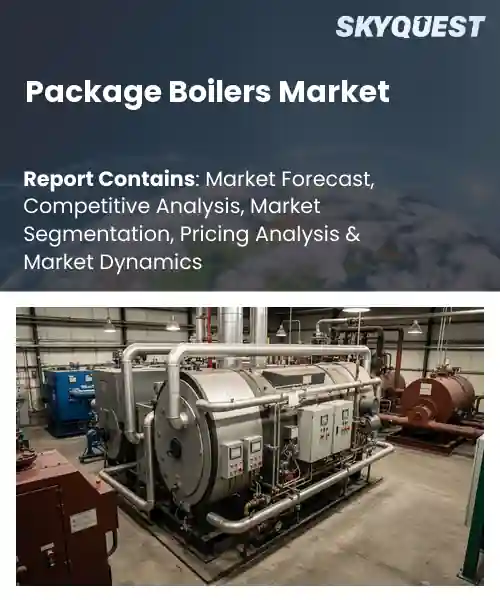
Package Boilers Market
Report ID: SQMIG20I3223
Report ID: SQMIG20I3223
[email protected]
USA +1 351-333-4748
Report ID:
SQMIG20I3223 |
Region:
Global |
Published Date: July, 2026
Pages:
157
|Tables:
176
|Figures:
79


Global Package Boilers Market size was valued at USD 10.6 Billion in 2024 and is poised to grow from USD 11.09 Billion in 2025 to USD 15.89 Billion by 2033, growing at a CAGR of 4.6% during the forecast period (2026-2033).
The global package‑boiler market comprises self‑contained heating units that can be shipped and installed as a single module, serving industries such as chemicals, food processing, and power generation. Its significance stems from the ability to reduce on‑site construction time, lower labor costs, and deliver consistent performance across diverse climatic conditions. Historically, the market expanded rapidly in the 1990s as emerging economies invested in industrial infrastructure, and the trend accelerated after 2008 when energy‑efficiency regulations prompted retrofits of aging steam systems. For example, a Brazilian fertilizer plant replaced a fragmented boiler network with a 15 MW package boiler, cutting fuel consumption by 18 %.The rising demand for low‑carbon steam, spurred by tighter emission rules and corporate sustainability targets, drives the market more than any other factor. Governments capping CO₂ force manufacturers to adopt high‑efficiency package boilers that incorporate condensing technology, enabling thermal efficiencies that exceed 95 %. This boost lowers fuel expenses and cuts carbon footprints, making the technology attractive to industries such as textile dyeing where uninterrupted steam is vital. In Vietnam, a textile hub installed modular boilers with waste‑heat recovery, achieving a 12 % cut in energy use and qualifying for green‑finance incentives. The regulatory push and economic upside thus fuels market expansion.
How is AI-driven automation reshaping efficiency in the package boilers market?
AI driven automation is redefining efficiency in the package boilers sector by linking real time data with advanced control algorithms. Sensors monitor temperature, pressure and fuel flow, while machine learning models predict optimal combustion settings and flag potential faults before they disrupt production. This reduces energy waste, shortens downtime and extends equipment life. Operators now rely on dashboards that suggest adjustments rather than manually tweaking valves, freeing staff to focus on strategic tasks. The approach also supports tighter emissions compliance as the system continuously balances output with environmental limits. Overall, the technology creates a more responsive and cost effective boiler operation.Babcock & Wilcox June 2024, introduced an AI enabled predictive maintenance platform that continuously analyses sensor streams from its package boilers and schedules service only when performance deviates, cutting unnecessary inspections and keeping plants running at peak efficiency, resulting in lower operational costs and higher reliability.
Market snapshot - (2026-2033)
Global Market Size
USD 10.6 Billion
Largest Segment
Water Tube Boilers
Fastest Growth
Electric Boilers
Growth Rate
4.6% CAGR
To get more insights on this market click here to Request a Free Sample Report
Global package boilers market is segmented by boiler configuration design, combustion fuel type, output capacity rating, operating pressure threshold, thermodynamic output state, end-use industry destination and region. Based on boiler configuration design, the market is segmented into Fire Tube Boilers, Water Tube Boilers and Electric Boilers. Based on combustion fuel type, the market is segmented into Natural Gas Fired, Fuel Oil Fired, Coal Fired and Biomass Fired. Based on output capacity rating, the market is segmented into Up to 10 t/hr, 11 to 25 t/hr, 26 to 50 t/hr and Above 50 t/hr. Based on operating pressure threshold, the market is segmented into High Pressure Boilers and Low Pressure Boilers. Based on thermodynamic output state, the market is segmented into Steam Generating Boilers and Hot Water Generating Boilers. Based on end-use industry destination, the market is segmented into Chemical Refining, Food Processing Operations, Beverage Processing Units, Petroleum Refining Sites, Gas Refining Plants, Textile Mills, Pulp Facilities and Paper Processing Plants. Based on region, the market is segmented into North America, Europe, Asia Pacific, Latin America and Middle East & Africa.
Fire tube boilers segment dominates because its simple construction and proven reliability match the cost sensitivity of most industrial users. The design allows quick fabrication and easy maintenance, which reduces downtime and operational expenses. Its adaptability to a wide range of capacities and pressures makes it a preferred choice for diverse applications, reinforcing its central position in the package boilers market, offering long term asset value for plant owners seeking stable performance.
Meanwhile, water tube boilers segment emerges as the most rapidly expanding area because advanced thermal efficiency and higher pressure capabilities align with growing demand for high grade steam in energy intensive processes. Ongoing innovations in metallurgy and modular fabrication are lowering installation barriers, driving broader adoption and creating new growth avenues for manufacturers.
Natural gas fired segment leads because its clean combustion profile and ready fuel availability satisfy stringent emission regulations while keeping operating costs predictable. The technology integrates smoothly with modern control systems, enabling precise temperature management and rapid response to load changes. These attributes make it the preferred choice for facilities seeking reliability and environmental compliance, cementing its pivotal role in the package boilers market and long term operational stability for operators.
Conversely, biomass fired segment is witnessing the strongest growth momentum because renewable energy incentives and carbon reduction targets are pushing industries toward sustainable heat sources. Improvements in combustion efficiency and feedstock flexibility are expanding its applicability across various sectors, unlocking new market opportunities and accelerating the expansion of the package boilers market.
To get detailed segments analysis, Request a Free Sample Report
Asia Pacific leverages a confluence of industrial diversity, robust manufacturing capabilities, and proactive energy efficiency policies that collectively elevate its leadership in the package boilers sector. The region’s extensive petrochemical complexes and heavy‑industry clusters demand reliable, high‑capacity steam solutions, prompting manufacturers to prioritize localized production and rapid deployment. Strategic investments in advanced engineering talent and supply‑chain integration further shorten lead times and reduce overall ownership costs. Moreover, evolving environmental regulations encourage adoption of modular, low‑emission boiler technologies, positioning Asia Pacific as a hub for innovative design and export‑ready solutions that resonate across global markets.
Japan Package Boilers Market
Package Boilers Market in Japan thrives on a heritage of precision engineering and a strong emphasis on sustainability, driving continuous enhancements in boiler efficiency and reliability. The domestic emphasis on high‑value industrial applications, coupled with collaborative research initiatives, cultivates advanced modular designs that meet stringent performance standards. Additionally, a well‑established distribution network ensures swift service support, reinforcing Japan’s reputation as a reliable source for sophisticated steam solutions.
South Korea Package Boilers Market
Package Boilers Market in South Korea benefits from a dynamic manufacturing ecosystem and aggressive adoption of smart‑factory principles, which accelerate the integration of automated control systems into boiler units. The nation’s focus on exporting high‑quality industrial equipment fuels continual refinement of modular designs that balance performance with compact footprints. Government incentives promoting energy‑saving technologies also stimulate demand for advanced package boilers across petrochemical and power generation sectors.
Europe’s package boilers market expands rapidly thanks to a deep‑rooted commitment to decarbonization, stringent emission standards, and a mature industrial base that values flexibility and modularity. The region’s emphasis on retrofitting existing facilities with cleaner, high‑efficiency steam solutions fuels demand for turn‑key packages that minimize downtime. Collaborative research across leading engineering hubs drives innovation in low‑carbon boiler designs, while strong engineering expertise ensures seamless integration with diverse process requirements. Market participants capitalize on a well‑developed supply chain and regulatory incentives that together accelerate adoption across multiple industry verticals.
Germany Package Boilers Market
Package Boilers Market in Germany is anchored by a legacy of precision engineering and a prolific network of specialized component manufacturers, fostering high‑performance modular solutions. The country’s extensive chemical and automotive sectors demand reliable, scalable steam generation, prompting continuous refinement of boiler technology to meet exacting standards. Strong emphasis on energy efficiency and compliance with rigorous environmental directives further propels innovation, positioning Germany as a benchmark for quality and sustainability in the European market.
United Kingdom Package Boilers Market
Package Boilers Market in United Kingdom accelerates through significant investment in infrastructure renewal and a proactive approach to carbon reduction across manufacturing and energy utilities. The market benefits from a collaborative ecosystem linking engineering firms, academic research centers, and regulatory bodies, which together drive the development of compact, low‑emission boiler modules. A focus on modular adaptability enables rapid deployment in both legacy facilities and emerging industrial projects, reinforcing the United Kingdom’s reputation as a fast‑moving hub for advanced steam solutions.
France Package Boilers Market
Package Boilers Market in France gains momentum as industries prioritize modernizing aging plant assets with modular, energy‑saving steam systems. The French industrial landscape, characterized by strong aerospace, chemicals, and food processing sectors, creates a fertile environment for tailored boiler solutions that enhance operational resilience. Governmental support for eco‑efficient technologies encourages manufacturers to adopt advanced combustion controls and heat recovery features, bolstering France’s emerging status within the broader European package boiler arena.
North America consolidates its role in the package boilers arena by leveraging extensive industrial diversification, a culture of technological adoption, and a proactive stance toward operational efficiency. The region’s emphasis on modular, turnkey solutions aligns with the need for rapid project execution in sectors ranging from power generation to large‑scale manufacturing. Continuous innovation in digital monitoring and emissions control reflects a commitment to meeting evolving regulatory expectations while enhancing reliability. Strong collaboration among original equipment manufacturers, integrators, and end‑users ensures that package boiler offerings remain adaptable, cost‑effective, and aligned with the continent’s strategic energy objectives.
United States Package Boilers Market
Package Boilers Market in United States thrives on a robust network of engineering firms and a strategic focus on customizable, high‑output steam solutions for diverse industrial applications. The market’s agility stems from widespread adoption of advanced control systems and a culture that values rapid project turnover, enabling swift integration into both new builds and retrofits. Emphasis on compliance with stringent environmental standards drives continuous improvement in boiler efficiency and emission reduction technologies, reinforcing the United States’ leadership in innovative package boiler delivery.
Canada Package Boilers Market
Package Boilers Market in Canada is shaped by a strong commitment to energy efficiency and a growing requirement for reliable steam generation in resource extraction and processing sectors. The Canadian market benefits from close collaboration between manufacturers and end‑users, fostering bespoke modular designs that accommodate harsh operating environments. Emphasis on low‑emission technologies and integration with renewable energy initiatives reflects Canada’s broader sustainability goals, positioning its package boiler industry as a forward‑looking contributor to the nation’s industrial resilience.
To know more about the market opportunities by region and country, click here to
Buy The Complete Report
Rising Industrial Energy Demand
Adoption Of Green Energy Regulations
High Initial Capital Expenditure
Limited Technical Expertise Availability
Request Free Customization of this report to help us to meet your business objectives.
The competitive landscape is shaped by aggressive M&A activity, strategic partnerships, and rapid tech innovation, with firms like AtmosZero leveraging decarbonization technology and Joulent securing multi‑billion financing to expand advanced energy solutions, intensifying pressure on traditional package boiler manufacturers to adopt greener designs and digital controls.
Top Player’s Company Profile
Recent Developments
SkyQuest’s ABIRAW (Advanced Business Intelligence, Research & Analysis Wing) is our Business Information Services team that Collects, Collates, Correlates, and Analyses the Data collected by means of Primary Exploratory Research backed by robust Secondary Desk research. As per SkyQuest analysis, the market’s expansion is chiefly fueled by rising industrial energy demand which pushes manufacturers to replace aging steam systems with compact, high‑efficiency package units, and a parallel surge in green‑energy regulations that compel firms to adopt low‑emission, waste‑heat‑recovering designs. A notable restraint is the high upfront capital required to procure and install these modular boilers, which can deter smaller players. Asia Pacific remains the dominant region thanks to its dense petrochemical clusters, strong manufacturing base and supportive policy framework, while fire‑tube boiler designs hold the largest share due to their simplicity, reliability and cost‑effectiveness and ease of maintenance across varied industrial applications.
| Report Metric | Details |
|---|---|
| Market size value in 2024 | USD 10.6 Billion |
| Market size value in 2033 | USD 15.89 Billion |
| Growth Rate | 4.6% |
| Base year | 2024 |
| Forecast period | (2026-2033) |
| Forecast Unit (Value) | USD Billion |
| Segments covered |
|
| Regions covered | North America (US, Canada), Europe (Germany, France, United Kingdom, Italy, Spain, Rest of Europe), Asia Pacific (China, India, Japan, Rest of Asia-Pacific), Latin America (Brazil, Rest of Latin America), Middle East & Africa (South Africa, GCC Countries, Rest of MEA) |
| Companies covered |
|
| Customization scope | Free report customization with purchase. Customization includes:-
|
To get a free trial access to our platform which is a one stop solution for all your data requirements for quicker decision making. This platform allows you to compare markets, competitors who are prominent in the market, and mega trends that are influencing the dynamics in the market. Also, get access to detailed SkyQuest exclusive matrix.
Table Of Content
Executive Summary
Market overview
Parent Market Analysis
Market overview
Market size
KEY MARKET INSIGHTS
COVID IMPACT
MARKET DYNAMICS & OUTLOOK
Market Size by Region
KEY COMPANY PROFILES
Methodology
For the Package Boilers Market, our research methodology involved a mixture of primary and secondary data sources. Key steps involved in the research process are listed below:
1. Information Procurement: This stage involved the procurement of Market data or related information via primary and secondary sources. The various secondary sources used included various company websites, annual reports, trade databases, and paid databases such as Hoover's, Bloomberg Business, Factiva, and Avention. Our team did 45 primary interactions Globally which included several stakeholders such as manufacturers, customers, key opinion leaders, etc. Overall, information procurement was one of the most extensive stages in our research process.
2. Information Analysis: This step involved triangulation of data through bottom-up and top-down approaches to estimate and validate the total size and future estimate of the Package Boilers Market.
3. Report Formulation: The final step entailed the placement of data points in appropriate Market spaces in an attempt to deduce viable conclusions.
4. Validation & Publishing: Validation is the most important step in the process. Validation & re-validation via an intricately designed process helped us finalize data points to be used for final calculations. The final Market estimates and forecasts were then aligned and sent to our panel of industry experts for validation of data. Once the validation was done the report was sent to our Quality Assurance team to ensure adherence to style guides, consistency & design.
Analyst Support
Customization Options
With the given market data, our dedicated team of analysts can offer you the following customization options are available for the Package Boilers Market:
Product Analysis: Product matrix, which offers a detailed comparison of the product portfolio of companies.
Regional Analysis: Further analysis of the Package Boilers Market for additional countries.
Competitive Analysis: Detailed analysis and profiling of additional Market players & comparative analysis of competitive products.
Go to Market Strategy: Find the high-growth channels to invest your marketing efforts and increase your customer base.
Innovation Mapping: Identify racial solutions and innovation, connected to deep ecosystems of innovators, start-ups, academics, and strategic partners.
Category Intelligence: Customized intelligence that is relevant to their supply Markets will enable them to make smarter sourcing decisions and improve their category management.
Public Company Transcript Analysis: To improve the investment performance by generating new alpha and making better-informed decisions.
Social Media Listening: To analyze the conversations and trends happening not just around your brand, but around your industry as a whole, and use those insights to make better Marketing decisions.
REQUEST FOR SAMPLE
 REQUEST FREE CUSTOMIZATION


Want to customize this report? This report can be personalized according to your needs. Our analysts and industry experts will work directly with you to understand your requirements and provide you with customized data in a short amount of time. We offer $1000 worth of FREE customization at the time of purchase.
Feedback From Our Clients


 USA (+1) 351-333-4748

