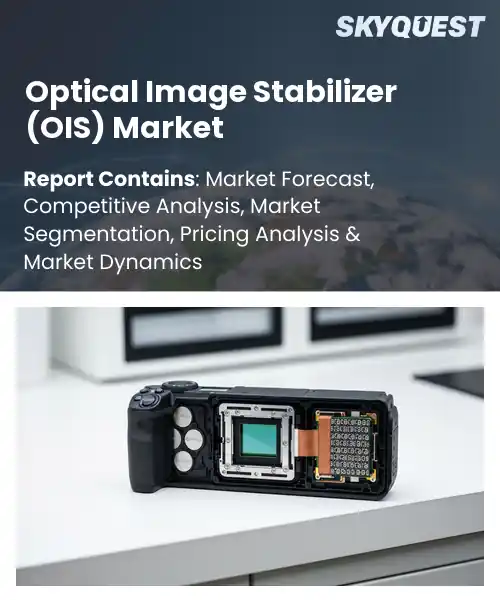
Optical Image Stabilizer (OIS) Market
Report ID: SQMIG45N2201
Report ID: SQMIG45N2201
[email protected]
USA +1 351-333-4748
Report ID:
SQMIG45N2201 |
Region:
Global |
Published Date: March, 2026
Pages:
157
|Tables:
117
|Figures:
77


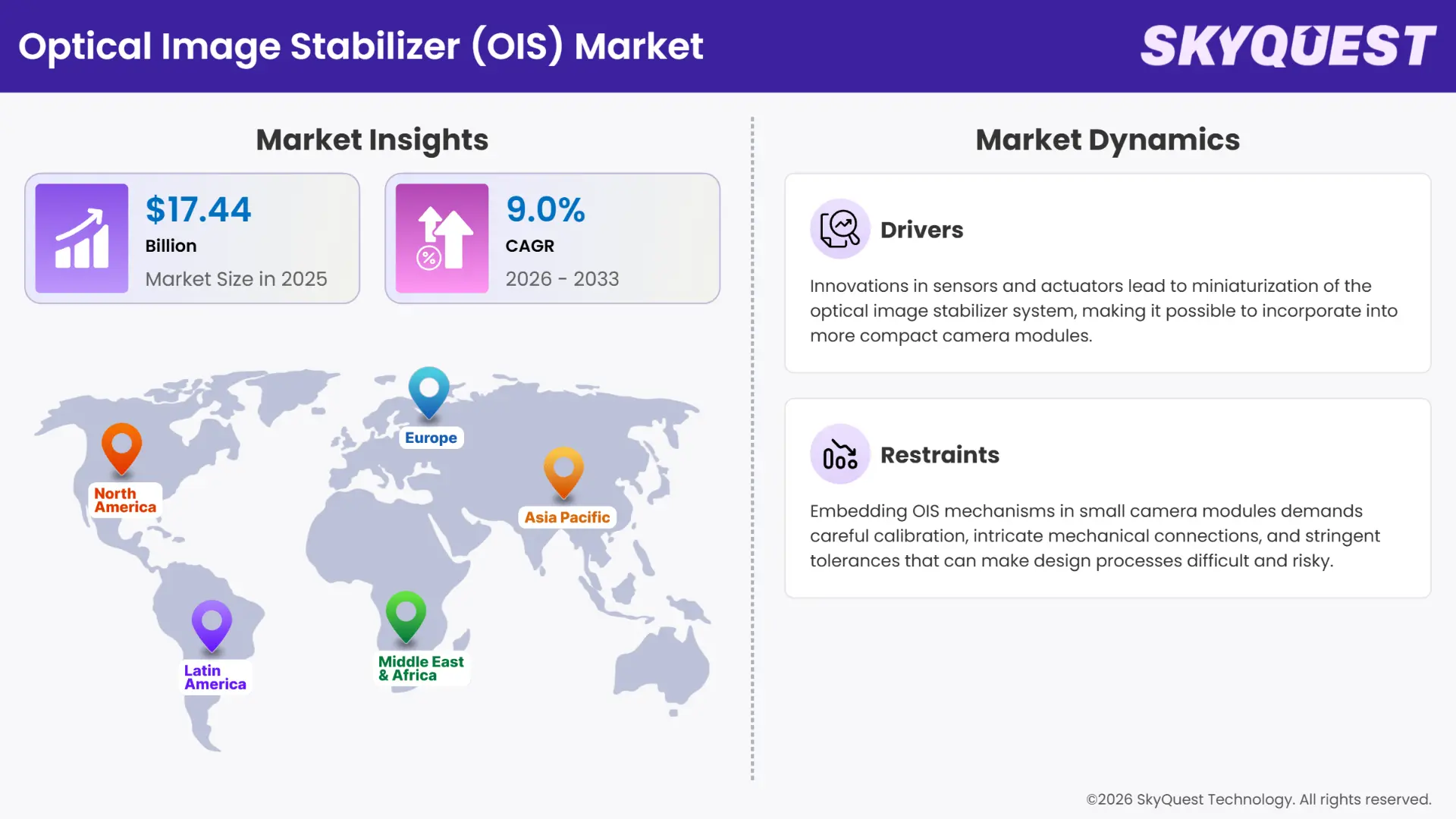
Global Optical Image Stabilizer (OIS) Market size was valued at USD 16.0 Billion in 2024 and is poised to grow from USD 17.44 Billion in 2025 to USD 34.75 Billion by 2033, growing at a CAGR of 9.0% during the forecast period (2026-2033).
Key Takeaways: Market Trends & Insights
Growing demand for high-quality imaging, rising adoption of advanced smartphone cameras, increasing use of video content creation, advancements in camera technologies, and integration of imaging features in consumer electronics are driving sales of optical image stabilizers (OIS).
Improved image sensor resolution and new technological innovations, including the implementation of periscope zoom capability, are only further fueling the demand for good stabilization technology, since high-megapixel images will accentuate any motion-induced artifacts in pictures. In addition, the growing trend toward streaming videos, drone technology, and vehicle vision systems means that there are even more use cases emerging for the employment of stabilization technology. Growing consumer preference for high-resolution photography and videography around the world coupled with increasing demand for enhanced camera performance is expected to primarily drive optical image stabilizer market growth. Surge in sales of smartphones, mirrorless cameras, and action cameras are also prompting investments in the R&D of novel optical image stabilizer (OIS) solutions.
On the contrary, high costs of advanced OIS modules, design complexity, space constraints in compact devices, and performance limitations in extreme conditions are anticipated to impede optical image stabilizer market penetration across the study period.
How is AI Influencing Innovation and Demand for Optical Image Stabilizers?
AI is helping evolve OIS from being entirely mechanical to becoming a hybrid technology. For example, machine learning algorithms can be used to recognize movement, estimate camera shakes, and merge information from gyroscopes and image frames to achieve enhanced stabilization results. Nowadays, there is an increasing trend toward combining multi-axis OIS systems with computational photography based on artificial intelligence technologies to provide better quality photographs taken in low-light conditions and while using zoom.
In March 2026, Qualcomm introduced the Snapdragon Wear Elite with an on-device AI accelerator and enhanced stabilization features. This allows smaller cameras and wearable devices to handle stabilization using AI, reducing reliance on complex mechanical systems, and enabling OIS adoption in new device categories.
To get more insights on this market click here to Request a Free Sample Report
Global optical image stabilizer (OIS) market is segmented by technology architecture, actuator type, application, axis stabilization, and region. Based on technology architecture, the market is segmented into Lens-Shift OIS, Sensor-Shift OIS, and Dual/Hybrid OIS. Based on actuator type, the market is segmented into Voice Coil Motor (VCM) actuators, piezoelectric actuators, and SMA (Shape Memory Alloy) actuators. Based on application, the market is segmented into smartphones & tablets, digital cameras, automotive ADAS cameras, and surveillance & security systems. Based on axis stabilization, the market is segmented into 2-axis stabilization and 3-axis & 5-axis advanced systems. Based on region, the market is segmented into North America, Europe, Asia Pacific, Latin America, and Middle East & Africa.
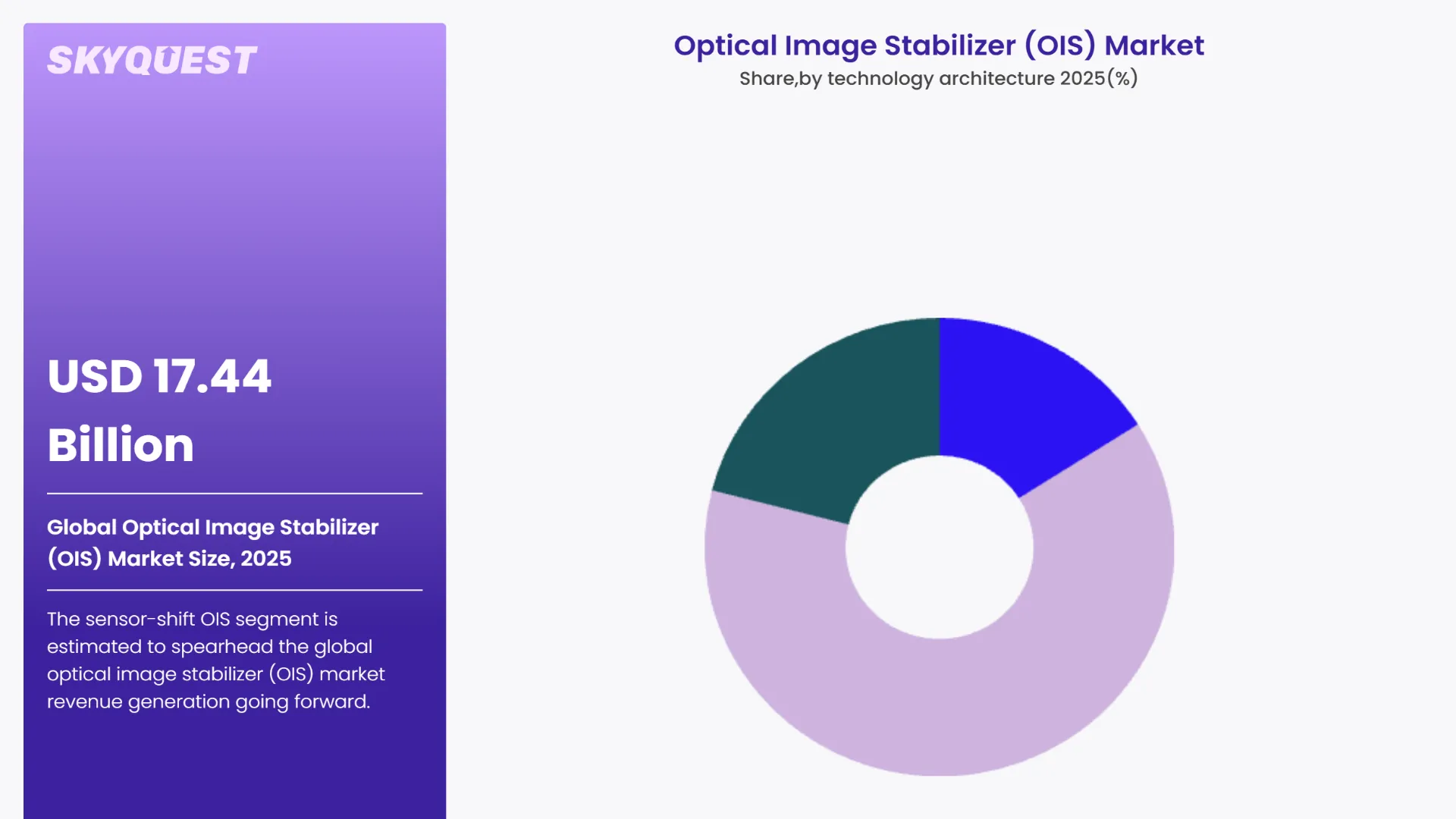
The sensor-shift OIS segment is estimated to spearhead the global optical image stabilizer (OIS) market revenue generation going forward. This solution relocates stabilization to the image sensor, delivering superior correction for both camera shake and motion blur to help this segment hold sway over others. The architecture makes the design easier to integrate with multi-lens modules and makes for an optical system that is smaller in size, which explains why OEMs prefer it. The technology reduces the use of bulky optical systems and allows for uniform performance in poor lighting conditions.
However, dual/hybrid OIS is emerging as the most rapidly expanding segment as per this optical image stabilizer (OIS) industry analysis. Combining lens and sensor motion control to handle complex vibration spectra and long focal length scenarios expands business scope via this segment. Advancements in algorithms and mechanical electronic integration have resulted in greater uptake of image stabilization technology in premium products and have allowed for product differentiation as well as advanced imaging capabilities.
The Voice Coil Motor (VCM) actuators segment is slated to account for the highest global optical image stabilizer (OIS) market share going forward. Simplicity, proven reliability and cost-efficient manufacturing of VCM actuators is forecasted to help this segment hold sway over others in the long run. Their ability to move in a straight line makes their optical adjustments predictable, with only small control circuitry required, thus reducing system complexity when integrated by the OEM. The presence of an already well-established distribution chain, combined with its capability to work with current camera modules, ensures that development times will be kept to a minimum.
In addition, piezoelectric actuators are gaining momentum on account of their fast response time and precise functionality that is able to provide better micro adjustments. Advancements in materials science along with miniaturized driver electronics have allowed them to be used extensively in high-end cameras, providing them with superior performance capabilities.
To get detailed segments analysis, Request a Free Sample Report
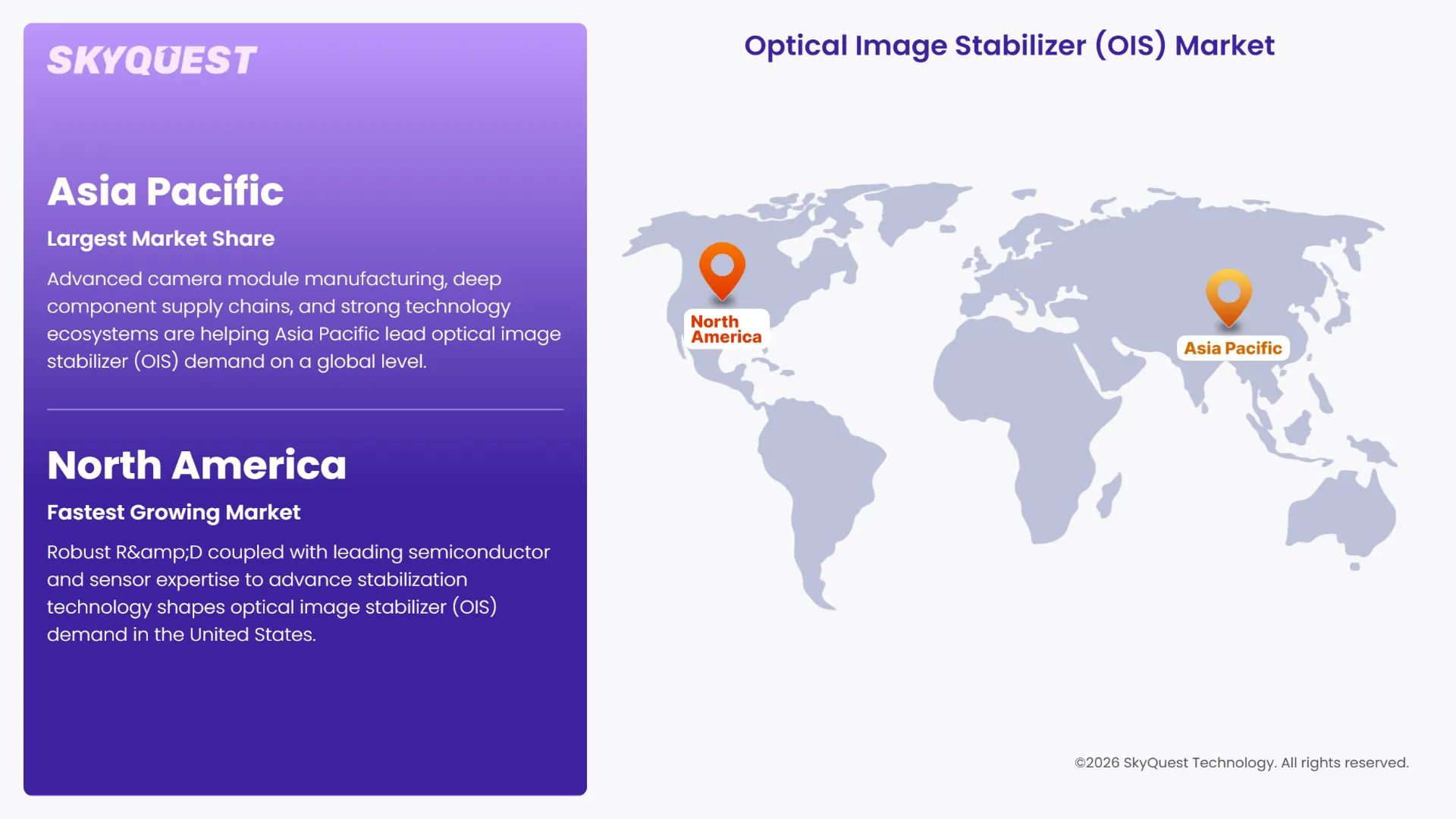
Advanced camera module manufacturing, deep component supply chains, and strong technology ecosystems are helping Asia Pacific lead optical image stabilizer (OIS) demand on a global level. In addition to the influence of regional OEMs and suppliers on development, creating close working relationships with sensors, lenses, actuators, and software developers to rapidly integrate OIS into mobile devices and cameras. Continuous strategic partnerships between chipset manufacturers and camera manufacturers followed by a work force that possesses a high level of engineering capability plus, component suppliers are in close proximity to one another are the major reasons that this region is able to maintain its leadership role in the continued introduction of innovative products and processes for OIS globally. In addition, various government policies designed to support advanced manufacturing and establish a competitive component ecosystem aid further in the regions continued competitiveness.
Deep expertise in precision optics, sensor manufacturing, and actuator technology makes Japan a hub for optical image stabilizer (OIS) innovation in this region. The focus on progressive development of technology, high-quality standards, and system design ensures that outstanding OIS systems are consistently delivered for cameras. The leading electronics companies and their suppliers cooperate with camera producers to fully exploit the potential of the image stabilization system.
High smartphone OEM demand, integrated supply chains, and advanced actuator miniaturization efforts are shaping optical image stabilizer (OIS) demand in South Korea. The local expertise in semiconductors and sensor technology can help to develop stabilization technologies with software algorithms. Ecosystems enable communication between component suppliers and device manufacturers for faster deployment and adaptation. A focus on prototyping, OEM support, and manufacturing is critical to achieving widespread use.
Strong innovation from technology hubs and strategic partnerships between semiconductor firms and camera specialists supports consistent optical image stabilizer (OIS) demand in North America. Rising consumer demand for better video capture in content production, surveillance, and machine vision is leading to an increase in the usage of advanced optical image stabilization solutions. Start-up companies involved with new technology innovations collaborate with existing OEM companies to develop state-of-the-art stabilization techniques that can be integrated into existing algorithms for sensing and computational imaging processes. Other possibilities include the push caused by regulatory compliance in the automotive sector and investing in AR/VR and drone technology. The already existing distribution and service channels can facilitate design wins and commercial success, offering further assistance in making North America one of the most favorable markets.
Robust R&D coupled with leading semiconductor and sensor expertise to advance stabilization technology shapes optical image stabilizer (OIS) demand in the United States. High demand for cameras among content providers and system integrators ensures the development and fine-tuning of their prototypes and facilitates manufacturing in the commercial sector and institutions. Designers of chipsets, makers of cameras, and startup companies involved in imaging technology work together to develop products for professional video, automotive, and industrial vision applications.
Emphasis on imaging research, sensor integration, and system design to support specialized OIS solutions shapes growth in Canada. Engineering expertise and development processes facilitate dependable and application-specific implementation of OIS systems. Collaborations between universities and research institutes with commercial firms speed up the stabilization of algorithms and sensor fusion. Local firms concentrate on niche products and work with foreign firms for product commercialization.
Precision optics expertise, strong automotive and industrial application demand, and cross border collaboration are shaping optical image stabilizer (OIS) procurement in Europe. The development of complementary collaborative research and development networks, integration with emerging sensor and software technologies, an emphasis on manufacturing quality and reliability are all factors that are enabling Europe to provide differentiated products and services to the OIS marketplace. Partnerships between chip makers, optics manufacturers and automotive manufacturers provide a rapid method of validating OIS for use in demanding end-user applications. In addition, a continuing emphasis on diversifying the supply chain and developing engineering talent further enhances Europe’s ability to provide high-value, competitive OIS solutions. Europe has been able to utilize its long-standing competitiveness in lens fabrication, mechatronics and systems engineering to produce high-performance, robust OIS modules for use in automotive, professional imaging and industrial applications.
Mechanical engineering expertise, automotive supply chains, and precision optics manufacturing are helping boost optical image stabilizer (OIS) demand in Germany. Focus on quality and advanced sensors and control systems ensures that German products are highly effective for various applications. Component providers collaborate with vehicle makers and original equipment manufacturers in verifying their performance in extreme conditions.
Strong imaging research, software capability, and a technology startup scene are helping boost optical image stabilizer (OIS) demand in the United Kingdom. Media production and broadcasting have made the need for top-quality video stabilization a priority, while relationships with international parts suppliers have helped OIS find a place in drone and AR markets. Research collaborations among universities, design companies, and system integrators target the development of algorithmic and sensor-based stabilization techniques, as well as miniaturized actuators.
Established optical component manufacturing, strong research in image processing, and heritage of precision instrument design are boosting adoption of OIS in France. Cooperation among optics companies, research institutions, and camera makers facilitates the incorporation of high-quality lenses together with effective stabilization systems. Emphasis on product differentiation, engineering capabilities, and connections with professional photographers and broadcasters ensures the success of niche OIS products in the marketplace.
To know more about the market opportunities by region and country, click here to
Buy The Complete Report
Miniaturization Of Camera Modules
Innovations in sensors and actuators lead to miniaturization of the optical image stabilizer system, making it possible to incorporate into more compact camera modules. As a result, there is room for thinner consumer products, as well as development of innovative forms of devices. In addition, the optimization of mechanisms used in OIS systems makes possible further miniaturization, without loss of effectiveness. The need for optical image stabilization increases in turn because manufacturers try to ensure good quality images despite their efforts to produce thin products.
Rising Smartphone Image Quality Expectations
Consumers are becoming more concerned about the ability to take photos and videos in low light conditions and in motion, causing smartphone producers to spend on sophisticated image stabilizers that would allow taking a clear picture in low light conditions and while moving. Image optical stabilizers help overcome the blur caused by hand movements and use long exposure times without shaking the camera. In this regard, it is consistent with the activities of smartphone producers to create an exclusive product line using cameras.
High Component Integration Complexity
Embedding OIS mechanisms in small camera modules demands careful calibration, intricate mechanical connections, and stringent tolerances that can make design processes difficult and risky. Companies have difficulties achieving stable performance among manufactured units while maximizing yields, which can further delay the process and drive up the cost of device manufacturing. Such technical and manufacturing barriers make it unattractive for smaller companies to deploy sophisticated OIS technologies, resulting in restricted use of OIS only in high-end gadgets.
Supply Chain and Manufacturing Challenges
Dependence on specialist materials and components, assembling OIS requires specific assembly machinery. Disruptions in supply chain operations could therefore affect OIS production, limiting the ability of producers to source components for the devices, and delaying delivery of products to the market. The lengthy time taken to produce some components as well as specialist component requirements further complicate procurement efforts, thereby limiting manufacturers' ability to integrate OIS and slowing down optical image stabilizer (OIS) market outlook.
Request Free Customization of this report to help us to meet your business objectives.
The competitive landscape is shaped by incumbent component suppliers, specialist MEMS and actuator startups, and camera module OEMs competing through technology differentiation, design-ins, and partnerships. Recent examples include MEMS Drive partnering with SmartSens and Sheba Microsystems launching MEMS autofocus and OIS evaluation kits, while consolidation and strategic design-win partnerships with Tier 1 OEMs drive rapid adoption of sensor-shift and micro gimbal solutions.
SkyQuest’s ABIRAW (Advanced Business Intelligence, Research & Analysis Wing) is our Business Information Services team that Collects, Collates, Correlates, and Analyses the Data collected by means of Primary Exploratory Research backed by robust Secondary Desk research.
As per SkyQuest analysis, increase in demand for high-quality imaging and increasing adoption of advanced camera technologies are anticipated to drive the demand for optical image stabilizers (OIS) going forward. However, high costs of advanced OIS modules, design complexity, and space constraints in compact devices are slated to slow down the adoption of optical image stabilizers in the future. Asia Pacific is slated to spearhead the demand for optical image stabilizers owing to the strong presence of leading consumer electronics manufacturers and high adoption of advanced imaging technologies. Advancements in AI-driven computational photography, integration of hybrid optical-electronic stabilization solutions, and development of miniaturized actuators are anticipated to be key trends driving the optical image stabilizer market through 2033 and beyond.
| Report Metric | Details |
|---|---|
| Market size value in 2024 | USD 16.0 Billion |
| Market size value in 2033 | USD 34.75 Billion |
| Growth Rate | 9.0% |
| Base year | 2024 |
| Forecast period | 2026-2033 |
| Forecast Unit (Value) | USD Billion |
| Segments covered |
|
| Regions covered | North America (US, Canada), Europe (Germany, France, United Kingdom, Italy, Spain, Rest of Europe), Asia Pacific (China, India, Japan, Rest of Asia-Pacific), Latin America (Brazil, Rest of Latin America), Middle East & Africa (South Africa, GCC Countries, Rest of MEA) |
| Companies covered |
|
| Customization scope | Free report customization with purchase. Customization includes:-
|
To get a free trial access to our platform which is a one stop solution for all your data requirements for quicker decision making. This platform allows you to compare markets, competitors who are prominent in the market, and mega trends that are influencing the dynamics in the market. Also, get access to detailed SkyQuest exclusive matrix.
Table Of Content
Executive Summary
Market overview
Parent Market Analysis
Market overview
Market size
KEY MARKET INSIGHTS
COVID IMPACT
MARKET DYNAMICS & OUTLOOK
Market Size by Region
KEY COMPANY PROFILES
Methodology
For the Optical Image Stabilizer (OIS) Market, our research methodology involved a mixture of primary and secondary data sources. Key steps involved in the research process are listed below:
1. Information Procurement: This stage involved the procurement of Market data or related information via primary and secondary sources. The various secondary sources used included various company websites, annual reports, trade databases, and paid databases such as Hoover's, Bloomberg Business, Factiva, and Avention. Our team did 45 primary interactions Globally which included several stakeholders such as manufacturers, customers, key opinion leaders, etc. Overall, information procurement was one of the most extensive stages in our research process.
2. Information Analysis: This step involved triangulation of data through bottom-up and top-down approaches to estimate and validate the total size and future estimate of the Optical Image Stabilizer (OIS) Market.
3. Report Formulation: The final step entailed the placement of data points in appropriate Market spaces in an attempt to deduce viable conclusions.
4. Validation & Publishing: Validation is the most important step in the process. Validation & re-validation via an intricately designed process helped us finalize data points to be used for final calculations. The final Market estimates and forecasts were then aligned and sent to our panel of industry experts for validation of data. Once the validation was done the report was sent to our Quality Assurance team to ensure adherence to style guides, consistency & design.
Analyst Support
Customization Options
With the given market data, our dedicated team of analysts can offer you the following customization options are available for the Optical Image Stabilizer (OIS) Market:
Product Analysis: Product matrix, which offers a detailed comparison of the product portfolio of companies.
Regional Analysis: Further analysis of the Optical Image Stabilizer (OIS) Market for additional countries.
Competitive Analysis: Detailed analysis and profiling of additional Market players & comparative analysis of competitive products.
Go to Market Strategy: Find the high-growth channels to invest your marketing efforts and increase your customer base.
Innovation Mapping: Identify racial solutions and innovation, connected to deep ecosystems of innovators, start-ups, academics, and strategic partners.
Category Intelligence: Customized intelligence that is relevant to their supply Markets will enable them to make smarter sourcing decisions and improve their category management.
Public Company Transcript Analysis: To improve the investment performance by generating new alpha and making better-informed decisions.
Social Media Listening: To analyze the conversations and trends happening not just around your brand, but around your industry as a whole, and use those insights to make better Marketing decisions.
REQUEST FOR SAMPLE
 REQUEST FREE CUSTOMIZATION
Global Optical Image Stabilizer (Ois) Market size was valued at USD 16.0 Billion in 2024 and is poised to grow from USD 17.44 Billion in 2025 to USD 34.75 Billion by 2033, growing at a CAGR of 9.0% during the forecast period (2026-2033).
The competitive landscape is shaped by incumbent component suppliers, specialist MEMS and actuator startups, and camera module OEMs competing through technology differentiation, design-ins, and partnerships; recent examples include MEMS Drive partnering with SmartSens and Sheba Microsystems launching MEMS autofocus and OIS evaluation kits, while consolidation and strategic design-win partnerships with Tier 1 OEMs drive rapid adoption of sensor-shift and micro gimbal solutions. 'Sony Corporation', 'Canon Inc.', 'Panasonic Corporation', 'Samsung Electronics', 'Apple Inc.', 'Nikon Corporation', 'LG Electronics', 'OM Digital Solutions', 'Fujifilm Holdings Corporation', 'GoPro Inc.', 'DJI Technology Co., Ltd.', 'Microsoft Corporation', 'Qualcomm Inc.', 'Sharp Corporation', 'Teledyne Technologies Incorporated', 'Vitec Group plc', 'Red Digital Cinema Camera Company', 'Leica Camera AG', 'Olympus Corporation', 'Ricoh Company, Ltd.'
Advances in sensor design and actuator technology enable smaller optical image stabilizer assemblies to be integrated into increasingly compact camera modules, supporting thinner consumer devices and enabling new form factors. This trend reduces space constraints for manufacturers and allows broader adoption across smartphones, wearables, and compact cameras. As engineers optimize mechanical and electronic components for size without compromising performance, demand for OIS solutions grows because device makers seek to maintain or improve image quality while meeting consumer expectations for sleek, lightweight designs.
Mobile Camera Differentiation: OIS has evolved into a key feature for mobile camera differentiation, enabling superior low light performance and smoother video capture across multiple lens modules. Manufacturers leverage stabilization to enhance computational imaging pipelines, improve zoom clarity, and support creative content applications. Demand for thinner modules and seamless integration with autofocus and sensor technologies drives design innovation. Ecosystem partnerships between component suppliers and device makers accelerate product roadmaps, making stabilized imaging a consumer benefit shaping purchasing decisions, brand positioning.
Asia Pacific Dominate the Global Optical Image Stabilizer (OIS) Market.
The Lens-Shift OIS segment currently holds the largest market share due to its widespread adoption in smartphones and digital cameras for delivering improved image and video stabilization performance.
Sensor-Shift OIS is anticipated to register the fastest growth during the forecast period, supported by its ability to provide advanced stabilization and superior imaging performance in modern camera systems.
The market includes Voice Coil Motor (VCM) Actuators, Piezoelectric Actuators, and Shape Memory Alloy (SMA) Actuators. These technologies enable precise movement and stabilization of camera components to reduce image blur caused by motion.


Want to customize this report? This report can be personalized according to your needs. Our analysts and industry experts will work directly with you to understand your requirements and provide you with customized data in a short amount of time. We offer $1000 worth of FREE customization at the time of purchase.
Feedback From Our Clients


 USA (+1) 351-333-4748

