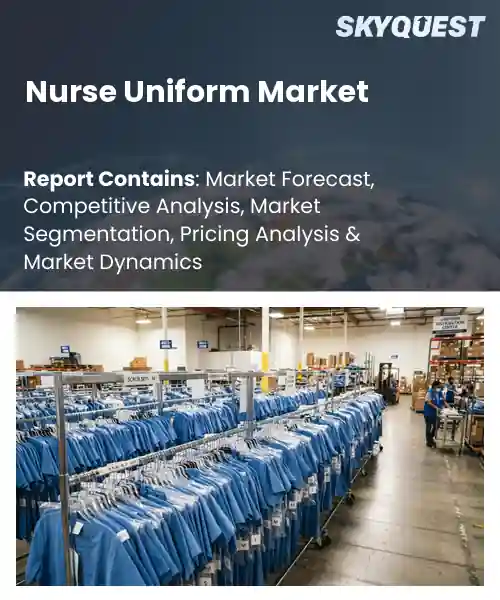
Nurse Uniform Market
Report ID: SQMIG25K2262
Report ID: SQMIG25K2262
[email protected]
USA +1 351-333-4748
Report ID:
SQMIG25K2262 |
Region:
Global |
Published Date: August, 2026
Pages:
157
|Tables:
121
|Figures:
77


Global Nurse Uniform Market size was valued at USD 2.14 Billion in 2024 and is poised to grow from USD 2.26 Billion in 2025 to USD 3.44 Billion by 2033, growing at a CAGR of 5.4% during the forecast period (2026-2033).
The global nurse uniform market includes scrubs, lab coats, and protective apparel purchased by hospitals, clinics, and home‑care agencies to clothe staff. Its importance lies in protecting clinicians and presenting a professional image that boosts patient confidence. The driver of expansion is the rising demand for healthcare services, spurred by aging populations and chronic‑disease prevalence, which compels providers to hire nurses and increase uniform consumption. Over past two decades sector has shifted from basic cotton garments to polyester blends, antimicrobial finishes, and recycled‑fabric fibers, exemplified by health systems adopting antimicrobial scrubs in 2018 and hospitals mandating recycled‑fabric uniforms in 2021. Building on the shift toward materials, sustainability has become the pivotal factor shaping the global nurse uniform market, because hospitals now face pressure to reduce carbon footprints and comply with stricter procurement guidelines. This regulatory impetus compels manufacturers to develop recycled‑polyester and biodegradable blends, which in turn open lucrative contracts with health systems seeking green credentials; for instance, a UK NHS trust awarded a supply deal to a vendor offering 70 % recycled‑content scrubs in 2022. Simultaneously, the integration of RFID tags into garments enables inventory tracking, reducing waste and lowering operating costs, thereby reinforcing the business case for product lines.
How is AI-driven customization influencing the nurse uniform market?
AI driven customization is reshaping the nurse uniform market by linking individual preferences with rapid manufacturing. Brands are leveraging machine learning to analyze feedback on fabric comfort, fit and style, then automatically adjust patterns for each user. This creates a more personal shopping experience while reducing returns and excess inventory. The approach also speeds up design cycles, allowing companies to respond to emerging trends without lengthy manual re‑work. As hospitals seek cost‑effective solutions, AI driven tools offer a way to maintain high quality standards and meet diverse staff needs, reinforcing the sector’s overall growth trajectory.BestEx Scrubs, February 2026, introduced an AI driven design platform that generates perfectly fitted, personalized scrubs from nurse‑submitted measurements, cutting production waste and accelerating delivery, thereby strengthening market efficiency.
Market snapshot - (2026-2033)
Global Market Size
USD 2.14 Billion
Largest Segment
Polymeric Nanoparticles
Fastest Growth
Polymeric Nanoparticles
Growth Rate
5.4% CAGR
To get more insights on this market click here to Request a Free Sample Report
Global nurse uniform market is segmented by product type, fabric, end user, distribution channel and region. Based on product type, the market is segmented into Scrub Tops, Scrub Pants, Scrub Sets, Dresses & Tunics and Jackets & Outerwear. Based on fabric, the market is segmented into Cotton, Polyester, Cotton-Polyester Blends and Performance & Stretch Fabrics. Based on end user, the market is segmented into Hospitals, Clinics & Physician Offices, Nursing Homes & Long-Term Care and Home Healthcare. Based on distribution channel, the market is segmented into Institutional Procurement, Specialty & Medical Stores and Online Retail. Based on region, the market is segmented into North America, Europe, Asia Pacific, Latin America and Middle East & Africa.
Scrub sets segment dominates because they offer a complete, coordinated look that simplifies purchasing decisions for institutions and reduces inventory complexity. By bundling tops and pants, they meet the demand for consistent branding and hygiene standards, while delivering cost efficiencies through bulk manufacturing. Their versatility across clinical settings enhances adoption, and the ease of uniform management makes them the preferred choice for procurement teams seeking streamlined solutions and operational efficiency.
However, dresses & tunics segment emerges as the key high growth area as healthcare facilities prioritize style alongside functionality, encouraging staff retention and morale. Innovative cut and seam designs and softer drape attract a broader workforce, while flexible fabric blends meet comfort expectations, accelerating market expansion and creating new branding opportunities.
Cotton polyester blends segment dominates because it marries the natural breathability of cotton with the resilience of polyester, fulfilling the core demand for comfort and longevity in clinical apparel. This hybrid fabric tolerates frequent laundering and resists wrinkles, which aligns with strict hygiene protocols. Its cost effective production supports large scale procurement, while the balanced tactile feel meets staff preferences, cementing its leading position in uniform sourcing decisions.
On the other hand, performance and stretch fabrics segment is witnessing growth momentum as infection control standards push for materials that maintain shape and elasticity after repeated sanitization cycles. Advanced moisture wicking and antimicrobial treatments attract facilities seeking upgrades, and the comfort boost drives staff adoption, propelling market expansion.
To get detailed segments analysis, Request a Free Sample Report
North America leverages a mature healthcare infrastructure combined with strong brand presence of leading uniform manufacturers. The region benefits from rigorous quality standards and a culture that values professional attire as a component of patient safety and staff identity. Robust supply chain networks ensure timely delivery and customization, while continuous innovation in fabric technology meets demanding clinical environments. Collaborative relationships between hospitals, educational institutions, and suppliers foster a consistent demand cycle, reinforcing market leadership. Additionally, heightened focus on infection control and staff well‑being drives adoption of advanced uniform solutions, sustaining North America’s dominant position.
Nurse Uniform Market in the United States reflects deep integration of advanced textile technologies with stringent regulatory expectations. Healthcare providers prioritize durability, comfort, and antimicrobial features, prompting manufacturers to invest in research that aligns with clinical workflows. Institutional procurement processes emphasize reliability and brand reputation, fostering long‑term supplier partnerships. The diverse range of care settings, from acute hospitals to community clinics, creates varied uniform specifications, encouraging product differentiation and niche specialization. Continuous professional development programs reinforce the importance of appropriate attire, further cementing the market’s vitality.
Nurse Uniform Market in Canada is shaped by a strong commitment to safety and sustainability within the healthcare sector. Provincial health authorities place emphasis on environmentally responsible materials, prompting suppliers to adopt eco‑friendly fabrics without compromising performance. Uniform designs are tailored to accommodate harsh climate considerations, ensuring comfort across seasonal variations. Collaborative procurement frameworks between hospitals and uniform providers support consistent quality standards and foster innovation through feedback loops. The emphasis on inclusive sizing and gender‑neutral options reflects broader social values, reinforcing market resilience and growth.
Europe’s expansion is propelled by a convergence of regulatory harmonization, heightened awareness of occupational health, and growing emphasis on sustainability. Uniform manufacturers respond to stringent EU directives on textile safety and environmental impact, advancing eco‑conscious product lines that resonate with hospitals striving for greener operations. Cross‑border collaboration among research institutes fuels development of high‑performance fabrics that address diverse clinical demands. Consumer expectations for comfort, style, and personalized branding encourage a shift toward modular uniform systems. Moreover, strong public‑private partnerships facilitate knowledge exchange, accelerating adoption of innovative solutions across the continent, thereby reinforcing Europe’s rapid market growth.
Nurse Uniform Market in Germany stands as a benchmark for precision engineering and quality assurance within the sector. Healthcare facilities prioritize robust, breathable fabrics that support intensive care environments, prompting manufacturers to adopt meticulous testing protocols. Strong collaboration between medical institutions and textile innovators drives continuous refinement of antimicrobial and fluid‑resistant properties. The market also benefits from a culture of efficiency, where standardized sizing and streamlined logistics enhance procurement reliability. Emphasis on vocational training ensures that uniform usage aligns with clinical best practices, sustaining Germany’s dominant market position.
Nurse Uniform Market in the United Kingdom is characterized by swift adoption of adaptable uniform solutions that respond to evolving clinical workflows. Heightened focus on infection prevention and staff well‑being drives demand for garments with advanced barrier technologies. Collaborative initiatives between NHS trusts and manufacturers foster rapid prototype testing and feedback integration, accelerating product cycles. The market also embraces flexible sizing and gender‑inclusive designs, reflecting broader societal shifts toward diversity. Strong procurement frameworks that prioritize cost‑effectiveness without sacrificing quality underpin the United Kingdom’s status as a fast‑growing market.
Nurse Uniform Market in France is emerging through a blend of tradition and innovation, with a growing appetite for environmentally responsible fabrics. French healthcare providers emphasize elegance and comfort, encouraging designers to integrate aesthetic considerations with functional performance. Partnerships with research laboratories catalyze development of smart textiles that enhance wearer ergonomics. Regulatory alignment with EU standards ensures consistent safety benchmarks, while regional procurement strategies support local manufacturers, fostering market diversification. This emerging dynamic positions France as a notable contributor to Europe’s expanding uniform landscape.
Asia Pacific is consolidating its role by capitalizing on rapid healthcare expansion, technological adoption, and cultural emphasis on professional appearance. Manufacturers are investing in research that blends traditional textile expertise with cutting‑edge performance characteristics, meeting the rigorous demands of modern medical facilities. There is a pronounced focus on integrating breathable, antimicrobial, and moisture‑wicking features to suit diverse climatic conditions across the region. Collaborative networks between hospitals, universities, and textile innovators accelerate product development cycles, while rising awareness of staff morale and patient perception drives demand for well‑designed uniforms. These strategic efforts collectively reinforce Asia Pacific’s strengthening market presence.
Nurse Uniform Market in Japan blends meticulous craftsmanship with advanced material science to meet exacting clinical standards. Healthcare institutions prioritize seamless integration of comfort and hygiene, prompting manufacturers to develop ultra‑lightweight fabrics with superior odor control. The market benefits from strong collaboration between medical schools and textile firms, fostering iterative design improvements. Cultural appreciation for uniformity and professionalism further fuels demand for high‑quality, consistently styled garments. Continuous refinement of ergonomic features ensures that the uniform supports prolonged wear, reinforcing Japan’s influential role in the regional market.
Nurse Uniform Market in South Korea is driven by a dynamic fusion of technological innovation and aesthetic sensibility. Manufacturers leverage cutting‑edge fiber engineering to produce garments that offer excellent fluid resistance and temperature regulation, essential for high‑tempo clinical settings. Partnerships with leading hospitals enable rapid testing of prototype designs, ensuring alignment with practitioner needs. Growing consumer awareness of workplace wellness encourages incorporation of ergonomic tailoring and anti‑fatigue features. The market’s focus on sleek, contemporary styling alongside functional performance underscores South Korea’s advancing position within the Asia Pacific uniform sector.
To know more about the market opportunities by region and country, click here to
Buy The Complete Report
Rising Emphasis on Infection Control
Shift Toward Sustainable Materials
High Cost Of Advanced Fabrics
Stringent Regulatory Compliance Requirements
Request Free Customization of this report to help us to meet your business objectives.
Competition in the global nurse uniform market is intensifying as legacy textile manufacturers secure large hospital contracts and adopt antimicrobial and smart‑fabric technologies, while VC‑backed entrants receive capital to launch tech‑enhanced scrubs. Recent moves include Nurse Capital’s $1 million fund targeting RN‑led uniform innovators and MaxQ Medical’s $10 million seed round to pilot sensor‑enabled apparel, highlighting a shift toward integrated care solutions.
Top Player’s Company Profile
Recent Developments
SkyQuest’s ABIRAW (Advanced Business Intelligence, Research & Analysis Wing) is our Business Information Services team that Collects, Collates, Correlates, and Analyses the Data collected by means of Primary Exploratory Research backed by robust Secondary Desk research. As per SkyQuest analysis the global nurse uniform market is projected to reach $3.44 billion by 2033, driven primarily by the rising emphasis on infection‑control standards that push hospitals toward antimicrobial and easy‑to‑sanitize fabrics. A second strong catalyst is the shift toward sustainable materials as health providers adopt recycled‑polyester and biodegradable blends to meet environmental targets. The market’s growth is modestly tempered by the high cost of these advanced textiles, which can strain limited procurement budgets. North America remains the dominant region thanks to its mature healthcare infrastructure and robust supply chains, while scrub sets lead the product landscape by offering coordinated, cost‑effective outfits that simplify purchasing for institutions.
| Report Metric | Details |
|---|---|
| Market size value in 2024 | USD 2.14 Billion |
| Market size value in 2033 | USD 3.44 Billion |
| Growth Rate | 5.4% |
| Base year | 2024 |
| Forecast period | (2026-2033) |
| Forecast Unit (Value) | USD Billion |
| Segments covered |
|
| Regions covered | North America (US, Canada), Europe (Germany, France, United Kingdom, Italy, Spain, Rest of Europe), Asia Pacific (China, India, Japan, Rest of Asia-Pacific), Latin America (Brazil, Rest of Latin America), Middle East & Africa (South Africa, GCC Countries, Rest of MEA) |
| Companies covered |
|
| Customization scope | Free report customization with purchase. Customization includes:-
|
To get a free trial access to our platform which is a one stop solution for all your data requirements for quicker decision making. This platform allows you to compare markets, competitors who are prominent in the market, and mega trends that are influencing the dynamics in the market. Also, get access to detailed SkyQuest exclusive matrix.
Table Of Content
Executive Summary
Market overview
Parent Market Analysis
Market overview
Market size
KEY MARKET INSIGHTS
COVID IMPACT
MARKET DYNAMICS & OUTLOOK
Market Size by Region
KEY COMPANY PROFILES
Methodology
For the Nurse Uniform Market, our research methodology involved a mixture of primary and secondary data sources. Key steps involved in the research process are listed below:
1. Information Procurement: This stage involved the procurement of Market data or related information via primary and secondary sources. The various secondary sources used included various company websites, annual reports, trade databases, and paid databases such as Hoover's, Bloomberg Business, Factiva, and Avention. Our team did 45 primary interactions Globally which included several stakeholders such as manufacturers, customers, key opinion leaders, etc. Overall, information procurement was one of the most extensive stages in our research process.
2. Information Analysis: This step involved triangulation of data through bottom-up and top-down approaches to estimate and validate the total size and future estimate of the Nurse Uniform Market.
3. Report Formulation: The final step entailed the placement of data points in appropriate Market spaces in an attempt to deduce viable conclusions.
4. Validation & Publishing: Validation is the most important step in the process. Validation & re-validation via an intricately designed process helped us finalize data points to be used for final calculations. The final Market estimates and forecasts were then aligned and sent to our panel of industry experts for validation of data. Once the validation was done the report was sent to our Quality Assurance team to ensure adherence to style guides, consistency & design.
Analyst Support
Customization Options
With the given market data, our dedicated team of analysts can offer you the following customization options are available for the Nurse Uniform Market:
Product Analysis: Product matrix, which offers a detailed comparison of the product portfolio of companies.
Regional Analysis: Further analysis of the Nurse Uniform Market for additional countries.
Competitive Analysis: Detailed analysis and profiling of additional Market players & comparative analysis of competitive products.
Go to Market Strategy: Find the high-growth channels to invest your marketing efforts and increase your customer base.
Innovation Mapping: Identify racial solutions and innovation, connected to deep ecosystems of innovators, start-ups, academics, and strategic partners.
Category Intelligence: Customized intelligence that is relevant to their supply Markets will enable them to make smarter sourcing decisions and improve their category management.
Public Company Transcript Analysis: To improve the investment performance by generating new alpha and making better-informed decisions.
Social Media Listening: To analyze the conversations and trends happening not just around your brand, but around your industry as a whole, and use those insights to make better Marketing decisions.
REQUEST FOR SAMPLE
 REQUEST FREE CUSTOMIZATION


Want to customize this report? This report can be personalized according to your needs. Our analysts and industry experts will work directly with you to understand your requirements and provide you with customized data in a short amount of time. We offer $1000 worth of FREE customization at the time of purchase.
Feedback From Our Clients


 USA (+1) 351-333-4748

