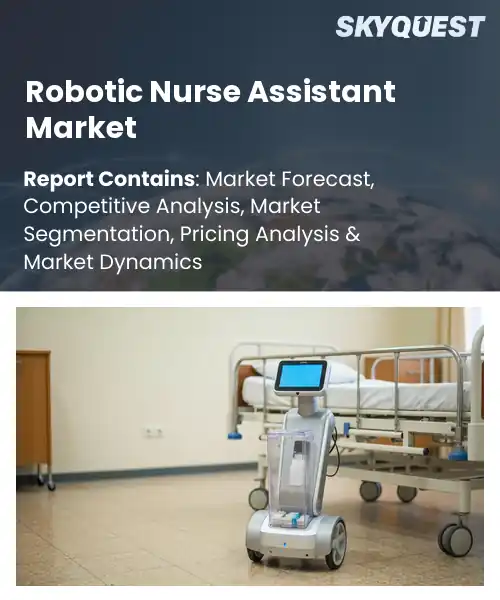
Robotic Nurse Assistant Market
Report ID: SQMIG35A3487
Report ID: SQMIG35A3487
[email protected]
USA +1 351-333-4748
Report ID:
SQMIG35A3487 |
Region:
Global |
Published Date: May, 2026
Pages:
157
|Tables:
179
|Figures:
79


Global Robotic Nurse Assistant Market size was valued at USD 2.10 Billion in 2024 and is poised to grow from USD 2.43 Billion in 2025 to USD 7.92 Billion by 2033, growing at a CAGR of 15.9% during the forecast period (2026-2033).
The major driver of the robotic nurse assistant market growth is the confluence of chronic disease prevalence, aging populations, and workforce shortages that create demand for scalable care solutions. Robotic nurse assistants consist of autonomous and semi autonomous platforms aiding with medication delivery, vital sign monitoring, mobility assistance and tasks. The market matters as it can increase patient care capacity while reducing clinician burnout and infection risk. In the past decade, pilots in long term care facilities and hospitals have transitioned from telepresence units to multifunctional mobile robots, such as deployments that reduced routine caregiver trips and sped response during infectious outbreaks.
A major growth factor is rapid advancement in AI and sensor fusion and systems integration that allow for safer autonomy and EHR connectivity. As these capabilities improve hospitals see measurable time savings that justify capital outlays. Examples include autonomous assistants like supply and medication carriers that have reduced nurse walking time and allowed clinicians to focus more on patient care, which increases throughput and reduces adverse events. Regulatory guidance and reimbursement pilots further catalyze adoption, as cost offsets are seen by payors, attracting funding from investors for scale up and manufacturers to reduce unit costs, unlocking opportunities in home care, rehabilitation and rural tele nursing deployments.
How is AI-driven Automation Transforming the Robotic Nurse Assistant Market?
Automation powered by AI is transforming the robotic nurse assistant market by combining machine perception, onboard decision making, and task orchestration to perform routine logistics and assistive tasks. Important elements include safe navigation in clinical spaces, adaptive task triage and natural interaction with staff and patients. Robots delivering medication and supplies in the early commercial deployments to minimize walking and administrative burden so nurses can spend more time at the bedside. They’re built for collaborative robotics, working with people, and align with research that shows collaborative robotics can reduce physical strain and free up clinical capacity powered by edge AI and integrated sensors.
Serve Robotics January 2026, completed the acquisition of Diligent Robotics and its Moxi hospital assistant, a move that underscores how AI-powered automation scales indoor logistics while simplifying workflows and relieving staffing pressures so clinical teams can focus on direct patient care.
Market snapshot - (2026-2033)
Global Market Size
USD 2.1 Billion
Largest Segment
Collaborative Robotic Nurse Assistants (Cobots)
Fastest Growth
Autonomous Robotic Nurse Assistants
Growth Rate
15.9% CAGR
To get more insights on this market click here to Request a Free Sample Report
Global robotic nurse assistant market is segmented by type, functionality, technology, mobility, deployment mode, end user and region. Based on type, the market is segmented into autonomous robotic nurse assistants, semi-autonomous robotic nurse assistants and collaborative robotic nurse assistants (Cobots). Based on functionality, the market is segmented into patient monitoring assistance, medication delivery & dispensing assistance, patient handling & mobility assistance, disinfection & sanitization assistance, telepresence & communication assistance, logistics & material transport assistance, rehabilitation & elderly care assistance and others. Based on technology, the market is segmented into artificial intelligence-based robots, machine learning-enabled robots, sensor & vision-based robots, cloud-connected robotic systems and iot-integrated robotic systems. Based on mobility, the market is segmented into mobile robotic nurse assistants and stationary robotic nurse assistants. Based on deployment mode, the market is segmented into on-premise systems and cloud-integrated systems. Based on end user, the market is segmented into hospitals, clinics, elderly care centers & nursing homes, rehabilitation centers, home healthcare settings and ambulatory surgical centers. Based on region, the market is segmented into North America, Europe, Asia Pacific, Latin America and Middle East & Africa.
The autonomous robotic nurse assistants is dominating the market as fully autonomous systems are able to work round the clock with minimal human intervention, performing routine clinical tasks reliably, and allowing nursing staff to focus on complex care. Their improved navigation and integration capabilities drive adoption by increasing workflow efficiency, reducing task duplication, and decreasing error rates. Such capability delivers real operational advantages that impact procurement priorities for care providers.
However, the semi-autonomous robotic nurse assistants segment is the fastest growing segment as hybrid systems combine automation with human oversight which addresses safety and regulatory concerns. The lower implementation complexity and flexible control models of these systems facilitate wider adoption in clinical and home settings, enabling incremental automation and new applications that expand market opportunities.
The patient monitoring assistance segment is dominating owing to continuous remote measurement and automated alerting that directly solve critical clinical needs and help to detect deterioration early and prioritize care. Better integration with electronic health records and more sophisticated sensor arrays improve clinical decision support, reducing the load of manual observations. These capabilities position monitoring assistance as a key investment for providers seeking to improve patient safety and operational efficiency, influencing how they buy and deploy across care settings.
On the other hand, the telepresence & communication assistance segment is witnessing the highest growth momentum with the rise of virtual consultations and remote collaboration. Its ability to engage patients, clinicians and family with real time interactions enhances care continuity and enables decentralized delivery. Advances in audiovisual integration and platform interoperability are broadening applications and creating new opportunities for service expansion.
To get detailed segments analysis, Request a Free Sample Report
North America is leading due to its concentrated healthcare infrastructure, advanced research in medical robotics, and mature pathways for clinical evaluation and adoption. Integration between academic centers, specialty hospitals and technology vendors accelerates real world pilots and iterative product refinement. Commercialisation and service model development are enabled by strong private investment and regulatory clarity that is supportive. clinician trust through a focus on interoperability with electronic health systems, clinician education programmes and evidence generation. Continued workforce pressures and strong emphasis on patient safety and workflow optimization drive health systems to adopt scalable robotic nurse assistant solutions backed by a robust maintenance and service network.
Robotic nurse assistant market share in United States is driven by presence of academic medical centers, active investors and formal procurement routes. Clinical research and interoperability expectations support electronic system integration. Health system pilots and focused clinician training encourage adoption as vendors adapt solutions for diverse care environments. The demand for advanced robotic nursing platforms across the market is supported by the focus on workflow efficiency, patient safety and bundled services that include implementation and maintenance.
Robotic nurse assistant market outlook in Canada is an expression of public health system priorities for equity in access and collaboration between hospitals and technology providers. Clinician engagement and regional procurement facilitates phased adoption across acute and community care settings. Vendors collaborate with healthcare networks to customize solutions to address workforce priorities and rural care needs. Training support, localized service arrangements, and interoperability expectations enable integrated deployment of nurse assistant robotics across varied care pathways.
In Europe, expansion is being driven by commonalities in healthcare priorities with workforce sustainability, patient safety and integrated care delivery being key. Cross-national collaboration between research institutions, technology vendors and health systems accelerates clinical pilots and knowledge sharing. Commercialization and national procurement initiatives are supported by regulatory harmonization and market access pathways that allow broader trials. Adoption is varied across hospitals and community care, driven by increasing interest in robotics to deal with clinician workload together with investment in health technology implementation and regional innovation clusters. Co-design with clinicians and multilingual training enable integration and data protection norms guide product features. Early adopter health networks and assessment frameworks lead the way in identifying where to adopt and reward vendors that provide high levels of training and maintenance services.
Robotic nurse assistant market forecast in Germany is supported by a strong robotics base, integrated hospital networks and procurement processes allowing for scalable deployments. The focus on clinical evidence and interoperability drives integration with hospital IT and workforce training programs. Manufacturers, research centers and health providers collaborate to improve solutions for acute care. The adoption of systems that reduce routine burden and improve care continuity is underpinned by national priority on workforce resilience and patient safety.
Robotic nurse assistant market regional outlook in United Kingdom is growing rapidly, supported by dynamic hospital networks, funding for innovation and a culture of piloting. Trials assess impact on workflow and patient experience with focus on digital transformation and retention. Strong partnerships between technology incubators, universities and health trusts accelerate testing and refinement. Focus on scalable service models, clinician training and integration with electronic systems will help achieve a wider adoption across acute and community care pathways.
Robotic nurse assistant market in regional forecast in France y pilot programs, partnerships with technology firms and government innovation initiatives. The emphasis on introducing robotics into hospitals and community care aims to relieve pressure on the workforce and improve the patient experience. Vendors stress language and care protocol customization, and interoperability with national health information systems. Collaboration with regional health authorities and academic centers facilitates evidence generation and the development of sustainable deployment and service models.
Asia-Pacific is making strides thanks to technological prowess, manufacturing scale, and targeted healthcare innovation, all working in concert to boost regional competitiveness. The presence of already established robotics and electronics industries allows rapid prototyping and adaptation of nurse assistant platforms to fit local care practices and languages. Public-private partnerships accelerate clinical pilots, as national initiatives promote integration of automation to address aging populations and workforce limitations. Focusing on human centered design, interoperability with existing hospital systems and a localized service network helps translate prototypes into practical deployments across acute and long term care settings. Industry players in the region combine clinical feedback cycles with manufacturing efficiency to shorten time to deployment and tailor sales service. The role of nurse assistant robots is expanding through clinical validation with universities and hospitals, and through the convergence of telehealth and remote monitoring. In some markets, coordinated regulatory approaches, combined with export oriented manufacturing, strengthen the region’s ability to serve domestic and international healthcare partners.
Robotic nurse assistant market penetration in Japan, an existing robotics ecosystem and tight links between technology companies and clinical institutions. Cultural acceptance of service robots and priorities in elder care drive deployment in hospitals and community settings. Vendors are concentrating on human-centered interaction, safety certification, and integration with care management platforms. Publicly funded programs and private partnerships supporting clinical pilots and training activities enhance usability and facilitate scale-up across a range of care settings.
Robotic nurse assistant industry in South Korea draws on its expertise in advanced electronics, manufacturing capability and close industry-academic partnerships to accelerate development. The clinical pilots in hospitals deal with workflow augmentation, patient interaction and integration with national health information systems. Local manufacturers emphasize user friendly interfaces, modular platforms, and after sales services networks for maintenance and upgrades. Government innovation programs and export oriented strategies foster scalability and collaboration with international health systems.
To know more about the market opportunities by region and country, click here to
Buy The Complete Report
Aging Population Demand
AI Integration and Automation
High Capital Expenditure
Data Privacy and Security Concerns
Request Free Customization of this report to help us to meet your business objectives.
The robotic nurse assistant market is a competitive space with fast-paced innovation in AI-enabled healthcare automation, rising investment activity and growing hospital adoption of collaborative service robots. To tackle nurse burnout and improve operational efficiency, market players are focusing on autonomous mobility, human-robot interaction, integration into workflow and automation of tasks. Big names such as Diligent Robotics, SoftBank Robotics and PARO Robots are strengthening their positions through AI upgrades, strategic partnerships and a move into eldercare and hospital logistics.
One major competitive trend is the transition from experimental pilot deployments to scalable commercial hospital automation. Machine learning, computer vision, voice interaction and predictive navigation are increasingly being incorporated by companies into robotic nurse assistants to better coordinate workflow within hospitals. For example, Moxi by Diligent Robotics has been deployed in a number of U.S. hospitals to transport supplies, lab samples, medications and linens, helping to reduce the non-clinical burden for nurses. The company collected data from more than 1.25 million hospital deliveries and rolled out Moxi 2.0 with improved AI computing capabilities.
Top Player’s Company Profile
Recent Developments in the Robotic Nurse Assistant Market
SkyQuest’s ABIRAW (Advanced Business Intelligence, Research & Analysis Wing) is our Business Information Services team that Collects, Collates, Correlates, and Analyses the Data collected by means of Primary Exploratory Research backed by robust Secondary Desk research.
As per SkyQuest analysis, the aging populations and increasing burden of chronic disease coupled with shortages of nursing workforce is the main drivers of global robotic nurse assistant market, which is mandating the adoption of scalable automation by providers. A second major driver is rapid advances in AI and sensor fusion that enhance autonomy, safety and EHR integration. Commercialization is being driven by mature infrastructure, investment, and clinical pilots in North America where adoption is centered. Autonomous robotic nurse assistants are the leading segment due to continuous low-intervention operations and clear workflow benefits. High upfront capital expenditure for hardware, integration and training is the main restraint, despite clear operational value, slowing broader deployment, particularly among smaller providers.
| Report Metric | Details |
|---|---|
| Market size value in 2024 | USD 2.1 Billion |
| Market size value in 2033 | USD 7.92 Billion |
| Growth Rate | 15.9% |
| Base year | 2024 |
| Forecast period | (2026-2033) |
| Forecast Unit (Value) | USD Billion |
| Segments covered |
|
| Regions covered | North America (US, Canada), Europe (Germany, France, United Kingdom, Italy, Spain, Rest of Europe), Asia Pacific (China, India, Japan, Rest of Asia-Pacific), Latin America (Brazil, Rest of Latin America), Middle East & Africa (South Africa, GCC Countries, Rest of MEA) |
| Companies covered |
|
| Customization scope | Free report customization with purchase. Customization includes:-
|
To get a free trial access to our platform which is a one stop solution for all your data requirements for quicker decision making. This platform allows you to compare markets, competitors who are prominent in the market, and mega trends that are influencing the dynamics in the market. Also, get access to detailed SkyQuest exclusive matrix.
Table Of Content
Executive Summary
Market overview
Parent Market Analysis
Market overview
Market size
KEY MARKET INSIGHTS
COVID IMPACT
MARKET DYNAMICS & OUTLOOK
Market Size by Region
KEY COMPANY PROFILES
Methodology
For the Robotic Nurse Assistant Market, our research methodology involved a mixture of primary and secondary data sources. Key steps involved in the research process are listed below:
1. Information Procurement: This stage involved the procurement of Market data or related information via primary and secondary sources. The various secondary sources used included various company websites, annual reports, trade databases, and paid databases such as Hoover's, Bloomberg Business, Factiva, and Avention. Our team did 45 primary interactions Globally which included several stakeholders such as manufacturers, customers, key opinion leaders, etc. Overall, information procurement was one of the most extensive stages in our research process.
2. Information Analysis: This step involved triangulation of data through bottom-up and top-down approaches to estimate and validate the total size and future estimate of the Robotic Nurse Assistant Market.
3. Report Formulation: The final step entailed the placement of data points in appropriate Market spaces in an attempt to deduce viable conclusions.
4. Validation & Publishing: Validation is the most important step in the process. Validation & re-validation via an intricately designed process helped us finalize data points to be used for final calculations. The final Market estimates and forecasts were then aligned and sent to our panel of industry experts for validation of data. Once the validation was done the report was sent to our Quality Assurance team to ensure adherence to style guides, consistency & design.
Analyst Support
Customization Options
With the given market data, our dedicated team of analysts can offer you the following customization options are available for the Robotic Nurse Assistant Market:
Product Analysis: Product matrix, which offers a detailed comparison of the product portfolio of companies.
Regional Analysis: Further analysis of the Robotic Nurse Assistant Market for additional countries.
Competitive Analysis: Detailed analysis and profiling of additional Market players & comparative analysis of competitive products.
Go to Market Strategy: Find the high-growth channels to invest your marketing efforts and increase your customer base.
Innovation Mapping: Identify racial solutions and innovation, connected to deep ecosystems of innovators, start-ups, academics, and strategic partners.
Category Intelligence: Customized intelligence that is relevant to their supply Markets will enable them to make smarter sourcing decisions and improve their category management.
Public Company Transcript Analysis: To improve the investment performance by generating new alpha and making better-informed decisions.
Social Media Listening: To analyze the conversations and trends happening not just around your brand, but around your industry as a whole, and use those insights to make better Marketing decisions.
REQUEST FOR SAMPLE
 REQUEST FREE CUSTOMIZATION
Global Robotic Nurse Assistant Market size was valued at USD 2.1 Billion in 2024 and is poised to grow from USD 2.43 Billion in 2025 to USD 7.92 Billion by 2033, growing at a CAGR of 15.9% during the forecast period (2026-2033).
I need to verify current, post 2019 startups and recent market developments to meet your requirement for latest verified data. May I perform a brief web search and then produce the Competitive Landscape section you specified? 'Intuitive Surgical', 'Stryker Corporation', 'Omnicell, Inc.', 'Aethon, Inc.', 'Diligent Robotics', 'Panasonic Holdings Corporation', 'Toyota Motor Corporation', 'Cyberdyne Inc.', 'SoftBank Robotics Group Corp.', 'FANUC Corporation', 'ABB Ltd.', 'KUKA AG', 'Samsung Electronics Co., Ltd.', 'Medtronic plc', 'Becton, Dickinson and Company', 'Swisslog Healthcare', 'Ava Robotics', 'Vecna Technologies, Inc.', 'Relay Robotics, Inc.', 'OhmniLabs, Inc.'
Robotic nurse assistants address growing care needs as older adults require continuous monitoring, assistance with daily activities, and chronic disease management. By taking over routine, repetitive, and physically demanding tasks, these systems free clinical staff to focus on complex care, improving workflow efficiency and reducing caregiver fatigue. Enhanced patient safety through fall prevention and medication reminders increases institutional confidence in automation, encouraging procurement and integration. The perceptible ability to maintain quality of care with fewer human resources motivates healthcare providers to adopt robotic solutions more broadly.
Workforce Augmentation And Skills: Adoption of robotic nurse assistants is accelerating transformation of caregiver roles by augmenting routine tasks and enabling staff to concentrate on higher value clinical and interpersonal work. Healthcare providers are investing in interdisciplinary training and management to integrate robots into care teams preserve therapeutic relationships. This trend emphasizes collaborative workflows, ergonomic design, and user-centered interfaces that support clinician acceptance. It also drives new competency frameworks and certification pathways as institutions redefine professional responsibilities and emphasize human oversight alongside automated assistance.
Why does North America Dominate the Global Robotic Nurse Assistant Market? |@12


Want to customize this report? This report can be personalized according to your needs. Our analysts and industry experts will work directly with you to understand your requirements and provide you with customized data in a short amount of time. We offer $1000 worth of FREE customization at the time of purchase.
Feedback From Our Clients


 USA (+1) 351-333-4748

