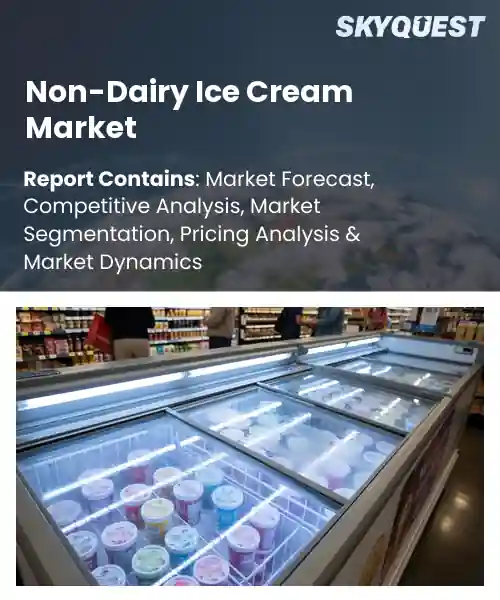
Non-Dairy Ice Cream Market
Report ID: SQMIG30I2904
Report ID: SQMIG30I2904
[email protected]
USA +1 351-333-4748
Report ID:
SQMIG30I2904 |
Region:
Global |
Published Date: May, 2026
Pages:
157
|Tables:
147
|Figures:
73


Global Non-Dairy Ice Cream Market size was valued at USD 3.52 Billion in 2024 and is poised to grow from USD 3.88 Billion in 2025 to USD 8.52 Billion by 2033, growing at a CAGR of 10.32% during the forecast period (2026-2033).
Non-dairy ice cream has emerged as a segment of the frozen desserts market that substitutes plant-based milks and alternative fats for dairy, driven primarily by changing consumer preferences toward health, sustainability and lactose-free diets. This primary driver reflects broader shifts in food consumption and lifestyle choices, including increasing veganism, rising awareness of dairy allergies, and public concern about agricultural emissions. The market matters because it reaches mainstream buyers seeking indulgence and niche consumers demanding functional ingredients, illustrated by almond, oat and coconut ranges from startups and brands. Over the last decade innovation accelerated via emulsifiers, flavor engineering and retail strategy.Because consumers demanded dairy-equivalent taste and added health benefits, producers allocated R&D budgets to refine bases and mouthfeel, producing products that finally matched consumer expectations and unlocked mainstream retail distribution. Consequently supermarkets and foodservice increased assortment, which motivated flagships such as Ben & Jerry's and Häagen-Dazs to introduce non-dairy lines that proved category scalability in mass channels. Scaling lowered per-unit costs and allowed private labels to compete on price, while format innovation in pints and single-serve cups expanded usage occasions. These changes created openings for fortified variants with protein or probiotics, presenting growth opportunities in performance nutrition and digestive health.
How is AI enhancing product innovation in the non-dairy ice cream market?
AI is reshaping product innovation in the non dairy ice cream market by speeding formulation, predicting sensory outcomes, and enabling smarter ingredient substitution. Key aspects include flavor design, texture simulation, and selecting sustainable inputs guided by machine learning. The market is responding to consumer demand for better taste and clean ingredient lists so brands use AI to reproduce dairy like creaminess and to pre test stability and melt performance before pilot production. These tools let product teams iterate faster, explore novel base ingredients, and align new launches with consumer preferences while reducing development uncertainty.The Magnum Ice Cream Company September 2025, announced a partnership with NotCo to apply Giuseppe AI to develop plant based formats and optimize formulations. That real world move shows how AI speeds flavor and texture development and helps manage ingredient choices which supports faster product rollouts and more efficient scale up in the non dairy ice cream market.
Market snapshot - (2026-2033)
Global Market Size
USD 3.52 Billion
Largest Segment
Almond Milk
Fastest Growth
Oat Milk
Growth Rate
10.32% CAGR
To get more insights on this market click here to Request a Free Sample Report
Global non-dairy ice cream market is segmented by base ingredient, flavor, format, distribution, consumer and region. Based on base ingredient, the market is segmented into Coconut Milk, Almond Milk, Oat Milk, Cashew Milk and Soy Milk. Based on flavor, the market is segmented into Vanilla, Chocolate, Fruit-Based and Others. Based on format, the market is segmented into Tubs/Pints, Bars and Sandwiches. Based on distribution, the market is segmented into Supermarkets, Online and Specialty Stores. Based on consumer, the market is segmented into Vegans, Lactose Intolerant and Health-Conscious. Based on region, the market is segmented into North America, Europe, Asia Pacific, Latin America and Middle East & Africa.
What role do coconut milk bases play in non-dairy ice cream product development? |@12
Coconut Milk segment dominates because its inherent fat structure and creamy mouthfeel enable product formulations that closely mimic dairy texture, simplifying formulation work for manufacturers and improving consumer acceptance. Its stable emulsion properties and compatibility with flavor inclusions reduce reliance on heavy stabilizers, while familiar tropical flavor profiles support indulgent positioning. Manufacturers favor coconut for predictable processing behavior and broad ingredient synergy, reinforcing its prominence in product portfolios.
However, Oat Milk is emerging as the most rapidly expanding option due to its neutral flavor profile, perceived sustainability credentials and ease of emulsification, driving adoption among mainstream consumers and innovators. Its adaptability for creamy bases and compatibility with clean label claims accelerates new product launches and creates incremental retail and online opportunities.
How are vegan consumers shaping non-dairy ice cream innovation and positioning? |@12
Vegans segment leads because concentrated consumer demand for entirely plant-based options compels brands to prioritize taste parity, certification, and transparent sourcing, driving broad portfolio investment. Vegan-focused marketing amplifies community advocacy and social media momentum, which influences mainstream retail listings and R&D resource allocation. This focused consumer group prompts innovation across flavor systems, texture technologies and ingredient sourcing, establishing vegan preferences as a strategic growth anchor for manufacturers and retailers.
However, Health Conscious consumers are the fastest expanding cohort as demand for lower sugar, functional ingredients and protein enriched formulations grows, prompting brands to reformulate and launch targeted ranges. Their preference for clean labels and nutrient forward positioning fuels product differentiation and partnerships with nutrition platforms, opening adjacent shelf space and premiumization pathways for future market growth.
To get detailed segments analysis, Request a Free Sample Report
Why does North America Dominate the Global Non-Dairy Ice Cream Market? |@12
North America dominates through a convergence of consumer openness to plant based diets, broad retail infrastructure, and a well established culture of product innovation and premiumization. Established food industry networks and strong private label presence enable rapid distribution of new formulations alongside mainstream brands. Robust foodservice channels and sophisticated marketing ecosystems amplify awareness and trial. Ingredient sourcing capacity and investment in processing technologies support a wide array of textures and flavors tailored to local palates. Regulatory frameworks and certification systems for alternative dairy products provide clarity that encourages manufacturer and retailer participation. Collaboration between startups and established manufacturers accelerates product development and broadens appeal across age groups. Retail promotions and sampling programs in varied channels further support penetration.
United States Non-Dairy Ice Cream Market |@12
Non-Dairy Ice Cream Market in United States reflects a sophisticated consumer palate and high readiness to trial plant based frozen desserts, driven by mainstream brand activity, artisanal makers, and wide retail availability. Innovation in flavors and textures, combined with targeted marketing and partnerships with foodservice operators, has broadened appeal beyond niche buyers. Supply chain sophistication and ingredient innovation enable premium positioning with seasonal limited edition launches that keep engagement high.
Canada Non-Dairy Ice Cream Market |@12
Non-Dairy Ice Cream Market in Canada is characterized by strong retailer support for plant based options and active participation by specialty producers and mainstream brands, creating offerings across price and quality tiers. Consumer interest in clean labels and environmental credentials informs product development, while regional ingredient sourcing and artisan craftsmanship differentiate local portfolios. Collaboration between local manufacturers and retailers facilitates broader sampling and shelf presence, reinforcing acceptance across demographic groups.
What is Driving the Rapid Expansion of Non-Dairy Ice Cream Market in Europe? |@12
Europe rapid expansion is driven by converging consumer trends toward plant based eating, heightened interest in health and sustainability attributes, and a dynamic retail and foodservice landscape that favors trial and premiumization. Strong culinary traditions encourage localized flavor innovation while cross country distribution networks allow successful concepts to scale. Private label and artisanal segments both contribute to breadth of choice, with retailers investing in distinct ranges to meet diverse shopper needs. Policy dialogue and certification schemes provide clearer labeling frameworks that reduce uncertainty for manufacturers and consumers. Market momentum is further supported by brand collaborations, ingredient innovation that improves sensory parity with dairy, and rising visibility of non dairy options in mainstream outlets. Ecommerce platforms and retailers amplify reach and enable niche flavors to find audiences, while sampling programs in stores and events accelerate conversion to purchase. Collaboration with chefs and patissiers elevates premium positioning and drives media attention.
Germany Non-Dairy Ice Cream Market |@12
Non-Dairy Ice Cream Market in Germany is supported by a strong manufacturing base and retail network that hosts mainstream and specialty offerings. Private label presence and culinary experimentation drive product refinement, while regional ingredient sourcing underpins quality control. Consumer focus on clear labeling and sustainability encourages formulation and packaging improvements. Partnerships between brands and retailers enhance visibility and help transition products from niche counters into regular supermarket assortments more widely.
United Kingdom Non-Dairy Ice Cream Market |@12
Non-Dairy Ice Cream Market in United Kingdom benefits from fast consumer trend adoption and strong activity from disruptive brands and manufacturers. Ecommerce and specialist retailers enable trial of novel bases and flavor concepts, while foodservice collaborations and pop ups drive experiential sampling. Media and influencer engagement amplify awareness, prompting retailers to broaden shelf presence and back premium indulgent formulations alongside health oriented options that cater to diverse consumer preferences broadly.
France Non-Dairy Ice Cream Market |@12
Non-Dairy Ice Cream Market in France is emerging from artisanal tradition and rising interest in plant focused indulgence, as patissiers and boutique producers trial alternative creams and regional flavors. Specialty gelato outlets and select retailers introduce premium non dairy options alongside classic choices, appealing to consumers seeking gourmet experiences with cleaner ingredient lists. Culinary collaborations with manufacturers elevate craftsmanship and help expand these products beyond niche artisanal counters into markets.
How is Asia Pacific Strengthening its Position in Non-Dairy Ice Cream Market? |@12
Asia Pacific is strengthening its position through a combination of culinary adaptation, ingredient innovation, and expanding distribution channels that resonate with local tastes and preferences. Manufacturers experiment with regionally relevant bases and flavors while improving textural attributes to match consumer expectations for indulgence. Growing retail modernisation and rapid e commerce adoption create routes to market for both artisanal makers and larger brands, enabling niche concepts to scale. Investment in processing and cold chain capabilities reduces logistical barriers, and partnerships between global players and local producers accelerate knowledge transfer. Increasing promotional activity, festival presence, and culinary collaborations boost visibility and foster trial among consumers who value novelty, health positioning, and sustainability credentials, reinforcing regional momentum. Rising consumer spending and premiumization trends encourage innovation in indulgent formats and packaging, while retailer own label strategies increase accessibility. Cross border e commerce and international partnerships also open pathways for recognition of regionally developed formulations.
Japan Non-Dairy Ice Cream Market |@12
Non-Dairy Ice Cream Market in Japan emphasizes craftsmanship and sensory refinement, with manufacturers and producers focusing on texture and subtle flavor balances that align with local palates. Traditional bases such as soy and rice inspire innovations alongside plant milks, while convenience channels and specialty retailers introduce novel formats to consumers seeking both indulgence and restraint. Collaborations with culinary professionals and packaging design support premium positioning and encourage sampling across centers.
South Korea Non-Dairy Ice Cream Market |@12
Non-Dairy Ice Cream Market in South Korea is shaped by a vibrant cafe culture and appetite for novel flavors. Trend brands and indie producers experiment with unconventional bases and bold taste combinations, backed by agile ecommerce and convenience retail networks. Consumers favor visually striking formats and collaborations that tap pop culture and influencer channels. Focus on refined textures and premium packaging helps non dairy products stand alongside traditional indulgent offerings.
To know more about the market opportunities by region and country, click here to
Buy The Complete Report
Drivers |@12
Rising Health Consciousness Among Consumers
Innovation In Product Formulation
Restraints |@12
Higher Production Costs And Margins
Regulatory And Labeling Challenges
Request Free Customization of this report to help us to meet your business objectives.
Competitive landscape shows intense competition between legacy CPGs and agile foodtechs over retail and foodservice shelf space, driven by demand for dairy-equivalent taste and functionality. Firms pursue concrete strategies such as CPG partnerships with precision fermentation suppliers exemplified by Unilever and Perfect Day, and retail rollouts by specialty challengers exemplified by Eclipse Foods securing Whole Foods listings, while M&A and distribution tie ups accelerate scale and shelf presence.
Top Player’s Company Profile
Recent Developments
SkyQuest’s ABIRAW (Advanced Business Intelligence, Research & Analysis Wing) is our Business Information Services team that Collects, Collates, Correlates, and Analyses the Data collected by means of Primary Exploratory Research backed by robust Secondary Desk research. As per SkyQuest analysis, the global non-dairy ice cream market is driven primarily by rising health consciousness among consumers seeking dairy-free, better-for-you indulgence and further propelled by innovation in product formulation that improves texture and flavor parity with dairy. Growth is restrained by higher production costs and margin pressures tied to specialized ingredients and processing. North America remains the dominant region due to strong retail infrastructure, consumer openness to plant-based diets and robust innovation ecosystems, while coconut milk bases lead the segment mix thanks to their creamy mouthfeel and formulation reliability. Market momentum favors brands that balance sensory quality, sustainability and clear labeling.
| Report Metric | Details |
|---|---|
| Market size value in 2024 | USD 3.52 Billion |
| Market size value in 2033 | USD 8.52 Billion |
| Growth Rate | 10.32% |
| Base year | 2024 |
| Forecast period | (2026-2033) |
| Forecast Unit (Value) | USD Billion |
| Segments covered |
|
| Regions covered | North America (US, Canada), Europe (Germany, France, United Kingdom, Italy, Spain, Rest of Europe), Asia Pacific (China, India, Japan, Rest of Asia-Pacific), Latin America (Brazil, Rest of Latin America), Middle East & Africa (South Africa, GCC Countries, Rest of MEA) |
| Companies covered |
|
| Customization scope | Free report customization with purchase. Customization includes:-
|
To get a free trial access to our platform which is a one stop solution for all your data requirements for quicker decision making. This platform allows you to compare markets, competitors who are prominent in the market, and mega trends that are influencing the dynamics in the market. Also, get access to detailed SkyQuest exclusive matrix.
Table Of Content
Executive Summary
Market overview
Parent Market Analysis
Market overview
Market size
KEY MARKET INSIGHTS
COVID IMPACT
MARKET DYNAMICS & OUTLOOK
Market Size by Region
KEY COMPANY PROFILES
Methodology
For the Non-Dairy Ice Cream Market, our research methodology involved a mixture of primary and secondary data sources. Key steps involved in the research process are listed below:
1. Information Procurement: This stage involved the procurement of Market data or related information via primary and secondary sources. The various secondary sources used included various company websites, annual reports, trade databases, and paid databases such as Hoover's, Bloomberg Business, Factiva, and Avention. Our team did 45 primary interactions Globally which included several stakeholders such as manufacturers, customers, key opinion leaders, etc. Overall, information procurement was one of the most extensive stages in our research process.
2. Information Analysis: This step involved triangulation of data through bottom-up and top-down approaches to estimate and validate the total size and future estimate of the Non-Dairy Ice Cream Market.
3. Report Formulation: The final step entailed the placement of data points in appropriate Market spaces in an attempt to deduce viable conclusions.
4. Validation & Publishing: Validation is the most important step in the process. Validation & re-validation via an intricately designed process helped us finalize data points to be used for final calculations. The final Market estimates and forecasts were then aligned and sent to our panel of industry experts for validation of data. Once the validation was done the report was sent to our Quality Assurance team to ensure adherence to style guides, consistency & design.
Analyst Support
Customization Options
With the given market data, our dedicated team of analysts can offer you the following customization options are available for the Non-Dairy Ice Cream Market:
Product Analysis: Product matrix, which offers a detailed comparison of the product portfolio of companies.
Regional Analysis: Further analysis of the Non-Dairy Ice Cream Market for additional countries.
Competitive Analysis: Detailed analysis and profiling of additional Market players & comparative analysis of competitive products.
Go to Market Strategy: Find the high-growth channels to invest your marketing efforts and increase your customer base.
Innovation Mapping: Identify racial solutions and innovation, connected to deep ecosystems of innovators, start-ups, academics, and strategic partners.
Category Intelligence: Customized intelligence that is relevant to their supply Markets will enable them to make smarter sourcing decisions and improve their category management.
Public Company Transcript Analysis: To improve the investment performance by generating new alpha and making better-informed decisions.
Social Media Listening: To analyze the conversations and trends happening not just around your brand, but around your industry as a whole, and use those insights to make better Marketing decisions.
REQUEST FOR SAMPLE
 REQUEST FREE CUSTOMIZATION


Want to customize this report? This report can be personalized according to your needs. Our analysts and industry experts will work directly with you to understand your requirements and provide you with customized data in a short amount of time. We offer $1000 worth of FREE customization at the time of purchase.
Feedback From Our Clients


 USA (+1) 351-333-4748

