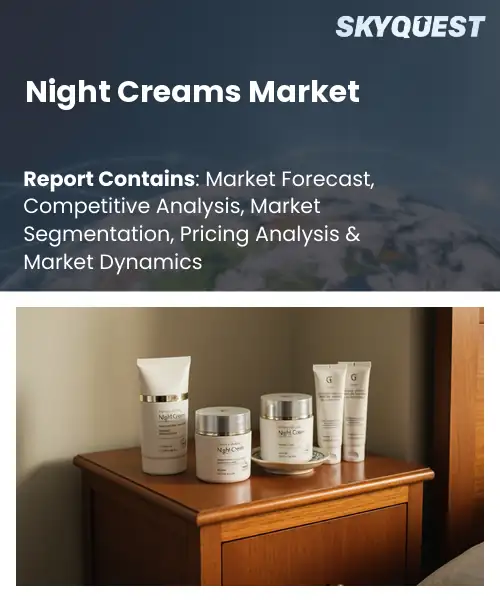
Night Creams Market
Report ID: SQMIG30L2369
Report ID: SQMIG30L2369
[email protected]
USA +1 351-333-4748
Report ID:
SQMIG30L2369 |
Region:
Global |
Published Date: May, 2026
Pages:
157
|Tables:
207
|Figures:
80


Global Night Creams Market size was valued at USD 9.5 Billion in 2024 and is poised to grow from USD 10.94 Billion in 2025 to USD 33.95 Billion by 2033, growing at a CAGR of 15.2% during the forecast period (2026-2033).
The night creams market focuses on topical products meant for skin repair at night. The major factor contributing to this night creams market growth is that as the population ages, consumers are becoming increasingly focused on preparing their skin to prevent future skin issues. This segment is very important in the beauty industry because some formulations are designed to concentrate active ingredients that have the potential to change the way your skin behaves, especially when they are used in conjunction with extended periods of time when the skin barrier is being repaired (the result is a product with demonstrated efficacy). In the past twenty years, night cream formulations have evolved from simple occlusive products (e.g., petroleum jelly) to more advanced serums and multifunctional creams (due to advances in ingredient technology).
For example, ingredients such as retinol, peptides, and hyaluronic acid no longer need to be purchased solely through dermatologist offices since they can now be found in retail (Korean Beauty, e-commerce). In addition to ingredient technology, there is a greater emphasis on digital selling methods, as well as the disruptive trend towards using new active ingredients and/or better-targeted delivery systems. Therefore, consumer perception of efficacy increases and consumer willingness to pay increases. The transformation of retinoid derivatives and peptide complexes into stable night creams allows direct-to-consumer brands and retailer brands to develop a large enough clinical science narrative about how a brand-smfretailers would drive site to site cross-selling.
For most brands (mass-market and prestige brands), using the cosmetic ingredient technology advancements in conjunction with the nighttime opportunity resulted in a split of consumers based on the brand (mass vs. prestige). This convergence creates opportunities for personalized regimens, subscription models and sustainable formats, and retailers and startups prioritize R&D, clinical testing and omnichannel launches globally.
How is AI Transforming The Night Creams Market?
AI is reshaping the night creams market by personalizing treatments, accelerating formulation research, and sharpening consumer targeting. Key aspects include AI driven skin analysis for tailored routines, machine learning that predicts ingredient interactions for gentler actives, and automation that streamlines product testing and supply planning. Today many brands use digital skin diagnostics and recommendation engines to match richer night formulas to individual concerns. This shift responds to consumer demand for bespoke nocturnal care and helps brands bring targeted products to market faster while reducing trial and error and minimizing ingredient waste, making offerings feel more relevant and effective.
L'Oréal March 2026, announced an expanded partnership with NVIDIA to apply predictive AI to molecular and formulation discovery. This innovation speeds discovery of actives and enables more efficient testing and bespoke night cream formulations, supporting faster product launches and improved operational efficiency in research and production.
Market snapshot - (2026-2033)
Global Market Size
USD 9.5 Billion
Largest Segment
Anti-Aging Night Creams
Fastest Growth
Skin Brightening Night Creams
Growth Rate
15.2% CAGR
To get more insights on this market click here to Request a Free Sample Report
Global night creams market is segmented by product type, ingredient type, skin type, consumer group, age group, price range, distribution channel and region. Based on product type, the market is segmented into Anti-Aging Night Creams, Hydrating & Nourishing Night Creams, Skin Brightening Night Creams, Acne Treatment Night Creams, Repair & Recovery Night Creams and Firming & Lifting Night Creams. Based on ingredient type, the market is segmented into Natural/Organic, Synthetic/Chemical-Based and Hybrid Formulations. Based on skin type, the market is segmented into Dry Skin, Oily Skin, Combination Skin, Sensitive Skin and Normal Skin. Based on consumer group, the market is segmented into Women, Men and Unisex. Based on age group, the market is segmented into Below 25 Years, 25–40 Years, 41–55 Years and Above 55 Years. Based on price range, the market is segmented into Mass Market, Premium and Luxury. Based on distribution channel, the market is segmented into Supermarkets & Hypermarkets, Specialty Beauty Stores, Pharmacies & Drug Stores, Online Retail, Direct Selling and Department Stores. Based on region, the market is segmented into North America, Europe, Asia Pacific, Latin America and Middle East & Africa.
As per night creams market analysis, the Anti-Aging Night Creams category leads in sales because customers place a high premium on visible results when managing the appearance of aging. Anti-aging brands also spend heavily on clinically validated active ingredients and advanced methods of delivering those active ingredients effectively to the consumer’s skin. Considerable amounts of research have been conducted on retinoids, peptides, and various cellular renewal technologies that provide significant visible benefits to consumers, resulting in continued repeat purchases. Furthermore, retail premiumization, physician endorsement and aspirational brand marketing have resulted in development of a loyal brand following and help maintain a strong presence at retail level. This can help attract investment into product development and further solidify this category as the leader in the marketplace.
As per night creams market forecast, growth of the Hydrating & Nourishing Night Creams category is among the fastest-growing product categories within the skincare industry, aided by an increase in the general popularity of daily skincare routines, and a growing demand for product solutions to help repair the skin barrier. New product developments of long-lasting moisturizers, sleeping masks, and skin repairing complexes appeal to all ages and all skin types represent mass market growth opportunities and provide for continued expansion of distribution into both traditional retail and online channels as well.
The natural/organic category is leading in sales due to the consumer demand for clean beauty products that are perceived as safe and reliable. These categories also use certifications like EPA, USDA, etc., to enhance the consumer's trust and their purchasing decisions when choosing between different brands of products. Because consumers with sensitive skin or looking for wellness-oriented products seek out transparency in sourcing, as well as using plant-derived actives, this has prompted brands to reformulate their existing products to highlight where their ingredients come from. Retailers tend to favor stocking products from the natural/organic category within their stores because they believe they have a lower regulatory risk than synthetically produced products. Furthermore, they believe these products have higher profit margins, which provides an incentive to increase the shelf visibility and maintain ongoing innovation within botanical technologies and/or gentle preservatives.
As per night creams market outlook, hybrid formulations have become a rapidly growing segment of the beauty products market, as they combine both botanical actives and high-performance synthetic ingredients to provide consumers with visible results while also providing a clean image. The use of hybrid formulations allows for scientific validation and broader claim sets, appealing to both wellness-oriented consumers as well as results-oriented consumers, thereby accelerating product innovation, diversifying portfolios, and expanding into multiple channels of distribution.
To get detailed segments analysis, Request a Free Sample Report
As per night creams market regional analysis, the dominant region is Asia-Pacific. The Asia-Pacific region has large numbers of consumers who regularly use night creams. It is also home to two major beauty markets - Japan & South Korea. Consumers have very high expectation of the effectiveness of night creams; as such, companies have heavily invested in developing advanced & unique formulations as well as sourcing novel actives. Additionally, regional cosmeceutical companies have mastered fast product development cycles & effective supply chain management, allowing them to quickly launch products that meet current trends. Large-scale use of e-commerce and well-developed networks of social media influences allow brands to promote new & innovative concepts. Brands are also focusing on premiumizing their products, as well as providing products that specifically target consumers' needs. There has been a significant increase in the combined use of traditional beauty principles with modern dermatological practices by Asian brands, resulting in significant differentiation in product offerings to consumers throughout the Asia-Pacific. Lastly, companies are forming strong strategic alliances with local universities & research institutes to develop new ingredients and formulate products using these ingredients, which only serves to strengthen & perpetuate the overall leadership of Asia-Pacific in the global night creams market.
In terms of Japanese Night Creams market, they have become very high-end and consumers really want creams with nice textures that are backed by scientific formulation. They are also going to look for ingredients to be gentle but work, while still providing a great sensory experience. Domestic brands focus a lot on conducting thorough research, following regulations and developing heritage formulations, as well as adapting them using more innovative ingredients. Distribution takes advantage of having a presence at traditional department stores, as well as targeted e-retail and specialty boutiques have allowed consumers in urban areas who purchase night creams to steadily acquire innovative night products.
The South Korean Night Creams market is completely trend driven and consumers have high receptiveness to new textures and ingredient formulations. Skincare has roots in cultural tradition and there is a significant demand for targeted solutions to help solve skincare problems at night. Locally based innovators use a combination of rapid product development cycles, influencer engagement and cross-channel retailing to develop products with more advanced formulations. Urban markets have been focused on the benefits of brightening, hydrating and repairing their skin barriers, which have allowed for extensive product experimentation by consumers who want the best products available.
As per night creams market regional outlook, the rapid growth of North America's regional beauty market is the result of increased consumer recognition of targeted skincare, as well as an evolving cultural approach toward preventive and restorative self-care. Consumer demand is shifting toward clinically-proven product lines and brands that can clearly communicate the benefits of their products through partnerships with dermatologists and other professional channels. The ability to purchase direct-to-consumer and primarily through digital means increases the ability for niche and prestige brands to reach targeted customers through new products easily discovered and personalized by consumers. As consumers are placing a high value on ingredient transparency, sustainability, and clean-formulation stories, there are numerous opportunities for brands to reformulate or introduce new products. The retail environment represents a combination of specialty beauty, pharmacies, and online marketplaces, with varying price points and distribution strategies. The combination of these factors has created an environment in which innovation, brand storytelling, and convenience combine to enable accelerated growth in the North American Regional Beauty Market. Investment into clinical research and partnerships with professional skincare channels will further commit to the validity of products and actively support trial among consumers across the total market.
The Night Creams Market in the United States has a strong demand for clinically validated actives and multifunctional formulations. Night Cream brands differentiate themselves by using science-led product positioning strategies, dermatologist endorsements, and targeted messaging strategies. Retail types for these brands include prestige counters, specialty e-commerce, and DTC channels that help consumers discover new products easily. Additionally, clean beauty narratives, personalized product options, and the channels utilized by brands create an overall competitive marketplace that focuses on both efficacy and appeal.
The Night Creams Market in Canada has a diverse consumer base who is interested in purchasing clean formulations that provide ingredient transparency. Night Cream brands differentiate themselves by producing formulas with gentle and climate remain resilient textures that can adapt to the various climate conditions and seasons throughout the year, which also helps to influence brand loyalty. Retail channels for Canadian Night Cream brands typically consist of pharmacy chains as well as specialty boutiques and e-commerce platforms which can support small niche players providing them with a retail presence. Cross border flow of specific Night Cream brands from the United States into Canada is helping to develop consumer expectations for professional validation and commitment to sustainability with the resulting increase in innovation for natural actives and eco-friendly packaging solutions.
Through the use of stricter regulations than other regions, well-known existing players in the industry, and increasing attention to sustainable practices and sourcing of ingredients, Europe is expanding its influence within the global market for night creams. In key markets, consumers around the world expect brands to provide high-quality products with safe manufacturing processes and socially responsible sourcing of ingredients. As a result, many companies have responded by investing in certified organic or natural ingredients and environmentally friendly packaging. Because many companies are combining their expertise in traditional botanical remedies with modern dermatological research to create new and unique product stories, there is significant opportunity for manufacturers to provide premium quality products that feature a combination of new technology and historical references/traditions. There are various appropriate channels through which to distribute these premium products - i.e. pharmacies, department stores, or specialty perfumeries - which assist consumers in making educated purchases. The collaboration between manufacturers and research institutions across Europe has resulted in a variety of independent brands offering distinct products that appeal to both conservative and trend-setting consumers throughout Europe. By providing a consistent regulatory framework, along with certification of products, companies increase consumers' trust in their brand, enabling companies to differentiate themselves in the marketplace via clinical evidence of product performance and by providing sustainability credentials that will resonate with educated consumers.
In Germany's Night Creams Market, the clinical credibility of a product and its tolerability are important factors that influence the consumer's decision to purchase a product. These are also heavily influenced by both recommendations from pharmacies and dermatologists. Gentle formulations that are developed with the goal of supporting the barrier function of the skin as well as providing long-term health for the skin are valued by consumers, making it important for brands to communicate their focus on skin science and their documented evidence of efficacy. Retail channels are a balance of pharmacy networks, as well as selective prestige and professional retail outlets. Manufacturers and emerging brands have also made sustainability credentials and ingredient transparency a major focus when developing and marketing their products.
The United Kingdom Night Creams Market is influenced by current trends and has a diverse retail mix comprising of department stores, specialty beauty retailers, and online e-commerce platforms. Consumers are searching for both sensory luxury and products that deliver results, which has created a large premium segment along with a wide variety of indie brands. There are also a variety of endorsements from dermatologists and beauty professionals as well as social media activity that help promote and encourage consumers to try new formulations. Manufacturing and Brand Development focus heavily on sustainability and ethical sourcing as a means to provide their consumers with an additional reason to choose their brand.
Night Creams Market in France blends heritage luxury with strong pharmacy and boutique channels, where sensorial texture and fragrance interplay with efficacious formulations. Consumers value provenance, craftsmanship, and thoughtfully curated ingredient stories, supporting both legacy maisons and innovative niche brands. Retail presentation in department stores and specialized perfumeries complements pharmacy advice, while sustainability and natural positioning guide product narratives. This environment fosters premiumization and nuanced differentiation across brand portfolios nationally.
To know more about the market opportunities by region and country, click here to
Buy The Complete Report
Rising Demand For Premium Formulations
The night cream market is expanding due to an increase in consumers preferring premium night cream formulations, which means manufacturers are investing in research, ingredient quality, and product positioning to create products appealing to consumers with aspirational purchasing patterns (consumers who want the best). Manufacturers differentiate their products through offering a pleasurable experience to consumers, providing substantive efficacy claims, and offering luxurious packaging that support higher price points as well as greater support from retailers. This type of behavior creates increased diversity of products and enhanced marketing efforts that allow firms to increase distribution and build brand loyalty, which leads to increased consumer demand and new opportunities for continued innovation and expansion of product lines within the segment of night creams.
Increasing Awareness Of Skin Health
The growing public awareness for skin health and prevention-based skincare is encouraging consumers to use night creams as part of a larger daily skincare regimen, which will further increase the frequency of usage and repeat purchases. Educational campaigns, as well as dermatologist recommendations and influencer content, are being used to create awareness surrounding the long-term benefits of repairs to the skin while sleeping, which directs consumers towards selecting targeted formulations based on their needs. Brands are responding by providing consumers with specialty-based formulations focusing on hydration, collagen stimulation, and skin adhesion, allowing for greater consumer confidence and higher perceived value for products purchased. The overall market depth of night creams is continuing to deepen, while the category is continuing to penetrate through all age demographics (younger to older adults), further contributing to sustained demand for innovative products.
High Cost Of Premium Ingredients
When a company relies heavily on expensive active ingredients or exotic botanicals, their production costs increase significantly, which ultimately results in higher retail prices for consumers and makes it difficult for lower-income individuals to access such products. As a result, small and mid-sized manufacturers struggle to compete with larger competitors who provide similar efficacy claims due to their inability to maintain profit margins while doing so; this in turn creates barriers to entry for new entrants into the marketplace, which results in the slow nature of innovation being available to consumers at an affordable price. Due to challenges associated with procuring supplies from suppliers and the concentration of suppliers providing product inputs to companies, manufacturers are forced to limit their product lines to established SKUs rather than experimenting with new formulations with the hope that they can ultimately create new offerings for consumers, which further contributes to slowing the pace of diversification among manufacturers in low-to-moderate income areas.
Stringent Regulatory and Labeling Requirements
Request Free Customization of this report to help us to meet your business objectives.
The landscape of competition in the global night creams industry is formed by various means including acquisition and consolidation through strategic partnerships with retailers; manufacturing method innovation for differentiation or creating more shelf space for your product can also be classified as competition. Examples of strategic action include Shiseido purchasing Drunk Elephant, indie brands attaining mass retailer placement at Target, and newly formed companies developing products based on encapsulation/peptide delivery system that offers proven clinical results along with premium market placement.
SkyQuest’s ABIRAW (Advanced Business Intelligence, Research & Analysis Wing) is our Business Information Services team that Collects, Collates, Correlates, and Analyses the Data collected by means of Primary Exploratory Research backed by robust Secondary Desk research.
As per SkyQuest analysis, the global night creams sector is primarily driven by growing consumer prioritization of preventive skincare among aging populations, which fuels demand for clinically effective nocturnal treatments. A second important driver is rapid ingredient innovation combined with digital distribution and AI enabled personalization that accelerates product development and consumer targeting. Growth is tempered by the high cost of premium active ingredients, which can restrict affordability and slow broad market penetration. Asia Pacific remains the dominating region thanks to strong skincare rituals, fast innovation cycles and e commerce uptake. Anti-Aging night creams is the dominating segment due to clinical credibility, repeat purchase and premium positioning.
| Report Metric | Details |
|---|---|
| Market size value in 2024 | USD 9.5 Billion |
| Market size value in 2033 | USD 33.95 Billion |
| Growth Rate | 15.2% |
| Base year | 2024 |
| Forecast period | (2026-2033) |
| Forecast Unit (Value) | USD Billion |
| Segments covered |
|
| Regions covered | North America (US, Canada), Europe (Germany, France, United Kingdom, Italy, Spain, Rest of Europe), Asia Pacific (China, India, Japan, Rest of Asia-Pacific), Latin America (Brazil, Rest of Latin America), Middle East & Africa (South Africa, GCC Countries, Rest of MEA) |
| Companies covered |
|
| Customization scope | Free report customization with purchase. Customization includes:-
|
To get a free trial access to our platform which is a one stop solution for all your data requirements for quicker decision making. This platform allows you to compare markets, competitors who are prominent in the market, and mega trends that are influencing the dynamics in the market. Also, get access to detailed SkyQuest exclusive matrix.
Table Of Content
Executive Summary
Market overview
Parent Market Analysis
Market overview
Market size
KEY MARKET INSIGHTS
COVID IMPACT
MARKET DYNAMICS & OUTLOOK
Market Size by Region
KEY COMPANY PROFILES
Methodology
For the Night Creams Market, our research methodology involved a mixture of primary and secondary data sources. Key steps involved in the research process are listed below:
1. Information Procurement: This stage involved the procurement of Market data or related information via primary and secondary sources. The various secondary sources used included various company websites, annual reports, trade databases, and paid databases such as Hoover's, Bloomberg Business, Factiva, and Avention. Our team did 45 primary interactions Globally which included several stakeholders such as manufacturers, customers, key opinion leaders, etc. Overall, information procurement was one of the most extensive stages in our research process.
2. Information Analysis: This step involved triangulation of data through bottom-up and top-down approaches to estimate and validate the total size and future estimate of the Night Creams Market.
3. Report Formulation: The final step entailed the placement of data points in appropriate Market spaces in an attempt to deduce viable conclusions.
4. Validation & Publishing: Validation is the most important step in the process. Validation & re-validation via an intricately designed process helped us finalize data points to be used for final calculations. The final Market estimates and forecasts were then aligned and sent to our panel of industry experts for validation of data. Once the validation was done the report was sent to our Quality Assurance team to ensure adherence to style guides, consistency & design.
Analyst Support
Customization Options
With the given market data, our dedicated team of analysts can offer you the following customization options are available for the Night Creams Market:
Product Analysis: Product matrix, which offers a detailed comparison of the product portfolio of companies.
Regional Analysis: Further analysis of the Night Creams Market for additional countries.
Competitive Analysis: Detailed analysis and profiling of additional Market players & comparative analysis of competitive products.
Go to Market Strategy: Find the high-growth channels to invest your marketing efforts and increase your customer base.
Innovation Mapping: Identify racial solutions and innovation, connected to deep ecosystems of innovators, start-ups, academics, and strategic partners.
Category Intelligence: Customized intelligence that is relevant to their supply Markets will enable them to make smarter sourcing decisions and improve their category management.
Public Company Transcript Analysis: To improve the investment performance by generating new alpha and making better-informed decisions.
Social Media Listening: To analyze the conversations and trends happening not just around your brand, but around your industry as a whole, and use those insights to make better Marketing decisions.
REQUEST FOR SAMPLE
 REQUEST FREE CUSTOMIZATION
Global Night Creams Market size was valued at USD 9.5 Billion in 2024 and is poised to grow from USD 10.94 Billion in 2025 to USD 33.95 Billion by 2033, growing at a CAGR of 15.2% during the forecast period (2026-2033).
The competitive landscape in the global night creams market is shaped by consolidation through acquisitions, retailer partnerships, and formulation technology that drive differentiation and shelf space. Strategic moves include Shiseido's acquisition of Drunk Elephant, indie brands securing mass retailer listings at Target, and startups deploying encapsulation and peptide delivery to claim clinical efficacy and premium positioning. 'L'Oréal S.A.', 'The Estée Lauder Companies Inc.', 'Shiseido Company, Limited', 'Beiersdorf AG', 'Unilever PLC', 'Procter & Gamble Company', 'Johnson & Johnson', 'Amorepacific Corporation', 'Coty Inc.', 'Kao Corporation', 'Avon Products, Inc.', 'Oriflame Holding AG', 'The Body Shop International Limited', 'Natura &Co Holding S.A.', 'Mary Kay Inc.', 'Revlon, Inc.', 'e.l.f. Beauty, Inc.', 'Lotus Herbals Pvt. Ltd.', 'VLCC Health Care Limited', 'Himalaya Wellness Company'
Growing consumer preference for premium night cream formulations is driving market expansion by encouraging manufacturers to invest in research, high-quality ingredients, and distinctive product positioning that appeals to aspirational buyers. Brands emphasize sensory experience, efficacy claims, and luxury packaging to differentiate offerings, which supports higher price points and retailer support. This dynamic prompts product diversification and deeper marketing efforts, enabling firms to broaden distribution and strengthen brand loyalty, thereby sustaining demand and incentivizing continued innovation and portfolio expansion within the night cream segment.
Personalized Skincare Diagnostics: Consumers increasingly seek personalized night cream regimens guided by skin diagnostics and algorithmic recommendations. Brands are integrating at-home assessment tools, professional consultations, and adaptive formulations to address individual hydration, repair, and barrier needs. This trend favors modular products, mix-and-match boosters, and subscription services that continuously refine recommendations. Emphasis on clinical collaboration, transparent ingredient roles, and customizable textures enhances perceived efficacy and loyalty, prompting legacy players and startups to invest in digital platforms that translate consumer data into bespoke nighttime solutions.
Why does Asia Pacific Dominate the Global Night Creams Market? |@12


Want to customize this report? This report can be personalized according to your needs. Our analysts and industry experts will work directly with you to understand your requirements and provide you with customized data in a short amount of time. We offer $1000 worth of FREE customization at the time of purchase.
Feedback From Our Clients


 USA (+1) 351-333-4748

