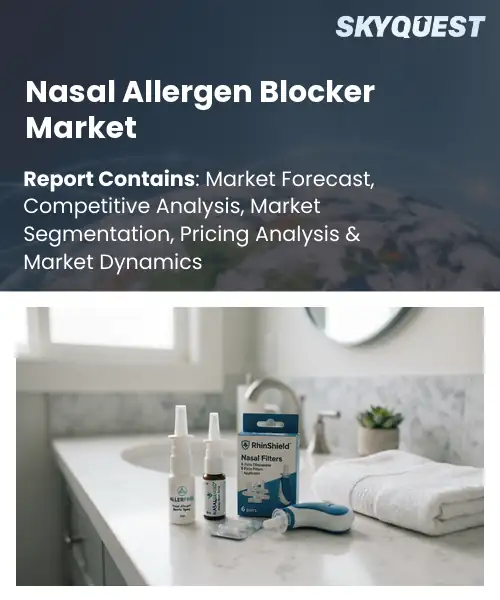
Nasal Allergen Blocker Market
Report ID: SQMIG35I3664
Report ID: SQMIG35I3664
[email protected]
USA +1 351-333-4748
Report ID:
SQMIG35I3664 |
Region:
Global |
Published Date: September, 2026
Pages:
157
|Tables:
143
|Figures:
78


Global Nasal Allergen Blocker Market size was valued at USD 2.74 Billion in 2024 and is poised to grow from USD 2.96 Billion in 2025 to USD 5.57 Billion by 2033, growing at a CAGR of 8.2% during the forecast period (2026-2033).
The global nasal allergen blocker market comprises products designed to create a physical barrier on the nasal mucosa, preventing pollen, dust, and microbial particles from triggering immune responses. Its relevance stems from rising prevalence of allergic rhinitis, which affects an estimated 30 percent of the world’s population and drives demand for non‑pharmacologic solutions. Historically, the market emerged in the early 2000s when innovators introduced cellulose‑based sprays and polymeric gels; adoption accelerated after clinical studies demonstrated reduced symptom scores compared with antihistamines. Over the past decade, consumer awareness of preventive health and the shift toward self‑care have propelled steady revenue growth. Building on that foundation, the principal growth catalyst for the market is the integration of digital health platforms that enable personalized dosing and adherence monitoring. When manufacturers embed sensors within spray devices, clinicians capture usage data, which informs treatment adjustments and demonstrates efficacy to insurers, encouraging reimbursement. This loop opened opportunities for partnerships with telemedicine providers, exemplified by a 2023 collaboration between a blocker brand and a virtual allergy clinic that reduced emergency visits by 15 percent among enrolled patients. Consequently, investors are attracted to models that combine barrier technology with data‑driven services, expanding the market’s addressable population beyond allergy sufferers.
How is AI-driven personalization influencing growth in the nasal allergen blocker market?
AI driven personalization is reshaping the nasal allergen blocker market by tailoring formulations to individual sensitization patterns. By integrating patient allergy profiles, environmental data, and machine learning algorithms, manufacturers can recommend the optimal blocker concentration and delivery schedule for each user. This reduces trial and error, improves adherence, and accelerates symptom relief. Companies are embedding digital health apps that capture real time exposure and adjust dosing, making the experience more interactive. The approach also helps clinicians identify niche sub populations, opening new revenue streams. As consumers expect bespoke health solutions, the market is seeing faster product cycles and heightened brand loyalty.In June 2023 Stallergenes Greer launched an AI driven personalized nasal allergen blocker platform, linking its nasal spray line with a mobile app that auto adjusts dosage based on real time pollen counts. This innovation speeds adoption, improves outcomes, and fuels market growth across different patient segments and enhances clinical confidence in practice.
Market snapshot - (2026-2033)
Global Market Size
USD 2.74 Billion
Largest Segment
Nasal Sprays
Fastest Growth
Nasal Powders
Growth Rate
8.2% CAGR
To get more insights on this market click here to Request a Free Sample Report
Global nasal allergen blocker market is segmented by product type, application, distribution channel, end user, availability and region. Based on product type, the market is segmented into Nasal Sprays, Nasal Gels and Nasal Powders. Based on application, the market is segmented into Seasonal Allergies, Perennial Allergies, Dust Allergies and Pollen Allergies. Based on distribution channel, the market is segmented into Hospital Pharmacies, Retail Pharmacies and Online Pharmacies. Based on end user, the market is segmented into Adults and Pediatrics. Based on availability, the market is segmented into Prescription and Over-the-Counter. Based on region, the market is segmented into North America, Europe, Asia Pacific, Latin America and Middle East & Africa.
Nasal Sprays segment dominates because they deliver precise dosage directly to the nasal mucosa, ensuring rapid onset of symptom relief that aligns with consumer expectations for immediate comfort. Their liquid formulation facilitates uniform distribution and easy administration, which builds strong brand loyalty among users accustomed to traditional spray devices. This ease of use combined with established clinical validation drives continual preference among healthcare providers and retail buyers, anchoring market leadership.
Meanwhile, Nasal Gels emerge as the most rapidly expanding area, propelled by heightened consumer interest in moisturizing formulations that provide prolonged barrier protection. Innovations in hydrogel technology enhance adherence to nasal tissues, extending relief duration and attracting users seeking a non spray alternative, thereby accelerating market breadth and future growth opportunities.
Seasonal Allergies segment leads because it generates predictable spikes in consumer demand that align with pollen cycles, prompting manufacturers to time product launches and promotional campaigns for maximum impact. The acute nature of symptoms drives patients to seek fast acting relief, encouraging formulation advances that prioritize rapid onset and easy repeat dosing. This cyclical pressure reinforces investment in research and marketing, cementing its central role in market dynamics.
Conversely, Perennial Allergies emerge as the fastest growing focus, driven by constant indoor allergen exposure that sustains year round symptoms. Ongoing demand for long term management fuels development of sustained release formulations and combination therapies, attracting users seeking protection without seasonal interruption. This usage pattern expands market volume and stimulates innovation pipelines, positioning the category for future expansion.
To get detailed segments analysis, Request a Free Sample Report
North America leads the global nasal allergen blocker market due to a confluence of advanced healthcare infrastructure, high consumer awareness, and robust R&D ecosystems. Strong collaboration between pharmaceutical innovators and academic institutions accelerates the development of novel delivery technologies and formulation refinements. Payers and providers in the region prioritize evidence‑based interventions, fostering swift adoption of effective nasal barrier solutions. Retail and specialty pharmacy channels benefit from sophisticated distribution networks that ensure product accessibility across urban and suburban markets. Moreover, consumer preference for non‑systemic allergy management drives demand for convenient, easy‑to‑use nasal applications. The regulatory environment supports rapid product approvals while maintaining rigorous safety standards, reinforcing confidence among clinicians and end‑users alike. In addition, strategic partnerships with technology firms enhance digital engagement tools that educate patients on proper usage, further cementing market leadership.
Nasal Allergen Blocker Market in United States benefits from a mature clinical research environment that encourages rapid translation of scientific insights into consumer products. Leading biotech firms collaborate closely with allergy specialists to refine barrier formulations tailored to diverse seasonal patterns. Distribution channels integrate both over‑the‑counter and prescription pathways, ensuring broad reach. Patient education campaigns leverage digital platforms to promote awareness of nasal protection as a proactive allergy strategy.
Nasal Allergen Blocker Market in Canada is shaped by strong public health frameworks that emphasize preventive care and accessibility. Health authorities support clinician‑led recommendations for barrier products as part of comprehensive allergy management. Collaborative research networks across universities and industry accelerate adaptation of formulations to the temperate climate nuances of the region. Retail pharmacies and community health outlets provide convenient points of purchase, while multilingual outreach programs enhance patient understanding of product benefits.
Europe’s rapid expansion of the nasal allergen blocker market reflects a synergistic blend of progressive regulatory support, heightened environmental awareness, and strong clinical endorsement across the continent. Health systems prioritize integrated allergy care pathways that incorporate barrier technologies as frontline interventions. Collaborative initiatives among research institutes and pharmaceutical innovators drive continuous improvement of formulation efficacy and user experience. Consumer demand for non‑invasive, fast‑acting solutions aligns with lifestyle trends favoring self‑managed health. Moreover, cross‑border trade agreements facilitate efficient distribution, enabling consistent product availability throughout diverse market segments. The confluence of these factors positions Europe as a dynamic hub for innovation and adoption in nasal allergy management.
Nasal Allergen Blocker Market in Germany thrives on a robust translational research ecosystem that links university laboratories with commercial developers. National health guidelines actively endorse barrier sprays as preventive measures, influencing prescriber confidence. Distribution through pharmacy chains and specialized allergy clinics ensures comprehensive market coverage. Consumer education is reinforced by public health campaigns emphasizing environmental triggers, fostering a receptive audience for advanced nasal protection products throughout the country and online platforms.
Nasal Allergen Blocker Market in United Kingdom experiences the fastest growth across Europe, driven by heightened public sensitivity to seasonal pollen fluctuations and strong endorsement from leading allergy societies. Retail pharmacies integrate nasal barrier options alongside traditional antihistamines, providing convenient access. Digital health tools and telemedicine consultations amplify awareness and guide proper usage. Collaborative research funded by government agencies accelerates formulation enhancements tailored to the unique climatic conditions of the British Isles.
Nasal Allergen Blocker Market in France is emerging as a notable segment, supported by evolving consumer preferences for non‑systemic allergy relief and proactive health initiatives. French medical societies increasingly recommend barrier sprays as complementary therapy, influencing prescription practices. Distribution networks combine traditional pharmacy retailers with emerging e‑commerce channels, expanding reach to both urban and regional populations. Ongoing collaborations between agronomy researchers and product developers aim to align formulations with specific allergen profiles prevalent in the Mediterranean climate.
Asia Pacific is steadily strengthening its position in the nasal allergen blocker market through a combination of rapid urbanization, heightened environmental awareness, and strategic investment in pharmaceutical innovation. Consumer lifestyles that prioritize quick, discreet health solutions have accelerated acceptance of nasal barrier products. Government health programs in key economies actively incorporate preventive allergy measures, creating a supportive policy backdrop. Collaboration between leading biotech firms and regional research institutions fuels continuous refinement of delivery mechanisms suited to diverse climatic conditions. Expanding retail networks, including both brick‑and‑mortar pharmacies and burgeoning online marketplaces, enhance product accessibility across a broad demographic spectrum. These dynamics collectively elevate Asia Pacific as an emerging hub for both consumption and development of advanced nasal allergen mitigation technologies. Industry stakeholders continue to explore novel formulations to meet rising consumer expectations.
Nasal Allergen Blocker Market in Japan benefits from an organized healthcare system that integrates preventive therapies into routine practice. Strong consumer confidence in scientifically validated products drives demand for nasal barrier solutions during pollen‑intense seasons. Collaboration between pharmaceutical companies and research universities accelerates adaptation of formulations to the allergen profiles common across the archipelago. Distribution through pharmacy chains and convenience stores ensures easy access, while digital platforms educate users on proper application.
Nasal Allergen Blocker Market in South Korea is propelled by proactive health initiatives that emphasize allergy prevention and rapid symptom relief. High urban density and seasonal pollen variations create a receptive market for convenient nasal barrier products. Partnerships between biotech firms and domestic research centers facilitate customization of ingredients to suit local allergen types. Retail distribution leverages traditional pharmacy outlets and growing e‑commerce channels, while mobile applications provide user‑friendly guidance on optimal usage.
To know more about the market opportunities by region and country, click here to
Buy The Complete Report
Increasing Consumer Awareness of Allergies
Advances In Nasal Delivery Technology
High Cost Of Specialized Formulations
Limited Clinical Evidence Supporting Efficacy
Request Free Customization of this report to help us to meet your business objectives.
11 major12 pharma13 and14 biotech15 firms16 leveraging17 M&A,18 strategic19 alliances20 and21 novel22 delivery23 technologies24. That's 24. Next sentence: "In 2023 GlaxoSmithKline completed the acquisition of the nasal‑spray specialist RespiraTech to integrate its patented mucosal‑adhesion platform." Count: In1
Top Player’s Company Profile
Recent Developments
SkyQuest’s ABIRAW (Advanced Business Intelligence, Research & Analysis Wing) is our Business Information Services team that Collects, Collates, Correlates, and Analyses the Data collected by means of Primary Exploratory Research backed by robust Secondary Desk research. As per SkyQuest analysis, the global nasal allergen blocker market is being propelled primarily by rising consumer awareness of allergic rhinitis, which drives demand for preventive barrier products, while advances in nasal delivery technology further accelerate growth by improving ease of use and efficacy. The market is led by North America, where robust healthcare infrastructure and strong R&D support sustain its dominance, and nasal sprays remain the dominant segment thanks to precise dosing and rapid symptom relief. However, high cost of specialized formulations restrains broader adoption, especially in price‑sensitive regions. Together, these factors shape a market poised for continued expansion.
| Report Metric | Details |
|---|---|
| Market size value in 2024 | USD 2.74 Billion |
| Market size value in 2033 | USD 5.57 Billion |
| Growth Rate | 8.2% |
| Base year | 2024 |
| Forecast period | (2026-2033) |
| Forecast Unit (Value) | USD Billion |
| Segments covered |
|
| Regions covered | North America (US, Canada), Europe (Germany, France, United Kingdom, Italy, Spain, Rest of Europe), Asia Pacific (China, India, Japan, Rest of Asia-Pacific), Latin America (Brazil, Rest of Latin America), Middle East & Africa (South Africa, GCC Countries, Rest of MEA) |
| Companies covered |
|
| Customization scope | Free report customization with purchase. Customization includes:-
|
To get a free trial access to our platform which is a one stop solution for all your data requirements for quicker decision making. This platform allows you to compare markets, competitors who are prominent in the market, and mega trends that are influencing the dynamics in the market. Also, get access to detailed SkyQuest exclusive matrix.
Table Of Content
Executive Summary
Market overview
Parent Market Analysis
Market overview
Market size
KEY MARKET INSIGHTS
COVID IMPACT
MARKET DYNAMICS & OUTLOOK
Market Size by Region
KEY COMPANY PROFILES
Methodology
For the Nasal Allergen Blocker Market, our research methodology involved a mixture of primary and secondary data sources. Key steps involved in the research process are listed below:
1. Information Procurement: This stage involved the procurement of Market data or related information via primary and secondary sources. The various secondary sources used included various company websites, annual reports, trade databases, and paid databases such as Hoover's, Bloomberg Business, Factiva, and Avention. Our team did 45 primary interactions Globally which included several stakeholders such as manufacturers, customers, key opinion leaders, etc. Overall, information procurement was one of the most extensive stages in our research process.
2. Information Analysis: This step involved triangulation of data through bottom-up and top-down approaches to estimate and validate the total size and future estimate of the Nasal Allergen Blocker Market.
3. Report Formulation: The final step entailed the placement of data points in appropriate Market spaces in an attempt to deduce viable conclusions.
4. Validation & Publishing: Validation is the most important step in the process. Validation & re-validation via an intricately designed process helped us finalize data points to be used for final calculations. The final Market estimates and forecasts were then aligned and sent to our panel of industry experts for validation of data. Once the validation was done the report was sent to our Quality Assurance team to ensure adherence to style guides, consistency & design.
Analyst Support
Customization Options
With the given market data, our dedicated team of analysts can offer you the following customization options are available for the Nasal Allergen Blocker Market:
Product Analysis: Product matrix, which offers a detailed comparison of the product portfolio of companies.
Regional Analysis: Further analysis of the Nasal Allergen Blocker Market for additional countries.
Competitive Analysis: Detailed analysis and profiling of additional Market players & comparative analysis of competitive products.
Go to Market Strategy: Find the high-growth channels to invest your marketing efforts and increase your customer base.
Innovation Mapping: Identify racial solutions and innovation, connected to deep ecosystems of innovators, start-ups, academics, and strategic partners.
Category Intelligence: Customized intelligence that is relevant to their supply Markets will enable them to make smarter sourcing decisions and improve their category management.
Public Company Transcript Analysis: To improve the investment performance by generating new alpha and making better-informed decisions.
Social Media Listening: To analyze the conversations and trends happening not just around your brand, but around your industry as a whole, and use those insights to make better Marketing decisions.
REQUEST FOR SAMPLE
 REQUEST FREE CUSTOMIZATION


Want to customize this report? This report can be personalized according to your needs. Our analysts and industry experts will work directly with you to understand your requirements and provide you with customized data in a short amount of time. We offer $1000 worth of FREE customization at the time of purchase.
Feedback From Our Clients


 USA (+1) 351-333-4748

