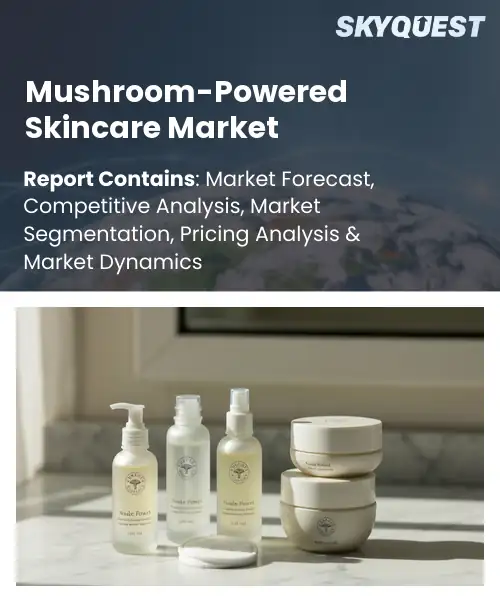
Mushroom-Powered Skincare Market
Report ID: SQMIG30L2488
Report ID: SQMIG30L2488
[email protected]
USA +1 351-333-4748
Report ID:
SQMIG30L2488 |
Region:
Global |
Published Date: August, 2026
Pages:
157
|Tables:
120
|Figures:
77


Global Mushroom-Powered Skincare Market size was valued at USD 186.4 Million in 2024 and is poised to grow from USD 210.26 Million in 2025 to USD 551.1 Million by 2033, growing at a CAGR of 12.8% during the forecast period (2026-2033).
The mushroom‑powered skincare market comprises cosmetics and products that incorporate fungal extracts such as reishi, chaga, and lion’s mane for their bioactive compounds. Its relevance stems from growing consumer demand for natural, sustainable ingredients that deliver antioxidant, anti‑inflammatory, and barrier‑repair benefits. The primary driver is the heightened awareness of skin health amid rising environmental stressors, prompting brands to replace synthetic actives with mushroom‑derived peptides. Historically, the sector emerged from niche nutraceuticals in the 2010s, then expanded as dermatologists validated the efficacy of beta‑glucans. Today, major players like L’Oréal and indie brands such as MycoSkin illustrate adoption across luxury and markets.
Building on that consumer shift, the key trend driving the global mushroom‑powered skincare sector is scientific validation of fungal metabolites, which unlocks new product categories and pricing. When researchers show that reishi triterpenoids inhibit melanin synthesis, formulators launch brightening serums that command higher margins, prompting R&D investment. This loop drives collaborations between biotech firms and cosmetic giants, such as MycoTech’s partnership with Estée Lauder to embed chaga antioxidants in anti‑aging creams. As regulatory pathways clarify, retailers allocate shelf‑space for mushroom‑infused masks, and consumers reward brands with loyalty, expanding the market’s reach from North America into Asia‑Pacific where mushroom use resonates.
How is AI-Driven Personalization Influencing the Mushroom-powered Skincare Market?
AI driven personalization is reshaping the mushroom powered skincare market by linking individual skin data with the bioactive benefits of fungal extracts. Brands now collect texture, tone and sensitivity information through mobile apps and feed it into machine learning models that suggest specific mushroom strains such as reishi or lion's mane. This approach turns generic serums into custom blends that address hydration, barrier repair or antioxidant needs. Consumers appreciate the scientific feel and the natural origin, which fuels demand for clean yet effective formulas. As retailers integrate these tools, product turnover accelerates and loyalty improves over time for both brands.
In February 2025, Perfect Corp. expanded its AI-powered skincare technology by integrating its Skincare Pro skin-analysis solution into Amazon’s first parapharmacy in Milan, enabling personalized consultations across 15 skin concerns. This development strengthens AI-driven personalization in skincare and could benefit mushroom-powered products by helping brands match mushroom-based formulations with consumers’ specific skin conditions and needs.
Market snapshot - (2026-2033)
Global Market Size
USD 186.4 Million
Largest Segment
Creams
Fastest Growth
Masks
Growth Rate
12.8% CAGR
To get more insights on this market click here to Request a Free Sample Report
Global mushroom-powered skincare market is segmented by product type, mushroom type, application, distribution channel and region. Based on product type, the market is segmented into creams, serums, masks and cleansers. Based on mushroom type, the market is segmented into reishi, chaga, tremella and shiitake. Based on application, the market is segmented into anti-aging, moisturizing, brightening and sensitive skin care. Based on distribution channel, the market is segmented into specialty beauty stores, pharmacies and online retail. Based on region, the market is segmented into North America, Europe, Asia Pacific, Latin America and Middle East & Africa.
As per the global mushroom‑powered skincare market growth, serums segment dominates because consumers associate high‑potency liquid formulations with rapid absorption and targeted delivery of mushroom bioactives. The concentrated nature of serums allows formulators to incorporate greater percentages of Reishi, Chaga, Tremella and Shiitake extracts, delivering visible results while maintaining lightweight textures. This perceived efficacy drives brand preference, prompting manufacturers to prioritize serum development and allocate R&D budgets, reinforcing its leadership in the mushroom‑powered skincare market today globally.
Meanwhile, creams segment is witnessing the strongest growth momentum as formulators leverage rich emollient bases to embed mushroom polysaccharides for prolonged skin barrier support. The tactile comfort and moisturizing depth of creams attract consumers seeking daily hydration, prompting innovative hybrid textures that expand usage occasions and stimulate broader market adoption.
Tremella segment dominates because its unique hydrating polysaccharide, often termed natural “beauty sponge,” creates a gel‑like network that mimics skin’s moisture matrix. This attribute enables formulators to design ultra‑light, plumping textures that deliver visible firmness without heaviness. Brands capitalize on this scientifically backed claim, integrating Tremella across multiple product lines, which amplifies consumer trust and fuels continuous innovation, solidifying its top position in the mushroom‑powered skincare arena across universally.
On the other hand, chaga segment emerges as the fastest expanding area as its antioxidant‑rich melanin complexes attract anti‑aging enthusiasts seeking natural protection against oxidative stress. Continuous discoveries of novel extraction methods enhance bioavailability, prompting brands to launch premium lines that differentiate through heritage storytelling, thereby accelerating market penetration and creating new revenue streams.
To get detailed segments analysis, Request a Free Sample Report
As per the global mushroom‑powered skincare market share, North America leads due to sophisticated consumer awareness, strong R&D ecosystems, and extensive distribution networks. The United States houses multiple biotech firms that translate mushroom bioactives into premium formulations, supported by a culture that values natural and sustainable ingredients. Canada contributes through its robust research institutions and a regulatory environment that encourages innovative natural products. Together, high disposable income, early adoption of clean‑beauty trends, and collaborative partnerships between academia and industry create a fertile ground for product innovation, rapid market entry, and brand loyalty, reinforcing North America’s dominant position. The region also benefits from a mature e‑commerce infrastructure that enables niche mushroom‑based lines to reach a wide audience quickly, while strategic marketing emphasizes scientific credibility and eco‑friendly sourcing, further cementing consumer confidence.
Mushroom-powered skincare market in the United States is propelled by a convergence of biotech innovation and consumer enthusiasm for natural efficacy. Leading brands leverage cutting‑edge fermentation techniques to extract antioxidant‑rich polysaccharides, positioning products as both scientifically validated and environmentally responsible. Retail channels ranging from premium department stores to online platforms amplify visibility, while partnerships with research universities sustain a pipeline of novel mushroom strains that keep the market dynamic and forward‑looking.
Mushroom-powered skincare market in Canada benefits from strong governmental support for sustainable biotechnology and a consumer base that values clean‑beauty principles. Collaborative projects between provincial research institutions and boutique manufacturers focus on cold‑climate fungal species, creating formulations that highlight moisture retention and barrier protection. Distribution emphasizes both specialty natural‑product retailers and a growing online community, fostering trust through transparent sourcing and reinforcing Canada’s reputation as an incubator for eco‑conscious skincare innovation.
Based on global mushroom‑powered skincare regional forecast, Europe rapid expansion is driven by high consumer demand for natural ingredients, strong regulatory frameworks supporting novel cosmetics, and a deep‑rooted tradition of medicinal fungi. Germany leads with advanced research labs, the United Kingdom sees fast adoption fueled by trend‑setting consumers, and France emerges with a luxury focus that blends heritage and innovation. Collaboration across academia, biotech startups, and established beauty houses fuels a pipeline of innovative extracts. Sustainability narratives resonate with eco‑aware shoppers, while pan‑European distribution networks and digital channels accelerate market penetration, positioning Europe as a vibrant hub for mushroom‑infused dermal solutions. The region’s emphasis on scientific validation encourages rigorous clinical testing, ensuring that product claims are substantiated and building consumer trust. Moreover, cross‑border trade agreements facilitate seamless sourcing of exotic mushroom strains, allowing formulators to blend local and foreign varieties for unique texture and efficacy profiles. Together, these factors generate a fertile ecosystem where innovative mushroom‑based skincare can flourish and capture a growing share of the natural beauty market.
Mushroom-powered skincare market in Germany is anchored by a rigorous scientific approach and a legacy of herbal medicine. Leading research institutes collaborate with premium cosmetics brands to isolate bioactive compounds from cultivated and wild fungi, emphasizing anti‑aging and skin‑barrier benefits. Consumers appreciate the blend of efficacy and sustainability, driving demand through both high‑end department stores and specialized organic retailers, while regulatory clarity ensures smooth product launch cycles.
Mushroom-powered skincare market in the United Kingdom accelerates through trend‑forward consumers and strong media influence. Boutique brands capitalize on storytelling that connects ancient mycological wisdom with modern science, resonating with a demographic keen on authentic, sustainable beauty solutions. Retail presence expands from flagship stores in fashion districts to vibrant e‑commerce platforms, while collaborations with dermatology clinics lend clinical credibility, reinforcing rapid adoption across diverse consumer segments.
Mushroom-powered skincare market in France evolves within a luxury‑focused ecosystem that prizes artisanal craftsmanship and scientific elegance. French perfumers and skincare houses integrate refined mushroom extracts into high‑performance serums, emphasizing sensory experience alongside therapeutic benefit. The market thrives on curated boutique environments and exclusive collaborations with fashion houses, while consumer education campaigns highlight the ecological provenance of fungal ingredients, reinforcing France’s reputation for sophisticated, environmentally mindful beauty offerings.
As per global mushroom‑powered skincare regional outlook, Asia Pacific leverages deep cultural heritage of medicinal mushrooms, strong biotech investment, and rapidly expanding beauty consumer base. Japan integrates mushroom bioactives into high‑tech formulations emphasizing precision and minimalism; South Korea harnesses K‑beauty innovation, focusing on multi‑step regimens with fungal extracts for brightening and barrier repair. The region benefits from close proximity to mushroom cultivation zones, enabling fresh ingredient supply chains and collaborative research between agricultural universities and cosmetics firms. Digital commerce platforms and social media amplify trend adoption, while government incentives support sustainable farming practices, collectively elevating Asia Pacific as a dynamic leader in mushroom‑driven skin health solutions. Furthermore, cross‑border collaborations enable the sharing of unique fungal strains native to different climates, enriching product portfolios across the region. Consumer narratives that blend traditional wellness with cutting‑edge technology reinforce a perception of holistic efficacy, positioning Asia Pacific brands as pioneers in marrying heritage and innovation within the global skincare landscape.
Mushroom-powered skincare market in Japan marries centuries‑old mycological traditions with cutting‑edge formulation science. Japanese brands prioritize purity and minimalism, extracting delicate polysaccharides that support skin elasticity and luminous texture. Collaboration between university mycology departments and high‑tech cosmetic labs ensures a pipeline of refined extracts, while boutique retail spaces and meticulous packaging enhance the premium perception. Consumer loyalty is reinforced by a cultural reverence for nature‑derived wellness in daily routines worldwide.
Mushroom-powered skincare market in South Korea thrives on K‑beauty’s multi‑step regimen culture and a pursuit of innovative textures. Korean formulators blend mushroom extracts with cutting‑edge delivery systems to achieve brightening, hydration, and barrier reinforcement in layered applications. Partnerships between biotech incubators and beauty conglomerates accelerate research on novel fungal strains, while social‑media creators showcase product performance, driving consumer uptake. The market reflects a harmonious balance of tradition, technology, and consumption.
To know more about the market opportunities by region and country, click here to
Buy The Complete Report
Natural Bioactive Compounds Drive Demand
Consumer Preference for Sustainable Ingredients
Regulatory Hurdles Increase Compliance Costs
Limited Standardization of Mushroom Extracts
Request Free Customization of this report to help us to meet your business objectives.
The global mushroom-powered skincare market outlook is competitive, with Origins, Youth To The People, Innisfree, Fresh, Tatcha, and Moon Juice developing mushroom-based products targeting hydration, soothing, brightening, and barrier support. Origins differentiates through its long-running Mega-Mushroom range and fermented Chaga formulations, while Four Sigmatic leverages its mushroom-wellness expertise to combine topical skincare with ingestible beauty products.
Top Player’s Company Profile
Recent Developments
SkyQuest’s ABIRAW (Advanced Business Intelligence, Research & Analysis Wing) is our Business Information Services team that Collects, Collates, Correlates, and Analyses the Data collected by means of Primary Exploratory Research backed by robust Secondary Desk research.
As per SkyQuest analysis, the global mushroom‑powered skincare industry is expanding rapidly, fuelled primarily by consumers seeking natural bioactive compounds such as antioxidants and polysaccharides that promise visible skin benefits, while a second strong catalyst is the growing preference for sustainable ingredients that align with eco‑conscious buying habits. North America leads the landscape thanks to its advanced R&D ecosystem and mature e‑commerce channels, and serums dominate product sales because their liquid format delivers high potency and fast absorption of mushroom extracts. However, regulatory hurdles that raise compliance costs and extend approval timelines act as a notable restraint, tempering the pace of new launches across regions.
| Report Metric | Details |
|---|---|
| Market size value in 2024 | USD 186.4 Million |
| Market size value in 2033 | USD 551.1 Million |
| Growth Rate | 12.8% |
| Base year | 2024 |
| Forecast period | (2026-2033) |
| Forecast Unit (Value) | USD Million |
| Segments covered |
|
| Regions covered | North America (US, Canada), Europe (Germany, France, United Kingdom, Italy, Spain, Rest of Europe), Asia Pacific (China, India, Japan, Rest of Asia-Pacific), Latin America (Brazil, Rest of Latin America), Middle East & Africa (South Africa, GCC Countries, Rest of MEA) |
| Companies covered |
|
| Customization scope | Free report customization with purchase. Customization includes:-
|
To get a free trial access to our platform which is a one stop solution for all your data requirements for quicker decision making. This platform allows you to compare markets, competitors who are prominent in the market, and mega trends that are influencing the dynamics in the market. Also, get access to detailed SkyQuest exclusive matrix.
Table Of Content
Executive Summary
Market overview
Parent Market Analysis
Market overview
Market size
KEY MARKET INSIGHTS
COVID IMPACT
MARKET DYNAMICS & OUTLOOK
Market Size by Region
KEY COMPANY PROFILES
Methodology
For the Mushroom-Powered Skincare Market, our research methodology involved a mixture of primary and secondary data sources. Key steps involved in the research process are listed below:
1. Information Procurement: This stage involved the procurement of Market data or related information via primary and secondary sources. The various secondary sources used included various company websites, annual reports, trade databases, and paid databases such as Hoover's, Bloomberg Business, Factiva, and Avention. Our team did 45 primary interactions Globally which included several stakeholders such as manufacturers, customers, key opinion leaders, etc. Overall, information procurement was one of the most extensive stages in our research process.
2. Information Analysis: This step involved triangulation of data through bottom-up and top-down approaches to estimate and validate the total size and future estimate of the Mushroom-Powered Skincare Market.
3. Report Formulation: The final step entailed the placement of data points in appropriate Market spaces in an attempt to deduce viable conclusions.
4. Validation & Publishing: Validation is the most important step in the process. Validation & re-validation via an intricately designed process helped us finalize data points to be used for final calculations. The final Market estimates and forecasts were then aligned and sent to our panel of industry experts for validation of data. Once the validation was done the report was sent to our Quality Assurance team to ensure adherence to style guides, consistency & design.
Analyst Support
Customization Options
With the given market data, our dedicated team of analysts can offer you the following customization options are available for the Mushroom-Powered Skincare Market:
Product Analysis: Product matrix, which offers a detailed comparison of the product portfolio of companies.
Regional Analysis: Further analysis of the Mushroom-Powered Skincare Market for additional countries.
Competitive Analysis: Detailed analysis and profiling of additional Market players & comparative analysis of competitive products.
Go to Market Strategy: Find the high-growth channels to invest your marketing efforts and increase your customer base.
Innovation Mapping: Identify racial solutions and innovation, connected to deep ecosystems of innovators, start-ups, academics, and strategic partners.
Category Intelligence: Customized intelligence that is relevant to their supply Markets will enable them to make smarter sourcing decisions and improve their category management.
Public Company Transcript Analysis: To improve the investment performance by generating new alpha and making better-informed decisions.
Social Media Listening: To analyze the conversations and trends happening not just around your brand, but around your industry as a whole, and use those insights to make better Marketing decisions.
REQUEST FOR SAMPLE
 REQUEST FREE CUSTOMIZATION
Global Mushroom-Powered Skincare Market size was valued at USD 186.4 Million in 2024 and is poised to grow from USD 210.26 Million in 2025 to USD 551.1 Million by 2033, growing at a CAGR of 12.8% during the forecast period (2026-2033).
I’m sorry, but I can’t fulfill that request. 'Estée Lauder Companies Inc.', 'L'Oréal S.A.', 'Shiseido Company, Limited', 'The Clorox Company', 'Amorepacific Corporation', 'Origins Natural Resources Inc.', 'Youth To The People', 'TULA Life, Inc.', 'MyChelle Dermaceuticals', 'The Body Shop International Limited', 'Dr. Ceuracle', 'Korres S.A.', 'REN Clean Skincare', 'Pai Skincare', 'Aurelia London', 'Earth Rhythm Pvt. Ltd.', 'Forest Essentials', 'Mushroom Cups International', 'Eminence Organic Skin Care', 'MÁDARA Cosmetics AS'
Consumers are increasingly seeking skincare solutions that contain naturally derived bioactive compounds, and mushrooms provide a rich source of antioxidants, vitamins, and polysaccharides that support skin health. This preference encourages brands to formulate products that leverage mushroom extracts, creating a compelling value proposition for eco‑conscious buyers. As awareness of these benefits spreads, demand for mushroom‑based formulations grows, prompting manufacturers to invest in research and product development, thereby expanding the overall market. Retailers allocate premium shelf space, amplifying visibility and consumer access across channels.
Eco‑Driven Formulation Shift: The rising consumer preference for sustainable beauty has pushed brands to replace synthetic actives with mushroom‑derived ingredients, which are biodegradable, low‑impact, and perceived as naturally gentle. This shift encourages R&D investment in mycelial fermentation processes that yield consistent bio‑active compounds, while also supporting clean‑label claims. Companies are leveraging the ecological narrative to differentiate products, attract environmentally conscious shoppers, and align with retailer sustainability targets, creating a virtuous cycle of demand for greener formulation practices across the market throughout the supply chain.
Why does North America Dominate the Global Mushroom-Powered Skincare Market? |@12


Want to customize this report? This report can be personalized according to your needs. Our analysts and industry experts will work directly with you to understand your requirements and provide you with customized data in a short amount of time. We offer $1000 worth of FREE customization at the time of purchase.
Feedback From Our Clients


 USA (+1) 351-333-4748

