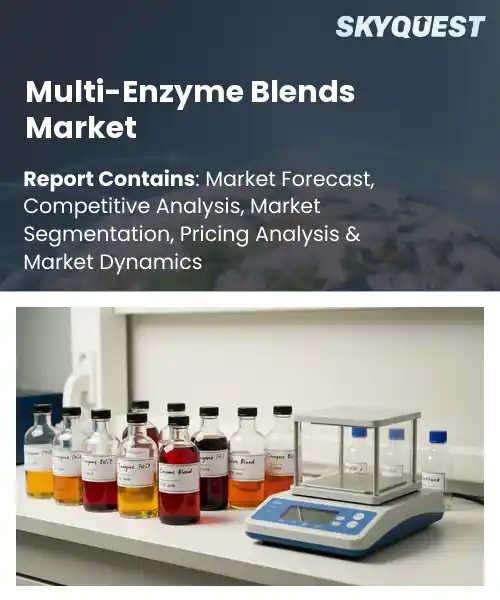
Multi-Enzyme Blends Market
Report ID: SQMIG35J2706
Report ID: SQMIG35J2706
[email protected]
USA +1 351-333-4748
Report ID:
SQMIG35J2706 |
Region:
Global |
Published Date: August, 2026
Pages:
157
|Tables:
147
|Figures:
78


Global Multi-Enzyme Blends Market size was valued at USD 1.74 Billion in 2024 and is poised to grow from USD 1.86 Billion in 2025 to USD 3.18 Billion by 2033, growing at a CAGR of 6.9% during the forecast period (2026-2033).
The multi‑enzyme blends market comprises formulations that combine two or more enzymes to enhance performance in sectors such as food processing, animal feed, detergents, and biofuels. Its significance stems from the ability of blended enzymes to act together, reducing processing time, energy consumption, and waste while improving product quality. Historically, the market emerged in the 2000s when manufacturers recognized limitations of single‑enzyme solutions in substrates. For instance, dairy processors adopted protease‑lipase blends to accelerate cheese ripening, and textile firms integrated cellulase‑amylase mixes to achieve gentler fabric finishes. This evolution reflects a shift toward biocatalytic systems that meet global sustainability targets.
Building on that shift, the growth catalyst for the multi‑enzyme blends market is the rising demand for sustainable processing in food, feed, and industrial sectors, which pushes manufacturers to replace chemical additives with enzymatic solutions. As regulatory pressure intensifies and consumers favor clean‑label products, firms invest in research to engineer blends that lower temperature requirements, cutting energy costs and carbon footprints. For example, poultry feed producers now use phytase‑carboxylase blends to unlock phosphorus from grains, reducing inorganic supplements and decreasing runoff. This impetus creates opportunities for enzyme companies to expand portfolios, enter markets, and form alliances with OEMs seeking technologies.
How is AI-driven Automation Influencing Product Development In The Multi‑enzyme Blends Market?
AI driven automation is reshaping product development in the multi enzyme blends market by accelerating formulation cycles and enabling data rich experimentation. Machine learning models predict optimal enzyme combinations for specific substrates, reducing trial and error. Integrated sensor platforms feed real time performance data back into the design loop, allowing rapid iteration. This approach shortens time to market and improves consistency across batches. Companies can tailor blends for dairy, bakery and animal feed with greater precision, meeting consumer demand for clean label and functional foods. The result is a more agile pipeline that leverages digital twins and predictive analytics to drive innovation.
In March 2024, Novozymes introduced an AI powered platform that designs multi enzyme blends for bakery applications, cutting development cycles and boosting enzyme performance. The tool demonstrates how AI driven automation can accelerate product launches and improve cost efficiency across the multi enzyme blends market.
Market snapshot - (2026-2033)
Global Market Size
USD 1.74 Billion
Largest Segment
Protease Blends
Fastest Growth
Multi-Enzyme Complexes
Growth Rate
6.9% CAGR
To get more insights on this market click here to Request a Free Sample Report
Global multi-enzyme blends market is segmented by enzyme type, source, application, form, end user and region. Based on enzyme type, the market is segmented into Protease Blends, Amylase Blends, Lipase Blends, Cellulase Blends and Multi-Enzyme Complexes. Based on source, the market is segmented into Microbial, Plant-Based and Animal-Based. Based on application, the market is segmented into Dietary Supplements, Food & Beverage, Animal Feed and Pharmaceuticals. Based on form, the market is segmented into Powder, Capsules and Liquid. Based on end user, the market is segmented into Food Manufacturers, Nutraceutical Companies and Feed Manufacturers. Based on region, the market is segmented into North America, Europe, Asia Pacific, Latin America and Middle East & Africa.
Microbial source segment leads because it offers scalable production, consistent enzyme quality, and lower cost compared with alternative origins. Microbial fermentation allows precise control over strain genetics, resulting in enzymes with tailored activity profiles that meet stringent food safety standards. The ease of upstream optimization reduces lead times, while the broad acceptance of microbial enzymes by regulators bolsters confidence, making this source the preferred choice for manufacturers seeking reliable performance.
On the other hand, Plant Based source is emerging as the key high growth area as consumer preference shifts toward clean vegan friendly ingredients. Advances in plant expression systems enable production of enzymes with comparable efficacy, while the natural origin narrative drives pricing opportunities. This momentum is expanding application reach into specialty nutraceuticals and functional foods, fueling market acceleration.
Protease Blends segment dominates because it directly addresses the core functional needs of food manufacturers seeking protein hydrolysis for texture improvement and flavor development. Manufacturers favor protease blends for their high specificity, predictable performance, and compatibility with existing processing lines, which reduces operational complexity. Additionally, the proven safety profile and widespread regulatory acceptance of microbial proteases enhance confidence, encouraging broader adoption across diverse product categories. This combination of merit and compliance advantage sustains its market leadership.
However, Amylase Blends are witnessing strong growth as manufacturers intensify starch conversion to meet demand for ready to eat products. Thermostable enzyme engineering now supports higher process temperatures, lowering viscosity and energy consumption, which appeals to food and beverage producers seeking efficiency gains. These capabilities are opening novel formulation pathways and accelerating market expansion.
To get detailed segments analysis, Request a Free Sample Report
North America commands leadership in the multi‑enzyme blends market through a confluence of advanced research ecosystems, extensive biotechnology infrastructure, and high‑value end‑use sectors that prioritize performance and sustainability. Strong collaboration between leading academic institutions, ingredient manufacturers, and consumer‑product companies accelerates innovation cycles and facilitates rapid commercialization. The region benefits from well‑established regulatory frameworks that encourage novel enzyme applications while ensuring safety, fostering confidence among adopters. Additionally, the presence of large‑scale food processing, animal nutrition, and bio‑fuel operations creates a broad demand base, reinforcing the market’s depth and resilience. These strengths are amplified by a proactive investment climate that supports start‑ups and scale‑up activities, and by a skilled workforce adept at integrating enzymatic solutions into complex formulations. The resulting ecosystem sustains a pipeline of differentiated products that meet stringent performance expectations across multiple industry segments.
Multi-Enzyme Blends Market in the United States is energized by a dense network of biotech firms that specialize in custom enzyme design for food, feed, and industrial applications. Close ties between research universities and commercial launch partners accelerate product development, while consumer trends toward cleaner labels and functional attributes drive adoption. Robust supply chains and a regulatory environment that balances innovation with safety further reinforce market momentum across diverse sectors.
Multi-Enzyme Blends Market in Canada benefits from a strong emphasis on sustainable production practices and a collaborative ecosystem that links provincial research institutes with ingredient manufacturers. Environmental stewardship and food safety priorities encourage the integration of enzyme technologies across dairy, grain processing, and bio‑energy chains. Government incentives for green chemistry and a skilled technical workforce support continuous innovation, fostering confidence among end‑users seeking efficient and low‑impact processing solutions in the market.
The European landscape propels rapid expansion of multi‑enzyme blends through a blend of stringent sustainability mandates, sophisticated consumer preferences, and a heritage of enzyme expertise anchored in strong research institutions. Companies across the region leverage collaborative frameworks that unite food processors, animal‑feed manufacturers, and bio‑based chemical producers, fostering cross‑sector knowledge transfer. Regulatory pathways that emphasize safety and environmental impact encourage the introduction of enzyme solutions that reduce waste and energy consumption. Moreover, a culture of premium product development pushes manufacturers to exploit enzymatic functionalities for texture, flavor, and nutritional enhancement. This convergence of policy support, innovative capacity, and market demand creates a fertile environment for continuous product diversification and adoption across multiple industry verticals. Stakeholder engagement through industry clusters further accelerates knowledge sharing and accelerates time‑to‑market for novel blends.
Multi-Enzyme Blends Market in Germany is anchored by a strong chemical manufacturing base and deep enzyme research expertise. Cooperation between industrial leaders and niche biotech firms enables swift scaling of tailor‑made solutions for food, feed, and bioprocessing. Sustainability incentives and a consumer preference for functional ingredients stimulate demand for enzymes that boost efficiency and product quality. A robust patent environment further fuels ongoing innovation and high‑value application development.
Multi-Enzyme Blends Market in the United Kingdom is driven by a life‑science cluster that links academic breakthroughs with start‑up ecosystems. Close ties between food processors, animal‑feed firms, and enzyme innovators speed translation of research into commercial blends that meet clean‑label and nutritional trends. Government backing for circular‑economy projects encourages uptake of enzymes that cut waste and energy use. This collaborative environment fosters rapid product iteration and positions the United Kingdom as a hub for enzyme‑driven solutions.
Multi-Enzyme Blends Market in France is emerging as manufacturers seek greener processes and value‑added product attributes. Collaboration between leading food conglomerates and boutique biotech firms accelerates development of enzyme blends tailored to dairy, bakery, and beverage applications. Consumer awareness of natural ingredients fuels interest in enzymatic solutions that enhance flavor, texture, and nutritional profile without synthetic additives. Supportive policy measures encouraging circular production further stimulate adoption, positioning France as a growing hub for innovative enzyme technologies.
The Asia Pacific region is consolidating its position in the multi‑enzyme blends arena through a combination of escalating demand for high‑efficiency processing, rapid scaling of biotech capabilities, and proactive government initiatives that champion sustainable manufacturing. Nations across the region are investing heavily in enzyme research platforms and fostering partnerships between traditional manufacturers and emerging start‑ups, enabling swift translation of innovative formulations into commercial use. Consumer trends favoring natural and functional ingredients drive food and beverage processors to adopt enzymatic solutions that improve yield, texture, and nutritional value while reducing resource consumption. Additionally, growing bio‑fuel and animal‑nutrition sectors provide ample opportunities for enzyme integration, reinforcing the region’s momentum toward broader market influence. Regional trade agreements that simplify cross‑border ingredient flow further accelerate market expansion, allowing producers to source specialized enzyme blends from neighboring innovation hubs with minimal barriers.
Multi-Enzyme Blends Market in Japan is defined by a tradition of precision manufacturing and a strong focus on food safety and quality. Collaboration between major food processors and niche enzyme developers produces blends that meet delicate taste profiles and functional health claims. Government support for advanced biotech research drives continual improvement of enzyme stability and specificity, while consumer demand for clean‑label products encourages enzymatic solutions that enhance texture and nutrition without additives.
Multi-Enzyme Blends Market in South Korea is rapidly advancing thanks to strong government investment in biotechnological research and a vibrant food‑technology sector. Partnerships between large conglomerates and specialized enzyme firms facilitate the creation of blends targeting fermented foods, dairy alternatives, and high‑protein snacks. Emphasis on reducing processing time and energy use aligns with national sustainability goals, prompting adopters to integrate enzymes that improve yield and functional properties. This supportive ecosystem accelerates innovation and positions South Korea as an emerging leader in enzyme‑driven product development.
To know more about the market opportunities by region and country, click here to
Buy The Complete Report
Rising Demand For Sustainable Products
Advancements In Genetic Engineering
Regulatory Complexity Across Regions
High Production Costs For Enzymes
Request Free Customization of this report to help us to meet your business objectives.
Intense rivalry among DSM, Novozymes, and BASF drives the multi‑enzyme blends market, with firms leveraging M&A, joint ventures, and advanced enzyme‑engineering platforms to secure differentiated portfolios. Recent examples include DSM’s partnership with BASF to co‑develop sustainable packaging enzymes, Novozymes’ acquisition of a biotech firm specializing in high‑throughput enzyme screening, and BASF’s launch of a digital enzyme‑design tool for feed applications.
SkyQuest’s ABIRAW (Advanced Business Intelligence, Research & Analysis Wing) is our Business Information Services team that Collects, Collates, Correlates, and Analyses the Data collected by means of Primary Exploratory Research backed by robust Secondary Desk research.
As per SkyQuest analysis, the global multi‑enzyme blends market is being propelled primarily by the rising demand for sustainable products, which pushes food, feed and industrial manufacturers toward enzymatic solutions that cut waste and energy use. A second important driver is the rapid progress in genetic engineering that enables precise tailoring of enzyme activities, creating highly efficient blends and shortening development cycles. However, regulatory complexity across regions remains a restraint, adding lengthy approval processes and compliance costs that can slow entry for smaller players. North America emerges as the dominant region due to its biotech ecosystem and strong adoption rates, while protease blends dominate the segment landscape owing to their critical role in protein hydrolysis and widespread regulatory acceptance.
| Report Metric | Details |
|---|---|
| Market size value in 2024 | USD 1.74 Billion |
| Market size value in 2033 | USD 3.18 Billion |
| Growth Rate | 6.9% |
| Base year | 2024 |
| Forecast period | (2026-2033) |
| Forecast Unit (Value) | USD Billion |
| Segments covered |
|
| Regions covered | North America (US, Canada), Europe (Germany, France, United Kingdom, Italy, Spain, Rest of Europe), Asia Pacific (China, India, Japan, Rest of Asia-Pacific), Latin America (Brazil, Rest of Latin America), Middle East & Africa (South Africa, GCC Countries, Rest of MEA) |
| Companies covered |
|
| Customization scope | Free report customization with purchase. Customization includes:-
|
To get a free trial access to our platform which is a one stop solution for all your data requirements for quicker decision making. This platform allows you to compare markets, competitors who are prominent in the market, and mega trends that are influencing the dynamics in the market. Also, get access to detailed SkyQuest exclusive matrix.
Table Of Content
Executive Summary
Market overview
Parent Market Analysis
Market overview
Market size
KEY MARKET INSIGHTS
COVID IMPACT
MARKET DYNAMICS & OUTLOOK
Market Size by Region
KEY COMPANY PROFILES
Methodology
For the Multi-Enzyme Blends Market, our research methodology involved a mixture of primary and secondary data sources. Key steps involved in the research process are listed below:
1. Information Procurement: This stage involved the procurement of Market data or related information via primary and secondary sources. The various secondary sources used included various company websites, annual reports, trade databases, and paid databases such as Hoover's, Bloomberg Business, Factiva, and Avention. Our team did 45 primary interactions Globally which included several stakeholders such as manufacturers, customers, key opinion leaders, etc. Overall, information procurement was one of the most extensive stages in our research process.
2. Information Analysis: This step involved triangulation of data through bottom-up and top-down approaches to estimate and validate the total size and future estimate of the Multi-Enzyme Blends Market.
3. Report Formulation: The final step entailed the placement of data points in appropriate Market spaces in an attempt to deduce viable conclusions.
4. Validation & Publishing: Validation is the most important step in the process. Validation & re-validation via an intricately designed process helped us finalize data points to be used for final calculations. The final Market estimates and forecasts were then aligned and sent to our panel of industry experts for validation of data. Once the validation was done the report was sent to our Quality Assurance team to ensure adherence to style guides, consistency & design.
Analyst Support
Customization Options
With the given market data, our dedicated team of analysts can offer you the following customization options are available for the Multi-Enzyme Blends Market:
Product Analysis: Product matrix, which offers a detailed comparison of the product portfolio of companies.
Regional Analysis: Further analysis of the Multi-Enzyme Blends Market for additional countries.
Competitive Analysis: Detailed analysis and profiling of additional Market players & comparative analysis of competitive products.
Go to Market Strategy: Find the high-growth channels to invest your marketing efforts and increase your customer base.
Innovation Mapping: Identify racial solutions and innovation, connected to deep ecosystems of innovators, start-ups, academics, and strategic partners.
Category Intelligence: Customized intelligence that is relevant to their supply Markets will enable them to make smarter sourcing decisions and improve their category management.
Public Company Transcript Analysis: To improve the investment performance by generating new alpha and making better-informed decisions.
Social Media Listening: To analyze the conversations and trends happening not just around your brand, but around your industry as a whole, and use those insights to make better Marketing decisions.
REQUEST FOR SAMPLE
 REQUEST FREE CUSTOMIZATION
Global Multi-Enzyme Blends Market size was valued at USD 1.74 Billion in 2024 and is poised to grow from USD 1.86 Billion in 2025 to USD 3.18 Billion by 2033, growing at a CAGR of 6.9% during the forecast period (2026-2033).
Intense rivalry among DSM, Novozymes, and BASF drives the multi‑enzyme blends market, with firms leveraging M&A, joint ventures, and advanced enzyme‑engineering platforms to secure differentiated portfolios. Recent examples include DSM’s partnership with BASF to co‑develop sustainable packaging enzymes, Novozymes’ acquisition of a biotech firm specializing in high‑throughput enzyme screening, and BASF’s launch of a digital enzyme‑design tool for feed applications. 'Novonesis', 'International Flavors & Fragrances Inc.', 'Kerry Group plc', 'DSM-Firmenich AG', 'Amano Enzyme Inc.', 'Advanced Enzyme Technologies Limited', 'Enzyme Development Corporation', 'Biocatalysts Ltd.', 'Aumgene Biosciences', 'Specialty Enzymes & Probiotics', 'Creative Enzymes', 'Sunson Industry Group Co., Ltd.', 'AB Enzymes GmbH', 'Enzyme Innovation', 'Aum Enzymes', 'Lallemand Inc.', 'Chr. Hansen Holding A/S', 'BASF SE', 'Azelis Group NV', 'BIO-CAT, Inc.'
The growing preference for environmentally friendly manufacturing processes encourages food and detergent producers to replace chemical catalysts with enzyme blends that reduce waste and energy consumption, thereby aligning product lines with consumer expectations for greener solutions. This shift not only enhances brand reputation but also fulfills corporate sustainability commitments, creating a compelling incentive for companies to invest in multi‑enzyme formulations that improve efficiency while minimizing ecological impact. These benefits translate into measurable operational advantages that reinforce the business case for adopting multi‑enzyme blends.
Sustainable Feedstock Integration: Sustainable feedstock integration is reshaping enzyme blend formulations as manufacturers prioritize renewable raw materials such as plant‑derived sugars and waste‑derived polymers. This shift reduces reliance on petrochemical inputs, aligns product portfolios with circular‑economy goals, and meets growing consumer demand for environmentally responsible food and bio‑industrial processes. Companies are investing in R&D to tailor enzyme cocktails that efficiently convert these novel substrates, thereby unlocking new applications while enhancing brand reputation and long‑term market resilience through collaborative partnerships and advanced analytics platforms.
Why does North America Dominate the Global Multi-Enzyme Blends Market? |@12


Want to customize this report? This report can be personalized according to your needs. Our analysts and industry experts will work directly with you to understand your requirements and provide you with customized data in a short amount of time. We offer $1000 worth of FREE customization at the time of purchase.
Feedback From Our Clients


 USA (+1) 351-333-4748

