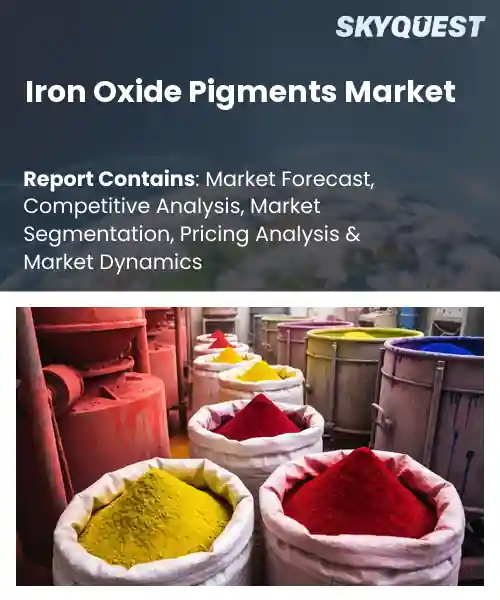
Iron Oxide Pigments Market
Report ID: SQMIG15E3973
Report ID: SQMIG15E3973
[email protected]
USA +1 351-333-4748
Report ID:
SQMIG15E3973 |
Region:
Global |
Published Date: July, 2026
Pages:
157
|Tables:
181
|Figures:
79


Global Iron Oxide Pigments Market size was valued at USD 2.3 Billion in 2024 and is poised to grow from USD 2.41 Billion in 2025 to USD 3.44 Billion by 2033, growing at a CAGR of 4.58% during the forecast period (2026-2033).
The global iron oxide pigments industry comprises colorants derived from natural or synthetic iron oxides, supplying reds, yellows, and blacks to paints, coatings, plastics, and cosmetics. Its significance drives from the pigments’ stability, low toxicity, and cost‑effectiveness, which make them indispensable for infrastructure and products. Historically, the market expanded alongside industrialization in the 20th century, when iron oxide pigments replaced hazardous lead‑based colors in shipyards and railway depots.
Consequently, demand has shifted from bulk commodity use to performance applications. Regulatory pressure on hazardous pigments serves as the catalyst accelerating the global iron oxide pigments market, because manufacturers must substitute banned substances with alternatives. This dynamic generates a cascade of opportunities: automotive OEMs replace lead‑based primers with iron‑oxide‑based finishes to meet emission standards, while textile firms embed the pigments in fabrics that claim impact coloration. The cause‑effect chain extends to supply chains, where increased demand stimulates investment in production lines that lower batch variation and unlock pricing for coating contracts. Consequently, regions possessing chemical infrastructure, such as Europe and East Asia, capture growth, reinforcing the market’s shift toward specialty applications.
How is AI-driven automation reshaping the iron oxide pigments market?
AI driven automation is redefining how iron oxide pigments are manufactured by linking real time sensor data with machine learning models that predict optimal reaction conditions. The technology reduces batch variability, shortens cycle times and lowers energy consumption, allowing producers to meet tighter colour specifications while cutting waste. Today most major pigment makers operate hybrid plants where robotic material handling, automated dosing and AI based quality control coexist with traditional furnace processes. For example, predictive algorithms adjust temperature profiles in real time to maintain consistent particle size, and vision systems inspect colour uniformity faster than manual inspection. These advances are making supply chains more resilient and opening opportunities for customized pigment blends.
BASF in June 2024, unveiled an AI driven automation platform that integrates predictive process control with robotic handling across its iron oxide pigment lines. The system accelerates batch turnover, improves colour consistency and reduces material waste, illustrating how intelligent automation fuels growth and efficiency in the market.
Market snapshot - (2026-2033)
Global Market Size
USD 2.3 Billion
Largest Segment
Synthetic Iron Oxide Pigments
Fastest Growth
Micronized Iron Oxide Pigments
Growth Rate
4.58% CAGR
To get more insights on this market click here to Request a Free Sample Report
Global iron oxide pigments market is segmented by by product type, by form, by process, by application, by end-use industry, by distribution channel and region. Based on by product type, the market is segmented into Synthetic Iron Oxide Pigments, Natural Iron Oxide Pigments, Micronized Iron Oxide Pigments and Transparent Iron Oxide Pigments. Based on by form, the market is segmented into Powder, Granules and Liquid Dispersion. Based on by process, the market is segmented into Precipitation Process, Thermal Decomposition Process, Natural Extraction Process and Others. Based on by application, the market is segmented into Construction Materials, Paints & Coatings, Plastics, Inks, Cosmetics, Paper and Others. Based on by end-use industry, the market is segmented into Building & Construction, Automotive, Packaging, Consumer Goods, Cosmetics & Personal Care, Printing and Others. Based on by distribution channel, the market is segmented into Direct Sales, Distributors & Traders and Online Sales. Based on region, the market is segmented into North America, Europe, Asia Pacific, Latin America and Middle East & Africa.
Synthetic iron oxide pigments segment leads with large iron oxide pigments market share because manufacturers can precisely control particle size, composition, and colour consistency, meeting stringent performance standards across diverse applications. This control enhances product reliability, reduces batch‑to‑batch variation, and aligns with strict regulatory and durability requirements, making it the preferred choice for high‑value formulations. Its versatility and repeatability drive widespread adoption, reinforcing its central position in the market.
As per iron oxide pigments market outlook, micronized iron oxide pigments are witnessing the strongest growth momentum as advances in milling and nano‑dispersion technologies enable ultra‑fine particles that deliver superior opacity and colour depth at lower loadings. These properties are attracting formulators seeking enhanced performance in coatings and plastics, spurring rapid uptake and expanding the market’s innovation pipeline.
As per iron oxide pigments market forecast, liquid dispersion form dominates because it simplifies incorporation into water‑based systems, eliminates dust handling issues, and offers better stability during processing, which is crucial for modern paint, coating, and ink formulations. Its ready‑to‑use nature shortens production cycles, reduces equipment wear, and aligns with environmental compliance by minimizing volatile organic compound emissions, thereby securing its dominant role.
Meanwhile, powder form is emerging as the key high‑growth segment driven by increasing demand for high‑solid content coatings and cost‑sensitive bulk applications. Improvements in flowability and anti‑caking additives are expanding its suitability for large‑scale manufacturing, prompting rapid expansion and creating new opportunities for market participants.
To get detailed segments analysis, Request a Free Sample Report
Asia Pacific shows a synergistic combination of advanced manufacturing infrastructure, abundant raw material sources, and a deep pool of technical expertise that fuels its leadership in iron oxide pigments. The region’s strong emphasis on research and development drives continuous innovation in colour stability and environmental performance. Close integration between pigment producers and downstream industries such as coatings, plastics and cosmetics ensures rapid adoption of new formulations. Strategic investments in sustainable production practices further reinforce market confidence, positioning the region as the preferred hub for both high‑volume supply and premium specialty applications.
As per iron oxide pigments market regional outlook, Japan benefits from a legacy of precision engineering and a culture of quality that permeates pigment formulation. Close collaboration between chemical manufacturers and automotive, electronics and cosmetic sectors accelerates product refinement. Robust intellectual property frameworks support ongoing research into pigment performance, while consumer demand for vibrant, durable colours sustains steady industrial consumption.
As per iron oxide pigments market regional forecast, South Korea is propelled by strong governmental support for high‑tech materials and a dynamic export‑oriented economy. Leading petrochemical complexes provide reliable feedstock, and close ties with fast‑growing industries such as construction and consumer goods drive application diversification. Emphasis on eco‑friendly manufacturing processes aligns with global sustainability trends, enhancing the country’s appeal as a reliable source of high‑quality pigments.
Europe’s expansion is underpinned by stringent regulatory standards that demand superior pigment performance and environmental compliance, fostering a climate of continuous improvement. The region’s deep expertise in specialty chemicals, coupled with a mature automotive and architectural coatings sector, creates strong demand for high‑end iron oxide solutions. Collaborative research networks across Germany, the United Kingdom and France accelerate innovation in pigment stability and colour precision. Moreover, a growing consumer preference for sustainable and safe products incentivises manufacturers to adopt greener production techniques, reinforcing Europe’s reputation as a hub for premium, responsible pigment offerings.
Germany is characterized by a concentration of leading chemical firms and a robust industrial base that prioritizes high‑performance pigments for automotive and engineering applications. Strong engineering traditions drive meticulous quality control, while close cooperation with research institutes fuels technical advancements in colour consistency and durability.
United Kingdom experiences rapid growth through vibrant collaboration between academic research centres and innovative start‑ups focused on pigment technology. The market benefits from a diversified demand across construction, fashion and specialty coatings, encouraging swift adoption of new formulations that meet evolving aesthetic and regulatory expectations.
France is emerging with a focus on artistic and luxury applications, leveraging the country’s heritage in design and haute‑cuisine aesthetics. Growing interest in bespoke colour solutions for interior design and premium consumer goods drives niche demand, while sustainability initiatives promote the development of environmentally benign pigment production.
North America reinforces its position through a blend of innovative research ecosystems, expansive manufacturing capacity and a broad spectrum of end‑use sectors that demand high‑quality pigments. The United States leads in technology integration, applying advanced analytics to optimise pigment performance for automotive, electronics and packaging markets. Canada contributes a strong emphasis on sustainable practices, with an abundance of natural resource inputs supporting greener production routes. Collaborative industry‑academic partnerships accelerate the development of next‑generation pigments that meet stringent performance and environmental criteria, thereby enhancing the region’s competitive edge on the global stage.
United States thrives on a culture of rapid innovation and extensive scale, supporting diverse applications from high‑volume automotive finishes to specialized aerospace coatings. Strong investment in R&D and close ties with leading consumer brands drive continual improvements in colour fidelity and durability.
Canada benefits from abundant natural resources and a growing commitment to environmentally responsible manufacturing. The market serves a range of sectors including construction, renewable energy infrastructure and specialty plastics, emphasizing sustainable pigment solutions that align with North American regulatory expectations.
To know more about the market opportunities by region and country, click here to
Buy The Complete Report
Increasing Demand for Sustainable Colors
Growth In Construction Coatings Market
Stringent Environmental Regulations
High Energy Consumption In Production
Request Free Customization of this report to help us to meet your business objectives.
The competitive landscape is shaped by intense rivalry among leading pigment producers that pursue M&A, joint‑development agreements and advanced nano‑engineering to secure higher value‑added iron oxide grades, while new entrants leverage sustainable feedstocks to capture niche segments. Recent examples include BASF’s acquisition of a regional iron‑oxide pigment portfolio, PPG’s partnership with a European nanotech institute to launch low‑VOC iron‑oxide dispersions, and Clariant’s launch of a nano‑engineered line for automotive coatings, all of which intensify product differentiation and pricing pressure.
In February 2025, LANXESS launched sustainable Scopeblue Bayferrox micronized yellow iron oxide pigments with a reduced carbon footprint. The products are ideal for high-quality paints and coatings, supporting eco-friendly formulations while maintaining uncompromising performance.
In October 2024, OXERRA completed the sale of Cathay Pigments and Chemicals Philippines Corporation to WWRC, enabling WWRC to strengthen its regional capabilities while supporting OXERRA’s strategy to advance sustainable pigment technologies and maintain strong customer relationships.
SkyQuest’s ABIRAW (Advanced Business Intelligence, Research & Analysis Wing) is our Business Information Services team that Collects, Collates, Correlates, and Analyses the Data collected by means of Primary Exploratory Research backed by robust Secondary Desk research.
As per SkyQuest analysis, the iron oxide pigments market growth is being propelled primarily by the increasing demand for sustainable colors, as manufacturers seek low‑toxicity, high‑stability pigments to meet greener formulation standards, while a second important driver is the robust growth in construction coatings fueled by urbanization and infrastructure projects. The main restraint comes from stringent environmental regulations that raise compliance costs and limit rapid product launches. Asia Pacific dominates the market due to its advanced chemical infrastructure, abundant raw materials and strong R&D linkages with downstream users. Within the product mix, synthetic iron‑oxide pigments lead the market, and the liquid‑dispersion form is gaining traction for its ease of integration into water‑based systems, together shaping the market’s forward momentum. The global iron oxide pigments market trend driven by rising demand from the construction, paints and coatings, plastics, and cosmetics industries.
| Report Metric | Details |
|---|---|
| Market size value in 2024 | USD 2.3 Billion |
| Market size value in 2033 | USD 3.44 Billion |
| Growth Rate | 4.58% |
| Base year | 2024 |
| Forecast period | (2026-2033) |
| Forecast Unit (Value) | USD Billion |
| Segments covered |
|
| Regions covered | North America (US, Canada), Europe (Germany, France, United Kingdom, Italy, Spain, Rest of Europe), Asia Pacific (China, India, Japan, Rest of Asia-Pacific), Latin America (Brazil, Rest of Latin America), Middle East & Africa (South Africa, GCC Countries, Rest of MEA) |
| Companies covered |
|
| Customization scope | Free report customization with purchase. Customization includes:-
|
To get a free trial access to our platform which is a one stop solution for all your data requirements for quicker decision making. This platform allows you to compare markets, competitors who are prominent in the market, and mega trends that are influencing the dynamics in the market. Also, get access to detailed SkyQuest exclusive matrix.
Table Of Content
Executive Summary
Market overview
Parent Market Analysis
Market overview
Market size
KEY MARKET INSIGHTS
COVID IMPACT
MARKET DYNAMICS & OUTLOOK
Market Size by Region
KEY COMPANY PROFILES
Methodology
For the Iron Oxide Pigments Market, our research methodology involved a mixture of primary and secondary data sources. Key steps involved in the research process are listed below:
1. Information Procurement: This stage involved the procurement of Market data or related information via primary and secondary sources. The various secondary sources used included various company websites, annual reports, trade databases, and paid databases such as Hoover's, Bloomberg Business, Factiva, and Avention. Our team did 45 primary interactions Globally which included several stakeholders such as manufacturers, customers, key opinion leaders, etc. Overall, information procurement was one of the most extensive stages in our research process.
2. Information Analysis: This step involved triangulation of data through bottom-up and top-down approaches to estimate and validate the total size and future estimate of the Iron Oxide Pigments Market.
3. Report Formulation: The final step entailed the placement of data points in appropriate Market spaces in an attempt to deduce viable conclusions.
4. Validation & Publishing: Validation is the most important step in the process. Validation & re-validation via an intricately designed process helped us finalize data points to be used for final calculations. The final Market estimates and forecasts were then aligned and sent to our panel of industry experts for validation of data. Once the validation was done the report was sent to our Quality Assurance team to ensure adherence to style guides, consistency & design.
Analyst Support
Customization Options
With the given market data, our dedicated team of analysts can offer you the following customization options are available for the Iron Oxide Pigments Market:
Product Analysis: Product matrix, which offers a detailed comparison of the product portfolio of companies.
Regional Analysis: Further analysis of the Iron Oxide Pigments Market for additional countries.
Competitive Analysis: Detailed analysis and profiling of additional Market players & comparative analysis of competitive products.
Go to Market Strategy: Find the high-growth channels to invest your marketing efforts and increase your customer base.
Innovation Mapping: Identify racial solutions and innovation, connected to deep ecosystems of innovators, start-ups, academics, and strategic partners.
Category Intelligence: Customized intelligence that is relevant to their supply Markets will enable them to make smarter sourcing decisions and improve their category management.
Public Company Transcript Analysis: To improve the investment performance by generating new alpha and making better-informed decisions.
Social Media Listening: To analyze the conversations and trends happening not just around your brand, but around your industry as a whole, and use those insights to make better Marketing decisions.
REQUEST FOR SAMPLE
 REQUEST FREE CUSTOMIZATION
Global Iron Oxide Pigments Market size was valued at USD 2.3 Billion in 2024 and is poised to grow from USD 2.41 Billion in 2025 to USD 3.44 Billion by 2033, growing at a CAGR of 4.58% during the forecast period (2026-2033).
The competitive landscape is shaped by intense rivalry among leading pigment producers that pursue M&A, joint‑development agreements and advanced nano‑engineering to secure higher value‑added iron oxide grades, while new entrants leverage sustainable feedstocks to capture niche segments. Recent examples include BASF’s acquisition of a regional iron‑oxide pigment portfolio, PPG’s partnership with a European nanotech institute to launch low‑VOC iron‑oxide dispersions, and Clariant’s launch of a nano‑engineered line for automotive coatings, all of which intensify product differentiation and pricing pressure. 'Lanxess AG', 'Cathay Industries Group', 'Venator Materials PLC', 'BASF SE', 'Tata Pigments Limited', 'Yuxing Group', 'Toda Kogyo Corp.', 'Sun Chemical Corporation', 'Ferro Corporation', 'Hunan Three-Ring Pigments Co. Ltd.', 'Jiangsu Yuxing Industry & Trade Co. Ltd.', 'Golchha Pigments Pvt. Ltd.', 'Heubach Group', 'Trust Chem Co. Ltd.', 'Prince International Corporation', 'Shandong Sino Pigments Co. Ltd.', 'Cosmo Synthetic Pigments Pvt. Ltd.', 'Applied Minerals Inc.', 'Synthetic Iron Oxide Pigments Pvt. Ltd.', 'Tayca Corporation'
The rising consumer preference for environmentally friendly products drives manufacturers to incorporate iron oxide pigments that offer low toxicity and high stability, aligning with green formulation requirements across automotive, cosmetics, and construction sectors. This shift encourages product developers to adopt these pigments as key color agents, reinforcing market expansion as companies prioritize sustainability and regulatory compliance, thereby creating a steady influx of new applications and reinforcing demand for high‑performance iron oxide solutions that meet stringent performance criteria and enhance product longevity.
Sustainable Color Innovation: Manufacturers are increasingly leveraging eco‑friendly raw materials and greener synthesis routes to produce iron oxide pigments that meet rising consumer demand for sustainable products. This shift emphasizes the use of natural iron sources, low‑temperature processes, and waste‑minimization techniques, enabling brands to market greener color solutions across cosmetics, food packaging, and construction coatings. The focus on sustainability also drives partnerships with certification bodies, enhancing traceability and reinforcing market positioning for companies that prioritize environmental stewardship through innovative R&D collaborations worldwide today.
Why does Asia Pacific Dominate the Global Iron Oxide Pigments Market? |@12


Want to customize this report? This report can be personalized according to your needs. Our analysts and industry experts will work directly with you to understand your requirements and provide you with customized data in a short amount of time. We offer $1000 worth of FREE customization at the time of purchase.
Feedback From Our Clients


 USA (+1) 351-333-4748

